Rise of US dollar impacts NZD/USD trade

The Kiwi pair staying on the back foot and it’s being underpinned by expectations of a rate hike by the Reserve Bank of New Zealand (RBNZ) on next month and Friday’s boosted U.S. jobs report that likely signaled the Federal Reserve would refrain from announcing any tapering plans sooner than expected and higher U.S. Treasury yields keeping the pair on edges.

Websites of a number of financial institutions in New Zealand and its national postal service were briefly down on Wednesday, with officials saying they were battling a cyber attack.  The country’s Computer Emergency Response Team (CERT) said it was aware of a DDoS (distributed denial of service) attack targeting a number of organisations in the country. ANZ and Kiwibank appear to have made progress recovering from a cyber attack that made their online services inaccessible for many New Zealanders on Wednesday.

On the other hand US dollar rose against major peers near a one-week high, which was due to higher treasury yields. The US dollar, which had fallen month following the August employment report on Friday, rose on yesterday. The dollar index has fallen to its lowest level since the beginning of August last weekend, with the surprisingly soft U.S. payroll report dropping the Federal Reserve from announcing a taper of stimulus at a policy meeting this month.

US traders’ return from an extended weekend brought strong greenback as market players relived the virus-led economic fears on the back of Friday’s downbeat US jobs report for August and ISM Services PMI data. Also roiling the mood were chatters over the US stimulus and roadblock for it. Data on Friday showed speculators’ net long bets on the U.S. currency grew in the latest week, with the value of the net long dollar position at $10.98 billion for the week ended Aug. 31, the largest long position since March 2020. The dollar also benefited from rising U.S. Treasury yields with the U.S. government selling new debt this week, including $58 billion in three-year notes, $38 billion in 10-year notes and $24 billion in 30-year bonds.

In New Zealand, there was positive news from the latest global auction of dairy, which saw prices rise 4% in a boom for farmers. Dairy is the country’s biggest export earner and has helped fuel a record-breaking rise in its terms of trade. That strength, combined with its success in containing a Delta outbreak, has seen markets fully price in a quarter-point rate hike from the Reserve Bank of New Zealand at its October policy meeting, and another 25 basis points in November too.

In the absence of high-tier macroeconomic data releases, the cautious market mood seems to be helping the USD find demand. The New Zealand market is looking for the fresh impetus.

NZD/USD 4 Hour Chart:
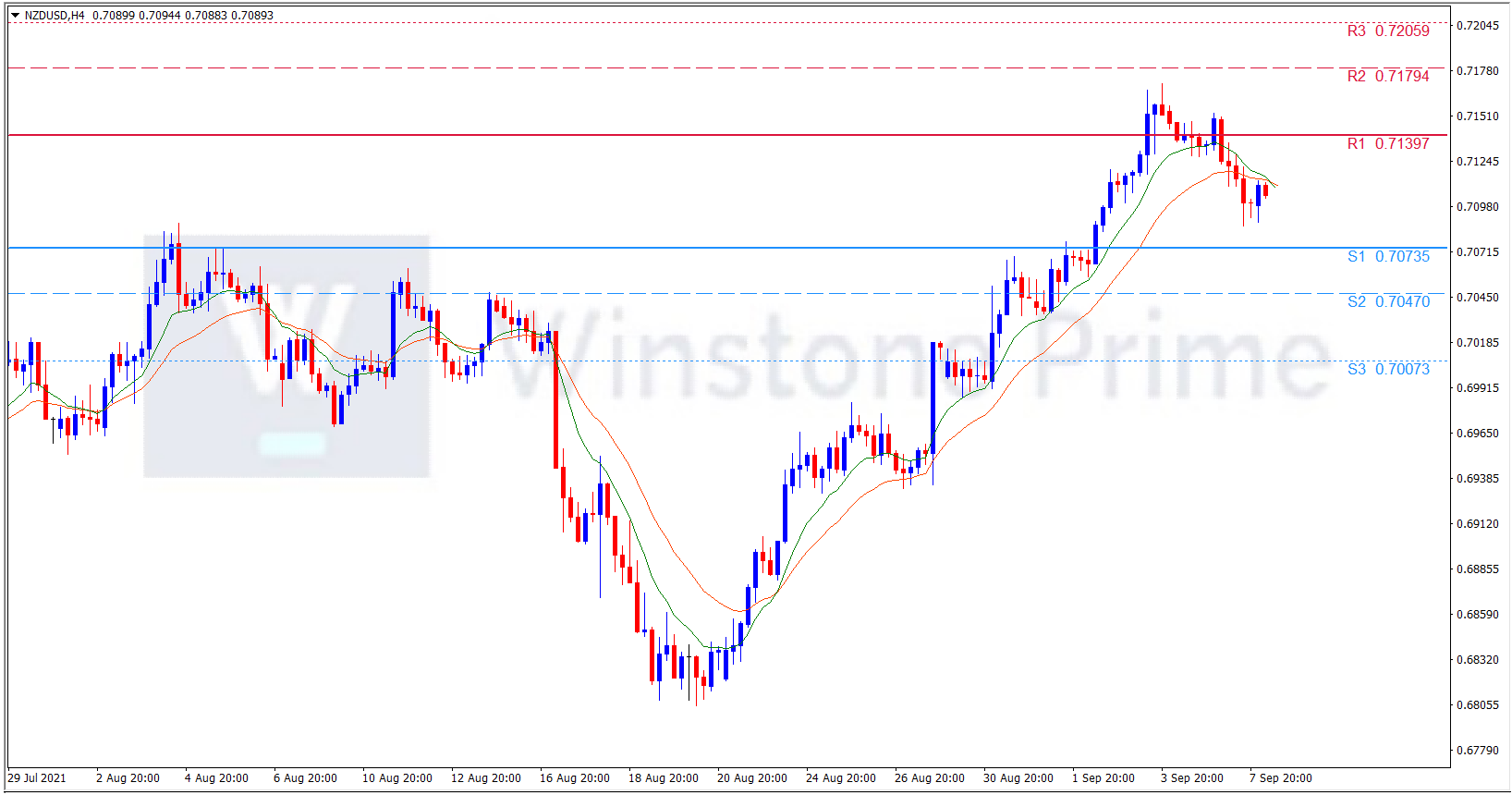
Support: 0.7074 (S1), 0.7047 (S2), 0.7007 (S3).

Resistance: 0.7140 (R1), 0.7179 (R2), 0.7206 (R3).

Amidst this above catalysts New-Zealand dollar is not in the hope of many traders and the Green back showing awesome moment today which could bring the New Zealand dollar down. We expect a bearish trend for NZD/USD.

RBA monetary policy might favor Aussie

Shares of Australia are heading for a stronger start on Tuesday as metal prices are likely to rise amid political uncertainty in Guinea, with investors sidelined ahead of the central bank’s September policy meeting. Investors are waiting for the Reserve Bank of Australia’s (RBA) policy meeting; the sentiment seems somewhat tense as authorities struggled to control the delta variance despite the lockdowns.

Analysts have not yet decided whether the RBA will suspend its tapping plans at its September policy meeting. Investors took heart from the hope that the US would keep its interest rates low for a long time. At home, job advertisements slipped as corona virus locks spread from Sydney to Melbourne and Canberra in August, a drop that was small compared to the losses incurred in the first phase of the epidemic last year.

On the other hand Australian GDP is actually making the pair fly again because it is stronger than expected. This is very interesting as the Australian economy has been locked up for a while due to the government’s exaggeration against the virus. Everything was equal, which is a reflection of the Chinese economy, which seems to be struggling. It should be noted, however, that the pre-RBA caution and fears of a spike in the virus-led hospitalizations in Australia challenge the pair buyers. Amid these plays, the Commonwealth Bank of Australia (CBA) said, “The near-term outlook is bleak, as extended lockdowns in NSW and Victoria cripple economic activity.”

US and Canada brace for weekly opening after the Labour Day holiday on Monday. It’s worth noting that the US Treasury yields seem to react to Friday’s downbeat jobs report for August, weighing on the Fed’s tapering plan. U.S. report released last week showed that non-farm wage earners were lower than expected and paid attention to expectations that the central bank would announce tapping assets in September.

US dollar moves and risk appetite may delight Aussie traders ahead of the RBA decision. Although the markets are already pushing for a delayed taper on the weekly bond purchase by the RBA, any surprise will be overreacting. In addition, there are no new virus cases in Victoria and the confidence of the Reserve Bank of Australia (RBA) in the delay is also favorable for late AUD / USD buyers.

AUD/USD 4 Hour Chart:

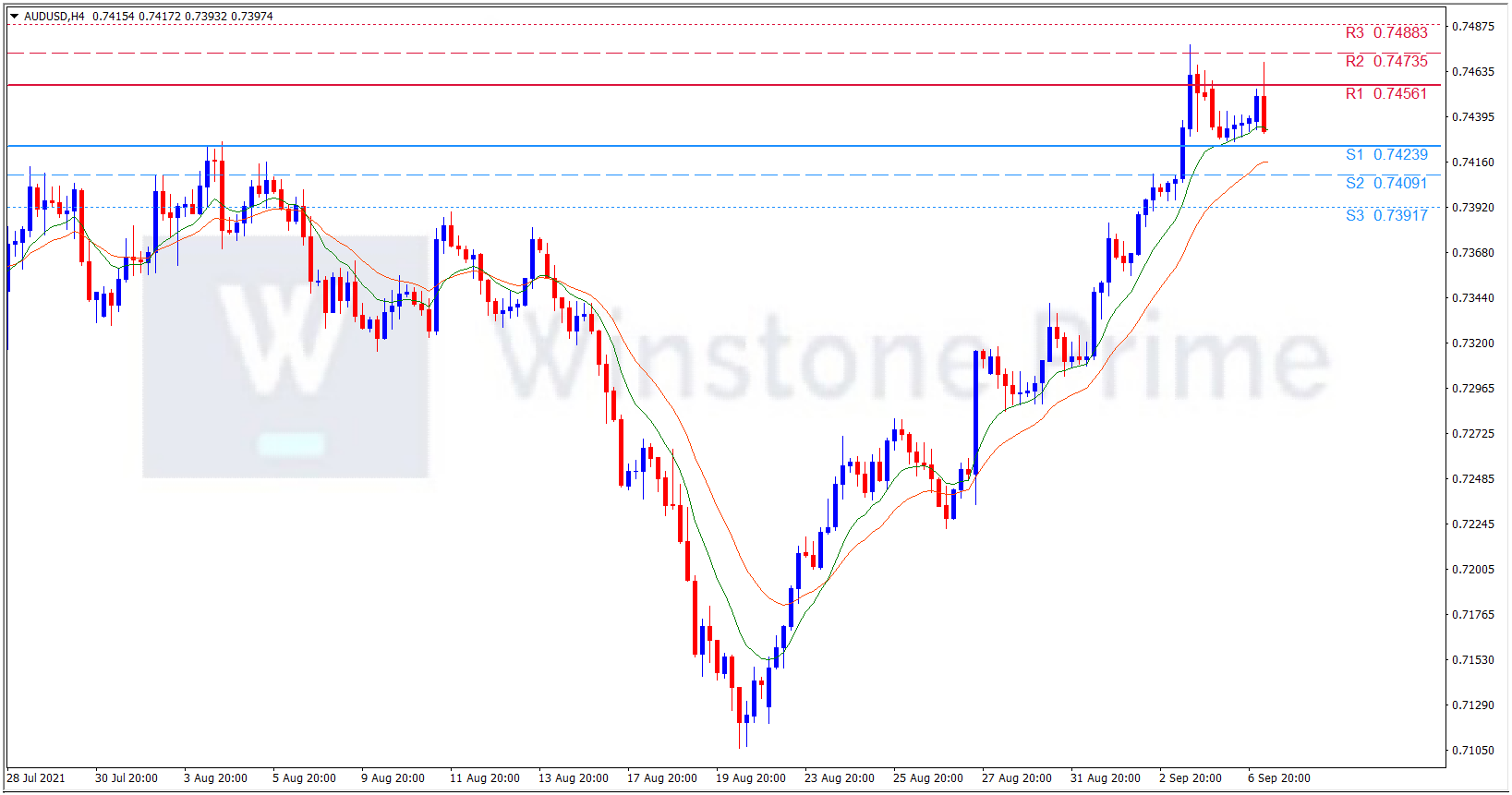
Support: 0.7424 (S1), 0.7409 (S2), 0.7392 (S3).

Resistance: 0.7456 (R1), 0.7474 (R2), 0.7488 (R3).

Hopes from RBA favors Aussie whereas spread of new variant of covid depress it. We expect a mid-trend for AUD/USD.

Impact of CPI on Forex trading

The Consumer Price Index (CPI) has the important role in forex trading. It is an important economic indicator and CPI affects not only foreign exchange but also interest rates and stock and bond prices. CPI shows the complete and true picture of inflation. Consistent rise in CPI promises the assured economic growth. Inflation consistent rises resulting into growth. But if the CPI increases indefinitely and uncontrollably it reflects the declining growth because, the poor or common man cannot be able to afford the basic amenities that what the objective of CPI, it reveals about the reality of the Economy of any country.

The CPI is used to make changes in cash flow mechanisms such as pensions, health insurance and income. CPI is influencing many markets as a result; most traders and investors find it influencing their strategies in some way.

In this article we will inspect about what is CPI as a concept and what to consider when trading Forex against CPI data.

How does CPI Measures 

The CPI is a metric to quantify inflation. It is calculated by tracking the change in the prices of essential products and services consumed by households over a period of time. The consumer price index captures the inflation in a fixed set of items like transportation, food, medical care, education, etc. at the retail level. It determines the average change in prices that the consumer market pays for the basket. 

The market basket is nothing but the total amount of all goods and services available in the market. The CPI measures the price point change of this wholesale market basket, which includes 180 categories classified into 8 major super categories such as food and beverage, transport and health care etc, covering about 80,000 goods and services. This Index is calculated and determined by the Bureau of Labor Statistics.

CPI is calculated by dividing the average cost of the market basket in the current year by the cost of the market basket in the base year and multiplying the result with 100. This gives us the CPI of the current year. The calculation involved during this process of estimation of CPI is extremely difficult. This is because thousands of categories and sub-categories along with their ever-changing prices should be considered and classified into urban or rural consumption segments. CPI is the most important statistics for an economy as it measures inflation and gives us an idea of the cost of living. According to economic experts, CPI is considered as the benchmark inflation guide for a country’s economy.

Consumer Price Index = Market Basket of Desired Year/Market Basket of Base Year*100

Alternatively, the CPI can be performed as CPI = Updated Cost/Base Period Cost*100

The “updated cost” (i.e. the price of an item at a given year, e.g.: the price of bread in 2021) is divided by that of the initial year (the price of bread in 1970), then multiplied by one hundred.

When inflation is too low, a central bank like the Federal Reserve may cut interest rates in order to spur economic activity. When inflation is too high, interest rates may be raised to stabilize prices. By increasing interest rates, a consumer may be more likely inclined to save money, rather than spend it, due to the return they may generate by keeping it in a bank. In Forex monthly CPI measure is one of the most important indicators monitored by many traders.

How CPI Impacts Forex Market

The CPI is an important benchmark for inflation in any economy. Traders must have their eyes fixed on the CPI. Once investors start feeling the heat of inflation, they are bound to change their investing strategies and look for alternate avenues to invest their capital. The Federal Reserve has a dual mandate that affects its actions in monetary policy.

The central bank wants to bring the economy to full employment and ensure a healthy inflation rate as the economy expands. As a result, Forex traders see both unemployment and inflation figures as figures dictating the central bank’s future decision to reduce, raise or maintain current interest rates. Traders can expect the impact of the interest rate on the strength or weakness of a currency to have an impact on the actions of the central bank and the impact of the dollar on currency pairs.

Forex traders consider the CPI and core CPI figures as the two most basic indicators of the performance of an economy. Between the two, however, the core CPI figure provides a better look at avoiding costs in the energy and food sectors, which experience higher price volatility over time. In the United States, the Department of Labor publishes CPI and core CPI figures that do not include energy or food costs in the measurement. If that number exceeds market expectations, the dollar will generally see gains against other currencies. However, if these readings fall short of consensus expectations, the currency will depreciate compared to other pairs.

However, its impact is not limited to the monthly report. Like all government data figures, the CPI figure is subject to revision by economists. Such changes can cause significant fluctuations in the value of a currency in the global market.

Conclusion

CPI gives a better glimpse of changes in the purchasing power of the consumer. While concluding this, It is worth to keep mind that most of the world’s major central banks target inflation. Therefore, the latest changes in CPI can give some clues, regarding the future path of the interest rates and monetary policy in general. For example, if in the given country the inflation rises well above the desired target, then the local Central Bank may respond with hiking interest rates and this can strengthen the currency. The second CPI effect on Forex usually takes more time to manifest. According to the Purchasing Power Parity, in the long term, currencies with low inflation tend to appreciate the ones with a higher rate of price level increases. This can be one way to explain the decline in the USD/CHF and USD/JPY in recent decades.

Euro is in downtrend ahead of ECB meeting

Euro is quite flat today and the ECB hawks are spooked by the recent rising inflation numbers but the doves are firmly in control right now and so the policy is likely to remain loose for the time being. There were almost too many hawks on the newswires to name but among them were ECB Vice-President Luis de Guingos, Bundesbank President Jens Weidmann and fellow Council members Robert Holzmann and Klaas Knot. They are all worried by a rebound in the Eurozone economy coupled with a sharp rise in inflation to 3%, well above the ECB’s target. The euro has loosed its level but somewhat supported by the expectations of European Central Bank, which meets Thursday, close to tapering its own stimulus programme.

Nevertheless, the retention of a majority in the doves Council, led by President Christine Lagarde, is almost certain, emphasizing that the excessive impact of the inflation target is temporary and there are no signs of further tightening of policy in the future. She can observe a surprising big drop in the Eurozone services PMI final August reading and the unexpected drop in German retail sales year/year in July, sending data last week. This could lead the euro pair into bearish move.

Lagarde likely to explain her thoughts at the press conference following the ECB’s announcement on Thursday but there is also something else that traders need to look out for: the ECB’s economic projections. However, some members of the central bank, including governing council member Francois Villerroy, are skeptical that the bank should consider the most favorable financial conditions in the euro zone in determining the pace of the PEPP this week. Villeroy is considered one of the Uber-doves, so his comments are significant. This refers to the sluggishness in the property purchase.

However, “in the monthly volumes, we see favorable financial conditions and we must underline that they are more favorable than our June meeting,” Villeroy stressed. We need to determine the monthly volumes for the fourth quarter. This means that when discussions take place, an action from the ECB should not come to certain meetings later, where the euro will be exposed for a long time. “We do not think a consensus will be reached until the December 16 meeting,” analysts at Brown Brothers Harriman argued.

On the other hand U.S. nonfarm payrolls rose just 235,000 in August, compared to the average estimate of 728,000 economists in a Reuter’s poll, and the resurgence of the Covid-19 stopped hiring as demand in restaurants and hotels increased. Redemption is a condition for separating its pandemic-era asset purchases. Job growth slowed more than expected in August amid a softening in demand for services and persistent worker shortages as COVID-19 infections soared.

Despite of hopes from the European Central Bank’s (ECB) meeting and the increasing COVID-19 tragedies do not hesitate to recall bears.

EUR/USD 4 Hour Chart:

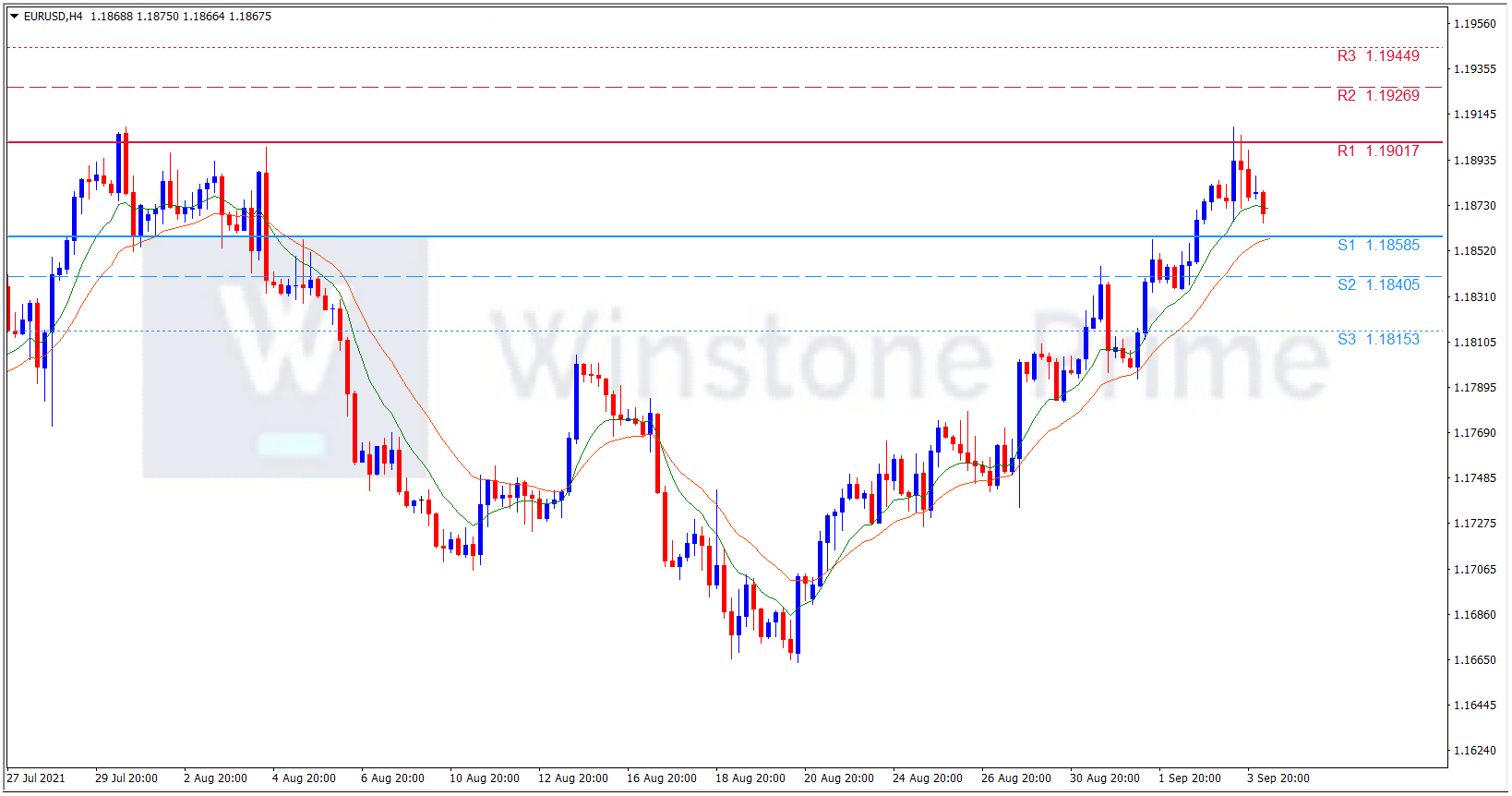
Support: 1.1859 (S1), 1.1841 (S2), 1.1815 (S3).

Resistance: 1.1902 (R1), 1.1927 (R2), 1.1945 (R3).

Amidst this above catalysts euro pair is on downtrend now. We expect a bearish trend for EUR/USD.