
Things you need to know about Bank of Japan

The Bank of Japan has much attention for its Monetary Policy decision and interest rate decision. The announcements have major impact on Forex, Japanese Stocks, Yen and Nikkei 225. It has always received a lot of attention for its unusual monetary policies. Discover everything you need to know here.

What is BOJ?

The Bank of Japan, or BOJ, is Japan’s central bank; it has been operational since 1885—when it first issued currency and it was reorganized in 1942. It is headquartered in the Nihonbashi business district in Tokyo.  It is also known as Nichigin. The Bank has 32 branches and 14 local offices in Japan, and seven international offices – including London, Frankfurt, Paris, Hong Kong and New York. The BOJ is responsible for determining monetary policy, setting interest rates, issuing and monitoring currency and treasury securities.

History

The Bank of Japan was established under the Bank of Japan Act (promulgated in June 1882) and began operating on October 10, 1882, as the nation’s central bank. The Bank was reorganized on May 1, 1942 in conformity with the Bank of Japan Act (hereafter the Act of 1942), promulgated in February 1942. The Act of 1942 strongly reflected the wartime situation:  It is the sole bank that issues the yen. The objectives of the Bank are the regulation of the currency, control and facilitation of credit and finance, and the maintenance and fostering of the credit system, pursuant to national policy, in order that the general economic activities of the nation might adequately be enhanced. The Act of 1942 was amended several times after World War II. Such amendments included the establishment of the Policy Board as the Bank’s highest decision-making body in June 1949.

The Act of 1942 was revised completely in June 1997 under the two principles of “independence” and “transparency.” The revised act (the Act) came into effect on April 1, 1998.

Structure

The Policy Board is established as the Bank’s highest decision-making body and is made up of nine members: the Governor, two Deputy Governors, and six Members of the Policy Board. Japan monetary policy decisions are made by a majority vote of the nine members of the Policy Board, which determines the guideline for currency and monetary control, sets the basic principles for carrying out the bank’s operations and oversees the fulfilment of the duties of the bank’s officers, excluding Auditors and Counsellors. The role of the Governor is to represent the bank and to exercise general control over the bank’s business operations in accordance with decisions made by the Policy Board. Hence, the Governor of the Bank of Japan has considerable influence on the economic policy of the Japanese government.

Japan Monetary Policy meetings

The main goal of the Bank of Japan monetary policy is to ensure price stability. The Bank of Japan manipulates the money supply in the economy and also influences the interest rates, to achieve price stability. The bank changes the money volume in the Japanese economy by performing money market operations. MPMs are held eight times a year, each for two days. In MPMs, policy board members discuss and decide on guidelines for monetary market operations. Monetary policy decisions are made by a majority vote of nine members of the Policy Board, consisting of the Governor, two Deputy Governors and six other members.

In addition to in-depth research and analysis on economic and financial conditions, the Bank studies and explores various aspects of monetary policy, namely monetary policy strategies and tools as well as the financial system. The bank uses its research findings as the basis for determining monetary policy.

BOJ interest Rate Decision

The Bank of Japan’s interest rate – just like any central bank – is the mechanism by which it manipulates inflation by imposing borrowing and lending rates for currencies.

The BoJ is known for its negative interest rates, meaning that banks have to pay to borrow money from the central bank. This policy first came into place in January 2016 and has been held into 2021.

BOJ Mission

  • Issuance and management of banknotes
  • Implementation of monetary policy
  • Providing settlement services and ensuring the stability of the financial system
  • Treasury and government securities-related operations
  • Compilation of data
  • International activities
  • Economic analysis and research activities


Conclusion

Trading the news and events surrounding the BoJ meeting is always exciting and can be potentially beneficial for traders. Following the content of the MPM’s decisions on monetary policy, such as the guideline for money market operations, in addition to its views on economic and financial developments can project an economic outlook and offers clues whether the BoJ will cut interest rates, increase interest rates or maintain them. For example, positive economic news can indicate an upcoming increase in interest rates, resulting in a strengthening JPY. If the news is negative, the opposite may happen, meaning we may expect a decrease in interest rates, leading to a weakening JPY. Consequently, a higher than expected rate is considered positive/bullish for the JPY, while a lower than expected rate is considered negative/bearish for the JPY.

Many traders base their positions on the MPM announcements. Moreover, knowing when the upcoming BoJ meeting is scheduled to occur allows to plan A and prepare in advance for the volatility that will almost certainly surround the event. Therefore, as traders, it is important to realize that the Japan monetary policy carried out by the BoJ is one of the most important factors affecting various types of assets on a fundamental level, hence creating potentially superb trading opportunities. These include the yen and its paired global currencies, government bonds, local equities and indices and other securities.

Business indicators report favors Aussie

Federal Reserve Chairman Powell’s long-anticipated speech on last week Friday at Jackson Hole provided fireworks but not quite what the market had expected. The dollar is at a several-week low today after Federal Reserve Chairman Jerome Powell said the storm that hit the oil fields in the Gulf of Mexico was slower than expected. The greenback fell broadly on Friday, with Powell managed to flag an exit from emergency monetary policy settings that did not spook markets or suggest a rush to raise interest rates. “It is appropriate to start slowing down the pace of property purchases this year,” Powell said in a speech, the determining factor in employment. But it does not directly signal higher rates because the hiking economy will have to go through a “different and substantially more severe test”.

“Powell was vague on the timing of tapering, and his reiteration that it is separate from a decision to raise rates was read to imply that there’d be a gap,” ANZ analysts said in a note. Together with COVID moments in the market and  Friday’s U.S. non-farm payrolls will make or break the case for announcing tapering at the (Fed’s) September meeting,” said Commonwealth Bank of Australia analyst Kim Mundy. “We consider another 800,000 jobs should be enough to announce tapering. We expect the dollar to regain some lost ground this week while market participants are still worried COVID will slow the world economy.” as per Reuters report.

On the other hand Australian Bureau of Statistics released its “business indicators” report for the June quarter on today. Australia Company Gross Operating Profits q/q measures a change in the total profits of private companies in the reported quarter compared to the previous one. The June month key points are “The seasonally adjusted estimate for: Inventories rose 0.2% in the June quarter 2021. But manufacturing sales of goods and services fell 0.2% this quarter. Wholesale trade sales of goods and services rose 0.2%.” And the Current price estimates are Company gross operating profits rose 7.1% forecast is 4.7% previous -0.6% and the Wages and salaries rose 2.0%. This report favors the Aussie today.

Same time Australia economy suffering with Victorian Premier Daniel Andrews flagging the state’s sixth lockdown will extend beyond Thursday as virus infections hit 92. There is also no end in sight for the NSW shutdown after the state hit a record 1218 virus cases on Sunday, and a further six deaths. Economists were already predicting the economy could contract by as much as four per cent in the September quarter as a result of the lockdowns in NSW and Victoria, the nation’s two most populous states. Still, the virus and lockdowns are sapping the strength of the Australian economy, and this will be evident in next week’s data, which includes July trade figures and the final August PMI.  Growth in the second quarter is expected to have slowed from an impressive 1.8% to around 0.5%, but the economy has slowed since, and the PMI warns of the risk of a contraction in Q3.

The focus is now on US labor data, which is the next clue to the tapping time of asset purchases and efforts to curb the spread of Covid-19 on Friday.

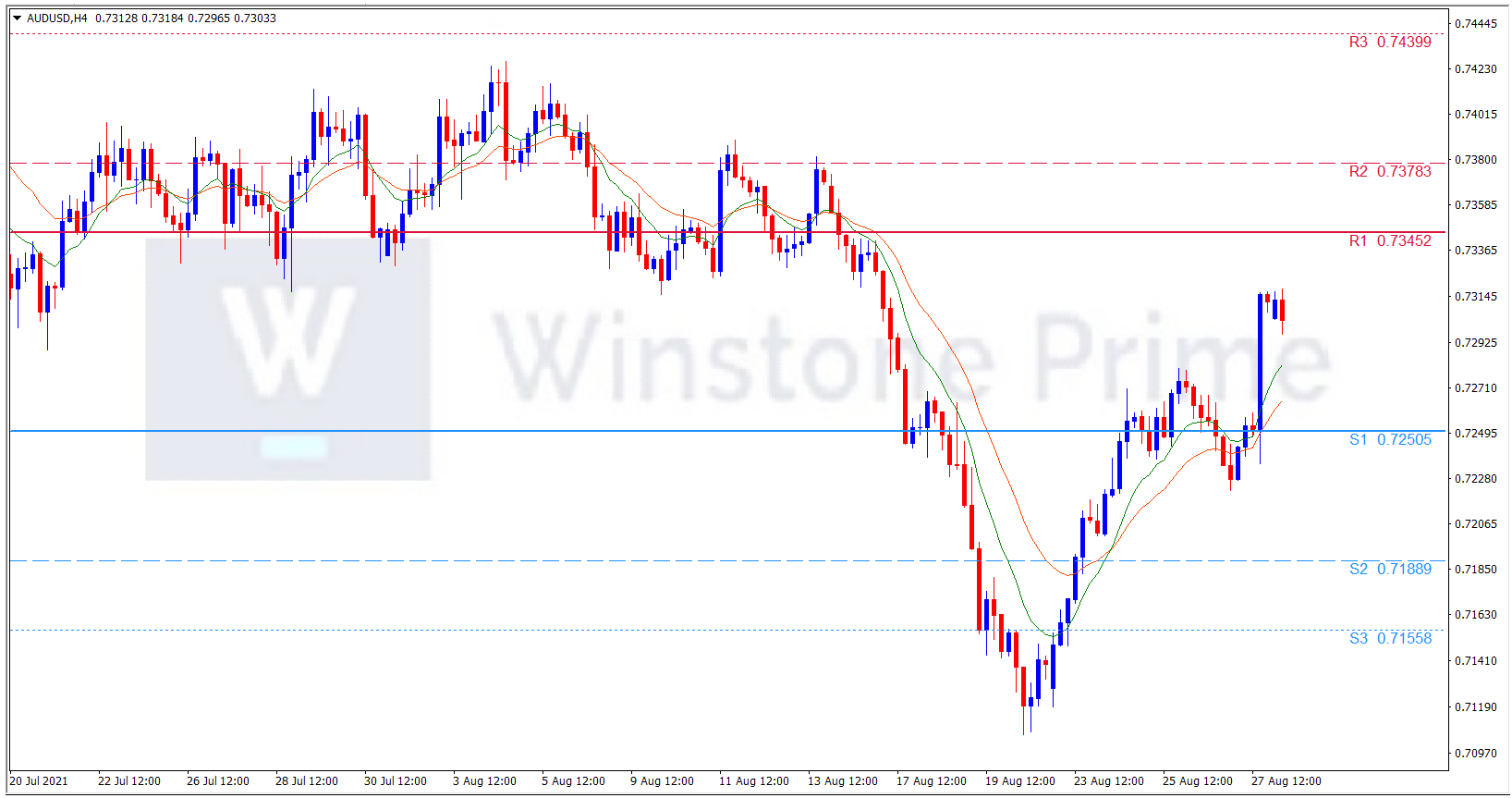
AUD/USD 4 Hour Chart:

Support: 0.7251 (S1), 0.7189 (S2), 0.7156 (S3).

Resistance: 0.7345 (R1), 0.7378 (R2), 0.7440 (R3).

Amidst this above catalysts the greenback soften trend and Aussie Business indicators report favoring Aussie. We expect a bullish trend for AUD/USD.

BTC/USD Weekly Forecast (30th August 2021 – 03rd September 2021)

Fundamental view:

Bitcoin portrayed a bullish trend against the greenback in this week. US dollar fall served a helping hand towards the Bitcoin uptrend. Other news also favors the Bitcoins. As per a news agency, Kyrgyzstan’s State Service for Regulation has developed a draft of regulations for crypto exchanges on August 25. The draft aims to legalize crypto exchange operations. It also hopes to reduce risk by introducing frameworks that could help develop a digital economy in Kyrgyzstan by leveraging blockchain technology. 

In a recent interview, Kraken, a US-based crypto exchange, announced that it is expanding to European markets in 2021. The company is working with the local authorities to receive a license that targets multiple local jurisdictions. While the exchange is already operating in 190 jurisdictions, this move could be to capitalize on the second phase of the 2021 Bull Run. Square and Twitter CEO Jack Dorsey, tweeted on Friday that TBD, payment giant Square’s new division focused on creating an open developer platform, is planning to build a decentralized bitcoin exchange. Overall the big crypto shows a bullish trend.

The major economic events deciding the movement of the pair in the next week are CB Consumer Confidence Index at Aug 31, ADP Nonfarm Employment Change, ISM Manufacturing PMI, EIA Crude Oil Stocks Change at Sep 01, Initial Jobless Claims at Sep 02, Nonfarm Payrolls and ISM Non-Manufacturing PMI at Sep 03 for US.

BTC/USD Weekly outlook:

Technical View:

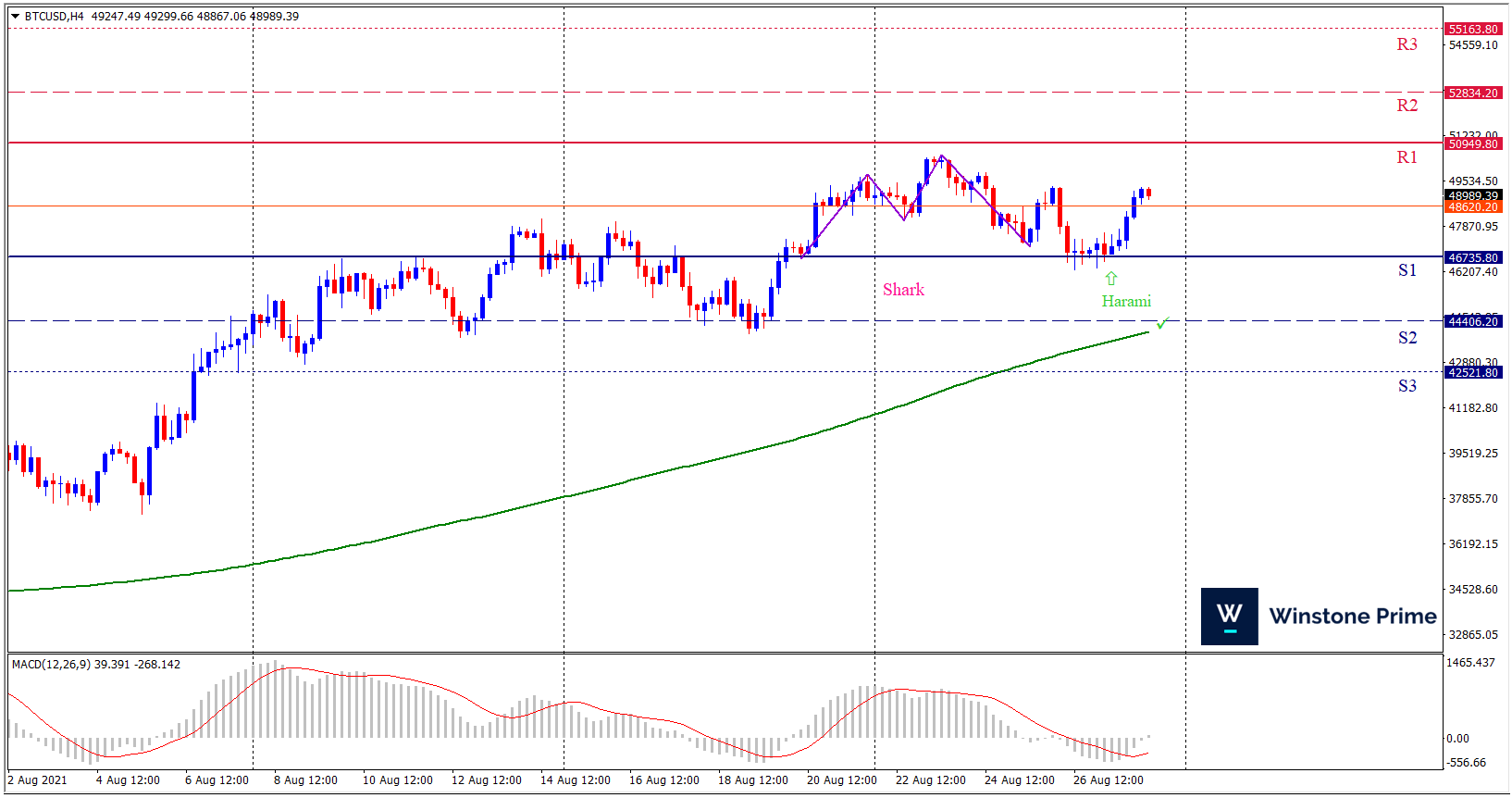
Last week’s high was 1.42% higher than the previous week. Maintaining high at 50504.5 and low at 46290.5 showed a movement of 4214 pips.

In the upcoming week we expect BTC/USD to show a bullish trend. The Instrument is trading above the 200 Simple Moving Average and the MACD trades to the upside. A solid breakout above 50949.8 may open a clean path towards 52834.2 and may take a way up to 55163.8. Should 46735.8 prove to be unreliable support, the BTCUSD may sink downwards 44406.2 and 42521.8 respectively. In H4 chart bullish shark pattern formation favors prospects of a bullish trend. Bullish Harami pattern constructs a bullish outlook for the pair in the upcoming week.

Preference
Buy: 48870.5 target at 52833.2 and stop loss at 46730.8


Alternate Scenario
Sell: 46730.8 target at 42522.3 and stop loss at 48870.5

XAU/USD Weekly Forecast (30th August 2021 – 03rd September 2021)

Fundamental view:

The selling pressure around greenback lead to the rise of the yellow metal in the last week. Gold saw immediate gains following Powell’s speech at the Jackson Hole Economic Policy Symposium. Powell sounded more cautious than other Fed officials when talking about tapering, stating that the central bank could start reducing its $120 billion in monthly bond purchases this year. According to analysts, Powell’s comments were more on the dovish side, creating some selling pressure in the U.S. dollar, which has been positive for gold.

US Bureau of Economic Analysis (BEA) announced that it revised the annualized real GDP growth in the second quarter to 6.6% from 6.5%. And the US Department of Labor said the Initial Jobless Claims increased by 4,000 to 353,000 in the week ending August 20. But it did not effect the market trend. Overall the gold enjoyed the US dollar weakness in the last week.              

The major economic events deciding the movement of the pair in the next week are CB Consumer Confidence Index at Aug 31, ADP Nonfarm Employment Change, ISM Manufacturing PMI, EIA Crude Oil Stocks Change at Sep 01, Initial Jobless Claims at Sep 02, Nonfarm Payrolls and ISM Non-Manufacturing PMI at Sep 03 for US.

XAU/USD Weekly outlook:

Technical View:

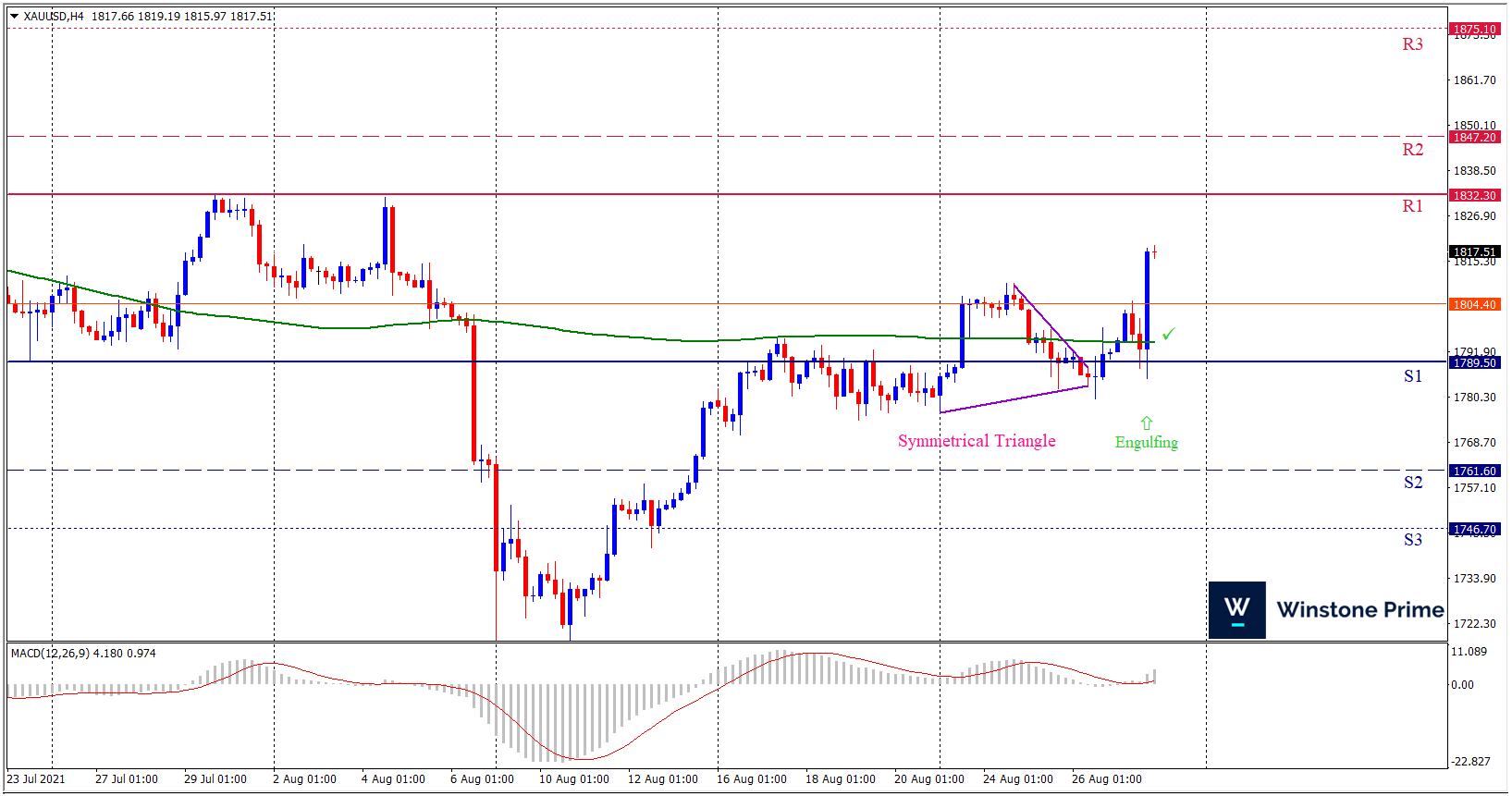
Last week’s high was 1.33% higher than the previous week. Maintaining high at 1819.2 and low at 1776.4 showed a movement of 428 pips.

In the upcoming week we expect XAU/USD to show a bullish trend.  The Instrument is trading above the 200 Simple Moving Average and the MACD trades to the upside. A solid breakout above 1832.3 may open a clean path towards 1847.2 and may take a way up to 1875.1. Should 1789.5 prove to be unreliable support, the XAUUSD may sink downwards 1761.6 and 1746.7 respectively. In H4 chart symmetrical triangle breakout favors prospects of a bullish trend. Also to be noted Bullish engulfing formation exerts the expectation of uptrend for the pair.

Preference
Buy: 1817.5 target at 1846.2 and stop loss at 1800.4


Alternate Scenario
Sell: 1800.4 target at 1762.6 and stop loss at 1817.5