
Types of Forex Trading Accounts

Becoming a Forex trader one need to sign-up with any of the broker for holding a trading account. Opening your first Forex account is one of the biggest steps you can take as a startup trader, so this is definitely not something you are not ready for. Many newbie’s rush into choosing the type of account without understanding it. Others are overwhelmed by the variety of account types available. Both of these approaches are misleading. We here to guide the accounts which are mostly used and how can you harness this accounts to get earn from this.

When choosing a forex account type, you need to carefully consider a variety of factors, including what type of forex trader you want to be, your budget and your trading strategy. Since your account type will affect your performance and profit, it is important that you choose the right account for you.

What is mean by Forex Trading Accounts
Forex Account is an account used to hold and trade foreign currencies. It works just like any other trading account. So, if you want to trade Forex, you usually open an account, deposit money in your home currency and use it to buy and sell currency pairs. If you want to know more about different types of forex accounts and want to get a brief overview of some of them, read on.

Well Known Trading Account Types

There are many different Forex account types available to forex trader who wants to trade in the online foreign exchange market online forex trading market. Different types of users require different types of accounts. There are three main types of trading account types which are Micro, Mini and Standard account.

The Foreign exchange market is a highly leveraged market for speculating on currency valuations. Forex traders can purchase large amounts of currency units using little capital of their own using Forex leverage. Forex Trading Leverage is what makes Forex attractive to many online forex traders – with leverage a forex trader can make more profits or losses because they use less of their capital and borrow the rest. Which type of account is right for you depend on your tolerance for risk, the size of your initial investment, and the amount of time you have to trade on a daily basis.

This account is mostly used lower level of account type which offers micro-lots of 1,000 units. These micro accounts are targeted at individuals who do not have a lot of money to spare, but yet are still interested in Forex trading. At this level, a pip has a value of about 10 cents, so the amount of money to be gained even on a volatile market is limited, but so are the potential losses.  As these accounts have a low barrier to entry, however, there are restrictions on your trading activity. Most micro accounts limit you to trading nano or micro lots. This helps you to control your risk-levels, making these types of accounts perfect for beginner traders.

The most frequent types of funded accounts are mini accounts. Mini accounts are a great means to get used to the execution paradigm of a certain broker and to learn how to trade profitably. Mini accounts are similar to regular trading accounts; the key difference is that on mini accounts the currency is traded in 1/10 lots, that is, 10,000 instead of 100,000. This means that the initial deposits on mini accounts are lower; interestingly, it also brings to broader customization of risk management.  The leverage on mini accounts is up to 400:1.

The reverse side of a mini account is a 10-times lower reward compared to that of a standard account: standard account owner receives $10 gain for every pip of positive movement when trading $10,000; whereas the gains of a mini account owner in the same situation will mean earning of just $1.

The majority of forex brokerage firms that offer standard accounts also offer mini accounts. Mini account is a way to attract traders with lower trading experience and smaller capitalization.

The standard Forex account is the most typical and common type of an account. The minimal required balance to start trading on a standard account is usually $2,000; some brokers set it at a level of $5,000-$10,000. Standard trading accounts are recommended primarily to the traders with enough experience on the currency markets.

With this type account a trader has access to standard lots of currency worth $100,000 each. Due to the rules of margin and leverage this means trading a standard lot with factually not $100k, but $1k for a standard lot (the ratio of 1:200). Among the advantages of having a standard account is a broader range of services offered by brokers to standard account owners. As for the potential earnings, the daily gain can amount to $1,000 once a position moves in favor of a trader by 100 pips during the day and one pip is worth $10. However, once a position moves unfavorably for a trader by the same 100 pips during the day, it means same big losses for the trader’s funds, therefore it is strongly recommended that novice traders do not put their capitals at risk and do not open standard accounts shortly after they enter the Forex market.

Commonly there are different types of forex accounts. Even though they known by several names, some of them share the same characteristics and can be grouped under above categories.

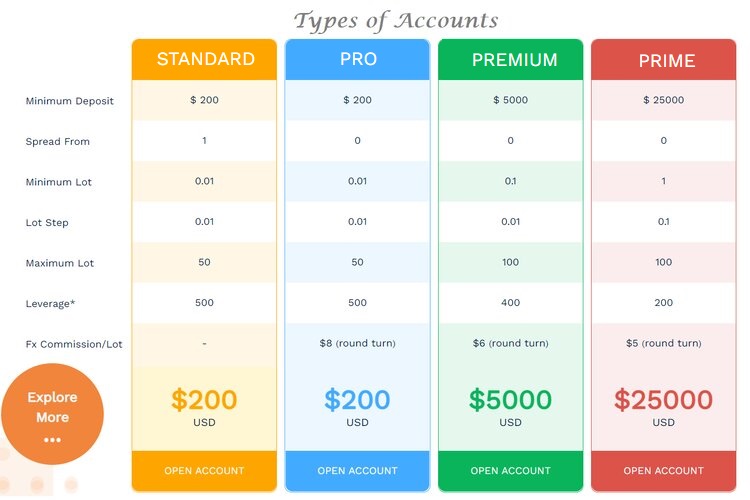
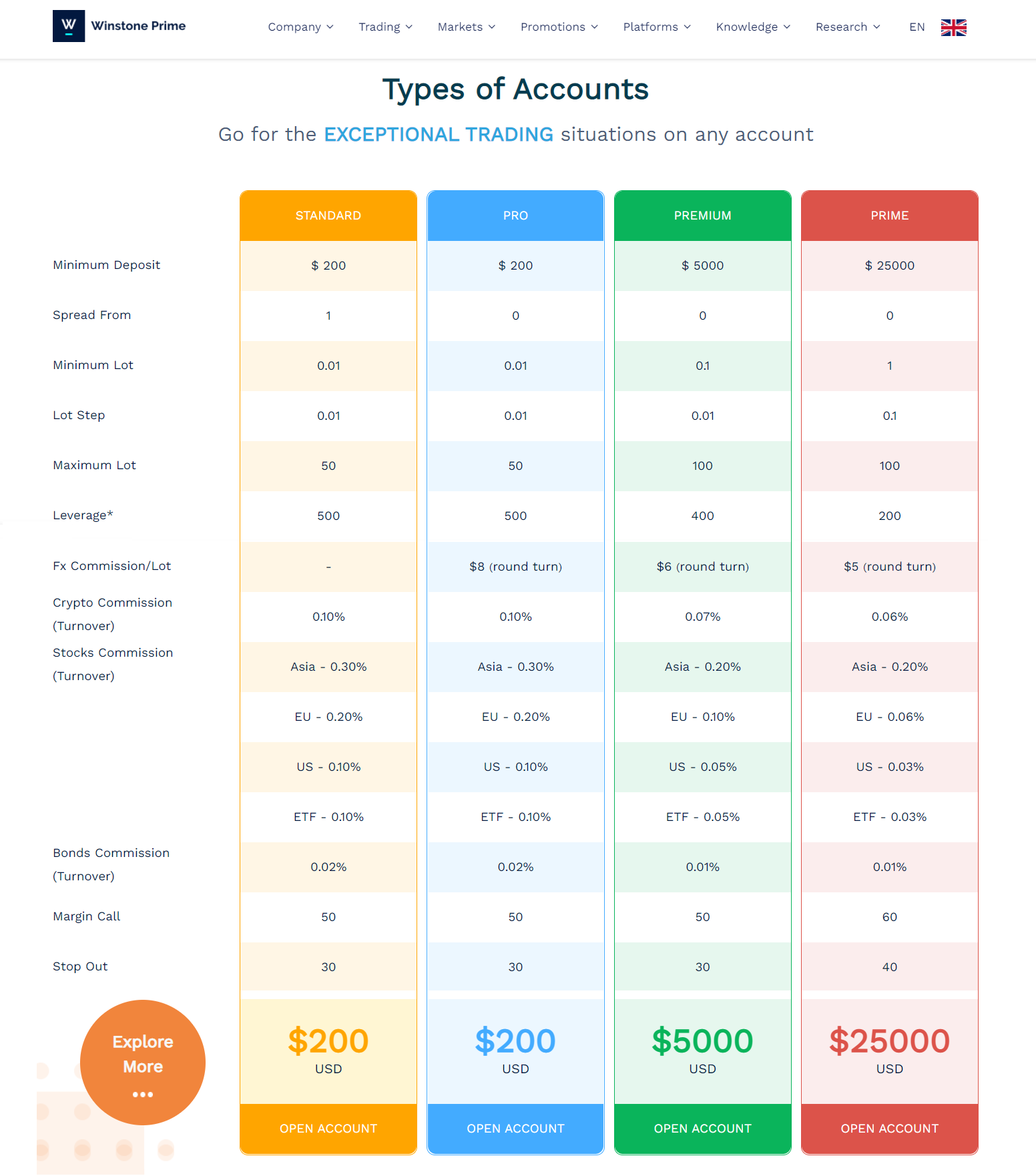
We Winstone Prime offers 4 types of account which are Standard($200), Pro($200), Premium($5,000) and Prime ($25,000). So traders can enhance their strategies into this account types.
Other Account Types

Aside from the main three account types, there are some other account types you should become familiar with. These types each have their own specific purpose.

Demo Accounts

Demo accounts allow you to practice your trading. They are virtual accounts loaded with virtual currency. Almost all demo accounts are free, yet they may have a limited usage period. This is normally around 30 days. If you proceed to open a live account with the same broker, however, you may regain access. 

Demo accounts are useful for both beginners and experienced traders. Novice traders can use them to get to grips with different trading platforms and to see the effects of their trades in real-time. Experienced traders also use demo accounts to test their trading strategies risk-free.

Swap-free Accounts

Most of the trading account types mentioned above will come with swap fees. This refers to the fee you incur for holding a position overnight. Traders who wish to hold positions open for a long time however, such as swing traders or investors, suffer heavy fees with a regular account. To prevent this, some brokers offer swap-free accounts.

Whilst swap-free accounts can seem appealing, it’s not simply a case of avoiding fees. Swap-free accounts usually come with higher trading costs and various restrictions. As such, unless you do plan on holding positions for a long time, it is normally best to avoid these types of accounts.

One exception to this rule is if you are a Muslim forex trader. Swap-free accounts are also sometimes called Islamic accounts. This is because they are often used by Muslim traders who cannot incur interested fees due to their religious beliefs.

Conclusion

There is New to Forex  online Guide that a beginner forex trader can study even before opening a real forex trading account, and to get extra practice in forex trading before opening a live forex trading account – a beginner forex trader should open a practice Forex demo trading practice account with a forex broker – so as to practice placing forex trade transactions before opening a real forex trading account and investing with real money. During the forex training period using the forex demo practice trading account, the beginner forex trader will learn the key factors needed to succeed in forex trading such as; forex education, forex money management, forex trading plan and forex trading systems.

The types of Forex trading strategies used and the skills required for any of these 3 forex trading accounts are essentially the same – those forex trading skills and forex trading strategies required for the Standard Forex Account or Mini Forex Account or Micro Forex Account are the same, the only difference to be adjusted are the forex money management rules for each forex trading account type.

Gold is in uptrend ahead of Powell’s speech

The price of gold was strong today as investors waited for Chief Minister Jerome Powell’s speech at the Jackson Hole Symposium later, After some US Federal Reserve officials called for a bond purchase. It has recorded some slight gains from previous session. Yesterday the Federal Reserve’s hawk policy analysts considered the central bank’s bond purchases useless. St. Louis Fed President James Bullard, Kansas City Fed President Esther George and Dallas Fed President Robert Kaplan also underestimated the impact of the Delta variance in separate interviews.

The higher US dollar appreciation eases some pressure from the price of gold among concerns that the soft U.S. initial jobless data that will expand the precious metal to other currencies will start a cut in its bond-purchasing program. Concerns about the delta pandemic are eroding investor confidence and risk appetite, which could eventually help revive the gold price correction.

Ignoring the US dollar’s recovery, the yellow metal also benefited from the bearish mood of the previous day’s market. However, the cautious feeling ahead of Fed chair Jerome Powell’s speech at the Jackson Hole Symposium explores the price of the gold. The main contributors to the sour sentiment were the recent comments by central bank officials, and supported the geopolitical challenges of the Middle East and China, not to forget the Covid tragedy. Powell is set to speak at 1400 GMT in the Kansas City Fed’s central banking conference, an event normally held in Jackson Hole, Wyoming, which has been often used by Fed policymakers in the past to provide guidance on their future policy.

Dallas Fed President Robert Kaplan said he believed the progress of economic recovery warrants tapering of the Fed’s asset purchases to commence in October or shortly thereafter, following earlier comments from St. Louis Fed James Bullard and Ester George were the rest of the non-voting Fed members who followed Kaplan and firmed up concerns over tapering. Furthermore, Blast at Kabul airport and reports of two or three US officials being hurt raised worries of the US response to the Taliban.

It is worth noting that viral tragedies and geopolitics challenge market sentiment along with a cautionary tale ahead of Fed Chairman Jerome Powell’s Jackson Hole Symposium speech. As it moves, US data, such as the core PCE price index for July, will join the risk stimulus to delight gold traders. However, the main focus will be on how Powell defends Fed’s easy monetary policy.

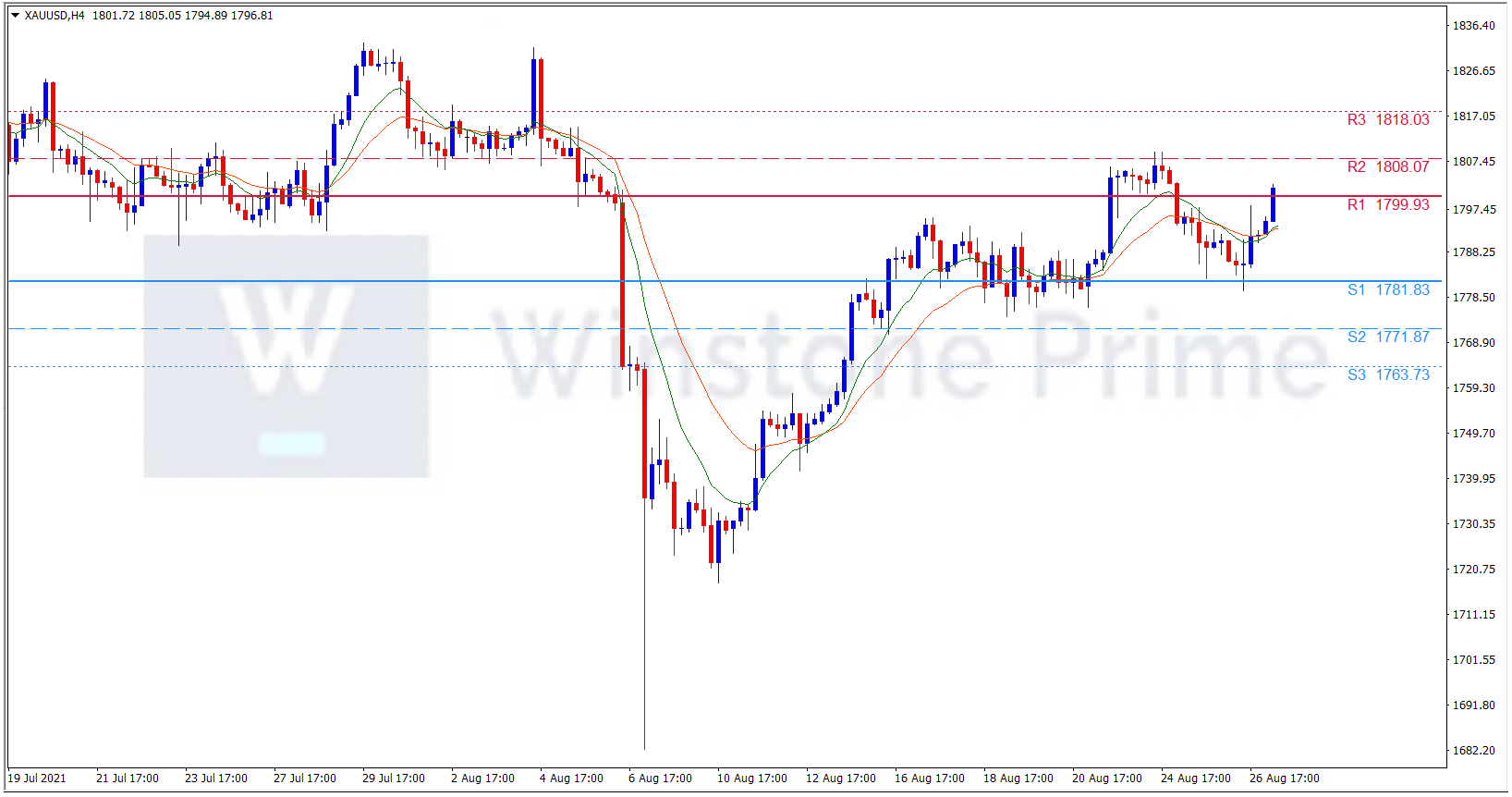
XAU/USD 4 Hour Chart:

Support: 1781.8 (S1), 1771.9 (S2), 1763.7 (S3).

Resistance: 1799.9 (R1), 1808.1 (R2), 1818.0 (R3).

Amidst this above catalysts the yellow metal showing consolidated mild gains on the last US session. We expect a bullish trend for XAU/USD.

CAPEX Survey pressurises Aussie

Aussie is on the back foot upon Aussie CAPEX smashes as well as virus concerns weighing on the quote. Australia’s second-quarter CAPEX survey has been released and beats expectations by a mile. Australia Q2 New Capital Expenditure +4.4 pct QoQ s/adj (Reuters poll +2.5 pct). Australia Q2 Building CAPEX +4.6 pct QoQ, s/adj. Australia Q2 Plant/Machinery CAPEX +4.3 pct QoQ s/adj. The focus ahead of Gross Domestic Product, however, is the equipment investment sub-component, which too was a strong number. Aussie is not impressed and remains subdued and it is on the down today.

Meanwhile, domestically despite the fact that the New South Wales government will today or tomorrow fully relax some restrictions on those vaccinated, reaching the 6 million vaccination target a week earlier, Westpac analysts said on today. Victoria, Australia’s 2nd most populous state will face new lawsuits because of sudden increase in the Covid cases, almost doubling the number of the previous day, from 80 vs. 45. Lock down in the state is severe as there is a curfew order in Melbourne. This is negative for Aussies considering how far the country has come in vaccine release. ‘The ABS will also release the latest fortnightly read for payrolls and wages, as of 31 July, which captures wide-ranging lockdowns.

On the other hand, the Countdown to the Federal Reserve chair will deliver a keynote address on Friday and markets are in high anticipation. If the US dollar expects this speech and is not immediate depending on the outcome, there may be a decisive bias in price determination in the coming days. The current status quo will work if Powell sticks to the same script we heard again and again in recent weeks on the latest Federal Reserve decision and its minutes. In such a scenario, the risk-on would reveal the movement of the US dollar into commodity currencies and EM-FX.

The Fed has done a very good job under their guidance, figuring out how they want to tape first and what conditions are required to do so, and then eventually move on to raising rates. With all this being said, the US dollar has fallen late and is slipping from the most critical levels on the long-term chart to the lowest level since the chances of a Taper announcement or an immediate start to the day were dialed in at the end of the year. Therefore, if Powell wants to resurrect the expectation that the start date will come soon, he may sit on the dry powder side of the US dollar and send it back for higher hikes.

Risk markets are trading positively as the Jackson hole opens this Thursday and concerns about future global growth outlook continue to ease. Delay variation is fluid and lives a dangerous life when the US and China come out with a cleaner slate than some other less influential countries. All of this boosted the US Treasury yield almost two weeks before Powell’s speech. That local data aside, markets are looking in the direction of the US calendar today.

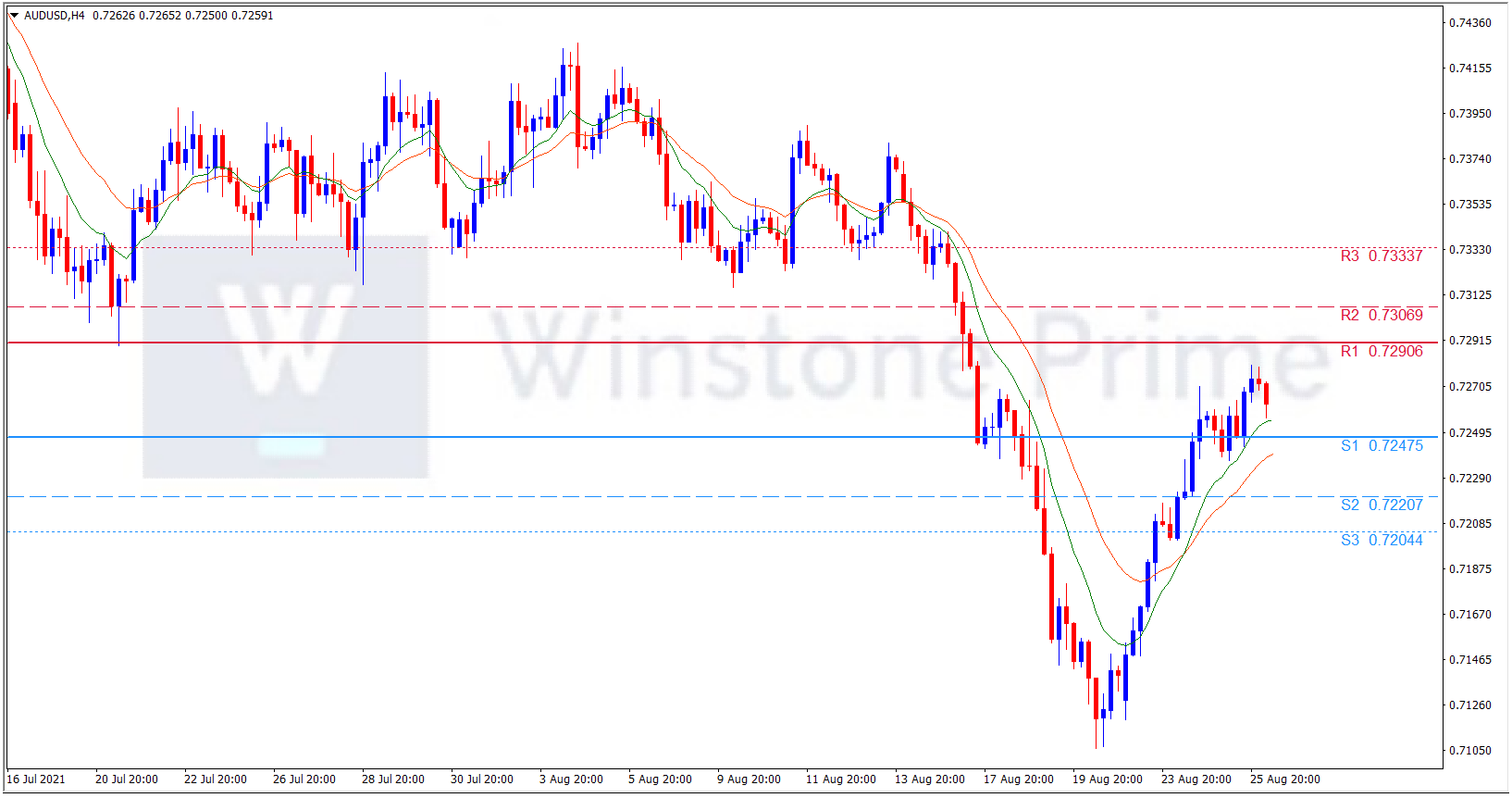
AUD/USD 4 Hour Chart:

Support: 0.7248 (S1), 0.7221 (S2), 0.7204 (S3).

Resistance: 0.7291 (R1), 0.7307 (R2), 0.7334 (R3).

Amidst this above catalysts Aussie pair is on sluggish moment upon CAPEX quarterly report and also US market looking ahead of Jerome Powell speech. We expect a bearish trend for AUD/USD.

Risk on and Risk off in Currency Trading

When market experienced sentiment flip flopping back and forth in its behavior Risk-on and risk-off happens. The price behavior responds to and is driven by changes in investor risk tolerance. There is daily headline risk, geopolitical risk and economic risk, not to mention the ongoing political rumor mill. This type of action can take a toll on a trader or investor’s emotions, and can also provide opportunity. But what exactly do “Risk-On” and “Risk-Off” mean?

What is “Risk-On” and “Risk-Off” mean?

During periods when risk is perceived as low, the risk-on risk-off theory states that investors tend to engage in higher-risk investments. When risk is perceived to be high, investors have the tendency to gravitate toward lower-risk investments. In this article We would like to explain in more detail what “risk-on, risk off” (RORO) means and how traders and investors can use the corresponding market developments.

When investor sentiment is optimistic about the economy, geopolitics and industry, riskier assets tend to get pricier. That is known as “Risk-On.” Conversely, when uncertainty or negativity hits the market, investors tend to sell these riskier assets and buy “safer” assets, ones that are typically less vulnerable to a weakening outlook or negative investor confidence. This is “Risk-Off.” Risk-on/risk-off describes how the markets react to events and are guided by changes in investors’ risk tolerance. RORO refers to changes in investment activity in response to global economic patterns. In periods when the risk in the markets is considered low, the risk-on/risk-off theory assumes that investors tend to invest in riskier asset classes. However, if the risk is perceived to be high, then investors tend to base their investment behavior on low-risk investments.

What determine the Risk Tolerance

“Risk-on” describes a positive market sentiment. Investors are using riskier, higher-yielding investments. They are in a buying mood.

The opposite of this is “risk off,” meaning the mood in the market is not good and investors are looking for defensive stocks. There is demand for obviously lower-yielding investments whose risk is presumed to be lower.

  • Risk-on means that traders and investors are prepared to take risks and they are focused on the return on investment; risk-on asset classes are in demand and there is a strong correlation; in other words, greed is dominating the markets.
  • Risk-off means that traders and investors are risk averse and the focus is on preserving capital; risk-off asset classes are in demand and there is a strong correlation; in other words, fear is dominating the markets.


Gold Safe Haven Value

Investors also turn to precious metals, such as gold, in times of economic turmoil. Over the years, the yellow metal has been considered a store of value. Gold cannot be printed like money; it’s also not impacted by interest rate decisions. Therefore, due to the precious metal maintaining its value, it serves as insurance during times of market uncertainty.

Another interesting point worth mentioning concerning gold is that it is entirely possible to see both equities and gold markets rally side-by-side. When the economic cycle is positive (GDP is rising), stocks generally appreciate while gold falls. Yet, if inflation is rising along with GDP then both gold and stocks can rally, as gold is thought to be a hedge for inflation

Oil

When the market reverts to a Risk-off setting, this suggests the global economy is likely to shrink. Less growth means less demand for oil. Things such as machinery for transportation, construction and airlines are all affected, thus a sell-off in oil is usually seen.

A decline in oil prices generally leads to the US dollar and USD/CAD rallying, as Canada’s economy is heavily tied to the price of oil. As of 2019, it’s the fourth largest oil producer in the world, delivering more than 5.50 million barrels per day. Because of the volume involved, it creates a huge demand for Canadian dollars.

Current Movements has been changed

Previous times risk-on and risk-off movements were different. They were defined in such a way that in a risk-on market sentiment the currency pairs EUR/USD, GBP/USD, AUD/USD and NZD/USD rose, while USD/CAD fell. In general, during this type of movement, the US dollar was actively sold. 

When central banks cut interest rates into negative territory and unusual monetary policy moves affected the currency markets the market behavior has changed.

The central banks’ comprehensive monetary policy programs (Quantitative Easing) have disrupted risk / risk-taking around the world. To introduce inflation central banks buy their own government bonds in this situation. Markets had to adjust to this new reality, and today we see negative interest rates in many major central banks around the world. The purpose of a negative interest rate environment is to encourage commercial banks to lend more to the real economy, which aims to create jobs and economic growth. As the economy expands, inflation will rise, and as it happens, central banks will return their monetary policies to normal. Until then, markets will adapt to new realities and risk-risk / risk perception will be defined. As a rule, you may remember that there is a risky trade when risky currencies are sold across the board against the Swiss Franc and the Japanese Yen.

Conclusion

Traders can take advantage of competition if they know what to expect from a risk-on/risk-off perspective. This will be very helpful to avoid excessive trade which can be caused by market interactions.