
1998 – Russian Financial Crisis

Financial crisis can be defined as a sharp decline in the value of property, businesses and consumers unable to pay their debts and financial institutions experiencing a liquidity crunch. A financial crisis is often associated with a panic or bank operation, during which investors sell assets or withdraw money from savings accounts because they fear that the value of those assets will decline if they are in a financial institution. A financial crisis may occur if institutions or assets are overvalued and can be exacerbated by irrational or herd-like investor behaviour. Russia’s economy was on the brink of a crisis on August 1998. At that time, Russia’s situation is worsened by the global recession. The recession had its roots in the 1997 Asian crisis.

In this article we will look into the reason behind the Russian financial crisis which hits Russia economy are detailed.

Back Ground and Course of Events

The most important year in this analysis is 1998 during which most of the incidents were very significant. So, it would be very useful to start talking about the political and financial situation that Russia was in during that period. Russia’s economy, during the last decade of the 20th century, was in transition after the fall of communism in the late 1980’s. Boris Yeltsin was the President of the Russian federation, serving from 1991, and leading the Russian federation through this difficult period of transition. It is much more interesting and important for the following analysis to focus on the period from 1996 to 1998 in order to better understand the situation of the Russian federation. During the late 1996 and the early 1997, the Russian economy showed some signs of improvement and as the OECD survey revealed “the Russian economy appeared stronger than at any previous time during the transition period”. This statement was supported after indications of the stabilization of output, the positive sign of the annual GDP growth and a rather tight monetary policy that was implemented by the Russian government. All these leaded to the stabilization of the inflation and the exchange rate thus making them more predictable for the investors. Adding up to all these, the living standards of the Russian population started to recover after being very low during the first years of the transition period. So, based on these improvements the Russian government wanted to try and fix things in the financial sector. This effort involved the elimination of the government’s debt and the control of the government’s fiscal imbalances. This was a very natural reaction by the Russian authorities but the main flaw in this effort was that it was based on the assumption that the relatively low interest rates that were achieved at that time would be kept at the same low level. In other words, the Russian government took the strong inflow of capital for granted and that proved to be a terrible mistake. This is how the situation stood until the November 1997. At that time Asia was hit by a financial crisis and this financial crisis affected the expectations of the investors as the export prices increased. So, the increase of the export prices and the decline in their demand caused the elimination of Russia’s current account surplus.

Political Fallout

The financial collapse resulted in a political crisis as Yeltsin, with his domestic support evaporating, had to contend with an emboldened opposition in the parliament. A week later, on 23 August 1998, Yeltsin fired Kiriyenko and declared his intention of returning Chernomyrdin to office as the country slipped deeper into economic turmoil. Powerful business interests, fearing another round of reforms that might cause leading enterprises to fail, welcomed Kiriyenko’s fall, as did the Communists.

Yeltsin, who began to lose his hold on power as his health deteriorated, wanted Chernomyrdin back, but the legislature refused to give its approval. After the Duma rejected Chernomyrdin’s candidacy twice, Yeltsin, his power clearly on the wane, backed down. Instead, he nominated Foreign Minister Yevgeny Primakov, who was approved by the State Duma by an overwhelming majority on 11 September 1998.

Primakov’s appointment restored political stability because he was seen as a compromise candidate able to heal the rifts between Russia’s quarreling interest groups. There was popular enthusiasm for Primakov as well. Primakov promised to make payment of wages and pensions his government’s first priority and invited members of the leading parliamentary factions into his Cabinet.

Communists and the Federation of Independent Trade Unions of Russia staged a nationwide strike on 7 October 1998 and called on President Yeltsin to resign. On 9 October 1998, Russia, which was also suffering from a poor harvest, appealed for international humanitarian aid, including food.

Conclusion

The Russian ruble crisis had many different causes that contributed to the sudden crisis of confidence, including falling energy prices, heightened geopolitical risks, and increasing demand for the U.S. dollar. With the ruble still trading near its lows with the U.S. dollar in 2021, the country continues to suffer from the same problems that caused the crisis.

International investors may want to take caution when investing in Russia, given the ruble crisis and its aftermath. Dollar-denominated debt could become difficult to service in rubles, while equities could suffer, thanks to deteriorating spending power among consumers and businesses. These trends could eventually lead to a similar crisis or recession down the road.

Weaker consumer report impacts dollar

The USD/JPY is on consolidated downtrend from last week Friday and the catalyst behind it could be weaker-than-expected consumer sentiment report, which drove U.S. Treasury yields sharply lower. It has swiped out all the previous gains of bullish U.S. Non-Farm payrolls report.  According to the University of Michigan, US consumer sentiment fell to its lowest level since December 2011. The move tightened the circulation between US government bonds and Japanese government bonds, making the US dollar a less attractive asset.

Yields were down 8 basis points at 1.287% on the key 10-year Treasury note. Yields on the 30-year Treasury bond fell 9 points to 1.937%. As per CNBC report consumer sentiment reading saw a dramatic drop in early August as the delta variant of COVID-19 increased fears about the path of the economy, the University of Michigan said on Friday. Wiping out the gains attributed to the bullish July Non-Farm Payrolls report suggests investors have already moved on from this data, and may be looking forward to weaker labor market data in August due to the reinstatement of mask mandates and other health restrictions in several states.

Federal Reserve Bank of Minneapolis President Neel Kashkari said in an interview with Bloomberg that the US Federal Reserve will allow the .S. central bank to begin winding down its bond-buying program, indicating that some more strong jobs reports in the coming months will indicate sufficient progress in recovering from the Covid. He noted, “If we look at some more job reports like the one we got, yes, we are – maybe the hole we were in was not completely filled – but we have made a lot of progress and now it’s time to start making our property purchases.

However, Kashkari said the central bank would eventually limit it to employment effects due to inflation, which could be achieved. “We do not have the capacity to target the black unemployment rate – and saying, ‘We need to get the Black unemployment rate to X, and we’re not going to be at full employment until we get it to X,’ because we have to pay attention to what that means for, on the inflation side of our dual mandate.”

On the other hand U.S. House Speaker Nancy Pelosi told lawmakers on yesterday that she had asked a House committee to advance both a $1 trillion infrastructure plan and a $3.5 trillion spending package together, an apparent effort to patch up divisions that had threatened to stall President Joe Biden’s legislative priorities. The U.S. Senate approved both the infrastructure legislation and the outline of a separate plan loaded with investments in new domestic programs. But the combined price tag of the two measures created fissures between the progressive and moderate wings of the Democratic Party, which controls both chambers of Congress by slim margins. Pelosi’s letter said her approach “will put us on a path to advance the infrastructure bill and the reconciliation bill.”

At the same time markets are awaiting fresh impulse for this week from US Retail Sales and the FOMC minutes.

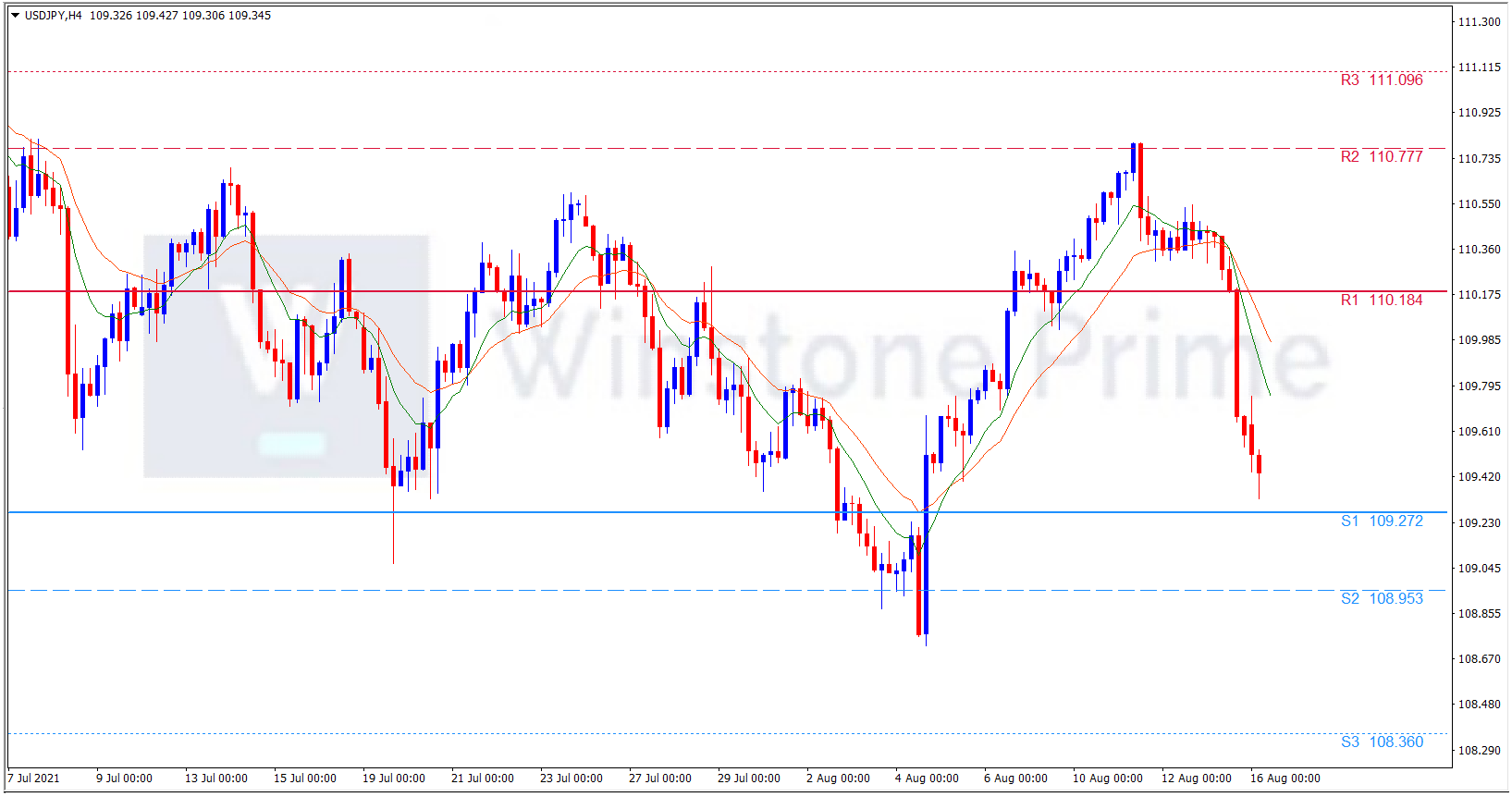
USD/JPY 4 Hour Chart:

Support: 109.27 (S1), 108.95 (S2), 108.36 (S3).

Resistance: 110.18 (R1), 110.78 (R2), 111.10 (R3).

Amidst this above catalysts the US dollar is on sell-off mood now. We expect bearish trend for USD/JPY.

BTC/USD Weekly Forecast (16th August 2021 – 20th August 2021)

Fundamental view:

Bitcoin has shown an uptrend against greenback in the previous week. Despite the recent crashes, Bitcoin adoption continues to progress. The President of Argentina, Alberto Fernandez, expressing his views on how Bitcoin can combat inflation with a local media outlet on August 12, this helps the Bitcoin’s uptrend.

Singapore’s largest bank – DBS Bank made an announcement on Thursday that it received a ‘go’ sign from the Monetary Authority of Singapore (MAS) to digitize payment token services as a payment institution via its broker arm, DBS Vickers (DBSV).  All these favored the Bitcoin against the greenback.

On the other hand,  The central bank is trying to cool down tightening expectations by saying that heating inflation will likely be temporary and resting on the tepid progress in the job sector which will help to maintain the ultra-loose monetary policy.

The major economic events deciding the movement of the pair in the next week are NY Fed Empire State Manufacturing Index at Aug 16, Retail Sales monthly report, Fed Industrial Production monthly report at Aug 17, EIA Crude Oil Stocks Change, FOMC Minutes at Aug 18, Philadelphia Fed Manufacturing Index and Initial Jobless Claims at Aug 19 for US.

BTC/USD Weekly outlook:

Technical View:

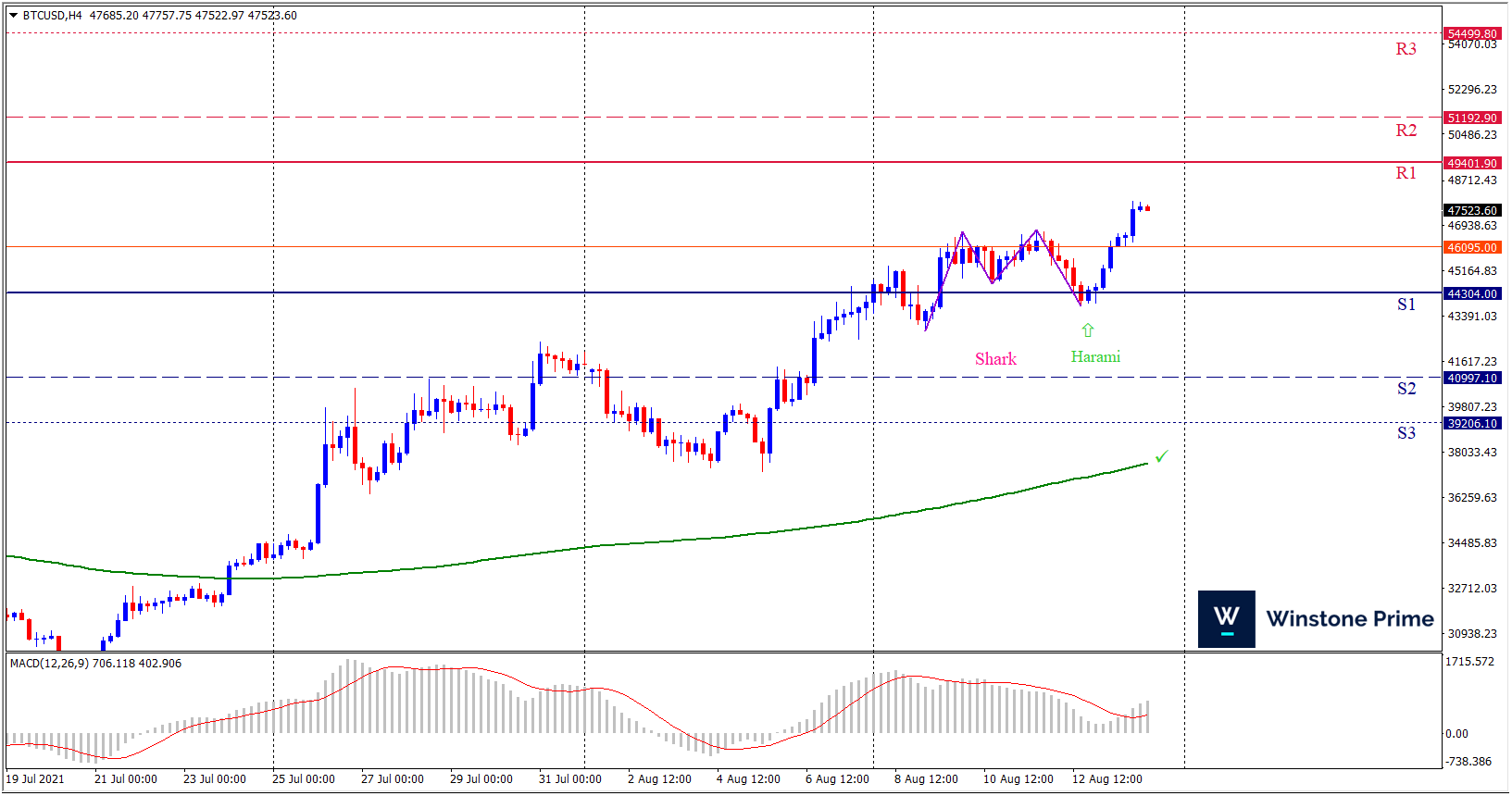
Last week’s high was 5.62% higher than the previous week. Maintaining high at 47886.1 and low at 42788.2 showed a movement of 5097 pips.

In the upcoming week we expect BTC/USD to show a bullish trend. The Instrument is trading above the 200 Simple Moving Average and the MACD trades to the upside. A solid breakout above 49401.9 may open a clean path towards 51192.9 and may take a way up to 54499.8. Should 44304.0 prove to be unreliable support, the BTCUSD may sink downwards 40997.1 and 39206.1 respectively. In H4 chart bullish shark pattern favors prospects of a bullish trend. Bullish harami pattern constructs a bullish outlook for the pair in the upcoming week.

Preference
Buy: 47586.4 target at 51191.8 and stop loss at 44300.6


Alternate Scenario
Sell: 44300.6 target at 39207.2 and stop loss at 47586.4

XAU/USD Weekly Forecast (16th August 2021 – 20th August 2021)

Fundamental view:

The yellow metal bounced up and down against the greenback in this week. The unabated USD strength at the start of the week caused the pair to show a downtrend at the beginning of the week. Atlanta Federal Reserve Bank President Raphael Bostic said that the Fed could start to reduce asset purchases between October and December, and the Richmond Federal Reserve Bank President Thomas Barkin said that the Fed has made substantial further progress towards the taper benchmark.

But by Wednesday, greenback showed selling pressure after the inflation release. The US Department of Labor reported that Initial Jobless Claims declined by 12,000 to 375,000 in the week ending August 7 and the US Bureau of Labor Statistics announced that the annual Producer Price Index (PPI) for final demand jumped 7.8% from 7.3%.Amidst all the catalysts, the yellow metal formed a bull candle.              

The major economic events deciding the movement of the pair in the next week are NY Fed Empire State Manufacturing Index at Aug 16, Retail Sales monthly report, Fed Industrial Production monthly report at Aug 17, EIA Crude Oil Stocks Change, FOMC Minutes at Aug 18, Philadelphia Fed Manufacturing Index and Initial Jobless Claims at Aug 19 for US.

XAU/USD Weekly outlook:

Technical View:

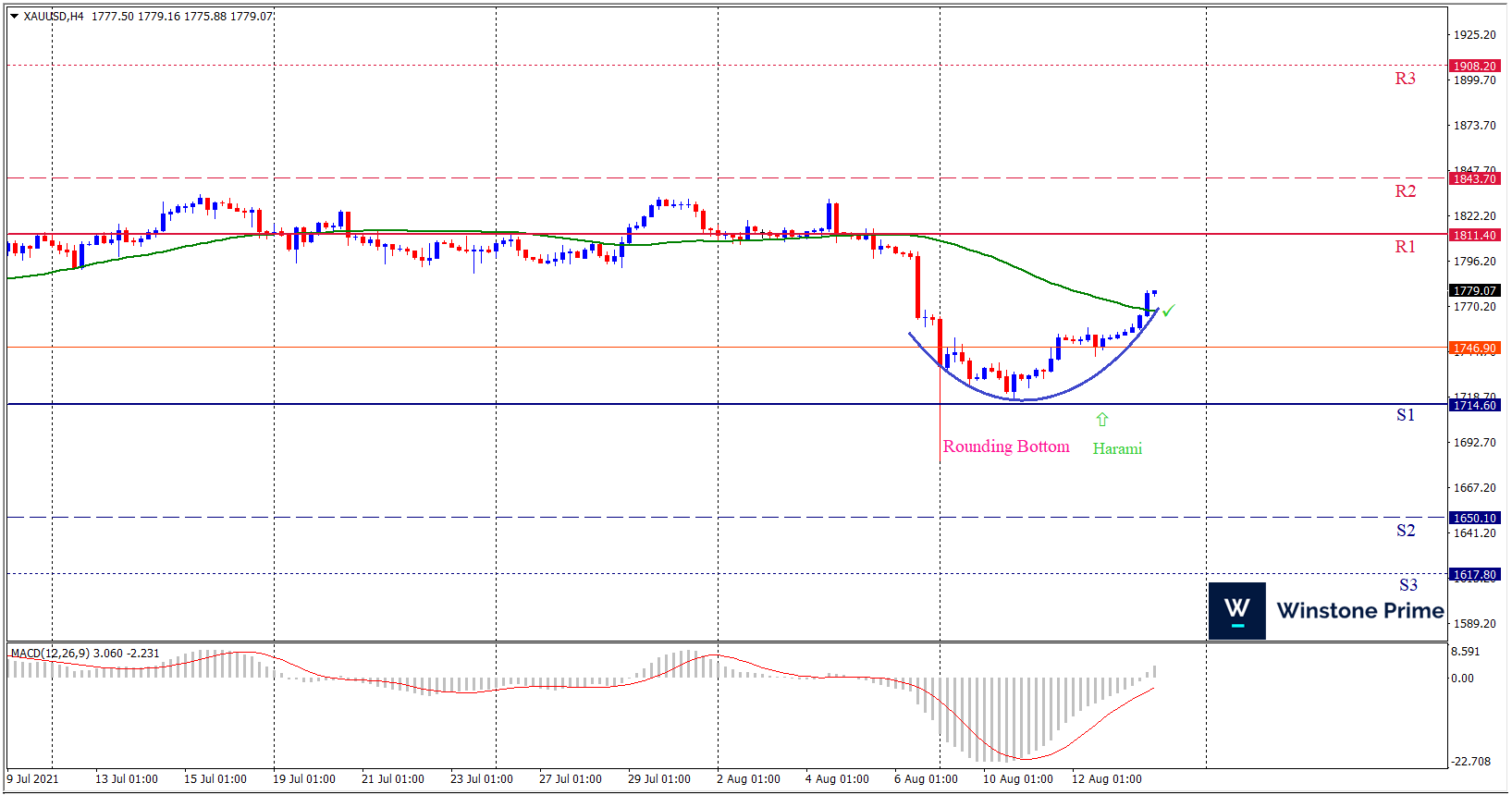
Last week’s high was 2.86% lower than the previous week. Maintaining high at 1779.2 and low at 1682.4 showed a movement of 968 pips.

In the upcoming week we expect XAU/USD to show a bullish trend.  The Instrument is trading above the 50 Simple Moving Average and the MACD trades to the upside. A solid breakout above 1811.4 may open a clean path towards 1843.7 and may take a way up to 1908.2. Should 1714.6 prove to be unreliable support, the XAUUSD may sink downwards 1650.1 and 1617.8 respectively. In H4 chart rounding bottom pattern favors prospects of a bullish trend. Also to be noted Bullish harami formation exerts the expectation of uptrend for the pair.

Preference
Buy: 1779.2 target at 1842.7 and stop loss at 1741.9


Alternate Scenario
Sell: 1741.9 target at 1678.6 and stop loss at 1779.2