Downbeat data and lockdown pressurises yen

USD/JPY has launched a relishes moment ahead of the U.S. Federal Reserve led markets to bring forward the likely timing of a policy tightening there, while action in Europe and Japan remain distant prospects. The yen pair portrayed a strong recovery after the previous day in May, with the US dollar benefiting from a volatile mood and concerns of tightening monetary policy. And also the pair reacted to the yesterday Japan’s services sector activity and expanding the nationwide lock down restrictions in Tokyo and five prefectures.

The US dollar rally came out after Fed Vice Chair Richard Clarida said conditions for an interest rate hike could be met in late 2022, setting the stage for a move in early 2023. He and three other Fed members also signalled a move to taper bond buying later this year or early next depending on how the labour market fared in the next few months.

On the other hand, the main currency pair went towards the yesterday services sector activity report. Japan’s services sector activity has shrunk fast for the 18th month of July, because the Corona virus is a blow to business activities and confidence to fight the rebellion of the coronavirus infections. The spread of the Corona virus has undermined the rescue opportunities of the world’s third largest economy by hurting hopes, sales, functions and also new business visits have shrunk fast.

The final au Jibun Bank Japan Services Purchasing Managers’ Index (PMI) dropped to a seasonally adjusted 47.4 from the previous month’s final 48.0 level, and compared with a 46.4 flash reading. The reading marked the 18th month that services activity came in below the 50.0 threshold that separates contraction from expansion, the longest such streak since a 27-month run through March 2010.

The president of the Japanese government on the Corona virus insisted to expand the current emergency of the country across the country. Omi Shigeru said in a Lower House committee meeting on Wednesday that the Delta variant is definitely a factor in the ongoing surge of infections. Tokyo and five provinces are under the state of emergency level and the western prefecture of Osaka, posing further potential headwinds to services sector activity ahead. But the survey still showed firms remained optimistic about conditions for the 12 months ahead, though they were slightly less positive than in the previous month.

Omi said that the nationwide emergency should be announced, if the government should discuss what measures should be taken. Japan also lifted the ban on poultry and egg exports from Ukraine imposed last year due to the spread of highly pathogenic avian influenza. The Ministry of Foreign Affairs of Ukraine informs that “On August 2, Japan lifted the ban on poultry and egg exports from Ukraine which was imposed in December last year due to the spread of highly pathogenic avian influenza in Ukraine,”

USD/JPY 4 Hour Chart:

Support: 108.90 (S1), 108.33 (S2), 107.95 (S3).

Resistance: 109.85 (R1), 110.24 (R2), 110.81 (R3).

Amidst this above catalysts the yen is on downtrend today. We expect a bullish trend for USD/JPY.

Must know things about ECB

Majority of countries have their own central bank, which issues currency, defines monetary policy and ensures the proper functioning of the banking system. In Europe, however, adopting the Euro necessitated the creation of a European Central Bank (ECB).

In this article, we will explore the European Central Bank, an institution created to help implement the Euro that manages currency and manage economic crisis across the Eurozone.

EUROPEAN CENTRAL BANK

The European Central Bank (ECB) is one of the seven institutions of the EU and the central bank of the entire Eurozone. It is a consortium of European countries that uses the euro as its sole official currency.  It is one of the most critically important central banks in the world, supervising over 120 central and commercial banks in the member states.  The ECB is responsible for managing monetary policy and protecting the value of the euro. In comparison to the Eurozone economy, the ECB’s actions attract the attention of US traders as well as those of the Reserve Bank of the United States.

It’s possible to assume that something like the European Central Bank would eventually be created in the European Union. After all, as early as 1962, the European Commission proposed that member states begin working toward total economic and monetary union between EU states. Only a decade later in 1973, the European Economic Community (as the EU was known at the time) implemented a system that connected its member states’ currencies to one another to ensure trade balances but also pave the way for a future monetary union.

However, the first tangible steps toward monetary union between member states did not begin until the 1990s. As part of the 1992 Treaty of European Union (which also officially changed the organization’s name to the EU), the EU set out definite rules for the implementation of a future, pan-European currency, the Euro. The Euro was implemented in 1999 for commercial and financial transactions, and in 2002, over 80 billion bank notes and coins were distributed across the EU in the largest monetary changeover in history.

Though several organizations existed before the European Central Bank, the ECB was instituted first in 1998 largely to handle the changeover to the Euro. The management of the European central currency has been its mandate ever since.

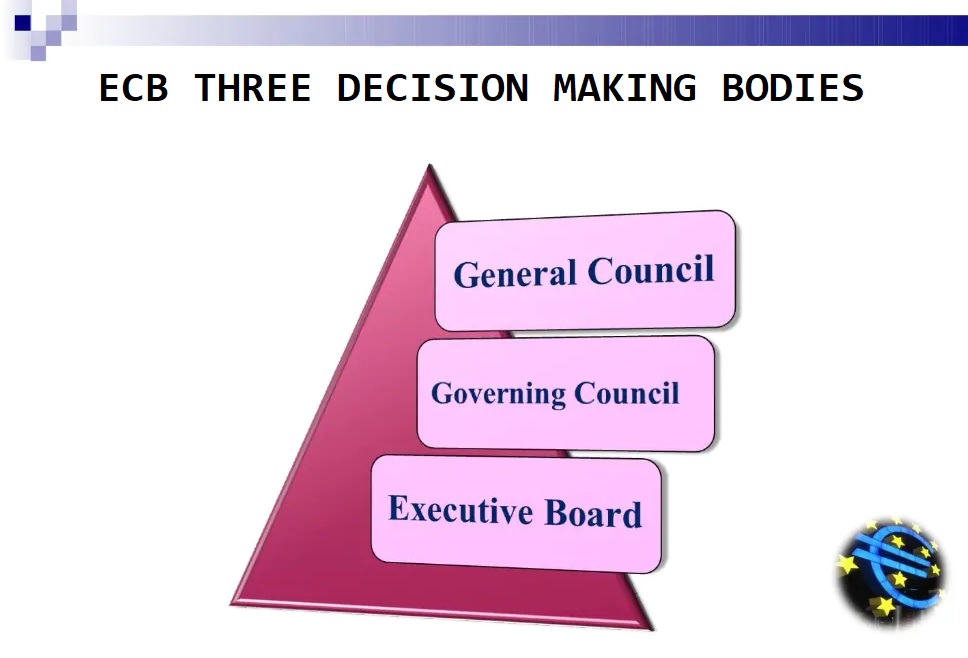
The European Central Bank was established in 1999. The governing council of the ECB is the group that decides on changes to monetary policy. The ECB is administered in the same way as the Federal Reserve.

The council consists of the six members of the executiveboard of the ECB and the governors of all the national central banks from the 19 euro area countries. As a central bank, the ECB does not like surprises. Therefore, whenever it plans on making a change to interest rates, it will generally give the market ample notice of an impending move through comments to the press. The governing council meets twice a month, but policy decisions are generally only made at meetings where there is an accompanying press conference, and those are held every six weeks.

  • To maintain price stability and safeguard the value of the Euro. The Governing Council defined price stability as inflation of under but close to 2%. Price stability is essential for spurring economic growth and job creation, which are core objectives of the EU.
  • The ECB has a monopoly on the issuing of banknotes in the Euro area. It influences the amount of money in the market by controlling money available to eligible central and commercial banks in EU member states.
  • ECB makes weekly announcements on the amount of money it wishes to supply and the minimum acceptable interest rate. Eligible banks that have provided collateral then place their bids for the ECB funds through an auction mechanism. Once the banks have obtained funds, they use them to advance loans to individuals and businesses.
  • Monitor the banking and financial institutions and ensures their compliance with the regulation and smooth conduct.
  • To control the inflation and unemployment of the member states.
  • Guides the member states on the functioning.
  • Ensures transparency and accountability at all levels and professional competency of all the members.

How ECB responses on Crisis time

The ECB was instrumental in organizing a response to the euro-zone debt crisis that started in 2009 after the spill over effects of the financial crisis of 2007–08 hit Europe. The ECB lowered interest rates to ensure a steady supply of euros into the Euro system.

Like the Fed, the ECB has responded to the COVID-19 pandemic by pledging to lend freely and stepping up its purchases of government debt.  Unlike the Fed, which had room to cut interest rates in response to the COVID-19 crisis, the ECB’s policy rate has been negative since 2014, when it was cut below zero to nudge banks to lend, rather than leaving deposits at the central bank. The deposit facility, the rate that banks receive for depositing at the ECB, is currently at minus 0.50 percent. But under a policy called ‘tiering,’ banks do not have to pay this penalty rate for a substantial proportion of their deposits. The ECB also controls two other short-term rates at which the banks can borrow from the ECB: the main refinancing operations and the marginal lending facility. These rates are largely irrelevant, however, as these facilities are rarely used today because the ECB has supplied liquidity in other ways.

Forward guidance. The ECB has offered forward guidance on the future path of its key interest rate, saying that they expect rates will remain “at their present or lower levels until it has seen the inflation outlook robustly converge to a level sufficiently close to, but below, 2 percent within its projection horizon, and such convergence has been consistently reflected in underlying inflation dynamics.” Such forward guidance on the overnight rate puts downward pressure on longer-term rates.

Conclusion

Traders and investors will monitor the impact of ECB policy decisions on securities such as currencies, stocks, indices and bonds. Traders might try to predict what monetary policy decisions get made before each meeting.ECB announcements and policies affect the interest rates set by commercial banks and other lenders, which affects spending and inflation across the Eurozone.Governing Council meetings are important dates in the economic calendar because the official interest rates for the Eurozone gets set. National central banks (NCBs) in the Eurosystem use these rates for transactions with commercial banks. The committee of the European central bank meets twice in a month to ensure smooth conduct and to formulate and discuss the plans for achieving the various objectives, which ensures the growth of the member countries.

Want to trade ECB meetings? Open an account today or build your strategy in a risk-free demo account.

Employment data favors kiwi

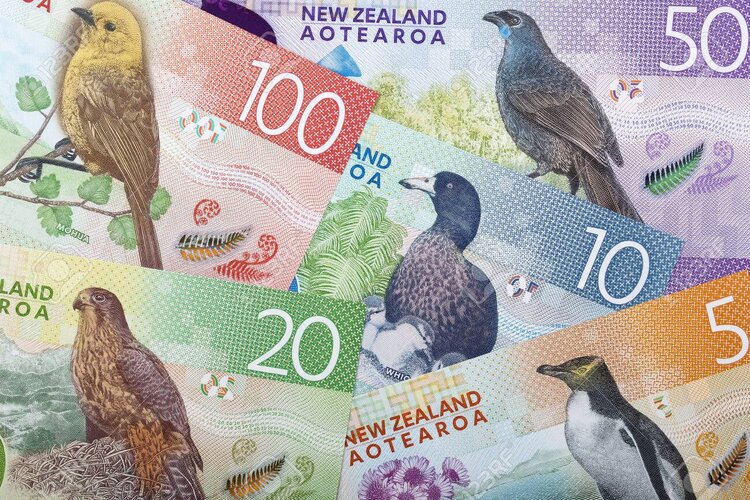
Kiwi pair is bolted higher on stronger than expected New Zealand’s employment data for the second quarter during early Wednesday. Kiwi departed when data showed that New Zealand’s unemployment rate had fallen to 4.0% in the last quarter, under the 4.5% market forecast, while employment was up 0.9%. In addition, RBNZ’s focus on ‘utilization’ has declined from 12.1% to 10.5% in the most recent quarter. The ‘participation rate’ rose to 70.5% from 70.4%.

The increasing heat in the labor market is fueling wage increases, with private sector wages up 0.9% in the quarter and an annual increase of 2.2%. This is ahead of the forecasts of many economists, and is slightly higher than the 2.1% RBNZ expected.

Policy responses to the pandemic caused a strong economic boom from a severe lockdown last March-May, but turned the remote economy New Zealand into a pressure cooker. Strong jobs data confirms the opinion of economists that the Reserve Bank of New Zealand (RBNZ) will raise the official Cash Rate (OCR) when it meets on August 18. ANZ Bank said in a note that “the data said New Zealand has surpassed full employment, and the economy is heating up.”

Wage growth accelerated in the June quarter, registering a 0.9% lift in the Private Sector Labor  Cost Index (LCI), which is higher than the forecast 0.6% increase. Wages were higher than expected, especially as activity in the growing housing market increased and closed borders restricted the supply of labour. The data comes a day after the Reserve Bank of New Zealand (RBNZ) said it was considering new ways to tighten home loan standards to control the housing market.

On the other hand the New Zealand Government has given out millions of dollars in electric vehicle and hybrid rebates in the month since the scheme was launched. It comes as some electric vehicle (EV) dealers are also seeing soaring demand. Figures released to one news channel reveals that 1422 applications for the rebate have been received in the first month. Of those, almost 1200 have been processed and 1047 rebates have been approved – at a total of almost $5.7 million. “I’m seeing a lot more EVs, it’s been increasingly easy to get charge around town, it’s saved me a lot of money on petrol,” hybrid owner Kate Sewell said. One Auckland car dealership has seen an increase in sales by 30 to 40 per cent.

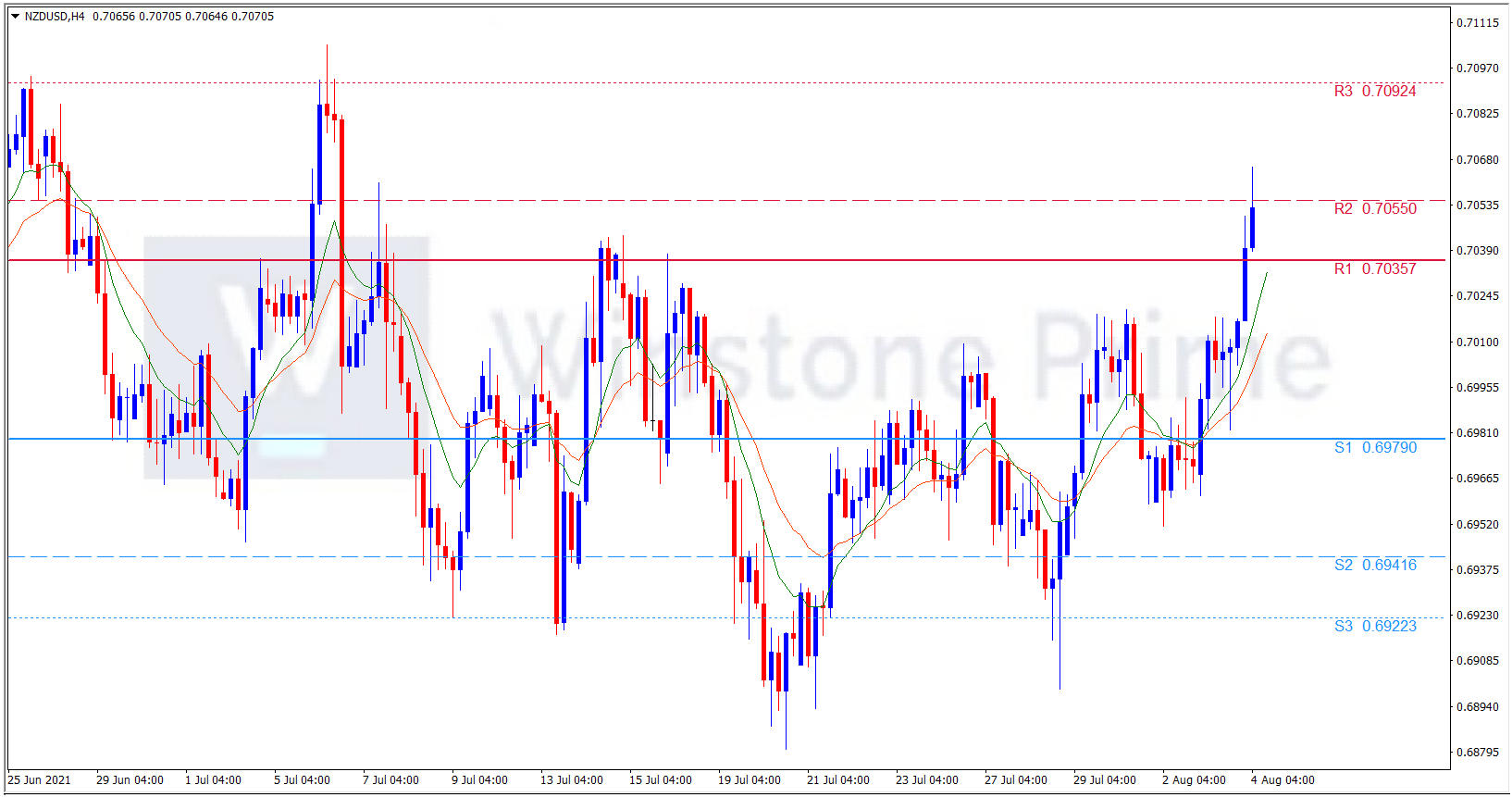
NZD/USD 4 Hour Chart:

Support: 0.6979 (S1), 0.6942 (S2), 0.6922 (S3).

Resistance: 0.7036 (R1), 0.7055 (R2), 0.7092 (R3).

Amidst this unemployment fallen rate and wages increases relishes the kiwi pair into bullish move. We expect a bullish trend for NZD/USD.

Positive Economic data favors Euro

Today’s market session kicked off Europe with an exciting moment on this August. Positive economic data from the Eurozone provided support, while rising Asian equities provided support to European majors. Production of PMI numbers for the month of July focused on retail sales from Germany at the beginning of the week. German retail sales rose 4.2% in June, following a 4.6% increase in May. Economists forecast a very moderate 1.5% increase on today.

The IHS Markit Eurozone Manufacturing PMI was 62.8 in July 2021, slightly different from the initial estimate of 62.6, but the lowest since June 63.4 and after March. Nevertheless, the sector has now recorded consecutive expansion months since July 2020, slightly lower than the latest reading June survey record. Output rose at a softer rate since February, while the growth rate of new business was close to the March survey record and new export orders continued to expand at a sharp pace.

In addition, amid a significant increase in job collection 24 years ago, employment levels have risen sharply since data collection began. Manufacturers continued to face significant supply-side challenges, with input lead times extended as one of the best degrees recorded in the survey. In the price front, input costs and output fees rose at record rates. Looking ahead, business confidence fell to a seven-month low, but overall remained strong.

On the other hand, the dollar retreated against the euro after soft US production data and growing concerns about the corona virus delta variation. U.S. yields fell on Monday following a report by the Institute for Supply Management (ISM), while U.S. manufacturing growth slowed for a second month in July.

It should be a Quiet day according to the economic calendar. The economic data of the eurozone are limited to employment figures from Spain. In the afternoon, factory orders from the United States will attract interest. As concerns about the economic outlook persist, weak numbers can be expected to test support for majors. Aside from the economic calendar, COVID-19 news updates and corporate earnings should also be considered.

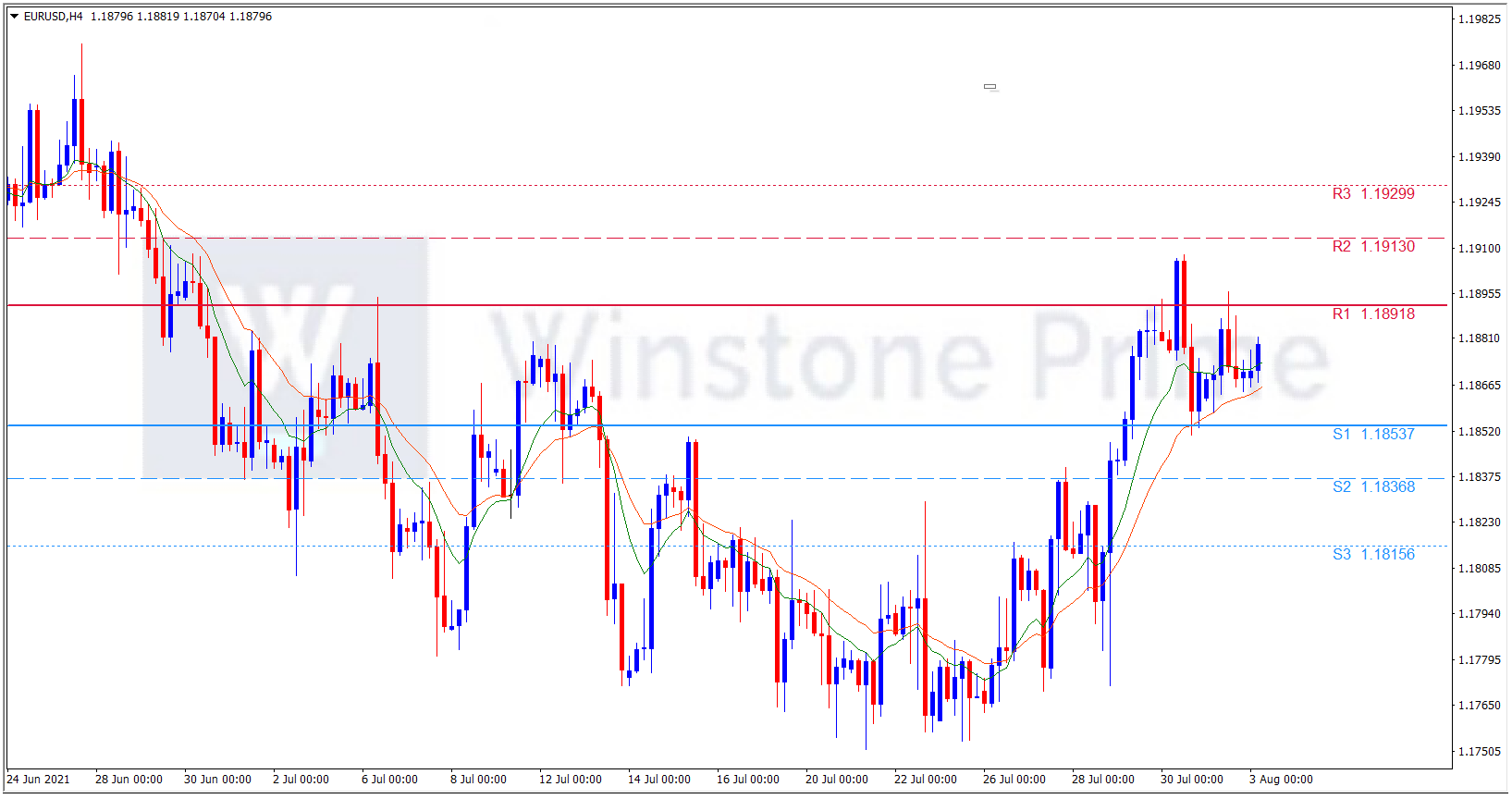
EUR/USD 4 Hour Chart:

Support: 1.1854 (S1), 1.1837 (S2), 1.1816 (S3).

Resistance: 1.1892 (R1), 1.1913 (R2), 1.1930 (R3).

Amidst this above overall predictions and expectations we can see a upward moment for Euro. We expect a bullish trend for EUR/USD.