
How Do Bank Trade Forex

Forex is the largest financial market. This precedes the stock market by some orders. Banks play a huge role in the world of Forex. Sometimes, they have the power to directly affect the value of coins. Banks make up a large number of trades in the currency market – but how do banks trade Forex?

Of course, banks are not going to be on the side of such a large amount. In fact, forex is often run by banks, especially central banks!

There is a lot more to foreign exchange than currency exchange for speculative purposes. Understanding this will help you to become a more profitable FX trader. And knowing how to trade Forex like banks can increase the chances of making a profit in Forex.

But first, who exactly are the smart monies?

Smart Money traders

Smart money traders drive forex trends. They are the market makers. They usually have a lot of money to trade, and their trading volume is enough to make significant changes in direct trends. Examples of smart money traders are:

  • Big banks like JPMorgan Chase and Citibank.

  • Central banks.
  • Hedge funds.
  • Large institutions like major insurance companies and global companies.


Now that you know who the smart money traders are, you want to know how they are different from you.

Firstly, smart monies have much more money to trade than you. Smart monies have tens and hundreds of millions to trade. And the sheer volume of their trades gives them the power to drive the market.

Secondly, they don’t trade on small timeframes. Smart monies trade daily, weekly, or even monthly timeframes. Traders that trade on small timeframes are usually looking to get in and out of the market in a short time. But the smart money is usually in the market for a long time

Trading Strategies of Bank’s

Forex watchers have observed that while institutional traders use many strategies, their trading decisions can be categorized in three distinct phases, as stated in the Dow Theory.

1. Accumulation Phase

Smart money traders set their positions by selling and buying in small amounts during the accumulation phase. They don’t trade all their money at once because that can drastically shift the market towards the direction they’re targeting. They do it slowly, giving as few hints as possible.

This phase usually happens towards the end of a downtrend. The outlook is pessimistic, price moves are slow, and many retail traders are selling. Banks, however, are buying. This briefly causes a downtrend in prices, which makes the accumulation phase a good time for retail forex traders to enter the market as well.

2. Manipulation Phase

Banks have the ability to handle the market and can do that when it comes to market consolidation stage. Many retailers keep their positions above or below the consolidation zone to ride it out no matter what new trend happens. If they move ahead and bite the bait of a false break, they can go directly opposite of the market trend and wipe out their stop losses.

3. Distribution Phase

The motives of the institutions at this time are not a mystery. The market is rising, and retailers are taking the currecies as a signal to buy. One word of warning though: banks often sell when others buy, while others buy when they sell. The distribution phase is another positioning period, so retail traders should watch out for the next trend.

How to trade Forex like the banks

It is usually a vain and unprofitable effort to trade against the banks in the long run. So, it only makes sense to learn to trade with them and not against them. Here are tips on how to trade like a market maker.

  • The first thing is to learn to trade on larger timeframes. Banks don’t trade on minute charts.
  • Using tools that can help you predict the bias of the banks helps too. Of course, the banks wouldn’t show you their entries for you to copy. But these tools can help you predict when the smart money is entering their trades so you can plan your own entries.


Conclusion

It is important to know that learning to trade with the bank takes time and practice. It is not a get-rich-quick strategy. Since banks won’t show you their trades for you to copy, it won’t be so easy. That is why you have to practice and test strategies and try out indicators until you have something that works. But this knowledge of how to trade Forex like the banks and institutions would set you in the right direction. Indicators that show market sentiments can be of immense help to you in learning how to trade like the banks. Because you now know that banks buy when the crowd sells and sells when the crowd buys.

Learning about forex bank trading strategies is just the first of many steps if you wish to master forex trading and do well enough to make it your main source of income. To learn more about forex trading and be part of a dynamic forex trading community, join Winstone Prime today.

European investment fund announcement favors Euro

The EUR/USD is on uptrend today and the pair opened higher following the previous day’s upside momentum A venture manager who supports the founders of the ‘open economy’ today announced the new 2021 fund worth $130m (£93m) – the largest in Europe. The fund is backed by $ 30 million from the European Investment Fund (EIF) and includes its co-founders. This fund is the first EIF-backed fund specifically compelled to invest in digital assets. It supports both traditional equity and software tokens and other digital assets owned by these new, inclusive and joint networks and applications. These are all underpinned by the recent invention of digital scarcity and hence ownership.

The Fabric Ventures said in a statement that “the founders of the open economy frequently have the explicit objective of delivering solutions to many of humanity’s most fundamental challenges. The venture manager described the open economy as “an upgrade to capitalism” because it facilitates “greater overall economic returns for all participants, and ultimately a fairer, more stable and sustainable society.” 

EIF chief executive Alain Godard said “deeptech entrepreneurs in the blockchain sector in Europe often struggle to find financial support and investors that have a deep understanding of their space. This partnership seeks to address that need and unlock financing opportunities for entrepreneurs active in the field of blockchain technologies – a field of particular strategic importance for the EU and our competitiveness on the global stage.” Fabric Ventures Group is registered as an AIFM with the CSSF in Luxembourg and includes an advisor entity which has been made an appointed representative in the UK.

It should also be noted that ECB recently stated the price stability was best maintained by Europe aiming for a 2% inflation target. ECB President Christine Lagarde warned about a fresh third wave of the COVOID-19 pandemic and its impact on the economy and the Euro pair little reacted to the sell off mood but not more. The Consumer Confidence Sentiment came at -4.4 in July from the previous month -3.3 readings. The Eurozone Service Sentiment rose to a 14-year peak in July at 19.3, but below the market estimates of 19.9.

On the other hand US Q2 GDP data justified the central bank’s cautious approach. In addition to GDP, enthusiastic weekly unemployment claims and further softening of household data led market players to believe more easy monetary policies from the central bank. It should be noted, that the corona virus tragedies and US data inflation expectations could be taxed by weighing market sentiment. As for now, traders await the Eurozone Gross Domestic Product (GDP) Rate and Inflation Rate to gauge the market sentiment. And today’s Core Personal Consumption Expenditure Price Index for June will be the key after the latest easing of GDP and housing figures.

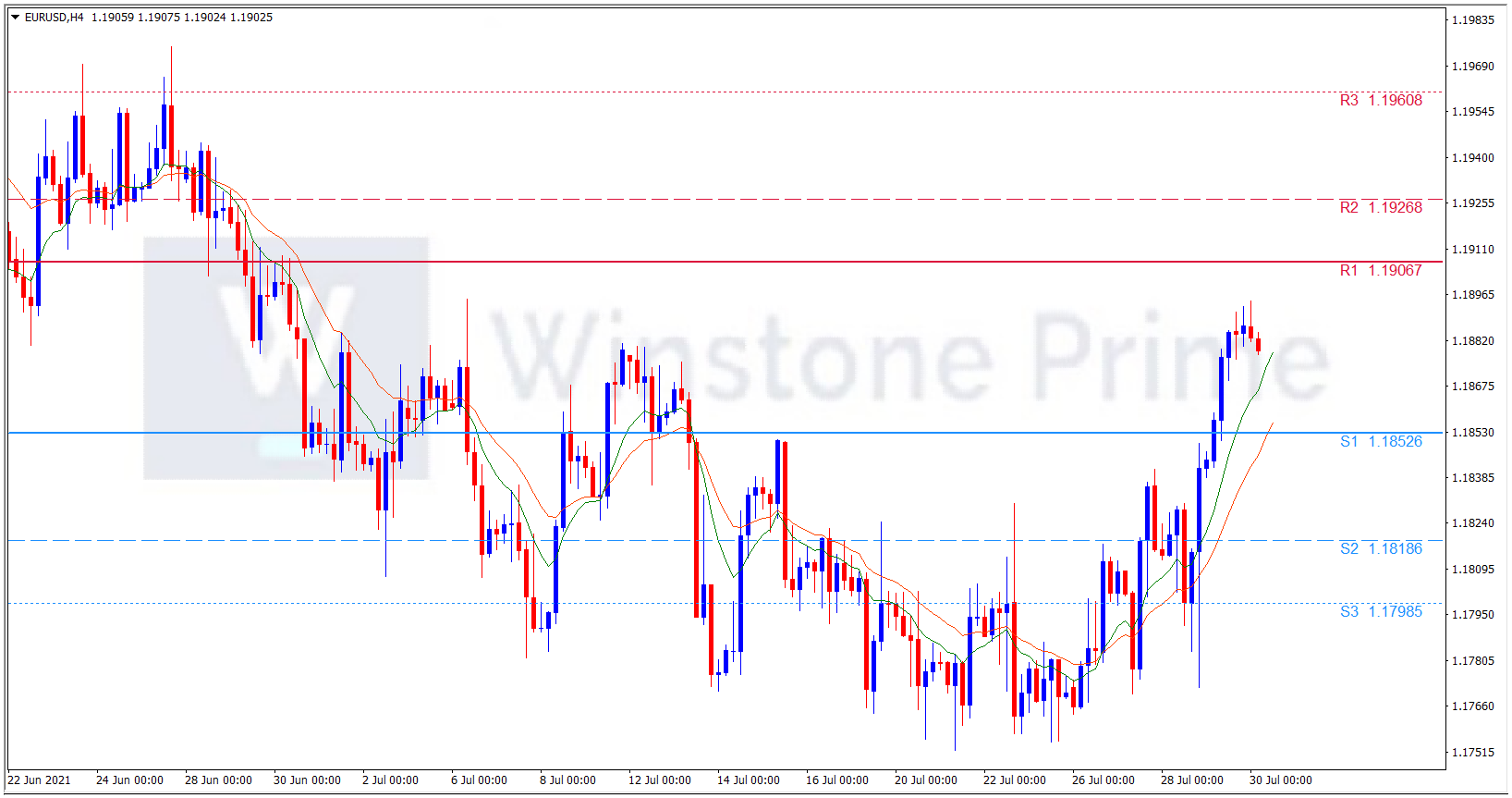
EUR/USD 4 Hour Chart:

Support: 1.1853 (S1), 1.1819 (S2), 1.1799 (S3).

Resistance: 1.1907 (R1), 1.1927 (R2), 1.1961 (R3).

Amidst all the catalysts favoring Euro, We expect a bullish trend for EUR/USD.

FOMC review discourages dollar

The US dollar is showing pressure by the later insistence from Federal Reserve chairman Jerome Powell that rate increases aren’t on the radar, while sterling has been riding higher with re-opening optimism. Yesterday the greenback rose after the release of FOMC decision for a short time and thereafter  it has went down into two weak low. The US central bank has pledged to continue to support the economy even as the effects of the pandemic ease.

The FOMC stated in a yesterday meeting that “the economy has made progress toward these goals, and the committee will continue to assess progress in coming meetings”. It saying that rising inflation was “largely reflecting transitory factors”. Federal Reserve officials indicated they have begun discussing when to tap the brakes on their robust support for the U.S. economy amid an inflation surge, even as the delta variant of the coronavirus poses a increasing threat to growth.

The central bank kept the target range for its benchmark policy rate unchanged at zero to 0.25 per cent and adjusted language to say that it had pledged in December to continue asset purchases at a $120 billion monthly pace until “substantial further progress” had been made on employment and inflation. Consumer prices are rising at the fastest pace since 2008 as the economy reopens and Americans renew spending after a year of lockdown. At the same time, the spreading delta variant of the coronavirus has jolted investors who worry it could threaten the economic recovery.

On the other hand the speech from Joe Biden in London that – is that all G7 nations, including the UK, should not even be talking about withdrawal of support. “G7 economies have the fiscal space to speed up their recoveries to not only reach pre-Covid levels of GDP, but also to support a return to pre-pandemic growth paths,” said Secretary Yellen in a speech on Saturday.

The IMF said UK economy will grow faster than expected this year as it recovers from the Covid pandemic. In a new assessment the IMF said the outlook for many developing countries has weakened. Among the forecast revisions for this year, the largest upgrade is for the UK to 7%. The UK’s Chancellor, Rishi Sunak, welcomed what he called “the positive signs that the economy is rebounding faster than previously expected”. Experts say that the British infection numbers ticked higher on yesterday but the rolling averages are heading into lower.

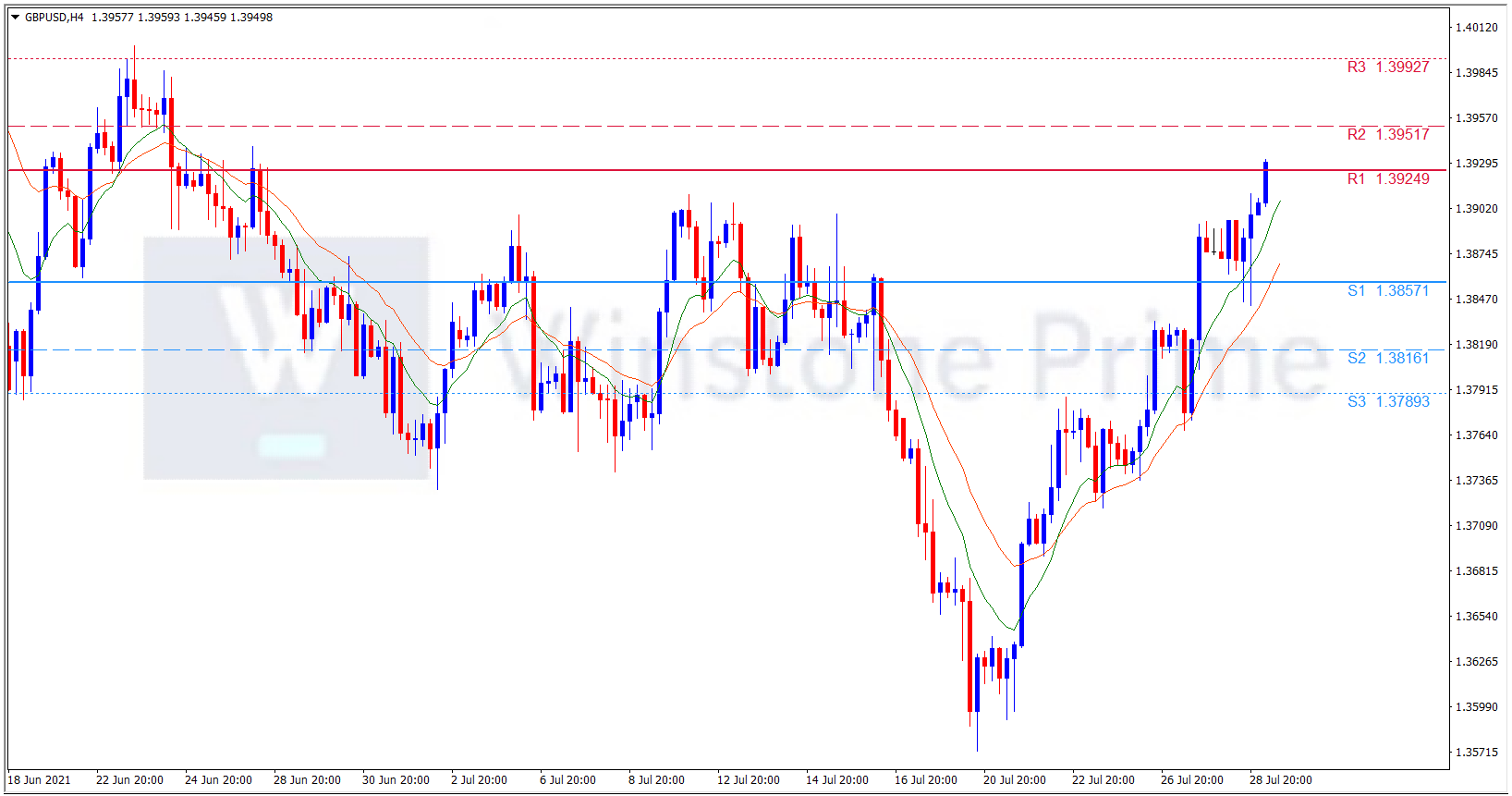
GBP/USD 4 Hour Chart:

Support: 1.3857 (S1), 1.3816 (S2), 1.3789 (S3).

Resistance: 1.3925 (R1), 1.3952 (R2), 1.3993 (R3).

The FOMC review pushes the greenback into downward moment. We expect a bullish trend for GBP/USD.

Dollar is in downtrend ahead of Fed Meeting

The USD/JPY market is remaining narrow ahead Fed meeting and Japan Monetary opinions. Market now seems to react to the US Federal Reserve announcement and US economic growth rate which are announced later today. US inflation expectations has been measured by the 10-year breakeven inflation rate, per the St. Louis Federal Reserve (FRED) data. In doing so, the risk barometer fades the one-week-old recovery moves, suggesting further hardships for the traders to predict the market sentiment.

The fall in inflation expectations as figures fall below market forecasts may be linked to the latest U.S. data on housing prices and durable goods orders, but previous readings have been corrected. This week’s meeting comes against the backdrop of a risky policy race by Federal Reserve Chairman Jerome Powell. Powell has bet that the central bank can design a more sophisticated task: keep the central bank’s key short-term rate close to zero, which means that from March 2020, until the labor market fully recovers, there will be no further stimulus for inflation.

US new home sales fell for the third consecutive month in June, falling 6.6% to reach their lowest level in more than a year. In this regard, the US Commerce Department reported that a drop in June sales left sales at a seasonally adjusted annual rate of 676,000. This followed a 7.7% drop in sales in May, and a 10.1% drop in April. The rise in prices may slow slightly as builders increase inventories. The number of new homes for sale at the end of June rose to 353,000, up 7% from May. The pace last month was 19.4% down from a year ago and the slowest since April 2020.

On the other hand Bank of Japan (BOJ) published the  ‘Summary of Opinions’ for the July month on latest. “Japan’s economy has picked up as a trend, although it has remained in a severe situation due to the impact of the novel coronavirus (COVID-19) at home and abroad.” The Bank of Japan must avoid prematurely tightening monetary policy as inflation remains short of its 2% target, one board member was quoted as saying in a summary of opinions from the bank’s July policy meeting. “There’s no major change to Japan’s inflation expectations even as commodity prices rise” was another opinion at the meeting, according to the summary released on Wednesday.

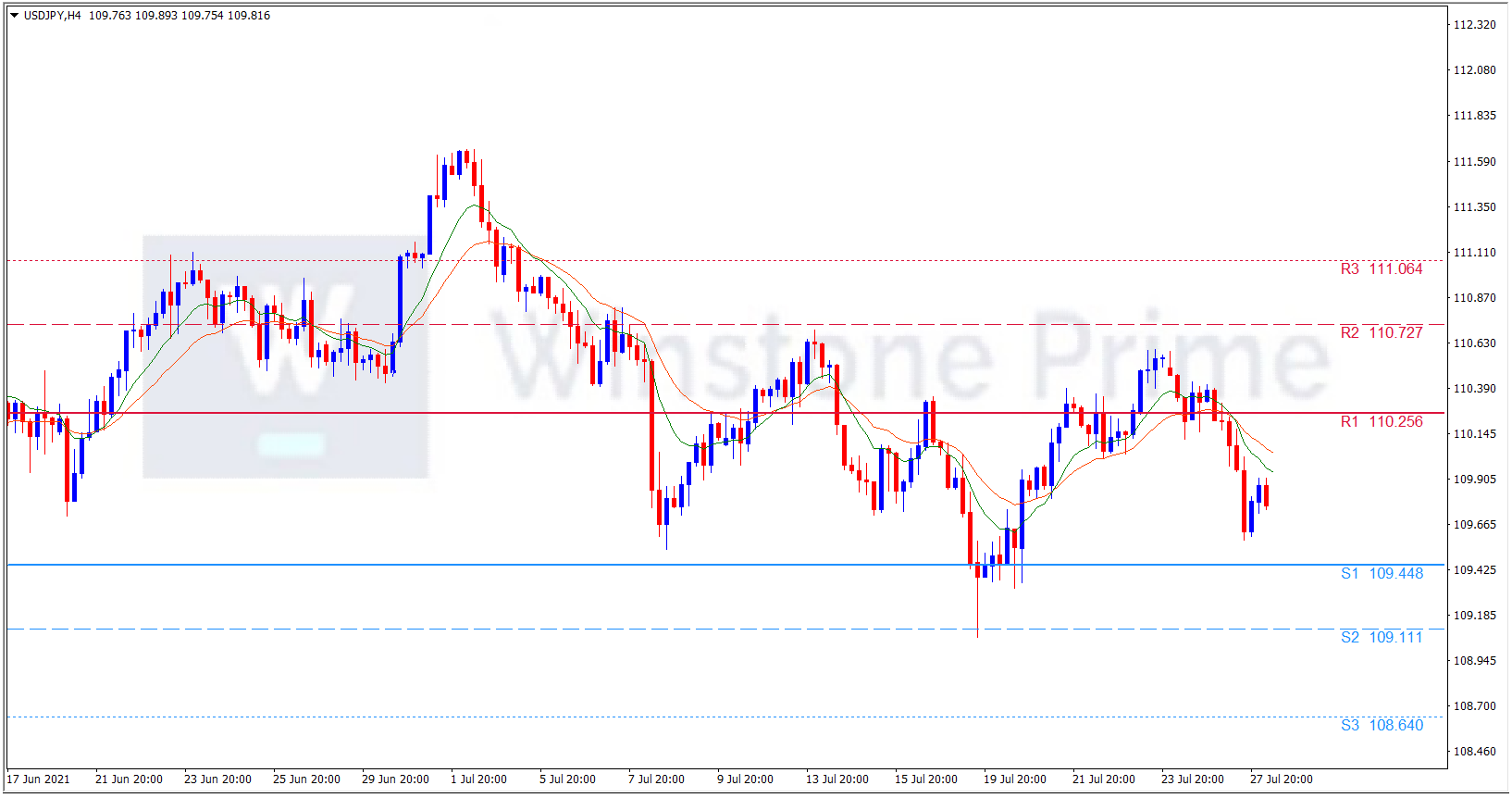
USD/JPY 4 Hour Chart:

Support: 109.45 (S1), 109.11 (S2), 108.64 (S3).

Resistance: 110.26 (R1), 110.73 (R2), 111.06 (R3).

Amidst this catalyst we have seen a downward pressure for the dollar-yen currency pair until the announcement of the US Central Bank, followed by the announcement of the growth rate of the US economy. We expect a bearish trend USD/JPY.