The origins of forex trading go back many centuries. Forex trading began in the time of the Babylonians. This system is designed for currencies and exchange. In the early days, goods were traded for another tangible commodity. When the Metal Age began, gold and silver became instruments of exchange.
As gold became an important trading tool, its use was restricted. Therefore the result which has been brought about by this is that the value of money has diminished.
A great panic happened then because people would like to exchange the value of their money for gold. In 1931, the gold standard was removed and the FOREX market was born; although people used to have a very small or no notion at all about it.
Forex was introduced, so citizens will have greater cash stability and reliability. Understanding the history of foreign exchange begins with the 1944 Bretton Woods Agreement, which aims to create a stable international financial institution anchored by gold. Instead of valuing all national currencies in terms of gold – as gold standards in the past did – only one currency was directly valued: U.S. Dollar. Other currencies Rated at a fixed rate in dollar terms. So, presumably, the value of all currencies is tied to gold.
There was already an international gold market in which traders could effectively guess the value of the US dollar. But the Bretton Woods system is not the only one in the U.S. Depending on the value of the gold in dollars. So when the dollar came under monetary pressure, the central banks had to intervene in the gold market to maintain the dollar’s pound of gold. In 1961, the eight largest central banks created the London Gold Pond to help control the price of gold by coordinating the sale and purchase of gold. From 1961 to 1968, the London gold pool successfully stabilized the price of gold in dollars, thus preventing the Bretton Woods system from collapsing.
After the UK government devalued the sterling against the dollar in November 1967, it changed the course of foreign exchange history – leaving the US dollar under constant speculation. The central banks in London’s gold reserve intervened to prevent the dollar’s gold bullion from breaking, by buying large quantities of gold in what could be seen as an early form of calibration (QE). However, the cost of supporting the dollar is politically unacceptable. In March 1968, the London Gold Pond ceased to exist.
After that, the market price of gold in dollars rose. The United States faced the choice of always selling large quantities of gold or breaking the gold link to the dollar to maintain the dollar’s gold bullion. In 1971, President Nixon chose the latter course.
When President Nixon stopped the dollar exchange for gold, all currencies lost contact with Gold. For the first time in the history of forex – or whatever – coins can only be valued by each other. From that moment on, the gold market played no role in international foreign exchange. Instead, traders exchanged currencies directly, thus, the birth of the modern forex market.
It has been more than 20 years since the end of Bretton Woods, when Western governments abandoned all fixed-exchange rate systems; By 1998, however, most people had adopted floating rates. Central banks intervened in the foreign exchange market and stabilized their currencies at times of high volatility. Increasingly, however, central banks have used interest rate policy to influence the behavior of foreign exchange market traders, rather than directly managing exchange rates. For the first time in forex history, forex market trading determines foreign exchange rates, rather than government policy or the value of an item.
At the same time, technological advances have brought about a fundamental change in the history of the foreign exchange market. In the 1970s and 1980s, foreign exchange trading was restricted to large banks and financial institutions; Non-banks can access the forex market only through a banking relationship.
Trading Platforms in the market
But in the 1990s, as the Internet spread around the world, banks and small companies started to create online networks to produce automated quotes and trade instantaneously. Around the same time, online trading platforms started to appear, enabling individuals to trade in FX markets for the first time. These platforms were designed to stream live quotes to their clients so that they could instantly execute trades themselves.
Meanwhile, some smart business-minded marketing machines introduced internet-based trading platforms for individual traders. Known as “retail forex brokers”, these entities made it easy for individuals to trade by allowing smaller trade sizes.
Unlike in the interbank market where the standard trade size is one million units, retail brokers allowed individuals to trade as little as 1000 units!
Retail Forex Brokers
In the past, only the big speculators and highly capitalized investment funds could trade currencies, but thanks to retail forex brokers and the Internet, this isn’t the case anymore. With hardly any barriers to entry, anybody could just contact a broker, open up an account, deposit some money, and trade forex from the comfort of their own home.

Brokers basically come in two forms:
- Market makers, as their name suggests, “make” or set their own bid and ask prices themselves and
- Electronic Communications Networks (ECN), who use the best bid and ask prices available to them from different institutions on the interbank market.
Market Makers

Suppose you wanted to go to France to eat some snails. To transact in the country, you need to go to a bank or local forex office and get a few euros first. They take the opposite side of your transaction and you have to agree to convert your home currency into euros at the price they set.
Like in all business transactions, there is a catch. In this case, it comes in the form of the bid/ask spread. For instance, if the bank’s buying price (bid) for EUR/USD is 1.2160, and their selling price (ask) is 1.2162, then the bid/ask spread is 0.0002.
Although seemingly small, when you’re talking about millions of these forex transactions every day, it does add up to create a hefty profit for the market makers. Market makers are the fundamental building blocks of the foreign exchange market. Retail market makers basically provide liquidity by “repackaging” large contract sizes from wholesalers into bite-size pieces. Without them, it will be very hard for the average Joe to trade forex.
Electronic Communications Network
Electronic communication network is the name given to trading platforms that automatically match customers’ buying and selling orders at a specific price. These quoted prices are collected from different market makers, banks and other traders who use ECN. Whenever a certain sell or buy order is made, it is matched up to the best bid/ask price out there.
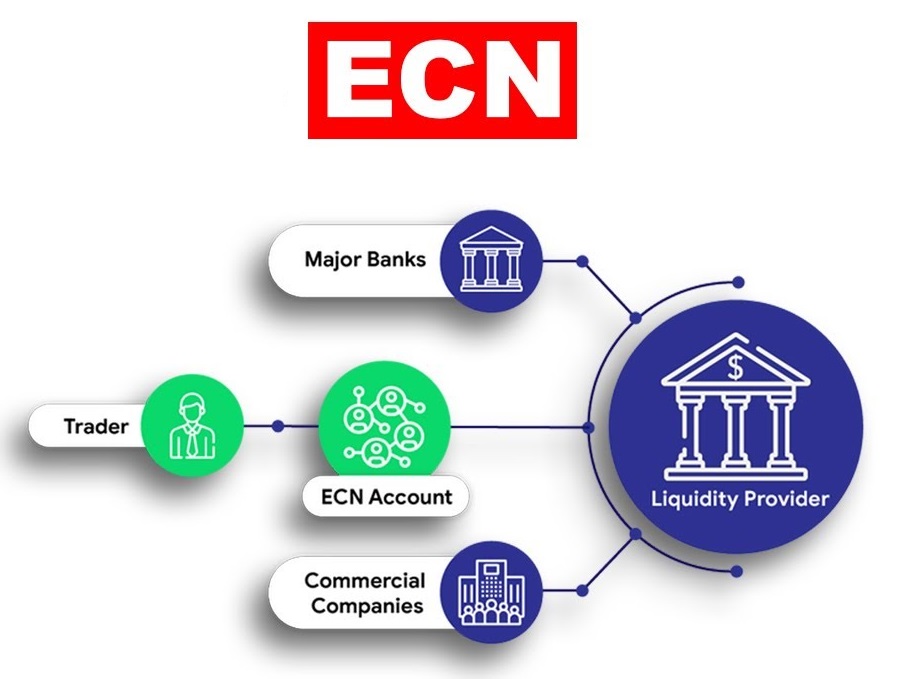
Due to the ability of traders to set their own prices, ECN brokers typically charge a VERY small commission for the trades you take. The combination of tight spreads and small commission usually make transaction costs cheaper on ECN brokers.
Conclusion
Forex has a long history and it is the largest financial market worldwide. The Forex market is decentralized, so is not under the control of any body. Currency trading are volatile and the unique characteristics of Forex trading, including leverage and a market that is open 24 hours, make it very attractive for retail traders. Digital crypto currencies such as Bitcoins have become very popular in recent years and due to ongoing global uncertainties and seemingly unstable monetary systems, these types of currencies also available in the Forex trading platforms as CFD’s. The developing of technologies and the expansion of digital currencies can lead to the change of the system soon.