EUR/USD Weekly Forecast (26th July 2021 – 30th July 2021)

Fundamental view:

The Euro has fallen against greenback again during the course of the week. European Central Bank President Christine Lagarde and her colleagues are behind the euro’s weakness. In the ECB’s first post-strategic review decision, the Frankfurt-based institution enhanced its commitment to keeping lower rates for longer. The ECB made its forecasts point to 2% annual inflation in the mid of its horizon – and holding above that level until the end of that period – before considering lifting borrowing costs.

Europe Construction Output monthly report on 19th July and US EIA Crude Oil Stocks Change on 21st July created uptrend whereas Europe Consumer Confidence Index on 20th July and US Existing Home Sales monthly report on 22nd July created downtrend for the pair.

The major economic events deciding the movement of the pair in the next week are Europe Ifo Business Climate at July 26, US Core Durable Goods Orders monthly report, US CB Consumer Confidence Index at July 27, Fed Interest Rate Decision at July 28, US GDP quarterly report, US Initial Jobless Claims at July 29, Europe GDP quarterly report and US Michigan Consumer Sentiment at July 30. 

EUR/USD Weekly outlook:
Technical View:

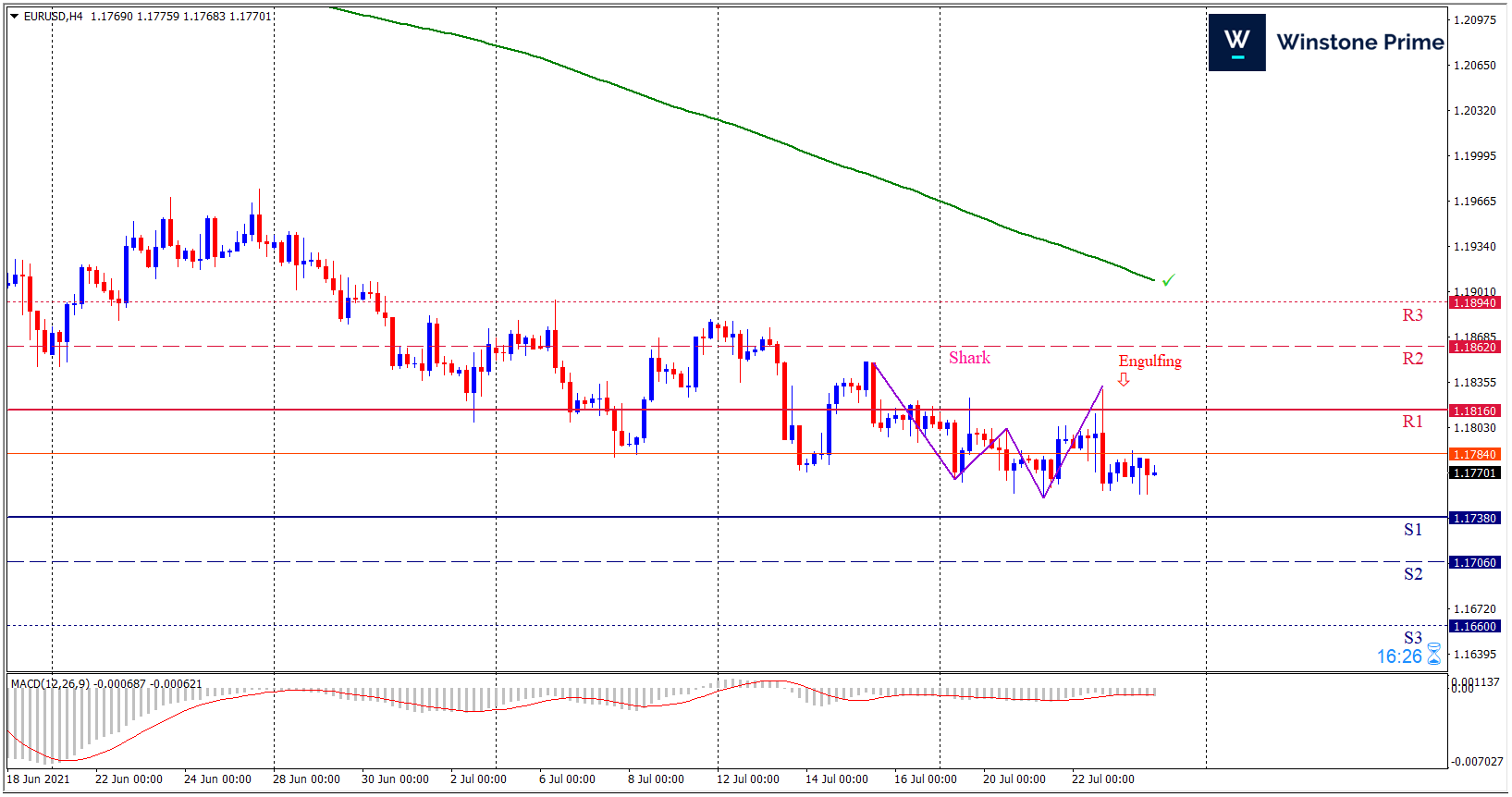
Last week’s high was 0.42% lower than the previous week. Maintaining high at 1.1830 and low at 1.1752 showed a movement of 78 pips.

In the upcoming week we expect EUR/USD to show a bearish trend. The currency pair is trading below the 200 Simple Moving Average and the MACD trades to the downside. A solid breakout below 1.1738 may open a clean path towards 1.1706 and may take a way down to 1.1660. Should 1.1816 prove to be unreliable resistance, the EURUSD may raise upwards 1.1862 and 1.1894 respectively. Chart formation of a Bearish shark pattern in H4 chart sets prospects for a bearish trend. Bearish engulfing formation in H4 chart escalates the expectation for a bearish trend.

Preference
Sell: 1.1771 target at 1.1707 and stop loss at 1.1821


Alternate Scenario
Buy: 1.1821 target at 1.1893 and stop loss at 1.1771

Advantages of Indices Trading

Index trading is a technique that refers to certain methods of determining the true value of stocks. The value varies from country to country, and they have a different index for each stock. Trading indices or indexes are very popular among day traders and long-term traders, often because they have high cash flow and offer attractive trading opportunities. In the financial world, for example, codes are created to track things: publicly traded stocks, bonds, and consumer prices of common goods and services. By 2021, there were more than 3 million different indices designed to follow virtually any particular niche of the market.

In this article we will investigate the best benefits and advantages of trading indices.

What moves indices markets

While trading an individual stock, you’re only interested in that company and their industry sector. If you’re trading an index, then you’ve got to expand that frame of reference to many more industries and an entire country. But if you’re looking at forex, then the fundamentals are even broader – taking in market forces across the planet!

But that’s not exactly true … the reality is that major indices are filled with international companies, which are driven by the global economy as a whole.

  • Assets vs Relationships

You can only benefit from the top of the stock market, while allowing forex versatility. But spread-betting has allowed ordinary traders to make money whether the markets are going up or down. Whether you ‘buy’ or ‘sell’ a index, its value is derived from the underlying assets – the companies that make that indices are valuable. Forex markets, by contrast, are about the relationship between two things. The value of one thing moves against another. We always trade them in pairs, buy one currency and sell another.

  • Better trends than currencies

The stock indices market moves are based on stock market price moves. Stock market price moves tend to move in one particular direction. In times of economic growth the prices of stocks increase constantly meaning the stock indices that track the prices of these stocks will also continue moving upward and maintain an upward trend. While in Forex currency market moves may not be well pronounced as the market moves in stock indices. 

  • Indices have less consolidations and market whipsaws

Unlike forex currencies, which can be consolidated over a long period of time, thus creating multiple whipsaw, stock market indices are rarely consolidated for long periods of time, and stock indices can show a specific trend direction at any given time – up or down. This means that less whipsaw will be generated when trading stock indices, and every trader will know that less whipsaw are equal to the best odds in making a profit.

  • Index moment better than currencies

Stock indices will move an average of 500 to 2,000 points per day; compare this to FX currencies that only move 50 to 100 points per day. Another advantage of this is that 1 point in stock indices move is equal to $0.1 and not $10 dollars like in FX trading. This means that when trading stock indices the average profit per 1 pip move is less, therefore a trader can implement better money management in stock indices as the minimum price move per 1 pip is not that big. At the same time because the average move in stock indices is an average of 500 to 2000 point traders will still make a good profit even if 1 pip move is equal to $0.1.

  • Margin can be low

The margin requirement per 1 lot for stock indices varies from $5 dollars per lot to about $250 dollars depending on the stock indices being traded. In FX the margin required per lot is $1,000 dollars per 1 lot. Therefore a trader needs lower capital to trade indices as compared to FX Trading.

  • Index trading is ethical

This may come as a surprise, but trading indices is ethical. You can explain it to your friends who judge traders without having the minimum knowledge of economics. By buying or selling indices, you have absolutely no impact on the share price, and thereby on the lives of employees. You have no impact on countries’ debt; you have no impact on raw materials, etc. You buy and sell an index. Directly investing in an index does not change stock prices. You have an absolutely neutral ecological footprint.

On the other hand, if your friends have life insurance, they have an impact on the economic life and the lives of “people”. For example, they speculate on the debt of countries. Generally, they will not appreciate you explaining this to them, but you have to get them out of their economic obscurantism.

Conclusion

Index trading is a secure form of trading with integrated money management. The risks of index trading are lower than on other products. By selling or buying stock indexes, you have absolutely no impact on the stock price, and therefore on the lives of employees. You have to be sure about your choices and analyzing skills. The more you learn the more you make a profit. 

Broaden your trading opportunities with Winstone Prime index trading.

Federal Reserve meeting expectation favors USD

The US Dollar has been set to end this week by its risk appetite and the U.S. market is moving in its path of shifting to the Federal Reserve meeting. The Labor Department said on yesterday that the total number of initial claims for unemployment insurance for the week ended July 17 was 419,000, higher than the 350,000 Dow Jones estimate and 368,000 revised from the previous period. Unemployment as a whole is the highest weekly figure since May 15, and the rise in unemployment benefits has come amid expectations that the jobs picture will improve significantly and companies are becoming more aggressive in filling vacancies.

On the positive side, the number of consecutive claims running a week behind the title number has dropped from 29,000 to 3.24 million, a new pandemic era. Following the announcement of the Covid-19 infection, the total was lower on March 14, 2020, and the U.S. More than 22 million people were sent to the unemployment line as governments across the state ordered businesses to close. The total of those receiving benefits under all government programs also declined, falling by more than 1.2 million to 12.57 million. A year ago, nearly 33 million people were collecting benefits.

The job site Indeed estimates there were about 9.8 million jobs as of July 16. This compares with 9.48 million workers, who the Labor Department estimated was unemployed in June,  indicating plenty of opportunity for aggressive hiring ahead. During the April-June period, 60,502 businesses reopened, the highest level in the past year, according to Yelp. That total reopened at 38,725 in April, the fastest monthly pace since May 2020.

On the other hand, Japanese Prime Minister Yoshihide Suka acknowledged that the Tokyo Olympics were a struggle to sell to the people of his country, many of whom feared that the arrival of athletes from around the world would trigger the Covid-19 crisis. But in an exclusive interview with NBC News, he stressed that the Summer Olympics will open on Friday as planned and that in the end it will be a success. Recent polls, including one published this week by The Asahi Shimbun, a national newspaper, have suggested that as much as 70 percent of the Japanese public wants the Games canceled or postponed amid a surge in Covid cases in the country.

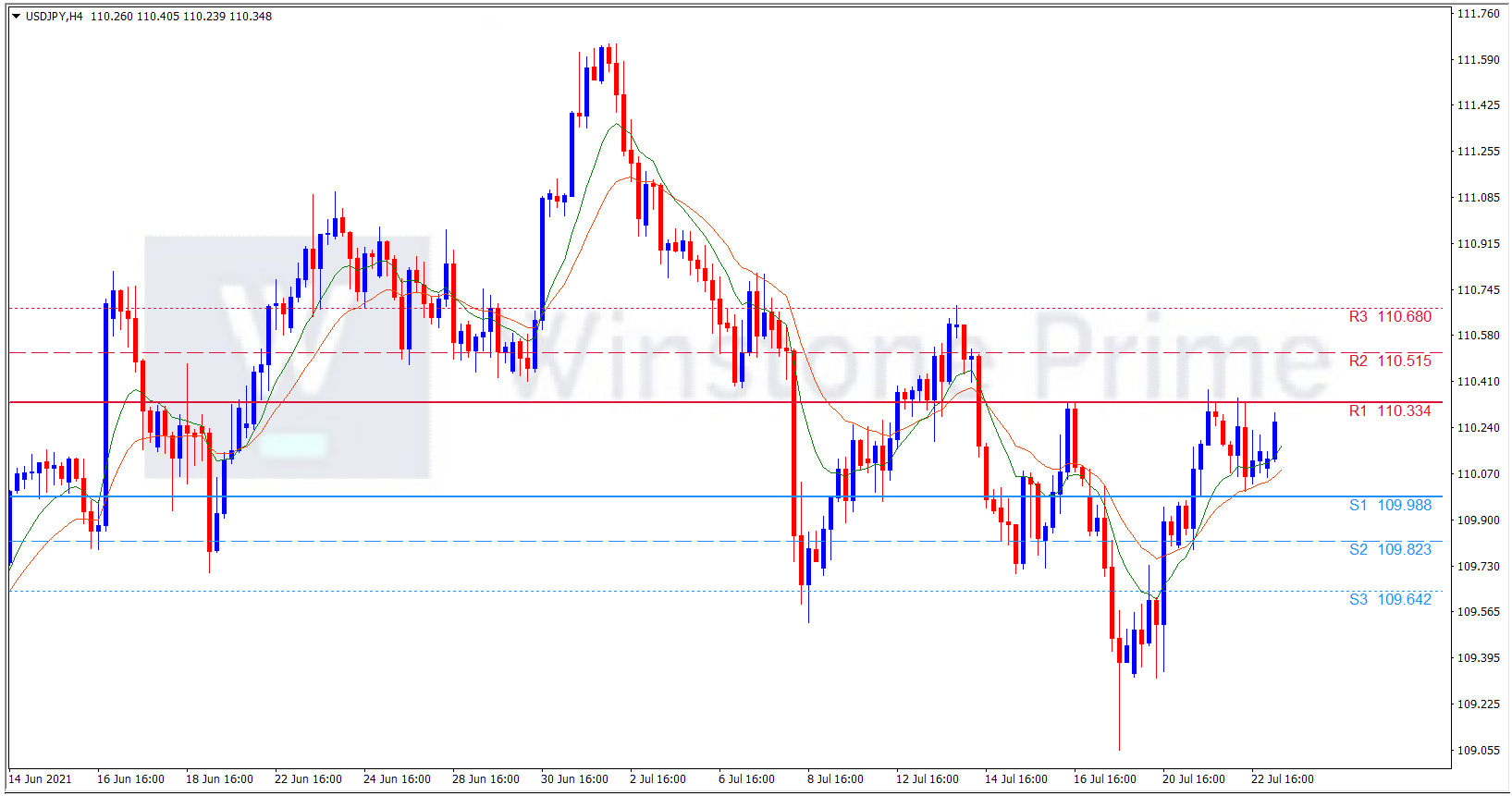
USD/JPY 4 Hour Chart:

Support: 109.99 (S1), 109.82 (S2), 109.64 (S3).

Resistance: 110.33 (R1), 110.52 (R2), 110.68 (R3).

Amidst all the previalling catalysts, we expect bullish trend for USD/JPY.

Expectation on ECB favors pound

GBP/USD picks up bids from the last 6 months low on the US dollar pullback. The Sterling bulls  have been appeared ahead of the European Central Bank (ECB) meeting. The European Union (EU) has rejected a 28-page paper to change the UK’s Northern Ireland (NI) protocol request. The British government said on yesterday that post-Brexit trade rules it negotiated with the European Union “cannot go on” and need a major rewrite, straining already tense U.K.-EU relations.

The government has said Britain will justify unilaterally suspending the legally binding Brexit deal, but has decided not to do so. Since the UK left the EU’s economic warmth at the end of 2020, relations have encouraged trade arrangements for Northern Ireland, the only part of the UK, bordering 27 countries. The agreement reached between the two sides before leaving the UK meant that customs and border checks would be carried out on certain goods moving between Northern Ireland and the rest of the UK.

Meanwhile sterling Bancorp (STL) came out with quarterly earnings of $0.52 per share, beating the Zacks Consensus Estimate of $0.51 per share. This compares to earnings of $0.29 per share a year ago. These figures are adjusted for non-recurring items. This quarterly report represents an earnings surprise of 1.96%. A quarter ago, it was expected that this bank holding company would post earnings of $0.46 per share when it actually produced earnings of $0.51, delivering a surprise of 10.87%. This could be the reason Sterling upward momentum.

Elsewhere, US policymakers rejected an initial debate on President Joe Biden’s infrastructure spending bill, pushing it to Monday, but Democrats appear to be optimistic about the passage. Moreover, Sino-US conflicts are escalating as US Trade Representative Katherine Dai supports the Australian trade dispute with China. Given the lack of key data/events in the UK, GBP/USD traders will focus on ECB meeting results and US second tier data flow, not forgetting risk triggers, for new triggers.

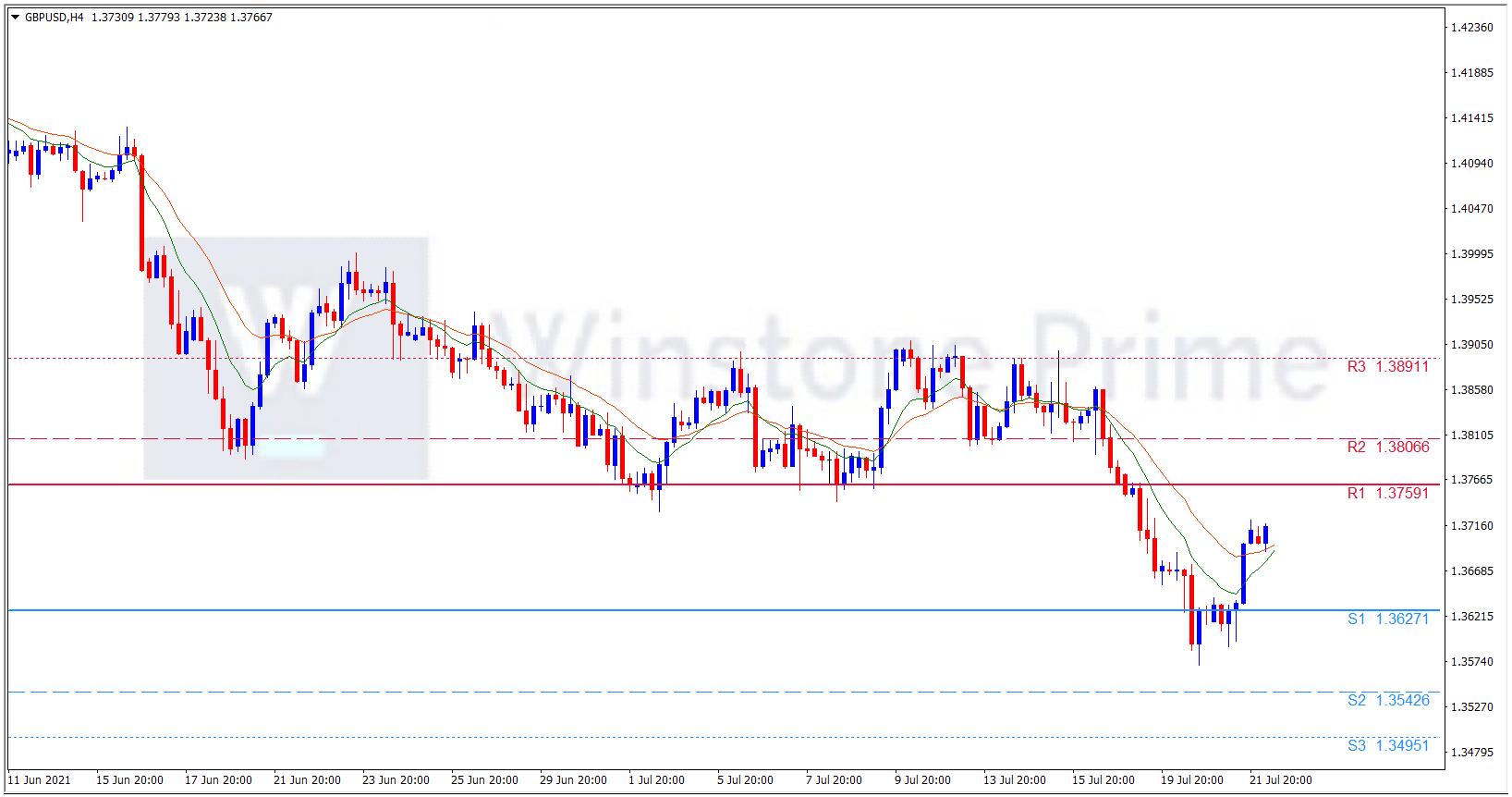
GBP/USD 4 Hour Chart:

Support: 1.3627 (S1), 1.3543 (S2), 1.3495 (S3).

Resistance: 1.3759 (R1), 1.3807 (R2), 1.3891 (R3).

Amidst this the expectation of ECB meeting and Sterling Bancorp (STL) Beats Q2 Earnings Estimates report pushes the sterling into positive moment. We expect bullish trend for GBP/USD.