USD/JPY Weekly Forecast (12th July 2021 – 16th July 2021)

Fundamental view:

The US dollar has fallen a bit during the course of the trading week. The USD/JPY is lower on the week, stocks had a fall on Thursday and Treasury yields have been sliding since the Fed meeting on June 16. The expectations for a powerful US rebound have been so overstated that a more realistic view was probably inevitable. Whereas Japan’s data gave scant evidence that the island economy is improving.

Japan Coincident Index on 7th July and Japan BoJ M2 Money Stock yearly report on 9th July framed uptrend whereas Japan Household Spending yearly report on 6th July and Japan Economy Watchers Sentiment on 8th July created downtrend for the pair.

The major economic events deciding the movement of the pair in the next week are US WASDE Report at July 12, US Federal Budget Balance at July 13, Japan Industrial Production monthly report, US Fed Chair Powell Testimony at July 14, Japan Tertiary Industry Activity Index monthly report, US Initial Jobless Claims at July 15, BoJ Interest Rate Decision and US Retail sales monthly report at July 16.

USD/JPY Weekly outlook:
Technical View:

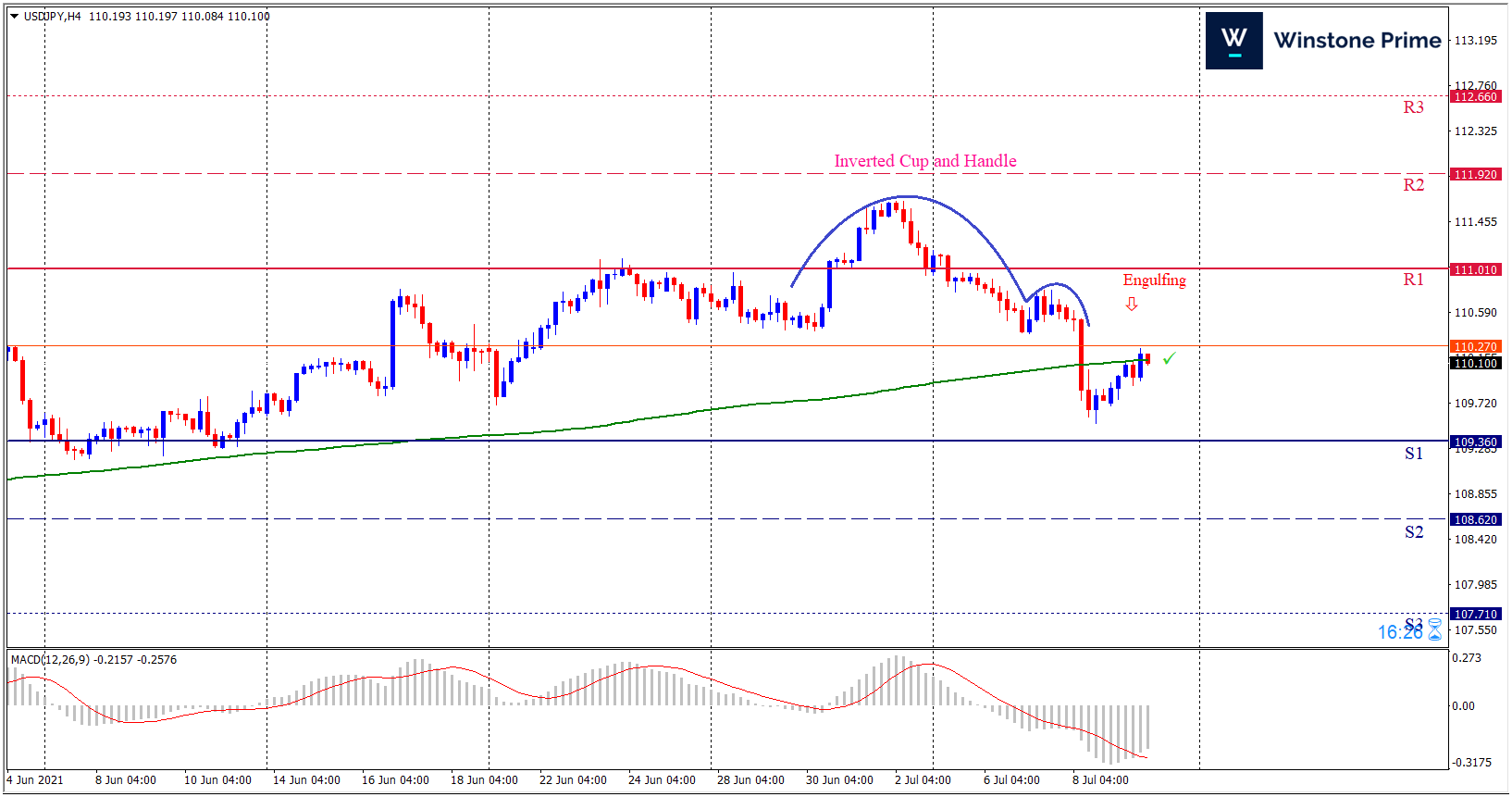
Last week’s high was 0.42% lower than the previous week. Maintaining high at 111.18 and low at 109.53 showed a movement of 165 pips.

In the upcoming week we expect USD/JPY to show a bearish trend. The currency pair is trading below the 200 Simple Moving Average and the MACD trades to the downside. A solid breakout below 109.36 may open a clean path towards 108.62 and may take a way down to 107.71. Should 111.01 prove to be unreliable resistance, the USDJPY may raise upwards 111.92 and 112.66 respectively. In H4 chart, Formation of inverted cup and handle pattern indicates reversal of the trend creating prospects of a bearish trend Along with a bearish engulfing formation braces our expectation.

Preference
Sell: 110.11 target at 108.63 and stop loss at 111.06


Alternate Scenario
Buy: 111.06 target at 112.65 and stop loss at 110.11

GBP/USD Weekly Forecast (12th July 2021 – 16th July 2021)

Fundamental view:

Pound went back and forth against dollar in this week. Prime Minister Boris Johnson made an announcement that the UK would fully reopen on July 19, scrapping hundreds of COVID-19 restrictions. This set of rules and prospects of a return to normal temporarily boosted the pound. Whereas The US Center for Disease Control & Prevention (CDC) warned of the rapid spread of Delta in some areas of the US where vaccination rates are low.

Britain Halifax HPI monthly report on 7th July and Britain Construction Output monthly report on 9th July created downtrend whereas Britain Markit/CIPS Services PMI on 5th July and Britain Trade Balance & Britain NIESR GDP Estimate on 9th July created uptrend for the pair.

The major economic events deciding the movement of the pair in the next week are US WASDE Report at July 12, BoE FPC Meeting Minutes, US Federal Budget Balance at July 13, US Fed Chair Powell Testimony at July 14, UK Claimant Count Change, US Initial Jobless Claims at July 15 and US Retail sales monthly report at July 16.

GBP/USD Weekly outlook:

Technical View:

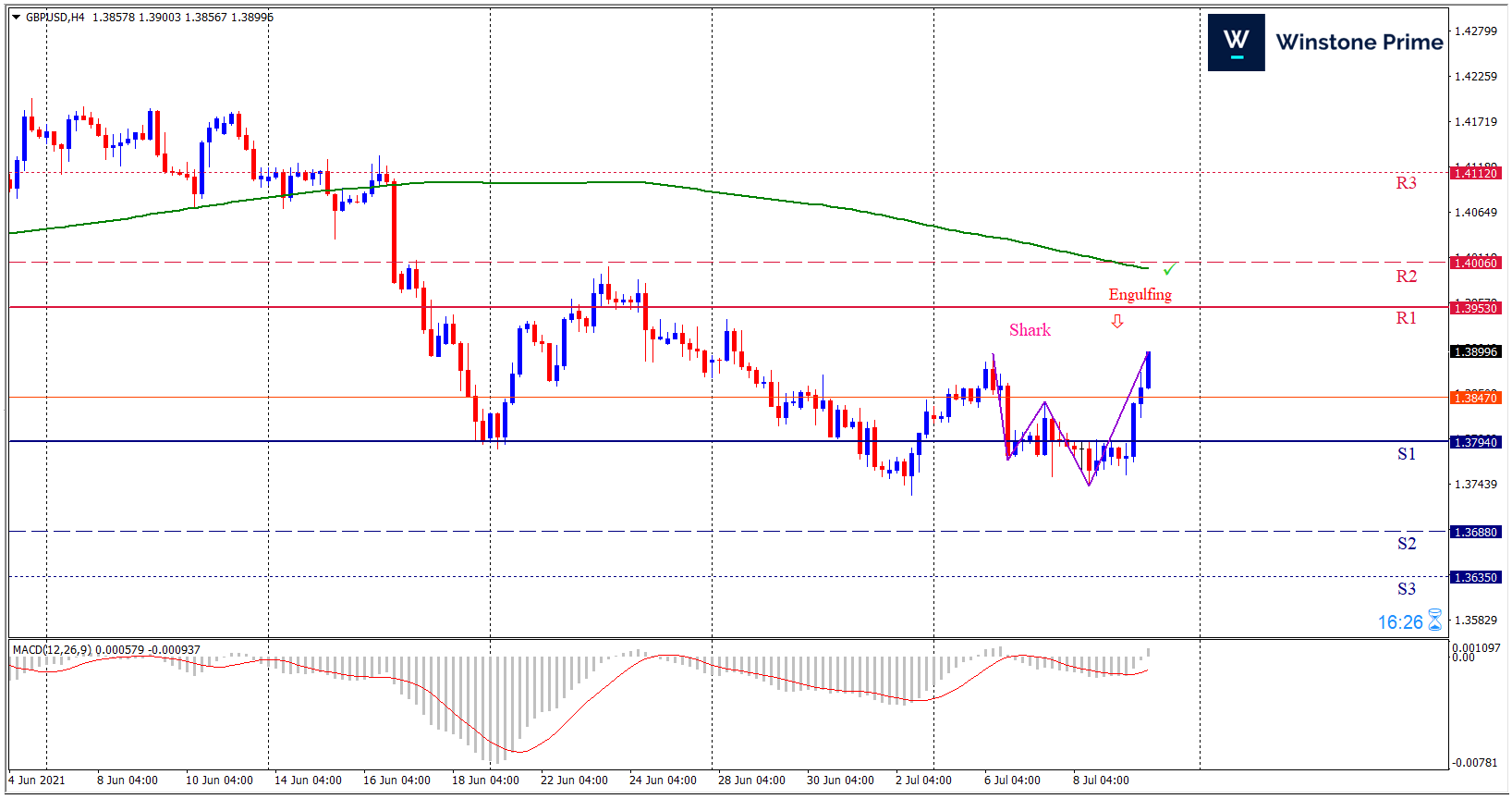
Last week’s high was 0.28% lower than the previous week. Maintaining high at 1.3900 and low at 1.3741 showed a movement of 159 pips.

In the upcoming week we expect GBP/USD to show a bearish trend.  The currency pair is trading below the 200 Simple Moving Average and the MACD trades to the upside. A solid breakout below 1.3794 may open a clean path towards 1.3688 and may take a way down to 1.3635. Should 1.3953 prove to be unreliable resistance, the GBPUSD may raise upwards 1.4006 and 1.4112 respectively. Chart formation of bearish shark pattern in H4 chart favors prospects of a bearish trend. Bearish engulfing pattern formation escalates the expectation for a bearish trend.

Preference
Sell: 1.3895 target at 1.3746 and stop loss at 1.3958


Alternate Scenario
Buy: 1.3958 target at 1.4111 and stop loss at 1.3895

EUR/USD Weekly Forecast (12th July 2021 – 16th July 2021)

Fundamental view:

Euro initially fell against greenback but overcame losses and closed the week with a bull candle. The American currency was bid through the first half of the week with the anticipation of the FOMC Meeting Minutes. The US central bank surprised market participants in its June meeting by forwarding changes of rate hikes amid economic improvement. The European Central Bank had a special meeting where the Committee discussed running unconventional monetary policies. The ECB made a decision to let inflation slightly overshoot its 2% target to avoid the risk of premature tightening. The fear of delta version of covid in Europe and Us has raised concern among traders.

Europe Factory Orders monthly and yearly report on 6th July and US Natural Gas Storage on 8th July created downtrend Whereas Europe Markit Services PMI on 5th July and Europe Exports monthly report & Imports monthly report on 8th July Created uptrend for the pair.

The major economic events deciding the movement of the pair in the next week are US WASDE Report at July 12, US Federal Budget Balance at July 13, Europe Industrial Production monthly report, US Fed Chair Powell Testimony at July 14, US Initial Jobless Claims at July 15, Europe Core CPI monthly report and US Retail sales monthly report at July 16.

EUR/USD Weekly outlook:

Technical View:

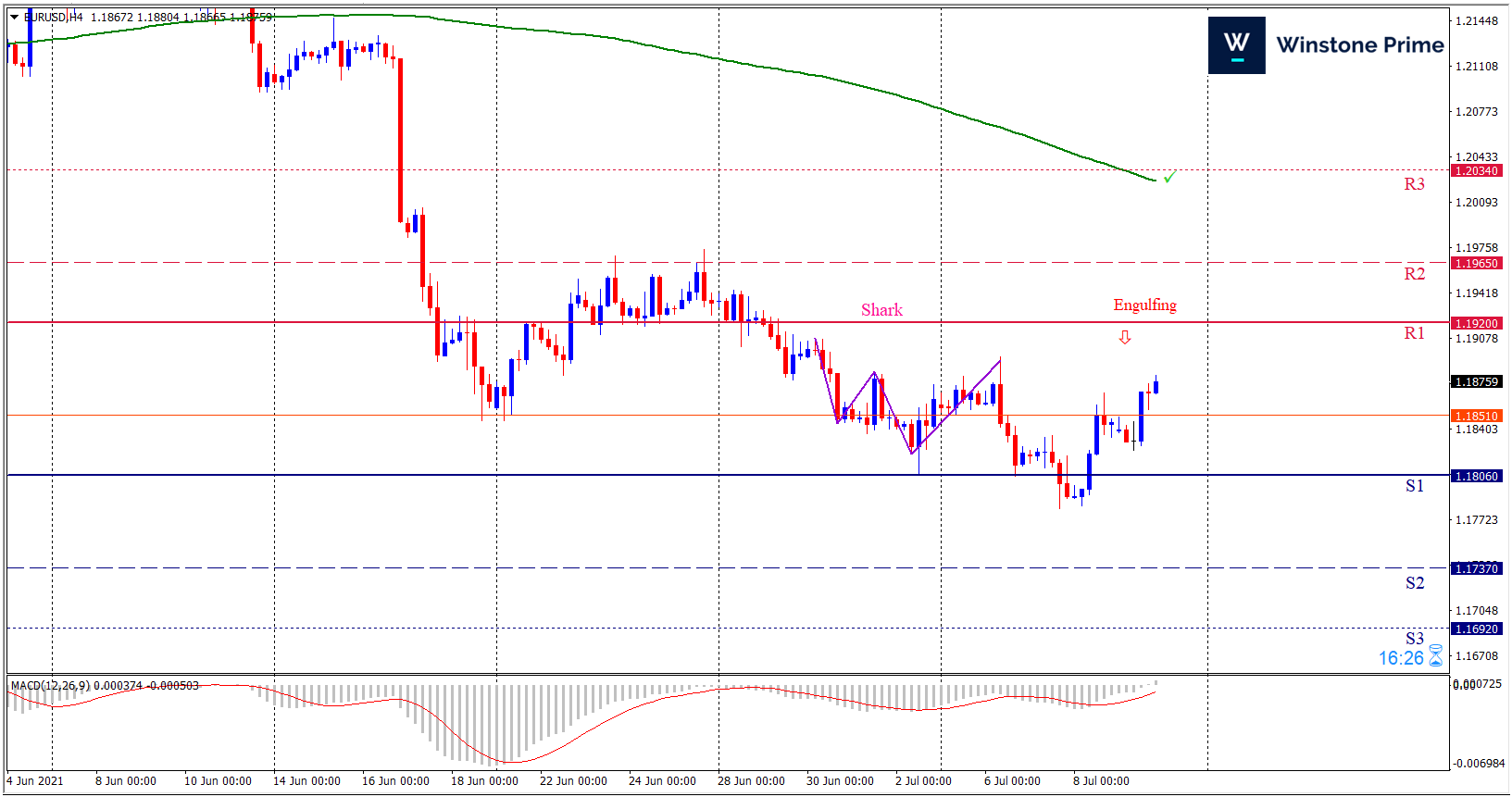
Last week’s high was 0.41% lower than the previous week. Maintaining high at 1.1895 and low at 1.1781 showed a movement of 114 pips.

In the upcoming week we expect EUR/USD to show a bearish trend. The currency pair is trading below the 200 Simple Moving Average and the MACD trades to the downside. A solid breakout below 1.1806 may open a clean path towards 1.1737 and may take a way down to 1.1692. Should 1.1920 prove to be unreliable resistance, the EURUSD may raise upwards 1.1965 and 1.2034 respectively. Chart formation of a bearish shark pattern in H4 chart sets prospects for a bearish trend. Bearish Engulfing formation in H4 chart escalates the expectation for a bearish trend.

Preference
Sell: 1.1864 target at 1.1756 and stop loss at 1.1925


Alternate Scenario
Buy: 1.1925 target at 1.2033 and stop loss at 1.1864

Brief Knowledge about Currency Crisis

Have you ever known a crisis with some of your currency? One day you will not have enough money. Maybe someone stole your money. It was however a small-scale based unfortunate personal currency crisis. Of course, real currency crises can occur nationally, and they can be very bad. Currency crisis are associated with severe falls in economic activity.

In this article, you will learn what are Currency crisis, how it occurs and some examples of them from recent incidents.

What is mean by Currency Crisis?

Any situation in the foreign exchange markets where a currency suddenly and/or unexpectedly loses substantial value relative to other currencies this situation can be defined as Currency Crisis. Currency crisis may also be called balance-of-payments crises as they generally result from serious current or anticipated payment imbalances at the reigning exchange rates. 

Simultaneously, the economic fundamentals were weak and were unable to prevent the exchange rate from falling. In most cases, a currency crisis is not an isolated event and usually follows a financial or socio-political crisis. When a currency crisis occurs, there is extreme volatility. This often draws the attention of speculators as well as central banks. Reasons range from a monetary policy that follows a fixed exchange rate, to economic failures and political crisis.

When a currency crisis occurs, it comes unannounced. One could draw a relation to a currency crisis as a black swan event. Yet, in most cases, in hindsight, the causes for it can be easy to explain. Some currency crises tend to have a short-term impact, while many other types tend to last longer, sometimes for years.

What happened during the currency crisis?

Depreciation severely hurts the economy. Many economic and business decisions depend on exchange rates. A fall in the exchange rate will create instability and mistrust of the domestic currency.

Let’s take a simple example. Suppose you are Indonesian.

Before the crisis, the rupiah exchange rate against the US dollar was IDR 2,000/USD. Let’s say you buy an imported item for USD1 per unit. Then, the crisis hit and depreciated the exchange rate to IDR 20,000/USD. To get the same item, you have to spend more rupiah. Depreciation makes you have to pay Rp 20,000 or 10 times more expensive than before the crisis.

There are a number of reasons for a currency crisis to occur. They can be categorized into the following:

Inflation Playing a role

Inflation remains the single biggest threat to currencies. Typically, central banks are mandated to maintain price stability. But, depending on the circumstances, inflation can start to creep higher. Examples of inflation leading to currency crisis include the famous inflation in Zimbabwe and the more recent episode in Venezuela.

Debt playing A role

It is often said that debt fuels the economy. Under general circumstances, governments tend to keep a close watch on the amount of borrowing in the economy. When lenders learn about potential factors that could lead to a cut in the credit ratings, the borrowing costs rise. This can eventually lead to a freeze in borrowing due to the higher interest rate demand by lenders.

Political stability playing a role

Currency crisis can occur due to political reasons as well. An economy needs to have a stable political environment. This is good for overseas investors as well as for the economy to grow. When there is political infighting or riots against the government, it can lead to instability. This, in turn, spurs foreign investment coming into the economy, resulting in an indirect impact on the currency’s value.

Economic Factors playing a role

The global economy also plays a role in the currency crisis. When there is a faltering economy, central banks respond by lowering interest rates. The open markets set the value of an exchange rate in a free-floating exchange rate policy. This can get difficult in case an economy is following a fixed rate regime. Defending the exchange rate peg can become a costly affair.

  • 1998, RUB Crisis

The Russian financial crisis (also called ruble crisis or the Russian flu) hit Russia on 17 August 1998. Declining productivity, a high fixed exchange rate between the ruble and foreign currencies to avoid public turmoil, fatal financial imprudence and a chronic fiscal deficit were the reasons that led to the crisis. During ruble crisis, the nation had to devalue its exchange rate. One of the reasons that led to the crisis was falling productivity amid a higher fixed exchange rate. The Russian central bank had to intervene in the markets to devalue its currency as a result. The crisis got to a point that Russia had to seek loans from the International Monetary Fund.

  • 2015, CHF De-peg

In 2015, the Swiss National Bank shocked the FX markets by announcing that it will de-peg the EUR and the CHF exchange rate. The SNB had, for years, maintained a floor on the EURCHF exchange rate. For a currency that was pegged to the euro, the CHF appreciated more than 30% on the day. This was unprecedented because currency crises typically lead to a devaluation of the currency.

  • 2018, TRY Devaluation

In the 2000s, the Turkish government enacted a series of political and economic reforms to attract foreign investment. After the 2008-2009 Global Financial Crisis, Turkey experienced a rapid influx of foreign capital. It was partly due to the reforms and also to the fact that most large countries lowered interest rates after the crisis to promote investment and boost aggregate demand.

In 2018, the Turkish lira (TRY) fell by almost 45% against the US dollar (USD). Between 2010 and 2018, Turkey experienced average GDP growth of around 6.5%. During the period, Turkish businesses and banks borrowed huge amounts of money from international investors. Most of the debt was dollar-denominated, which meant that Turkey was exceptionally susceptible to US monetary policy. The TRY became strongly devalued as it fell to 4 USD per Turkish lira. The exchange rate was about 1.34 USD/TRY back in 2005.

The impact of the devaluation in the Turkish lira also reached across shores into Europe. Because Europe had a significant amount of investment in Turkey, the currency crisis led to a decline in European equities as well.

Currency Crisis Solutions

Some preventative measures can be taken to prevent a crisis from occurring.

Floating exchange rates tend to avoid currency crises by ensuring that the market is always setting the price, as opposed to fixed exchange rates where central banks must fight the market. 

Britain’s fight against George Soros required that the central bank spend billions to defend its currency against speculators, and this strategy proved to be impossible to maintain.

Central banks should also avoid monetary policies that involve trading against the market unless it’s necessary to prevent a broader crisis. For example, emerging market economies could have accepted the inevitability of currency outflows and reformed investment policies to attract foreign direct investment instead of trying to raise interest rates.

Conclusion

Currency crises can come in multiple forms but are largely formed when investor sentiment and expectations do not match the economic outlooks of a country. Investors should always be cognizant of currency dynamics when they’re making investment decisions. It’s often possible to predict major problems before they arise, at least to some extent, although market timing can be exceptionally difficult. Currency crisis can impact any economy, regardless of it being a developed or an emerging market. However, one could always look back in history to see how the economies have handled their respective currency crises.

Currency imbalances can present a good opportunity to hedge a portfolio against risk, rather than a time to make a major bet against the currency or country. While volatility is often low in the FX markets, a currency crisis can deeply affect the exchange rate. Money is the basis for the financial world. And, as a result, the impact is felt far and wide.