
Backup plan while trading

Raising the standards of a professional and successful forex trader is not an easy task at all. The whole process requires not only a lot of time and knowledge, but also a considerable amount of commitment, which motivates traders to stay in constant trade circles even in the most difficult moments. To become a successful trader, it is very important to strictly adhere to the chosen trading strategy and see whether anything is really working. The Forex market is so fast and volatile that it is up to you to think about each subsequent trading step as if it were the last one.

Trading without a good strategy is like a lottery bet and the easiest way to lose the entire or desired amount. Unfortunately, even the best-looking trading strategy is not omnipotent, so there is a need to have a backup plan that includes a backup trading strategy (entries, exits, and various market orders) that will fill in the gaps of the primary trading strategy.

As seasons alternate on Earth, different trading periods alternate in markets. Professional traders use different primary trading strategies according to these periods, and when the market demands it and there are no other options, they activate their backup plan, where traders usually deploy their backup trading strategies.

Never worst Day cost you

Every trader has their bad days in his trading experience. As a rule, never let a bad day cost you more than you make on an average profitable day. If you average $700 on your winning days, don’t lose much more than that on a bad day. Control the downside.

A big loss causes all sorts of inner conflict a need for revenge, fear, anger, frustration, self-hate, market-hate, and the list goes on. After a big loss, there’s no way to trade with a clear head. There are more than 250 trading days in a year, so there is no rush to get back in there; today is not the day to make it back.

Accept Responsibility

Maybe it was just a bad few days, maybe it was your biggest single loss ever, or maybe it’s a life-altering loss. In the latter case facing financial ruin there isn’t much to do. Don’t trade until the issue is resolved. Once it is, then you can proceed. If you have drawn down your account, had a losing streak, or suffered a big sudden loss, that’s different.

You’re still in the game, just a little beaten up. Everyone loves a comeback story, and every trader who has been around a while has one (or several). It doesn’t matter if a surprise news announcement caused the price to blow past your stop loss, or a technology meltdown caused you to lose your connection and the market moved against you.

Practice and Rebuild Confidence

After a big loss, confidence can be low. That means the mind may not be right for trading. Not having a clear mind can cause you to skip trades, panic out of trades (trading not to lose), or be overly-aggressive in an attempt to get back to your old winning ways quickly. None of these are good. Take a step back and trade in a demo account for a few days. If you have been losing, you will likely save yourself money. 

Because it’s not real money, there is also less pressure in a demo account, so it is easier to focus on trading, and not worry about the financial aspect of it.

The main steps needed to create a backup trading plan (strategy):
Change your Mindset

The first and main step is to admit that, despite highly disciplined trading, the primary trading strategy may fail. It looks easy, but it’s really harder than it seems! It is mainly related to the ego and the functioning of today’s society, which is set to expect from people the best and flawless results, and we often refuse to admit that plans and strategies would not work.

Create a backup plan

Creating a backup plan does not only mean creating a backup strategy, but a plan is a set of activities to help achieve a goal. Therefore, a backup plan is such a plan where the trader precisely determines under what circumstances certain measures will be taken. The easiest, and perhaps somewhat ironic, most effective creation of a backup plan is by using the phrase “when -> so”.

Example: When something happens on the market, that back plan need to respond. And, in the context of the backup plan, it should look like this. When the primary strategy fails this way, it will activate the backup plan.The backup plan is then nothing but a set of trading conditions and subsequent entries and exits from trades.

Managing and updating the backup plan

If there is a backup plan where it is clear from a simple analysis that its conditions are not feasible in the current medium-term time horizon, then such a plan is not very usable. Therefore, it’s a good idea to update the backup plan once in a while to check its relevancy.

A backup trading strategy should include:

  • is fundamentally different from the primary strategy
  • easy to use and understandable
  • tradable on the same timeframe as primary trading strategies
  • If it’s possible to create stress-free Strategy for trader.


Trading without a backup plan and strategy can be very risky and unprofessional, so do not repeat the mistakes of your predecessors.

Conclusion

If you’ve just taken a big hit and stopped to trade for a couple of days and do look at your trades, Your trading plan and address your issues. Why it’s happened and also make an change in necessary trading plan. Practice in a demo account to build a confidence upon your strategy. Only switch to live account once the confidence rise in your mind when you made some profitable days and are feeling more like your old trades.

Fear of new corona virus puts pressure on Kiwi

Newzealand Dollar edged lower on Tuesday the most in G10 before recovering losses after the Reserve Bank of New Zealand (RBNZ) set Newzealand’s wellbeing as the longer-term target. And also the concerns of new coronavirus outbreaks in the region could undercut an economic recovery even as robust momentum in the United States prompts the Federal Reserve to contemplate a quicker exit from accommodative policy.

The New Zealand government has announced that the travel bubble with Australia will resume with South Australia, ACT, Tasmania and Victoria on July 5. The bubble was paused on the weekend in response to the growing number of cases being reported across Australia. New Zealand had earlier decided to close the travel bubble to New South Wales until July 7.

New Zealand’s COVID Response Minister Chris Hipkins today said travellers from SA, ACT, Tasmania or Victoria, to be eligible to fly, must not have been in NSW since June 22 or Queensland, the NT or WA from June 26. “The cabinet agreed that partially lifting the pause was the appropriate course of action,” Mr Hipkins told a news conference. “The health advice is that the spread of COVID-19 in these parts of Australia has been contained at this point,” he said.

Investors are also keen at U.S. consumer confidence data on Tuesday as well as the Institute for Supply Management’s manufacturing index on Thursday for clues as to where interest rates are headed. The US dollar have benefited from some safe-haven demand driven by concerns over the spread of the Delta virus strain.

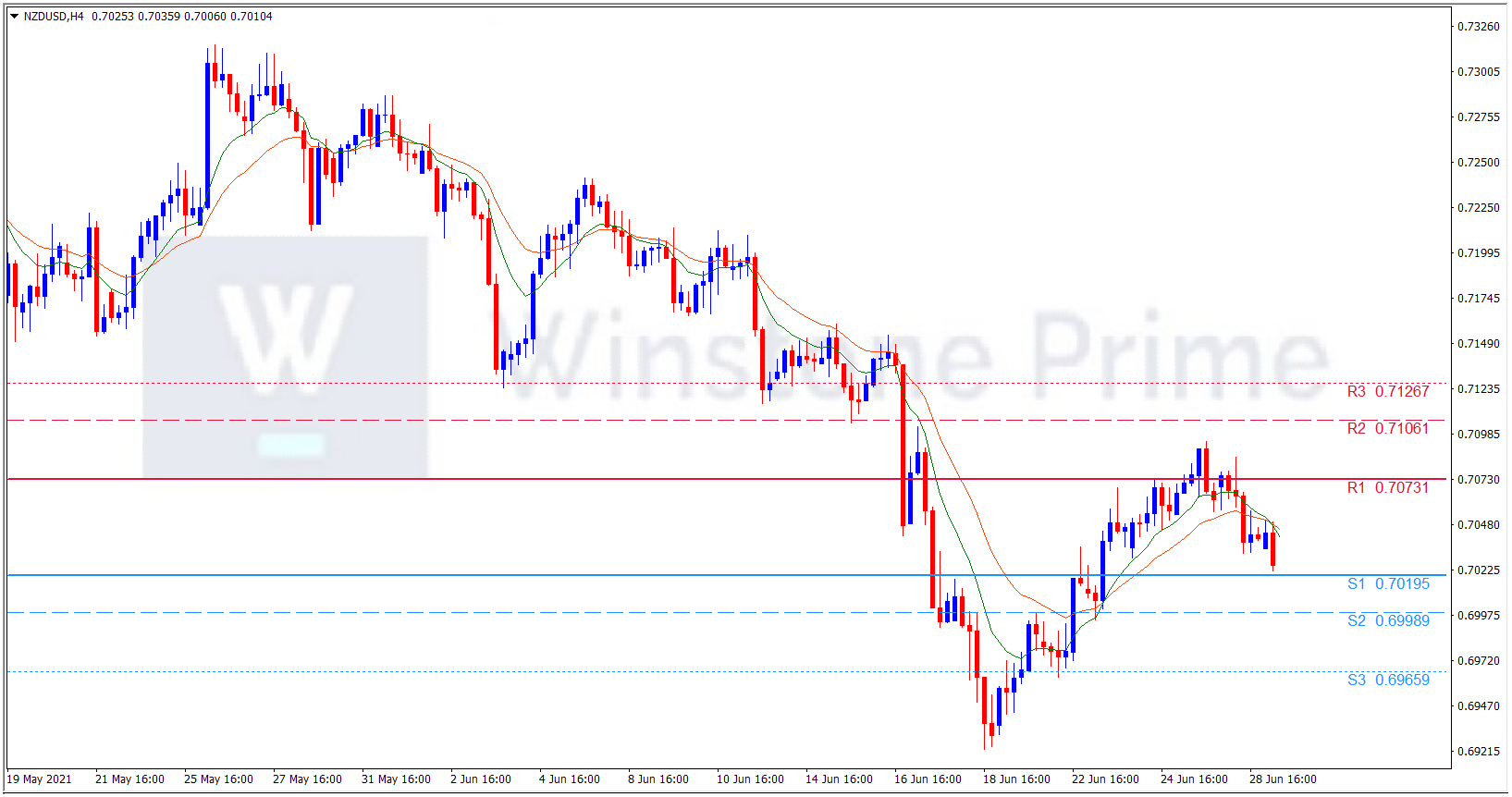
NZD/USD 4 Hour Chart:

Support: 0.7020 (S1), 0.6999 (S2), 0.6966 (S3).

Resistance: 0.7073 (R1), 0.7106 (R2), 0.7127 (R3).

Among this the kiwi pair under pressure among US Consumer confidence data. We expect a bearish trend for NZDUSD.

US Core PCE favors greenback

The Euro consolidates losses from its last week recovery moves and heads into today European Session.  Because of the sluggish market the pair failed to control sellers as a new fear of inflation and the corona virus (COVID-19) favored demand for the US dollar, due to its risk-protection faint.

The European economy just flopped into a double-dip recession, but it already seems to be bouncing back and could even start outpacing the U.S. which is like providing another engine for global growth. The reason’s for optimism are economies are reopening, the delivery of vaccinations are finally accelerating and the European Union’s multi-year joint stimulus fund is set to take off to complement already ultra-loose monetary policy.

US Core Personal Consumption Expenditures (PCE) Price Index, published Friday, seems to be the main catalyst behind the greenback’s recovery moves. The Fed’s preferred gauge of Inflation jumped to the highest in the near three decades with 3.4% YoY figures in May and probed the Fed’s sustained repeated efforts to tame inflation fears and chatters over rate hikes, as well as tapering.

On the other hand Germany will attempt to ban British travellers from the European Union regardless of whether or not they have had a COVID-19 vaccine, The Times reported on Monday. The German chancellor wants to designate Britain as a “country of concern” because the Delta variant of the coronavirus is so widespread, the newspaper said. The plans will be discussed by senior European and national officials on the EU’s integrated political crisis response committee and will be resisted by Greece, Spain, Cyprus, Malta and Portugal, the newspaper added.

German chancellor Angela Merkel is due to meet British Prime Minister Boris Johnson at Chequers next week. Britain plans to unveil plans next month to allow fully vaccinated people to travel unrestricted to all countries except those with the highest COVID-19 risk.

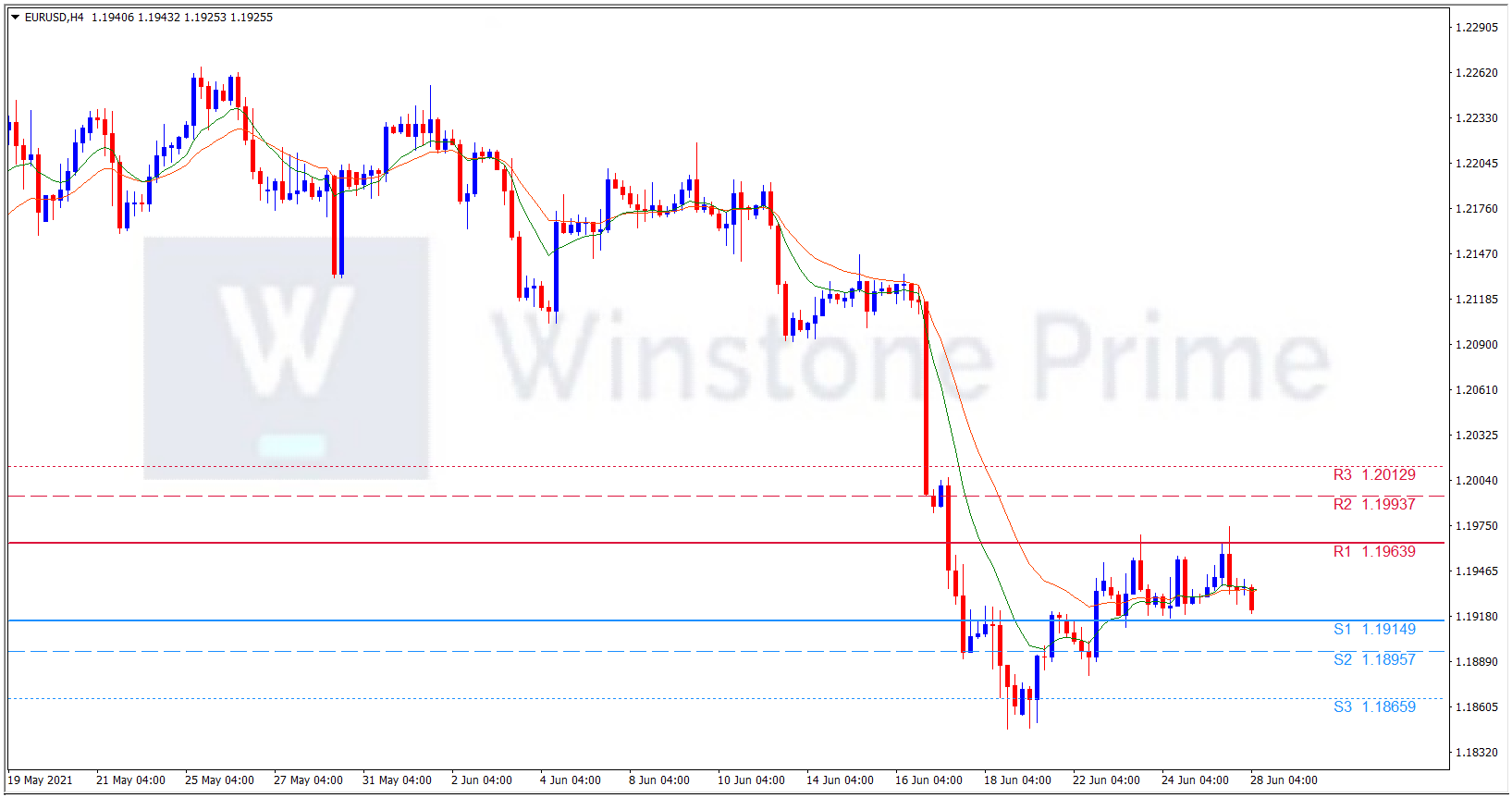
EUR/USD 4 Hour Chart:

Support: 1.1915 (S1), 1.1896 (S2), 1.1866 (S3).

Resistance: 1.1964 (R1), 1.1994 (R2), 1.2013 (R3).

Amidst the Germany ban of British travelers and Greenback gaining dominate the euro into downward pressure. We expect bearish trend for EUR/USD.

What is a Flash Loan Attack? How to avoid it?

Decentralized Liquidity Is the Backbone of DeFi and Flash loans are exciting and powerful which can provide instant and sizable liquidity to anyone in the world, at any point in time, they have increasingly been used to fund attacks on DeFi protocols. Decentralized finance (DeFi) ecosystem has recently emerged with new liquidity mechanisms. Cryptocurrency and by extension DeFi is a highly experimental field. When so much money is at stake, it’s only a matter of time before vulnerabilities are discovered.

In this article we briefly explained the attacks occurred in Flash loan and prevention of it.

Flash loan attacks are a type of DeFi attack. These attacks were, in a word, magnificent. In each attack, a penniless attacker instantaneously borrowed hundreds of thousands of dollars of ETH, threaded it through a chain of vulnerable on-chain protocols, extracted hundreds of thousands of dollars in stolen assets, and then paid back their massive ETH loans. All of this happened in an instant. Such attacks can occur in mere seconds that is, in a single ethereum transaction.

Flash loan attacks are the most common types of DeFi attacks since they are the cheapest to pull off and easiest to get away with. They have been consistently making headlines since DeFi’s surge in popularity in 2020 and appear to be growing more rampant in 2021, spanning several hundred million dollars in losses to date.

Flash loans allow a user to borrow as much as they want with zero capital. For instance, if you’d like to borrow $70,000 worth of ETH, a lending protocol instantly gives it to you, but that doesn’t mean it’s yours. You need to do something with the borrowed funds in order to pay back the loan and perhaps pocket the excess amount.

For this to work, the process needs to happen fast and the debt must be repaid to the protocol in time, otherwise the transaction will reverse. A decentralized lender doesn’t require collateral from you since the agreement to pay your debt is enforced by a blockchain. Flash loan attackers thrive on finding ways to manipulate the market while still abiding by a blockchain’s rules.

It is the number one cause of attacks right now, by far. It is important to be noted that decentralized exchanges are not decentralized oracles. Using Uniswap, Sushiswap, or Curve to get pricing information to execute trades is pulling data from potocols whose price depends soley on liquidity. Looking at the infamous ground zero bZx attack that sparked this wave of attacks, we can see exactly what happens. These flash loans are used to crash and manipulate the price of these decentralized exchanges, which most projects deemed safe to use. The fact is that issue relies here with these protocols prices depend entirely on liquidity. The easiest way to solve this is to use decentralized oracles. 

A reentrancy attack can occur when you create a function that makes an external call to another untrusted contract before it resolves any effects. If the attacker can control the untrusted contract, they can make a recursive call back to the original function, repeating interactions that would have otherwise not run after the effects were resolved. Leave external transactions to the last parameter. These are the harder ones to prevent. The DAO attack is an example of the reentrancy attack as well, and is also considered the mother of not just defi, but decentralized attacks in general on the ETH chain.

Since everything on-chain is public information, an attacker can watch transactions on-chain and look for those that would be detrimental to the attacker, and make a transaction with a higher gas price to occur before that transaction goes through. For example, they notice a whale is about to dump a token that the attacker holds, so the attacker pays extra gas to dump theirs first. This is known as “front running” in traditional finance, you could also think of it as a race condition because there can be scenarios where it’s more complicated than this example, but still boiled down to this. Reentrancy technical falls under this category.

Pump and arbitrage attacks are difficult to find, some even saying they are less “attacks” and more “the system working as intended”. Liquidity is an important part of any and all processes, so when a whale spikes or crashes a price, does that really reflect the true value of that crash/spike? It’s hard to say. Prevention at the moment hangs around preventing anyone from being able to cause these spikes. Sometimes, coordinated attacks from social groups can be enough to pump and dump a price of an asset.

These attacks are fatal attraction for hackers. The most recent flash loan attack as of May 2021 occurred at PancakeBunny, a BSC-powered yield farming aggregator, which suffered an exploit that caused its token to plummet by more than 95% of its previous value.

The attacker initially borrowed a large amount of BNB through PancakeSwap and used it to manipulate the price of USDT/BNB and BUNNY/BNB in PancakeBunny’s pools. This allowed the hacker to steal a large amount of BUNNY, which they dumped on the market, causing the price to crash. The hacker then paid back the debt via PancakeSwap.

Data suggests that the hacker was able to get away with nearly $3 million in profits, leaving a tarnished protocol in its wake.

The largest flash loan hack in 2021 occurred last February when the Alpha Homora protocol was drained of $37 million using Iron Bank, Cream’s lending platform. The leveraged yield farming protocol was hit with a series of flash loans.

The hacker repeatedly borrowed sUSD from Iron Bank via the Alpha Homora dapp, doubling the amount borrowed each time. This was done in a two-transaction process where the hacker lent the funds back into Iron Bank each time, which allowed them to receive Yearn Synth sUSD (cySUSD) in return.

Then, the perpetrator borrowed 1.8 million USD Coin (USDC) from Aave via a flash loan then swapped them with sUSD using Curve. The sUSD was used to pay back the flash loan and lend to Iron Bank, which enabled them to continuously borrow and lend more of them and receive a proportional amount of cySUSD each time.

Basically, the hackers rinsed and repeated this process many times, which allowed them to steal massive amounts of Creamy cyUSD that they in turn used to borrow other cryptocurrencies from Iron Bank. Hence, they borrowed 13K Wrapped Ethereum (WETH), 3.6 million USDC, 5.6 million USDT, and 4.2 million DAI.

As you can see, the process can be quite complex and requires a series of steps that need to happen very fast, which is a testament to how far these attackers are willing to go.

How to Prevent Flash Loan Attacks

Flash loan hackers take a lot of steps to get around the coded security system. These steps vary during attacks and the breadcrumbs can be difficult to follow. If successful, these attackers are able to steal millions in cryptocurrency valuation.

Considering the growing number of flash loan attacks at present, it’s clear that there is no be-all and end-all solution yet. However, there are notable steps that can be taken to combat this issue. 

Use Decentralized Oracles for Price Data

The most optimal way to reduce the attack vector for flash loan exploits is for DeFi platforms to use decentralized pricing oracles like Chainklink and Band Protocol instead of relying on a singular DEX for their price feed. Alpha Homora had to learn this the hard way before deciding to launch their Alpha Oracle Aggregator last May. 

Force Critical Transactions to Go Through Two Blocks

Dragonfly Research has proposed forcing flash loans to go through two blocks instead of one. However, this isn’t a complete solution either since if it is designed incorrectly, the exploiter could simply flash loan attack both blocks. Furthermore, this can drastically affect the UI of DeFi protocols since transactions will no longer be synchronous.

Avoid Front Running Attacks

The best way to prevent against these is with a commit-reveal scheme.  This is when a project sends a transaction that goes through and is accepted, but is hashed or encrypted. Only after the transaction has concluded that they send a “reveal” phrase that decodes the transaction. This method prevents both miners and users from frontrunning transactions as they cannot determine the contents of the transaction. Transactional value however, cannot be commit-revealed, making this far less effective in the defi world. This is another very difficult type of attack to prevent.

Using Flash Loan Attack Detection Tools

Open Zeppelin has recently launched a program called Open Zeppelin Defender that enables project managers to detect smart contract exploits and other unusual activity, which would allow them to respond swiftly and neutralize attacks. According to their blog post, this tool has already been integrated by the Synthetix, Yearn and Opyn teams.

Conclusion

Ultimately, the result of a flash loan attack is out of your hands. By limiting concentrations of singular protocols or altcoins, you can hedge against these attacks to a degree. However, this is the inherent risk involved in cryptocurrency. Balancing your portfolio with more established coins is also a smart move.

As cryptocurrencies shift protocols away from proof-of-work, additional questions will be raised about the security of alternatives.