GBP/USD Weekly Forecast (21st Jun 2021 – 25th Jun 2021)

Fundamental view:

The British pound has broken down significantly during the couse of the week. The main focus shifted to the Bank of England, which puts pressure on economic optimism and the spread of the Delta covid variant. On the other hand, The Federal Reserve shocked markets by signalling two rate hikes in 2023, opposite to none at all beforehand. The bank also upgraded other forecasts such as that for inflation – with underlying prices set to hit 3% in 2021 – and hailed the rapid recovery.

US Retail Sales monthly report & US NY Fed Empire State Manufacturing Index on 15th June, Britain PPI Input monthly report and PPI Output monthly report and CPI monthly report on 16th June favored bullish trend for the pair whereas US EIA Crude Oil Stocks on 16th June and US Philadelphia Fed Employment & US Continuing Jobless Claims on 17th June favored bearish trend for the pair.

The major economic events deciding the movement of the pair in the next week are Fed Chair Powell Testimony at Jun 22, UK Markit/CIPS Manufacturing PMI, US Markit Manufacturing PMI at Jun 23, BoE Interest Rate Decision, US GDP quarterly report, US Core Durable Goods Orders, US Initial Jobless Claims at Jun 24 and US Core PCE Price Index at Jun 25.

GBP/USD Weekly outlook:
Technical View:

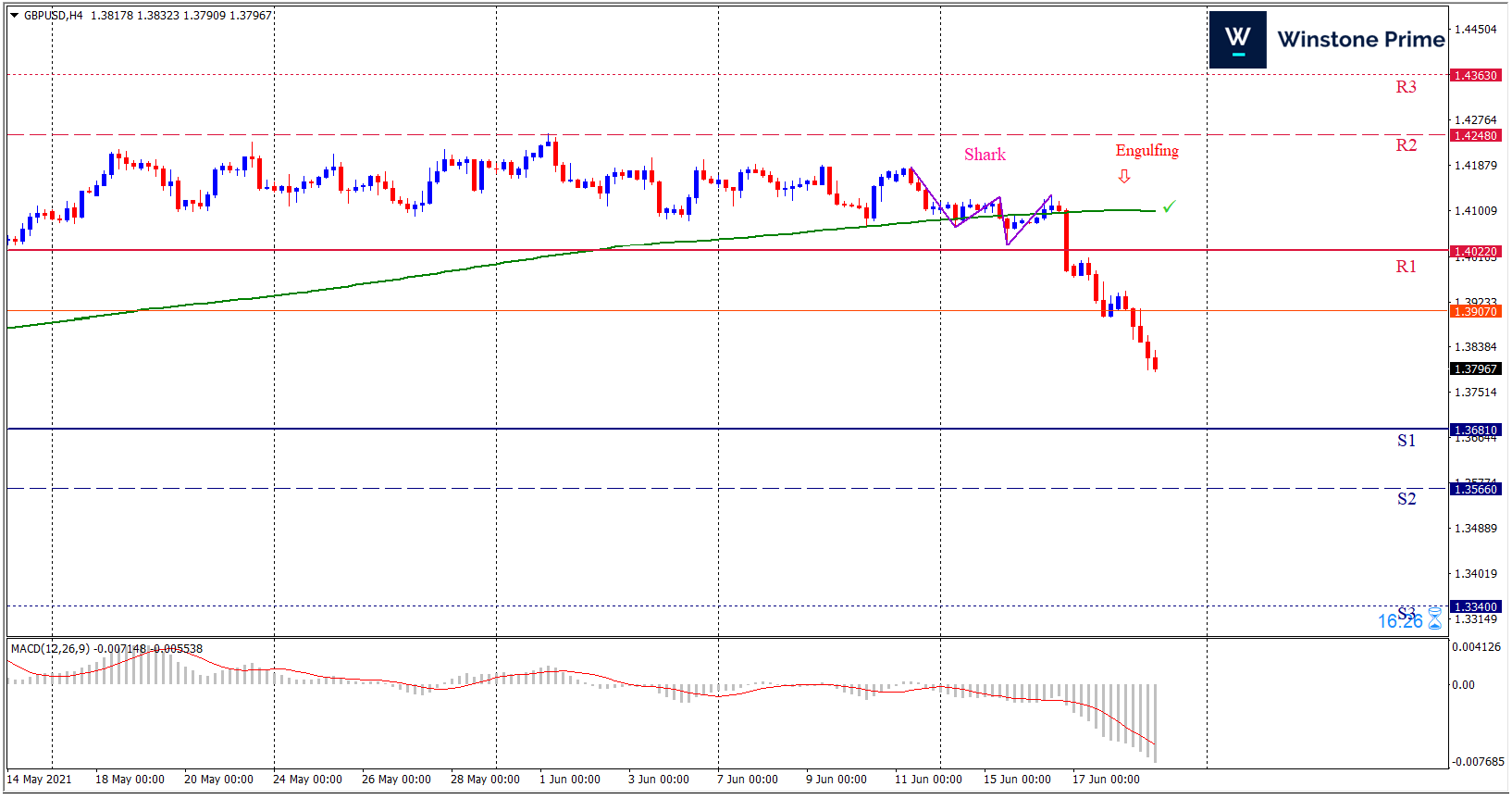
Last week’s high was 0.41% lower than the previous week. Maintaining high at 1.4132 and low at 1.3791 showed a movement of 341 pips.

In the upcoming week we expect GBP/USD to show a bearish trend.  The currency pair is trading below the 200 Simple Moving Average and the MACD trades to the downside. A solid breakout below 1.3681 may open a clean path towards 1.3566 and may take a way down to 1.3340. Should 1.4022 prove to be unreliable resistance, the GBPUSD may raise upwards 1.4248 and 1.4363 respectively. Chart formation of bearish shark pattern in H4 chart favors prospects of a bearish trend. Engulfing pattern formation escalates the expectation for a bearish trend.

Preference
Sell: 1.3798 target at 1.3567 and stop loss at 1.4027


Alternate Scenario
Buy: 1.4027 target at 1.4362 and stop loss at 1.3798

EUR/USD Weekly Forecast (21st Jun 2021 – 25th Jun 2021)

Fundamental view:

The Euro has fallen against its US counterpart during the course of the week, showing signs of extreme negativity after the Federal Reserve spooked everybody. Elsewhere The central bank shifted its cautious tone without much warning, forwarding chances of rate hikes. The dot-plot has showed that most Fed officials expect to raise rates in 2023 twice from a previous stance of no hikes until 2024. The current monetary policy was left unchanged as expected.

Europe Industrial Production yearly report on 14th June and US NY Fed Empire State Manufacturing Index on 15th June favored uptrend for the pair whereas Europe Labour Cost Index & Europe Wage Costs yearly report on 16th June and US Philadelphia Fed Employment & US Continuing Jobless Claims on 17th June favored downtrend for the pair.

The major economic events deciding the movement of the pair in the next week are Fed Chair Powell Testimony at Jun 22, ECB Non-monetary Policy Meeting, US Markit Manufacturing PMI at Jun 23, Europe Ifo Business Climate, US GDP quarterly report, US Core Durable Goods Orders, US Initial Jobless Claims at Jun 24 and US Core PCE Price Index at Jun 25.

EUR/USD Weekly outlook:

Technical View:

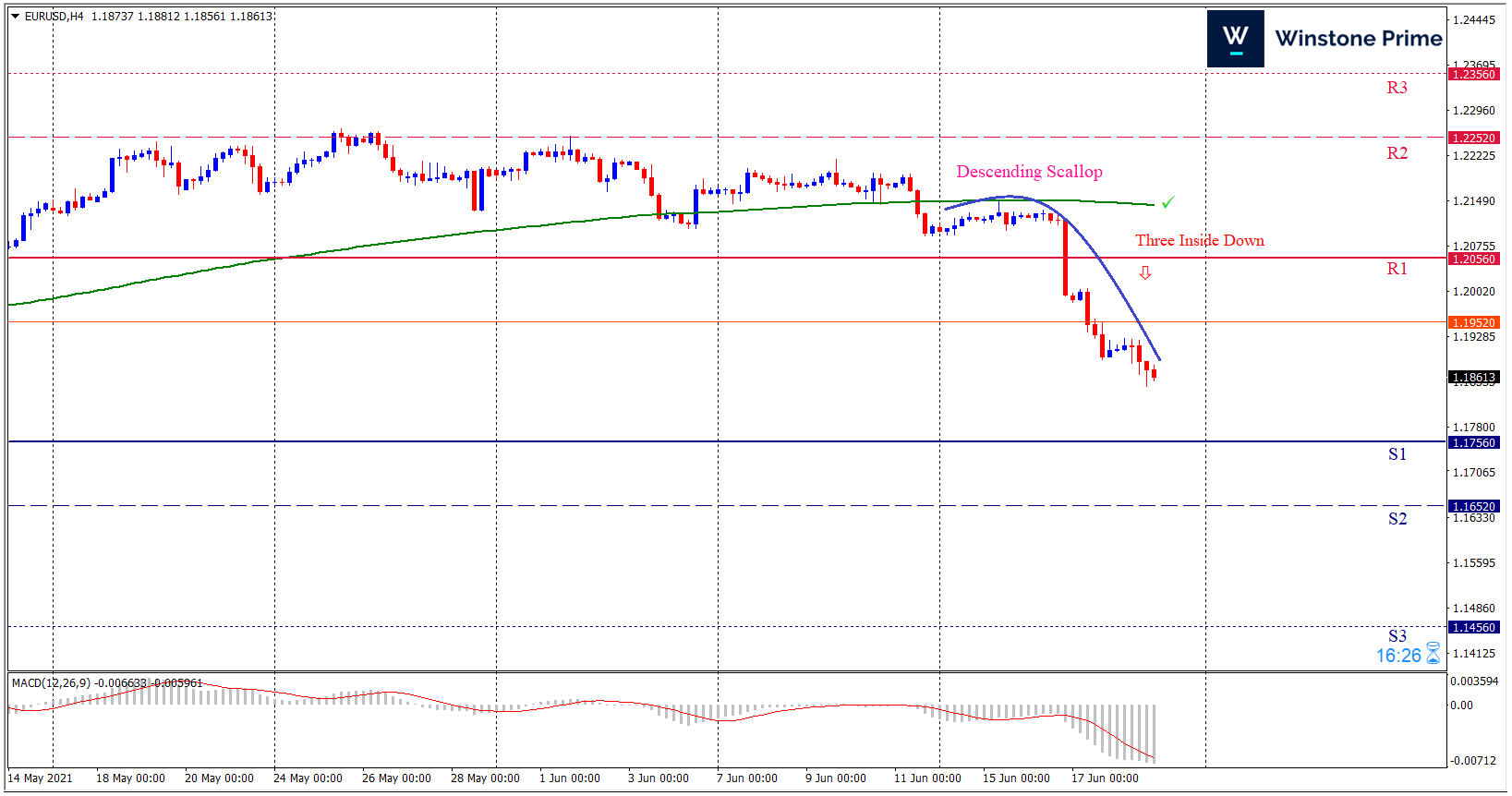
Last week’s high was 0.57% lower than the previous week. Maintaining high at 1.2147 and low at 1.1847 showed a movement of 300 pips.

In the upcoming week we expect EUR/USD to show a bearish trend. The currency pair is trading below the 200 Simple Moving Average and the MACD trades to the downside. A solid breakout below 1.1756 may open a clean path towards 1.1652 and may take a way down to 1.1456. Should 1.2056 prove to be unreliable resistance, the EURUSD may raise upwards 1.2252 and 1.2356 respectively. Chart formation of a descending scallop pattern in H4 chart sets prospects for a bearish trend. Three inside down formation in H4 chart escalates the expectation for a bearish trend.

Preference
Sell: 1.1865 target at 1.1653 and stop loss at 1.2061


Alternate Scenario
Buy: 1.2061 target at 1.2355 and stop loss at 1.1865

How to get a Flash Loan

To getting the normal loan is not easy, it’s mandatory to maintain balance, income and more on your account and verification is important one for this. But Flash loans are like lending to steroids.

But are they good or bad? It depends on who you are asking. For some, Flash Credit is the biggest innovative and effective tool in decentralized finance (DeFi), primarily on the Ethereum network. Flash loans provide an opportunity for their opponents to extort millions from dishonest actors using poorly protected ethics. Fast growing array of financial products dubbed flash loans are promising the crypto faithful. It is a type of uncollateralized lending that has become very popular in decentralized finance (DeFi). 

So what are flash loans all about? And how can they be used to borrow millions of dollars worth of crypto with no collateral? You’ll find answers to these questions in this article.

What is mean by Flash Loans?

How to get a Flash Loan - 2

A flash loan is relatively new type of uncollateralized lending that has become popular across a number of decentralized finance (DeFi) protocols based on the Ethereum network.

These types of loans have made headlines recently because they have been used to exploit a number of vulnerable DeFi protocols, leading to millions of dollars in losses. 

Yet, advocates argue flash loans introduce an innovative and useful tool to the world of finance for arbitrage and quick trades that weren’t possible before blockchains.

Most of us are familiar with normal loans. A lender loans out money to a borrower to be eventually paid back in full. The lender receives a payout from the borrower for temporarily parting with its money. 

Flash loans are similar, but they have the following unique properties:

  • Smart contracts: Flash loans use smart contracts, tools enabled by a blockchain that don’t let funds change hands unless certain rules are met. In the case of a flash loan, the rule is that the borrower must pay back the loan before the transaction ends, otherwise the smart contract reverses the transaction – so it’s like the loan never happened in the first place. 
  • Unsecured loan: Often lenders require borrowers to put up collateral to ensure that if the borrower can’t pay back the loan the lender is still able to get their money back. But in an unsecured loan, no collateral is required. This lack of collateral doesn’t mean the flash loan lender will not get its money back. It’s just sent back in a different way. Instead of offering collateral, the borrower needs to pay back the money right away, which brings us to our next point.
  • Instant: Usually, obtaining and fulfilling a loan is a long process. If a borrower gets approved for a loan, he or she typically has to pay it back steadily over a period of months or years. A flash loan, however, is instantaneous. The smart contract for the loan must be fulfilled in the same transaction that it is lent out. This means the borrower has to call on other smart contracts to perform instant trades with the loaned capital before the transaction ends, which is usually a few seconds.


This type of loan can be useful in certain instances, such as many traders looking to quickly profit from two markets.

How repaying a flash loan works

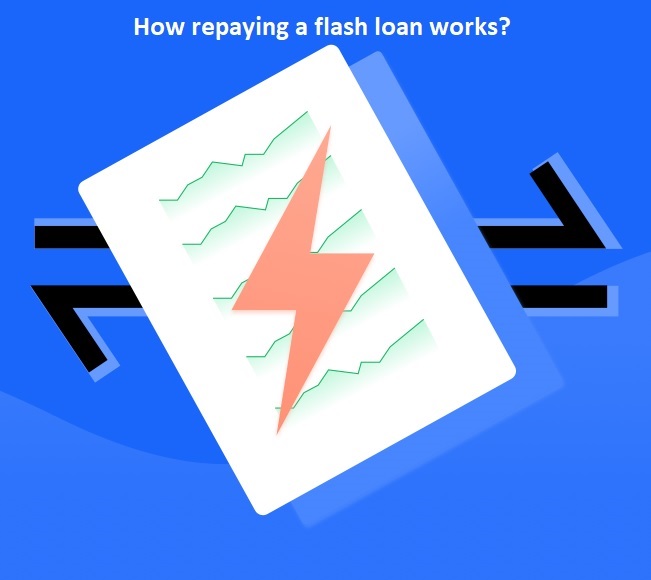
Borrowers can take collateral-free loans from lenders and use the proceeds for whatever they want. One of the most popular uses is to arbitrage discrepancies in coin prices on different exchanges. The key is that the loan, the trade and repayment are bundled into the same block of transactions being processed on the Ethereum digital ledger and are executed simultaneously.

The time from borrowing to returning a loan typically takes seconds. In the example, the transaction gets submitted to the network, temporarily lending the borrower the funds. If the trade isn’t profitable, the borrower can reject the transaction, meaning that the lender gets their funds back in either case. As far as the blockchain is concerned, the lender always had the funds. The user pays blockchain processing fees.

Using Flash Loans for arbitrage trading

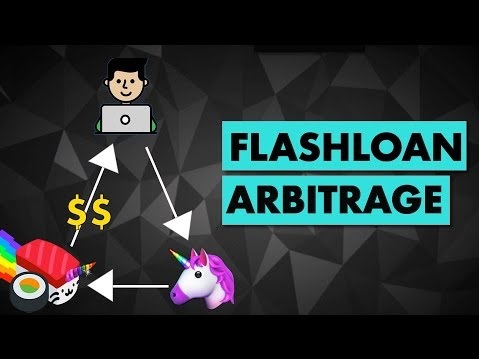
Arbitrage trading is a process in which a trader purchases an asset on one exchange and sells it on another exchange to take advantage of price differences. It is as simple as buying low and selling high.

One can utilize flash loans in the case of arbitrage trading to leverage higher levels of liquidity and earn extra profit.

Assume a DAI/USDC trades at a 1:1 ratio on Uniswap, but you can buy 1 USDC for 0.99 DAI on Curve Finance. On Curve Finance, a trader who borrows 10,000 DAI will sell it for 10,101 USDC. They will then exchange them for DAI at a 1:1 ratio on Uniswap, repaying the 10,000 DAI loan and pocketing the 101 DAI gap. Arbitrage provides a mechanism to ensure prices do not deviate substantially from fair value for long periods of time. 

Debt refinancing is the second-best use case for flash loans, frequently used in situations where a user creates regular DeFi loans. More often than not, a crypto enthusiast will take out a loan only to discover that another platform offers the same loan but with better interest rates.

In that scenario, the individual could make use of the other platform with the help of flash loans. He would have to pay off the interest rate (e.g., 10%) on the original loan and borrow 5% from the second loan at the more affordable lending platform. The cycle is completed by paying back the flash loan, after which the user ends up having the loan with the better interest rate in his hands.

Collateral exchanges enable DeFi consumers to access loans from a multi-collateral lending app. For example, suppose you borrowed Dai from Compound and put Ethereum up as collateral. You will exchange the Ether collateral for Dai collateral by taking a Dai flash loan to offset the Dai borrowed.

Conclusion

Flash loans are a key financial tool used by technically savvy DeFi users. They are excellent for Arbitraging, Debt refinancing and Collateral Swaps. You can make money with Flash loans without providing your personal information and the process only takes a maximum of a few minutes. While the benefits are certainly huge, there is one big problem with providing a deal breaker for most people. In fact, flash loans are very vulnerable to exploitation, and they are the number one reason why many DeFi platforms lose millions of dollars in 2020.

Always be aware of the risks that Flash Loan offers to you and the dangers behind other DeFi products as well . When developers are carrying heavy loads, your job is to better manage risk and protect your personal financial assets from vulnerability.

BOJ interest rate decision favors yen

US dollar lost its gain against yen today. The main reason could be linked to the mixed performance of US Treasury yields and the S&P 500 Futures amid a light calendar and pre-BOJ caution.

Meanwhile The Bank of Japan (BOJ) has kept its monetary policy settings unchanged following the conclusion of its two-day monetary policy review meeting on Friday. Elsewhere, the central bank kept the benchmark policy rate on hold at -10bps while maintaining its pledge to buy J-REITS at an annual pace of up to JPY180 bln.

The BOJ as widely expected has extended a deadline for its pandemic-relief programme beyond September by six months, in a continued effort to stimulate the fragile economy and less enthusatic inflation.

On the other hand, Japan will tighten its rules on support for the exports of new coal power plants, in line with a pact by the Group of Seven nations (G7) to halt new government backing for unabated coal power by the end of 2021, a government official said on Friday.

The G7 pledged on Sunday to rapidly scale up technologies and policies that speed the transition away from such power, generated by plants that lack emissions-cutting measures, such as carbon capture and storage (CCS).

Japan has tightened state-backed financing criteria for overseas coal-fired power plants last July, after drawing criticism for its support of the dirty fossil fuel. However it exempted certain situations, such as when a country seeking energy stability lacks any alternative to coal and seeks to build a coal-fired station employing Japan’s so-called clean coal technology.

The market struggles for a clear direction and the US Treasury yields are indecisive after Thursday’s slump. Hence, today’s BOJ meeting is not to offer any key moves to the USD/JPY prices till it offers a major relief to citizens over the covid-led emergency that ended in most prefectures except for Tokyo yesterday. It should, however, be noted that the Japanese central bank may highlight the weaker inflation expectations at home and abroad to keep the easy money flowing, which in turn may prove the USD/JPY sellers.

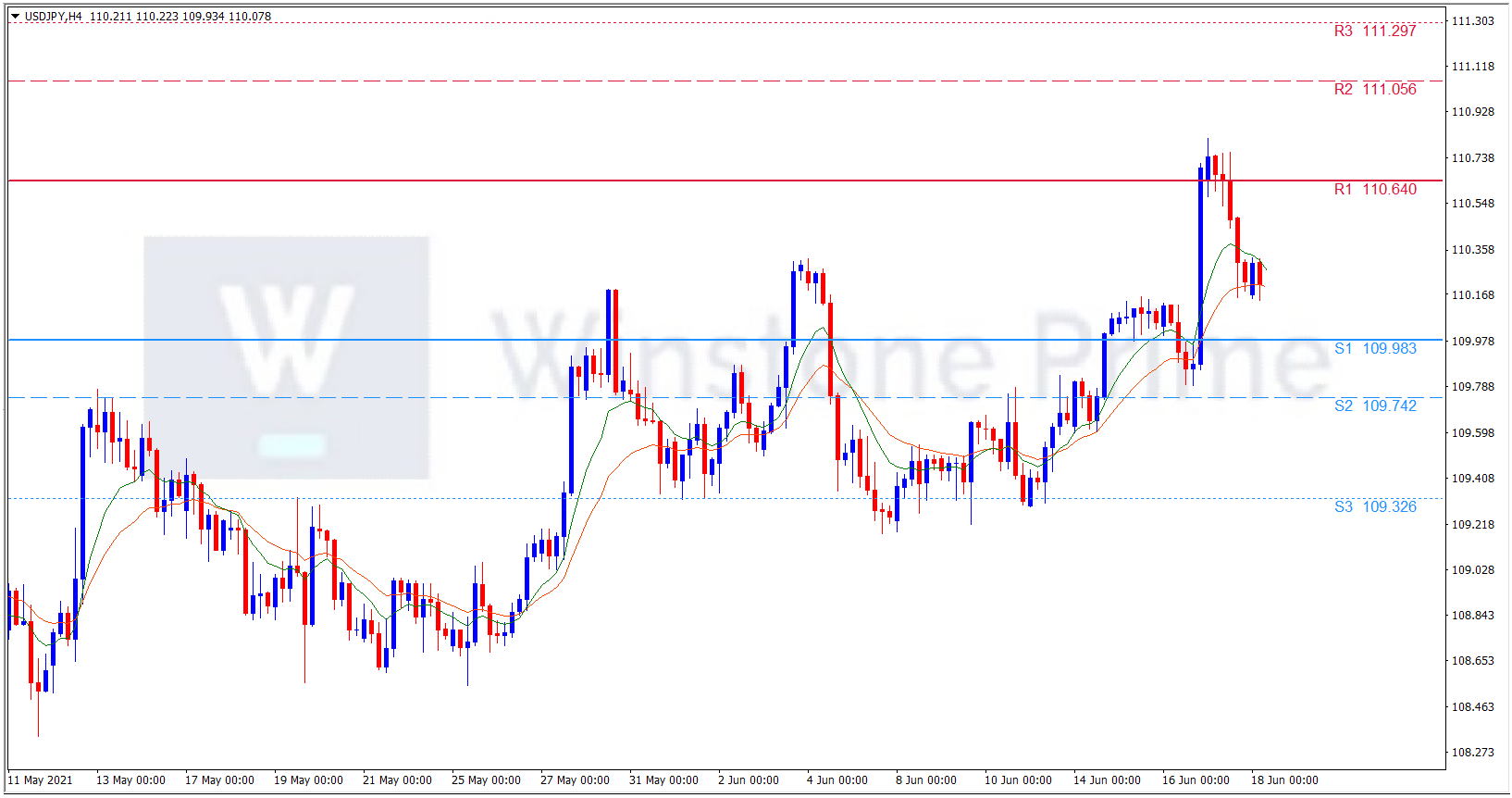
USD/JPY 4 Hour Chart:

Support: 109.98 (S1), 109.74 (S2), 109.33 (S3).

Resistance: 110.64 (R1), 111.06 (R2), 111.30 (R3).

Amidst the BOJ interest rate decision pushes the yen into gaining moment. We expect a bearish trend for USD/JPY pair.