RBA Lowe’s comments pressurises Aussie

The Aussie potrayed substantial negative pressure because of the RBA Governor Lowe’s comments. The RBA Governor Phil Lowe warned of the upward wage pressure if the border remained closed for another one year.

Elsewhere the policymakers further said it would be premature to consider the end of the bond buying program.  Which in turn soured the sentiment surrounding the aussie.

The Australia Unemployment Rate had a fall to 5.10% in May from 5.50% in the previous month. Full-Time Employment increased by 97.5K in May. The Labor Force Participation rate had a jump of 66.2% in May from 66% in the previous month. The readings provide some cushion to the lower levels for the aussie. 

The rising tensions between Australia and China is another negative factor for Aussie’s performance. In the recent development, the Australian Prime Minister, Scott Morrison while speaking at the Organisation for Economic Cooperation Development (OECD), lashed out at China for undermining the rule of law and threatening free world order.

Australia’s banking watchdog has asked the country’s largest banks to give assurances they are lending responsibly and managing risks in their home loan books amid sky-rocketing house prices and signs of increased risky lending, regulators said Thursday. The Council of Financial Regulators also warned that it was discussing “policy options” that could be used to address risks if growth in household debt substantially outpaced that in income.

On the other hand, The Federal Reserve (Fed) kept monetary policy unchanged on Tuesday, but revisions to the economy and the rate forecast rushed to market bonds and the US dollar. On addition of that, central bank chairman Jerome Powell acknowledged that rising inflation may be more consistent than previously expected and weighed on market sentiment and the previous day’s AUD / USD price.

AUD/USD 4 Hour Chart:
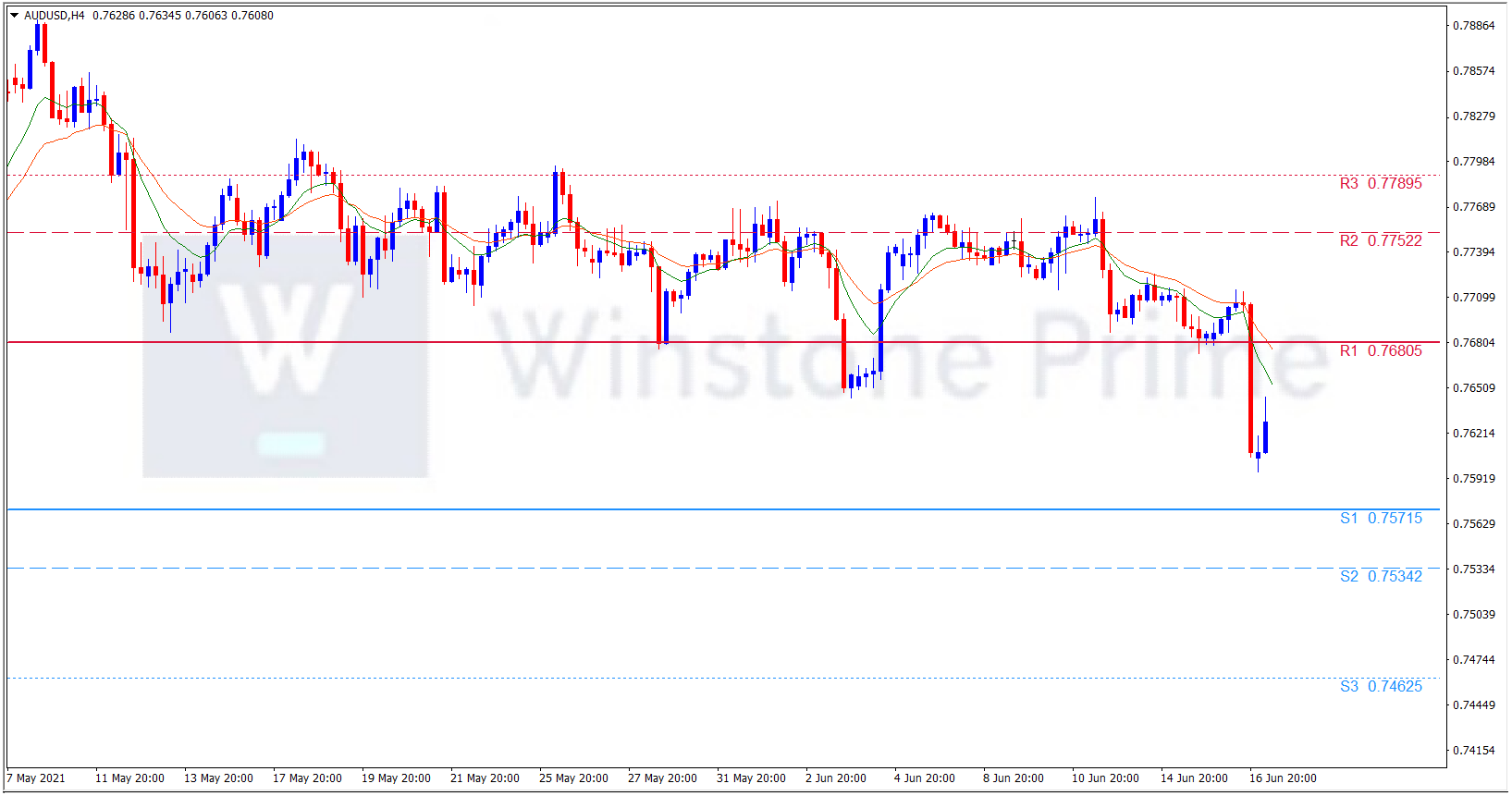
Support: 0.7572 (S1), 0.7534 (S2), 0.7463 (S3).

Resistance: 0.7681 (R1), 0.7752 (R2), 0.7790 (R3).

Due to all the catalysts, the aussie seems to be under pressure. We expect a bearish trend for AUD/USD.
US dollar weakness favors kiwi

Kiwi moved from its low level and steps into bullish trend amid the U.S Dollar Weakness. U.S. retail sales has dropped much more than expected in May but sales in April were revised sharply up and are far less above their pre-pandemic level. With spending rotating back to services from goods as vaccinations allow Americans to travel and engage in other activities, the data cemented the perception of a strong recovery in the economy.

Separate data potrayed wholesale price inflation accelerated to 6.6%, the largest gain since November 2010.

U.S. Recent data showed rising consumer prices which have raised concerns about rising inflation. But the federal officials say rising inflationary pressures are moderate and that the easiest monetary systems will last for some time. The Federal Reserve is expected to hold initial talks with its policymakers on when and how quickly it will repay the massive bond purchase program launched in 2020, the policy meeting will be later in the day.

On the other hand ‘Extraordinary’ lack of seasonal flu in New Zealand, ESR virologist says. Every year the seasonal flu influenza arrives, often just in time for winter. But right now, influenza and other respiratory illness doesn’t appear to be circulating in the community due to the successful lockdown. At the same time Australia and New Zealand started negotiating a Free Trade Agreement (FTA) with the UK at the same time.  “The urgency, enthusiasm and passion for our New Zealand exporters needs to be at the front and centre of Minister O’Connor’s agenda.”

Elsewhere China is increasingly being seen as a threat by New Zealanders but the country should continue to engage with it, according to people surveyed by the Asia New Zealand Foundation. “For the first time, more New Zealanders see China as a threat than those who view it as a friend,” the report said. At the same time investors look forward to the outcome of the U.S. Federal Reserve meeting for hints on tapering of economic support measures.

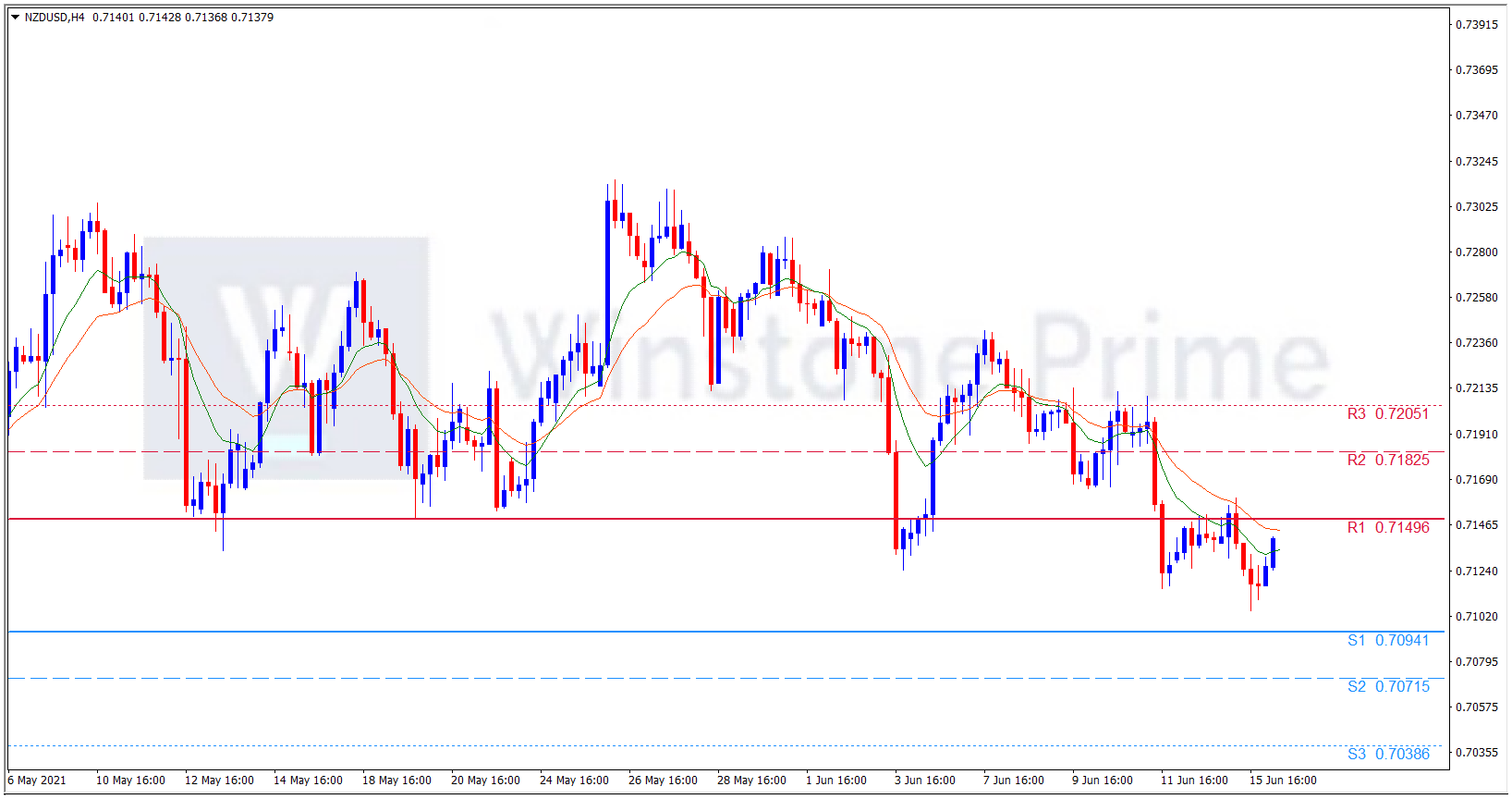
NZD/USD 4 Hour Chart:

Support: 0.7094 (S1), 0.7072 (S2), 0.7039 (S3).

Resistance: 0.7150 (R1), 0.7183 (R2), 0.7205 (R3).

The supportive economic news and lockdown plays a major role in favoring the newzealand currency and it keeps the kiwi on uptrend and traders now look for the FOMC outcome. We expect a bullish trend for NZD/USD.

The spread of covid weakens yen

The US Dollar has gained on Tuesday ahead of a much-anticipated Federal Reserve meeting that can give a signal of change in the outlook for U.S. monetary policy. The U.S. currency has been buoyed as traders closed short positions before the Fed’s two-day policy-setting confab, which kicks off on Tuesday. So far Fed officials, led by Chair Jerome Powell, have stressed that rising inflationary pressures are transitory and ultra-easy monetary settings will stay in place for some time to come.

The Bank of Japan is about to extend a September deadline for its pandemic-relief programme at this week’s policy meeting, former BOJ board member Makoto Sakurai said. The Japan government is considering placing Tokyo under state of emergency during the Olympics, given that a number of health experts have expressed concern over a potential spike in COVID-19 cases, according to government officials. The Olympics are due to begin July 23, but public fears persist about a surge of coronavirus infections triggered by an influx of people into the capital and driven by more contagious variants.

Prime Minister Yoshihide Suga will convene a task force meeting as early as Thursday to make a decision on whether to end the third state of emergency. Attention is focused on what the government and the organizing committee of the games will do regarding spectators after those from overseas were barred in March. Since late April, Tokyo has been under a stricter state of emergency, but it will likely end on June 20 as a fourth wave of infections has somewhat abated. In addition to Tokyo, nine prefectures including Hokkaido, Osaka and Fukuoka are currently under the emergency.

Mean while opposition parties submitted a no-confidence motion against the Cabinet of Prime Minister Yoshihide Suga, as the ruling coalition has rejected their calls for extending the current regular parliamentary session.  “Prime Minister Suga’s Cabinet has no sense of responsibility or crisis in protecting the lives and livelihoods of people from coronavirus infections, deemed the greatest crisis of the postwar era,” Edano told a news conference after the meeting.

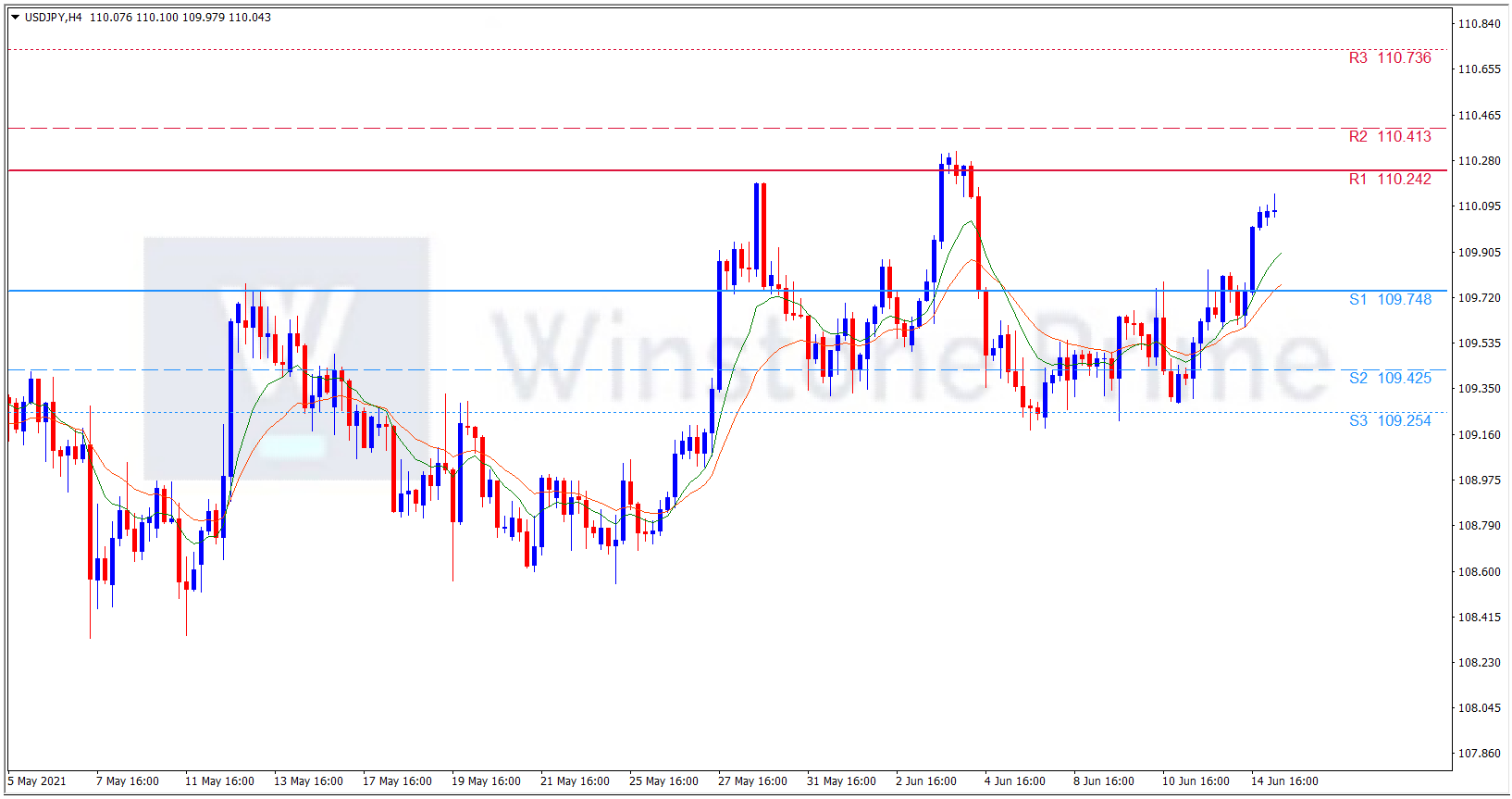
USD/JPY 4 Hour Chart:

Support: 109.75 (S1), 109.43 (S2), 109.25 (S3).

Resistance: 110.24 (R1), 110.41 (R2), 110.74 (R3).

Amidst the lack of necessary steps by Japanese Government and spread of virus has made the yen weaker against the US dollar. We expect a bullish trend for USD/JPY.

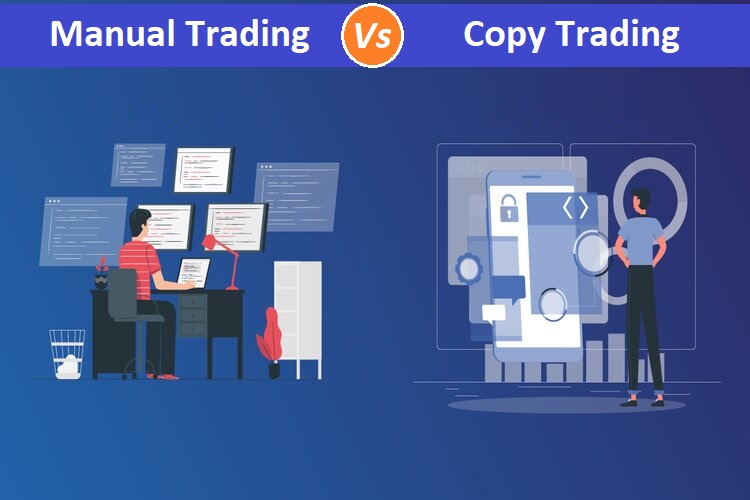
Manual trading Vs Copy trading

Trading is a form of art. Trading can be done in different ways, two of the main ways that people trade include manual trading  –  the art of performing all the market analysis yourself and then placing the trades and copy trading, – the simple act of finding a trader that you believe has a good strategy, and simply copying their trades onto your own account. The latter is fastly becoming one of the more popular ways to trade with multiple platforms appearing allowing people to copy other traders’ trades. We are going to be looking at the advantages and disadvantages of both so you can compare which method of trading may be best suited for you.

In this article we will explain the differences between automated & manual trading. So let’s dig a little deeper into both! Manual trading Vs Copy trading.

Manual trading system

Manual trading Vs Copy trading - 2

This is the traditional style of trading which involves you to look at the markets and enable you to open or close market positions whenever you choose and then placing your trade in line with your strategy and any risk management plans that you have in place. Trading seems relatively simple: you place a deposit, select a currency pair to trade, determine the direction of the market trend, set the leverage level (specifying the stop loss and profit taking points) and open the trade.

  • When you are trading in a manual manner, you are less susceptible to certain events such as economic news, simply because you are in control of your trades and can decide not to put any trades on during these times.
  • You are able to perform better than a computer in regards to placing trades, simply due to the fact that you have experience, your own intuition, and are able to make decisions based on real-world events that a robot may not be able to.
  • The other main advantage is simply the fact that as a human trader you have the ability to analyse more variables that influence the markets whereas a computer will not be able to.
  • Trading can also take a long time, time that you do not always have and so you may need to make sacrifices to other parts of your life to trade properly. Due to this, you have to sit at the computer for long periods of time, making it a little boring if nothing is happening.
  • As a human, you are prone to emotions, these emotions can have an effect on your trading and can potentially cause you to make mistakes. Your trading will also be limited to your availability, you can only trade when you are there at the terminal, so this will be limited by things like sleep and work.

Copy Trading system

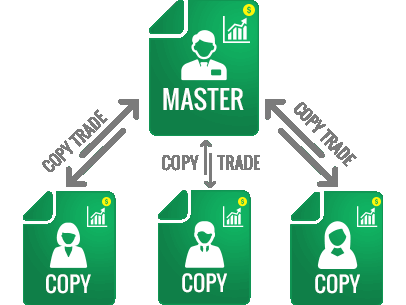
Specifically for copy trading, there is a master account that is controlled by a person. Master account is linked by number of slave accounts. When a trade is placed on the master account, it is automatically copied to the copy accounts.

There are actually a few different versions of copy trading including, signals, mirror trading, and social trading. Each one has a similar concept, you are finding a trader and then simply taking their trades and putting it onto your own account, hence the term copy trading. It takes a lot of responsibility, but you are putting your accounts and trades in the hands of someone else. So let’s take a quick look at the different versions and advantages of these trading methods.

  • One of the main advantage copy trading offers, is that it saves precious time for all traders, both experienced and new, by eliminating the need to constantly track and analyze the markets.
  • The other advantage of this sort of trading include that you can trade with very little knowledge of forex, there is no need for you to monitor your trades all day long, you won’t miss any trades as you are taking the same ones as the trader is, you have the opportunity to learn from the taker by watching what they are doing, you are also able to diversify your portfolio while at the same time keeping your risk low.
  • The fact is that if a master will make a bad trade that will result in a bad outcome for a copy trading account and your account is out of your control in this situation.
  • You also can’t make any decisions based on your own findings or initiatives.
  • Finally, you won’t gain as much knowledge and experience simply copying someone rather than doing the work yourself you have to simply follow it.

Mirror Trading

Mirror Trading has been in use in the foreign exchange market since the early 2000s.  It probably sounds pretty similar due to the names of copy and mirroring. The main difference is that with copy trading you are copying from a single trader, with mirror trading, you are taking trades from a basket of traders, you don’t necessarily have a choice of which traders and which trades to mirror, just that you will get some from that basket of traders.

  • It does not take a lot of time at all, the trades and analysis are done by other people. There is a reduced risk when compared to copy trading due to there being a choice of multiple traders rather than just one.
  • The potential for consistent profits are higher and can be expected due to the trading models generated from mirror trading, there are also no emotions when trading like this as they cannot affect the trades that are being put on.
  • You are not in control of the trades that your account is making, the algorithms used to choose the trades are also often not known which can make it hard to know why certain trades are being made.
  • Mirror trading is not recommended for beginners, as you need some form of understanding when choosing which traders to have in your basket.

Social Trading System

The other style of trading is social trading, this is a mix between the other two, this is where there is a kind of marketplace where you can view other traders or trades and choose which ones to copy, it gives little more control over what you trade and copy.

  • The advantage of this style of copy trading is that you have more control over what you are trading.
  • You are also able to engage with other traders, getting and giving ideas on trades, and working out different reading strategies. There is often more information available on the traders so you can better analyze their trading strategy to work out exactly what you want to trade.
  • It will take a long time to work out who to follow due to the amount of analysis that you will need to perform.
  • You may also miss opportunities for trades if you are not at your computer, some traders and news events can have more hype than expected, giving a false sense of confidence in certain traders and some of the social trading platforms can have transparency issues, keeping their workings and costs hidden from the copiers.

Conclusion

Encompassing the best of both Manual and Copy trading, these Automated Trading Signals may come from either (or a combination of both) forex trading professionals and automated systems, and their trades are automatically replicated to your trading account.

So that is manual trading and copy trading, there are advantages and disadvantages both, you need to work out which one will work for you, or maybe even try a little bit of both. There is no harm in trying multiple methods, as a beginner, copy trading is perfect, but it is always good to learn on the side so that you can later be an independent trader with the ability to trade fully yourself and not have to rely on others.