EUR/USD Weekly Forecast (07th Jun 2021 – 11th Jun 2021)

Fundamental view:

The American dollar has strengthened against the euro but it is ending the week unevenly against them. The US central bank made an announcement that it would begin winding down one of the emergency programs created to support the economy throughout the pandemic.  “Portfolio sales will be gradual and orderly and will aim to minimize the potential for any adverse impact on market functioning,” the Fed said. Overall the euro seemed to struggle against the greenback.

Europe HICP monthly report on 31st May and Europe Markit Manufacturing PMI & Europe Unemployment Change on 1st June favored uptrend for the pair whereas US ADP Nonfarm Employment & US ISM Non-Manufacturing PMI Change on 3rd June and US Factory Orders monthly report on 4th June favored downtrend for the pair.

The major economic events deciding the movement of the pair in the next week are Europe Employment Change quarterly report, Europe GDP quarterly report, US JOLTS Job Openings at Jun 08, US EIA Crude Oil Stocks Change at Jun 09, US Core CPI monthly report, ECB Interest Rate Decision, US Initial Jobless Claims at Jun 10 and US Michigan Consumer Sentiment at Jun11.

EUR/USD Weekly outlook:
Technical View:

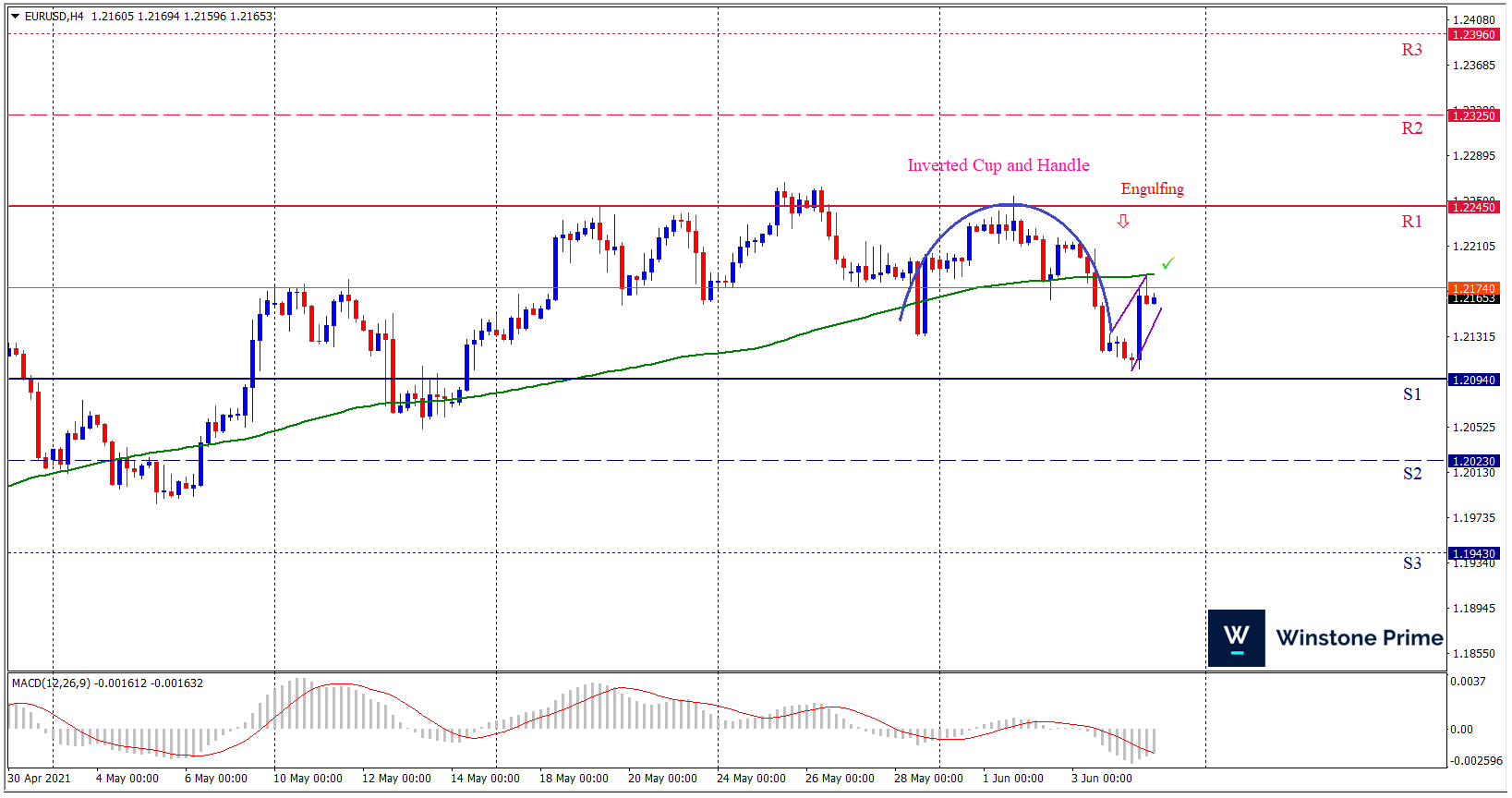
Last week’s high was 0.09% lower than the previous week. Maintaining high at 1.2254 and low at 1.2103 showed a movement of 151 pips.

In the upcoming week we expect EUR/USD to show a bearish trend. The currency pair is trading below the 200 Simple Moving Average and the MACD trades to the downside. A solid breakout below 1.2094 may open a clean path towards 1.2023 and may take a way down to 1.1943. Should 1.2245 prove to be unreliable resistance, the EURUSD may raise upwards 1.2325 and 1.2396 respectively. Chart formation of a inverted cup and handle pattern in H4 chart sets prospects for a bearish trend. Engulfing formation in H4 chart escalates the expectation for a bearish trend.

Preference
Sell: 1.2170 target at 1.2024 and stop loss at 1.2250


Alternate Scenario
Buy: 1.2250 target at 1.2395 and stop loss at 1.2170

Top 5 Richest Forex traders in the World

Forex trading is considered to be one of the most thrilling financial activities. There are virtually no limits to your earnings. Investing and trading are two words that fascinate everyone. They both imply pleasure and money combined. However, it can also be referred to as a business activity.

If you have been trading for quite some time and you have been wondering how the wealthiest Forex traders make it to the top, then you have come to the right place. If you are entirely new to trading Forex, or are an experienced currency trader on the markets, you are to be expected to share one key aspiration. It would be best if you always moved forward. Never stop what you do, and do not pay too much attention to failure – learn from it and move on.

With that being said, there has been an increase in young and promising forex traders who have emerged out of the shadows and shone the light on their achievements. In this article, we will familiarize you with some of the richest forex traders in the trading environment who many traders look up to.

No rich forex traders list will ever be complete without the legendary Geoge Soros who has been active in the trading scene since the late 1960s. Soros is the kind of trader who believes good investments are always the boring ones and if you’re having too much fun investing then you’re probably not making enough money. 

He rose to international fame in 1992 as the trader who broke the Bank of England, netting a profit of $1 billion after short-selling a reported $10 billion in British pound sterling (GBP). On Sept. 16, 1992, the U.K. withdrew the currency from the European Exchange Rate Mechanism after failing to maintain the required trading band due to Soros’ trade, solidifying a day known as Black Wednesday in history.

This incredible trade is a highlight of his career and cemented his title of one of the top traders of all time. Soros is currently one of the 200 wealthiest individuals in the world.

Soros’ notoriety made him a hedge fund tycoon overnight and that reputation alone allowed him to manage countless clients till his retirement in 2011. Soros founded a firm that specializes in managing hedge funds called the Soros Fund Management, LLC. Under his management, this firm went on to generate a mind-boggling income of $40 billion which later spawned many other corporations under his name. As of 2018, George Soros had a net worth of $8 billion most of which he invests in his businesses or gives away to charitable causes.

As of September 2020, George Soros’ net worth amounts to $10 billion. Sometimes his net worth value stood at $25 billion. But he transferred $18 billion to his charity foundation Open Society Foundations which works in more than 100 countries.

He is easily one of the best forex trader ever. Most of the traders of the forex market know his forex success stories. He is among the traders who shorted the October 1987 market crash, which is also known as Black Monday. At the age of 64, he is considered one of the richest day traders alive to this day, with a net worth at 4.5 billion USD.

He started his journey as a commodity trader. He working as a commodities trader in the NYSE. In 1980, he founded his own company called Tudor Investment Corporation. There, he was a hedge fund manager who was famous for taking part in macro trading. He mainly bet on fluctuations in interest rates and the forex market.

In October 1987, he made a profit of 62%, just by holding short position trading, when the markets were crashing. That year, he continued to earn 100 millions USD for his company. It felt like nothing can stop him at that time. In the period between 1992 and 1995, he was the Chairman of the NYSE and the top of the list of successful forex traders. In 2013, Tudor Jones obtained the profit of 14.3% for his company mainly because of his bet against the Japanese stock exchange and the Japanese Yen.

Bill Lipschutz is an American full-time foreign exchange trader. He has a B.A. degree in Cornell College in Fine Arts, as well as a Master degree in Finance. Next to his duties connected with the university, he was always keen on stock and Forex market. Lipschutz started trading already in his college times and successfully turned $12,000 investment into $250,000. This operation made him one of the best traders on Forex.

During his career, he experienced a big loss. Due to one bad trading decision he lost his entire capital. After this event, he gave more notice to risk management, which he carried on throughout his further career.

Co-founder and former director of Hathersage Capital Management, has gained popularity among millions of traders after successfully managing to turn $12,000, inherited from the grandmother in billions of dollars, helping Salomon Brothers make $300 million a year. While Bill Lipschutz net worth is not known, he is easily among the best Forex traders out there.

Andrew Kreiger started his trading career back in 1986 when he joined the Bankers Trust. At that time, the standard trading limit for employees in that company was set at $50 million. However, taking into account his talent and successes, the firm’s management decided to increase the trading limit for Kreiger to $700 million. His position allowed him to even gain profit from the Black Monday crash in 1987.

They were not disappointed. In fact, in 1987 Andrew Kreiger identified the New Zealand dollar to be very overvalued. As a result, he placed short positions for NZD, using 1:400 leverage. It goes without saying that this was a quite risky bet. Yet, it paid off quite well. As the New Zealand dollar fell by 5% against the US dollar, Kreiger has earned $300 million for the firm. Later in his life, he also worked for the Quantum Fund with George Soros.

After earning $300 million in selling the New Zealand currency, Andrew Krieger became famous in the trading field. In 1988 he started working for Soros Management Fund and later changed it to Northbridge Capital Management. He is also known for his philanthropic work – after the tsunami in 2004, he donated $350,000 for the victims.

From an early age as a young man making a living as a taxi driver, Bruce Kovner always thought he would be rich and become an active philanthropist. With this ambition, the young Bruce Kovner has invested a lot of time in studying commodity trading. Well-educated, he is very interested in academic research activities, supporting investment activities in education and arts.

Since the founding of Caxton Associates, the fund’s average annual return has been 21 percent compared with the S&P 500 average gain of 11 percent. Bruce Kovner only had in 1994 a loss in 20 years of fund management. Before founding Caxton Associates, Bruce Kovner also achieved an unprecedented record on the commodity exchange, with a 90% return on 10 years of operation. This is really an achievement that very few experts can achieve in terms of both trading on the commodity floor and the efficiency of investment in the stock market.

His net worth is only second to the richest forex trader in this list, George Soros.

Why do you need to know the richest forex traders?

Right now, you must be wondering as such. “It’s good to know who they are, but what will I do with this information? How can this benefit me? They are just some old guys.” Well, first of all, now you know who has the best forex strategy. You know who the best are, so you can come to them to learn something. You may be wondering if a forex course is trustworthy. Now you can see who you can put your faith in.

Why you should trade forex

Unlike the stock market and other financial markets, the Forex market has no conditions for you to buy and sell. Investors always have the opportunity to buy and sell, making profit even when the market goes up or down. Thanks to this advantage, traders can make a profit regardless of market trends without having to depend on an upside of the market.

To start participating in this market is not difficult, you need to have an understanding of the market and a minimum capital of $200 to start and still be able to make a profit by knowing how to use leverage on time and how to analyze the market by financial indicators. The Forex market is too large and has a lot of components involved in trading. Therefore, there is no single organization or individual or central bank to control the price of any currency pair in the Forex market in the long run.

The impact of large financial institutions like the Fed or the Central Bank will only affect the market price for a very short time. Central banks are increasingly less likely to intervene in this market.

We hope that this article has been inspirational for you to go ahead and start your path as a trader. It makes perfect sense to get started on a practice account with a virtual balance before you commit your own money to trading. Open Winstone Prime demo account and start trading now.

Upbeat US job report favors the greenback

The yellow metal is trading low against the greenback due to Upbeat US macro data and uptick in the US bond yields.

According to the ADP National Economic Report released Thursday, U.S. private-sector employment surged by 978,000 in May, this gain was above forecasts from economists with a record of 923,000 jobs.

It is to be noted that this is the largest monthly gain since last June when the economy began to reopen after the first wave of the coronavirus pandemic. The private-sector added a revised 654,000 in April, down from the prior estimate of 742,000. This robust jobs report coupled with dollar strength puts intense selling pressure on gold.

Elsewhere, The U.S. weekly jobless claims drop below 40k with record of 385k, the figure is well below the expectation of 425k and previous record of 405k.Even the U.S. service sector index is at record high in May,

The Signs of a strengthening US economy has boosted bets for higher inflation and further created hopes on the speculations that the Fed may bring forward the timeline for tapering its bond purchases. This was evident from a fresh leg up in the US Treasury bond yields, which provided an additional support to the greenback

We’re coming out of the woods here, the data is getting better, there are some inflation issues that could put a damper on things, but we have turned the corner,” Bob Haberkorn, senior market strategist at RJO Futures, said.

The better-than-expected data has put traders on the defense. They’re preparing for possible statements from the Federal Reserve on tapering or higher rates, although not immediately.

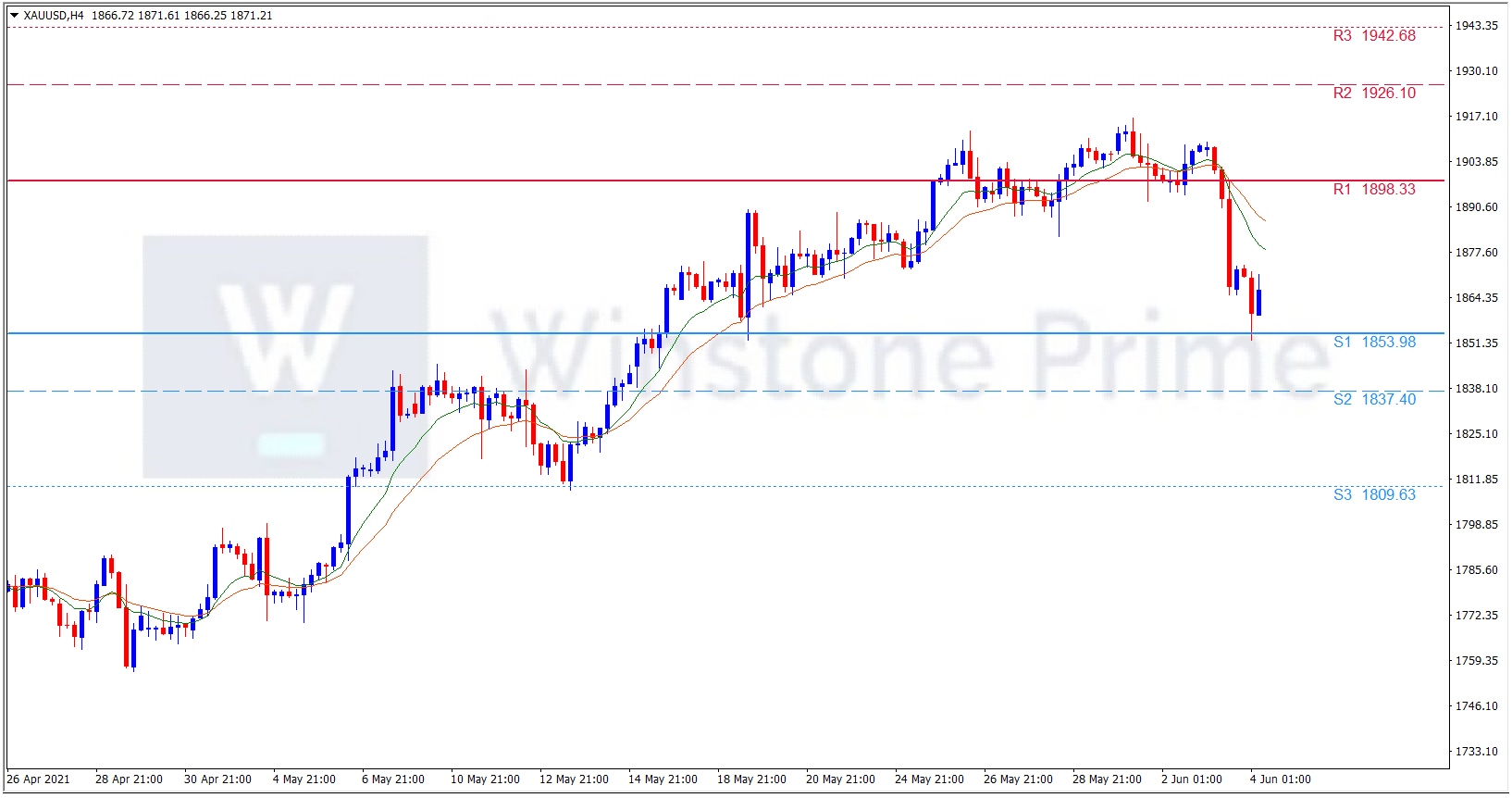
XAU/USD 4 Hour Chart:

Support: 1854.0 (S1), 1837.4 (S2), 1809.6 (S3).

Resistance: 1898.3 (R1), 1926.1 (R2), 1942.7 (R3).

Amidst the US macro data and hopes on US economy recovery favors the greenback against the precious metal; the next focus will be on U.S. nonfarm payroll numbers due on today. We expect a bearish trend for XAU/USD.

Release of macroeconomic data pressurizes AUD

The AUD/USD pair trades downside amid the release of both favorable and unfavorable Australian macroeconomic data.

On Wednesday the country reported that Gross Domestic Product was up 1.8% QoQ in the first quarter of the year, much better than the 1.5% expected.

Whereas Australia’s trade surplus has widened in April, increasing from $5.8bn to $8.0bn. That was broadly in line with expectations, But the Imports declined by -3.2%, -$1.1bn.

The fall in imports portrays a temporary dip after strong back-to-back gains, +4.7% and +4.5% for February and March. The underlying trend is one of goods imports recovery as the economy reopens and domestic demand expands.

Export earnings rose by 3.0%, up $1.2bn, a significant increase but falling short of the strong rise suggested by customs data. Coal exports bounced back, up $0.5bn, following the flood related disruptions which contributed to a $0.4bn decline in March. Metal ores rose $0.3bn on the higher iron price and rural goods lifted by a further $0.2bn.

Elsewhere, Commonwealth Bank Services PMI showed a fall of 58.0 which is less than market expectation and previous record of 58.2 The April final retail sales figure has dropped to 1.1% from 1.3% while meeting the expectation.

China has seen Caixin Purchasing Managers’ Index (PMI) report for May at 55.1 which is less than the previous record of 56.3 and expectation of 55.4.

On the other hand, Traders appear to be trading lightly this week because of the potentially hard-hitting United States non-farm payrolls report approaches. While the global economic reopening continues to gain momentum, concerns over rapidly rising prices in the economy have economists and investors alike worried that central banks may be forced to tighten policy should inflation measures continue to ramp up.

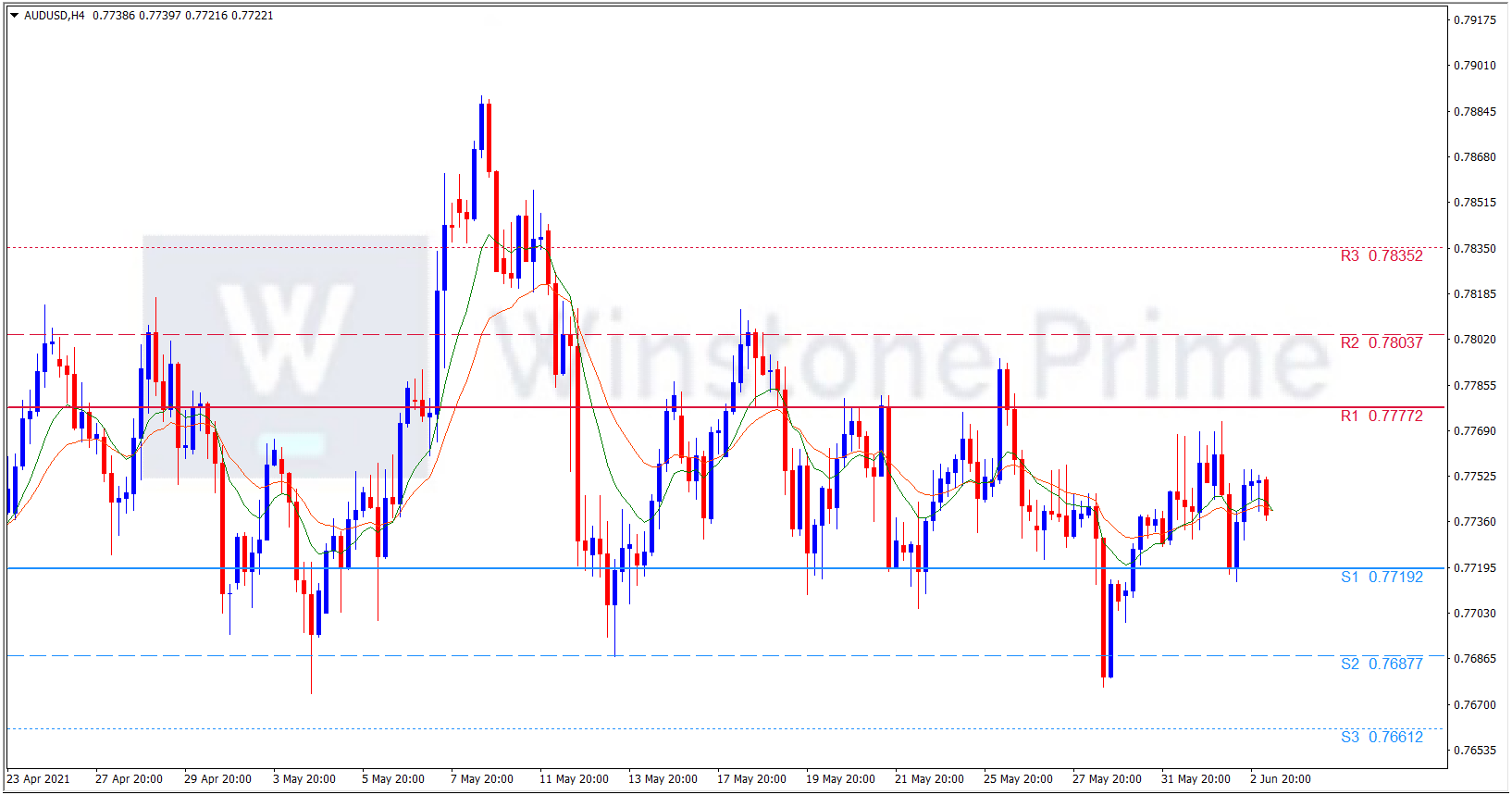
AUD/USD 4 Hour Chart:

Support: 0.7719 (S1), 0.7688 (S2), 0.7661 (S3).

Resistance: 0.7777 (R1), 0.7804 (R2), 0.7835 (R3).

Despite some macroeconomic data being favorable for Aussie, the unfavorable data along with the market concerns ahead of the US nonfarm payroll release pressurizes Aussie. We expect a bearish trend for AUD/USD.