Forex, or say its full title: Foreign Currency Exchange is the largest, most liquid market in the world. It is a decentralized global market, where all the currencies in the world are traded with more than $6.6 trillion traded every day. The Forex market deals with the 180 worldwide ‘fiat’ currencies; these are all currencies which are legal tender and backed by a centralised government.
On the other hand Cryptocurrency referred as ‘digital currency’ is a relative newcomer, but is rapidly making its mark with the number of investors increasing every year. Cryptocurrency trading is the act of speculating on cryptocurrency price via a buying and selling the underlying coins through an exchange. Cryptocurrencies work under the principle of blockchain technology, which indicates that they are decentralized, and they work without involving any third party/central authority; however, they can be stored in wallets.
Let’s see the similarities between the Forex and the Crypto before we move into the differences.
Forex and Crypto Play Together
Both markets are driven by supply and demand, and both the trading schemes can be highly volatile, indicating significant price changes.
Decentralization
Crypto market is decentralized market. All that means is there is no central regulation on the market. There’s a little secret: The forex market is also decentralized. FOREX.com is not a central regulatory body for forex, just a well-named exchange!
On its own, decentralization does not mean that a market is less stable. It does mean you need to watch your back when investing, but that should go without saying.
Same players
Crypto and forex markets include players varying from people to massive financial institutions, all either handling regular business or attempting to earn a profit.
Both deals with currencies
They both deal in currencies and rely on modern-day communicational technology to perform trading. Forex was introduced prior to IT advancements, whereas the concept of cryptocurrency was introduced later that relies completely on the internet for trading purposes. This is the reason it is also referred to as ‘digital currencies.’
Lets now discuss with the difference between the both
Market Size
The forex market is the world’s No. 1 market in the world for trading volume with a large margin. The global forex trading market is worth $1,934,500,000,000 (that’s $1.93 quadrillion). Put another way, this is 2.5X larger than the global GDP.
This huge size of the forex market gives it different level of liquidity when compared to cryptos. Forex beginners can start out trading currency pairs from stable countries with more protection from large losses before trading speculative ones.
Liquidity and Volatility
As compared to Forex, Crypto is a smaller market. So smaller amounts of money moves crypto more substantially than forex. Crypto market is more volatile compared to the Forex Market.
Increase in volatility means increased risk for investors, greater chance of an exponential upside as well as huge, financially crippling losses. Increase in volatility makes less liquidity because more people are naturally attracted to a smooth marketplace. Less volatility and high liquidity means the forex market can absorb economic shocks. This benefits the average person both investor and noninvestor with relatively stable currencies even in bad economic times.
Anonymity
Cryptocurrency has ability to foster anonymous transactions which helped the cryptocurrency initially . Government intervention has limited the ability of top coins like Bitcoin and Ethereum to hide identities, but smaller coins like Monero, Zcash and Verge retain this characteristic.
On the other hand Forex Market is regulated by a set of forex brokers and financial professionals known as the interbank market. Since the year 2014, the interbank market has incorporated a “know your customer” (KYC) standard that requires traders to provide personal information to access an exchange.
The Forex market is a very much sensitive to global events which makes foreign currency exchange rates so susceptible to economic data releases, central bank policy changes, and macroeconomic and political events.
Forex has low volatility
As already said, Forex has low volatility compared to cryptos. Forex assets are fiat currencies which are managed by central banks, and these banks can expand or reduce supplies of their respective currencies as they wish, giving them the ability to turn both demand and supply on or off. As central banks generally strive for relatively stable exchange rates for their currencies, Forex tends to be a relatively stable mean-reverting market most of the time, although persistent trends do of course happen, especially in the biggest currencies such as the U.S. Dollar and the Euro.
The cost associated in trading Forex is relatively low.
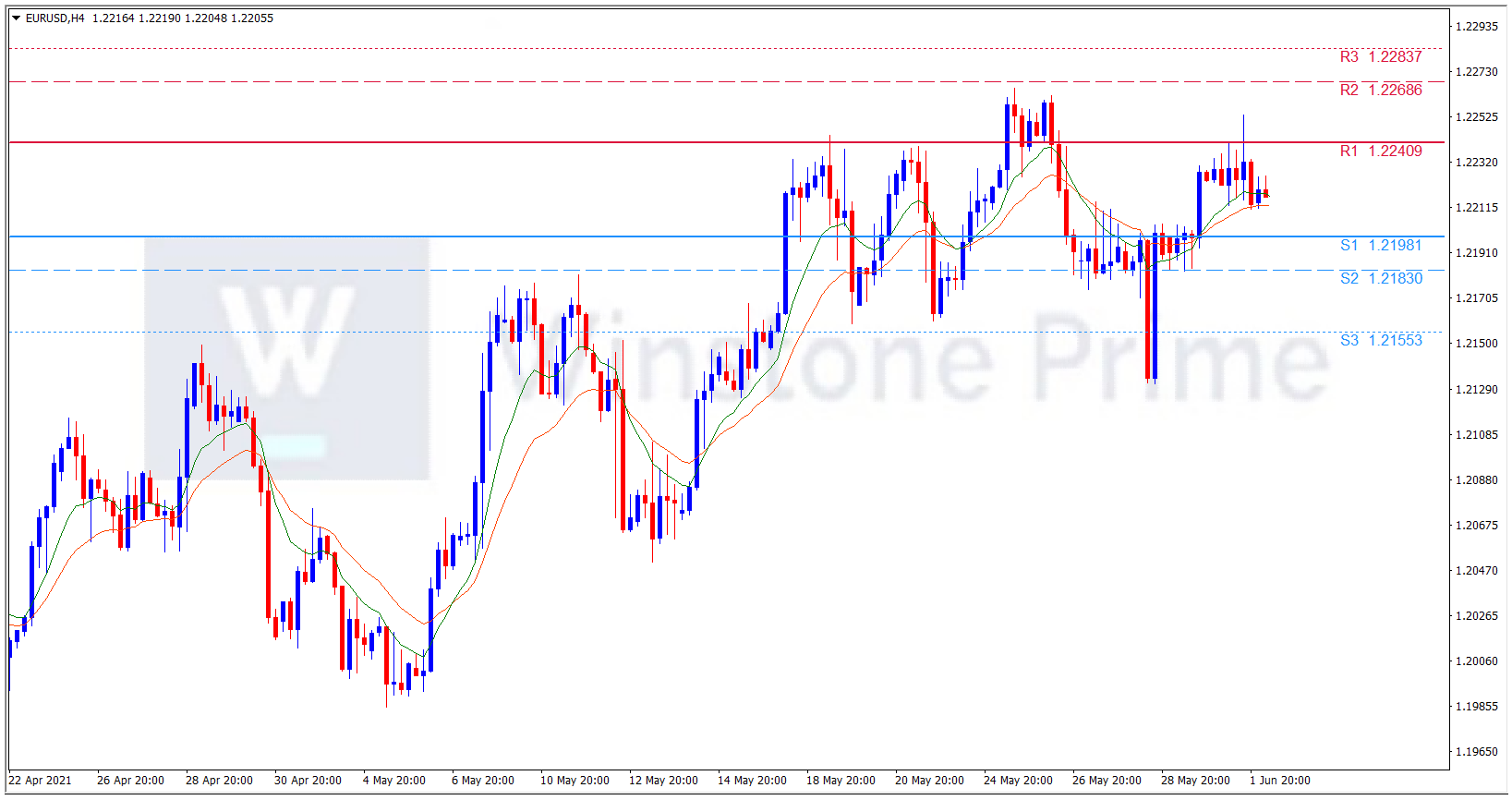
Retail Forex traders usually pay a spread of approximately 1 pip on a round trip trade in the benchmark EUR/USD currency pair, which represents a cost of less than 0.01% of the value of the asset traded. Whereas the costs of trading or investing in cryptocurrencies tends to be considerably higher when compared to forex.
Due to low volatility than cryptos, regulators usually allow retail Forex brokers to offer high leverage in Forex currency pairs
Regulators offer more leverage in forex as much as 500. This means that if you trade Forex, you can usually buy and sell much more Forex than the actual money you have deposited in your account, but it is not advisable to be very highly leveraged.
Forex is open from Monday till Friday whereas crypto’s can be traded during weekend also.
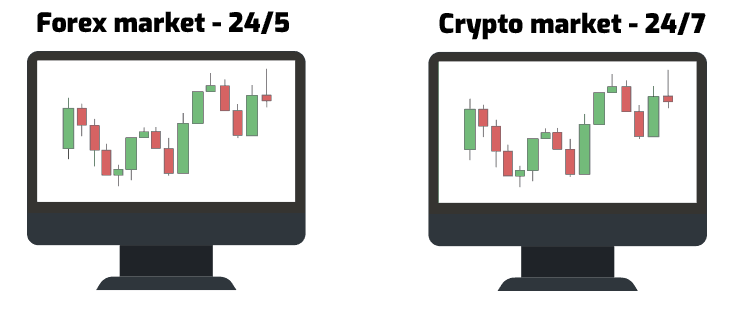
The retail Forex market is generally open from Monday morning in the far east until Friday night in the U.S.A. Essentially, it is open for business 24 hours per day, 5 days per week but Crypto’s can be traded during the weekend also.
There are three major Forex market sessions: American, European, and Asian, which occur during the usual business hours of these geographic areas. The sessions are dominated by New York, Tokyo, and London as the most important global financial hubs. Broadly speaking, the Forex market is most active and best traded during the London / New York session overlap, from approximately 9am to Noon New York time.
Buy and Hodl of cryptos safely can be beneficial
If you are about to buy and hold the legal ownership of cryptocurrencies, you will not incur any charges like swap (overnight charges). You cannot do this with Forex. But make sure to keep your password safe as you cannot recover, if it is lost or hacked.
Trading cryptos is costlier than forex
Earlier we discussed major Forex currency pairs can be traded at a cost of less than 0.01% of the value of the asset traded. It is relatively considerably more expensive to trade cryptocurrencies. For example, the major cryptocurrency Bitcoin usually has a spread/commission structure of about 0.10% of the asset traded, about 10 times the cost of trading EUR/USD. Also Spread is less in forex as compared to crypto due to low liquidity in crypto. Which makes profitable short-term trading in cryptocurrency more challenging in cryptocurrency than in Forex.
Cryptocurrencies, by excluding Bitcoin, are much smaller in capitalization than the national currencies which are traded in Forex.
The cryprocurrencies are more sensitive to micro issues that affect their own markets such as their integrity, adaptability, and popularity. In a sense, it is largely believed that in the end there will only be a few successful cryptocurrencies which become widely used, so the value of the smaller cryptocurrencies will tend to rise or fall depending upon how their chances of becoming a “successful” cryptocurrency are seen.
Cryptocurrencies has been more volatile than Forex currency pairs.
Over a year, a cryptocurrency might make a rise in value tenfold – 1,000% – while a major Forex currency pair may typically fluctuate by 10% over a similar period of time. Forex have central banks and national governments managing them, while cryptocurrencies does not have anything but only market forces acting on them, meaning they are far more likely to fluctuate wildly in price. This means that large amounts of money can be made by trading or investing in them, but risk levels are much higher. Cryptocurrencies are also far less liquid than most national fiat currencies.
Due to the nature of high risk and volatility, most brokers offer trading in cryptocurrencies at very low rates of maximum leverage.
The leverage offered to trade in cryptos are usually 5 to 20 which is comparatively less than forex.
Cryptos can be traded on weekends too
Unlike Forex, crypto markets tend to be open at weekends, meaning you can trade them on Saturdays and Sundays. You cannot do this with Forex.
Which One to Choose?
You choose to trade forex or crypto whichever, you must note that each type of trading has their own risk and rewards and positive and negative sides.
Generally speaking, Forex trading is the most popular form of trading in the world. All fiat currencies are legal tender which is government-backed, in that respect, they are considered reliable and tangible commodities. On the other hand, Cryptocurrencies are the complete opposite, there is no government backing, you have to trust the integrity of the company responsible for creating the currency and there is no actual commodity.
Both markets are similar in the sense that they are electronic trading forms of currency. All that you need is an access to the Internet and a computing device to start trading.
The liquidity of the forex market and regarding volatility of the crypto market means that traders would have to use different trading strategies for the two markets. The size, behaviour and structure of each market place is different. There are many similarities but equating them is just like comparing apples and mangos.
Opportunities have no boundaries. Many forex traders have recently turned to the cryptocurrency due to its increasing popularity. The decision of whether to trade forex or cryptocurrency totally depend on your personal goals, resources and risk tolerance level. We suggest you to spend some time to do your own analysis and research on both markets before choosing which one to trade.
Final words :
We hope that this article gave you some insightful information on both markets and might help you in making a decision or form an opinion on both the markets.
If you’re feeling ready and inspired to start trading cryptocurrencies or Forex, you may be pleased to know that Winstone Prime provides the ability to trade with Forex as well as Cryptos. Open account and start trading.