GBP/USD Weekly Forecast (24th May 2021 – 28th May 2021)

Fundamental view:

The British pound has rallied during the course of the trading week. The market is continuing trading depending on the expectations of rising inflationary pressures in the US and how those may affect the Federal Reserve monetary policy while uncertainty about the UK reopening played a role in moving the pound.

The UK has loosened many of the restrictions, but doubts crept in about the final stage due on June 21. The strain found in India consists of only a small part of overall COVID-19 cases but it is spreading rapidly. In the time being, Britain has only attempted to accelerate its vaccination campaign without stopping the reopening. That has supported sterling. 

US NY Fed Empire State Manufacturing Index on 17th May and US Building Permits on 18th May favored downtrend whereas US EIA Crude Oil Stocks Change on 19th May and US Philadelphia Fed Employment on 20th May favored uptrend for the pair.

The major economic events deciding the movement of the pair in the next week are Fed Governor Brainard Speech at May 24, BoE MPC Member Tenreyro Speech, US CB Consumer Confidence Index at May 25, UK Nationwide HPI yearly report, US GDP quarterly report, US Core Durable Goods Orders monthly report at May 27 and US Michigan Consumer Sentiment at May 28.

GBP/USD Weekly outlook:
Technical View:

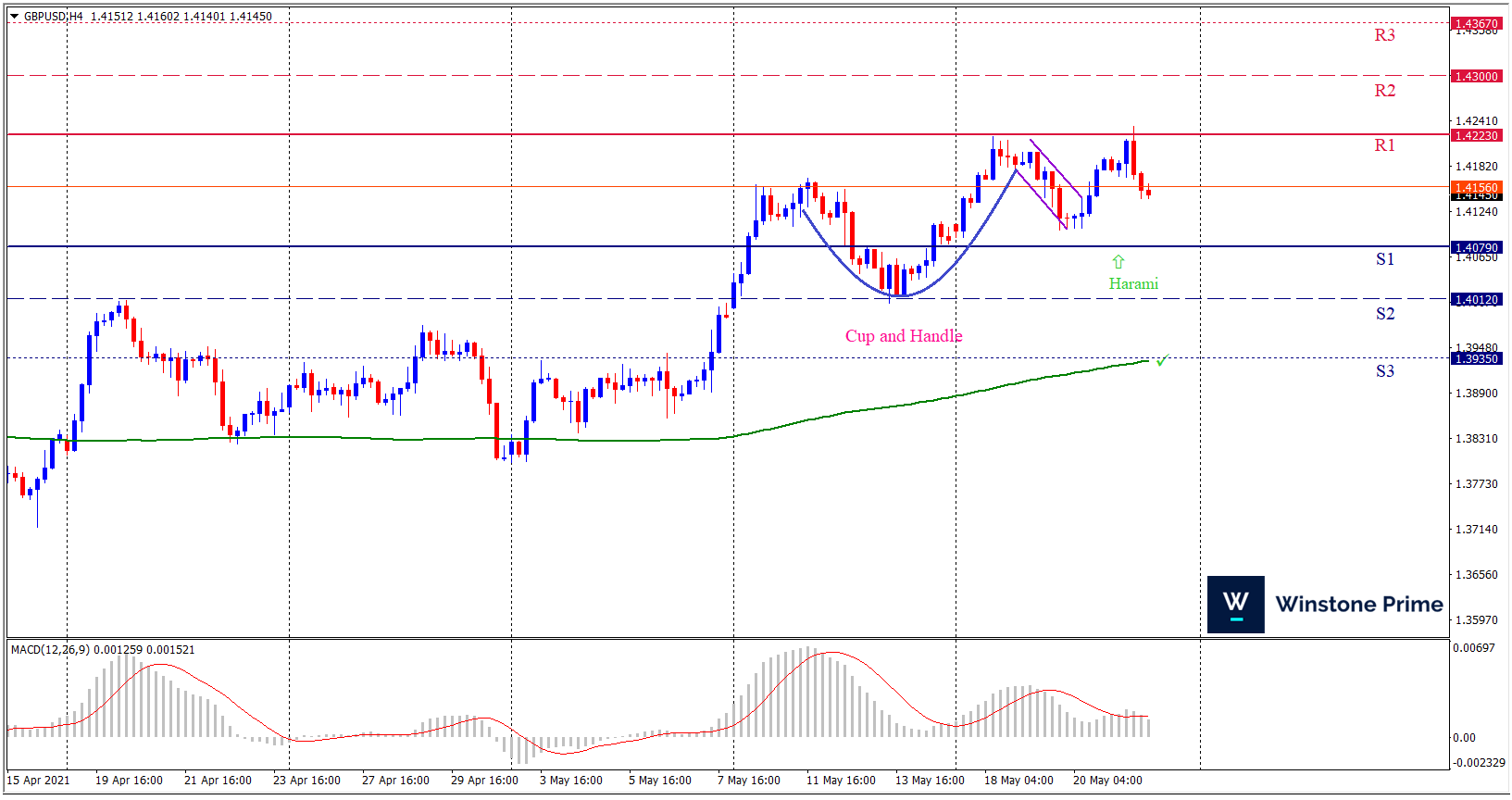
Last week’s high was 0.47% higher than the previous week. Maintaining high at 1.4234 and low at 1.4090 showed a movement of 144 pips.

In the upcoming week we expect GBP/USD to show a bullish trend.  The currency pair is trading above the 200 Simple Moving Average and the MACD trades to the upside. A solid breakout above 1.4223 may open a clean path towards 1.4300 and may take a way up to 1.4367. Should 1.4079 prove to be unreliable support, the GBPUSD may sink downwards 1.4012 and 1.3935 respectively. Chart formation of cup and handle pattern in H4 chart favors prospects of a bullish trend. Harami pattern formation escalates the expectation for a bullish trend.

Preference
Buy: 1.4152 target at 1.4296 and stop loss at 1.4074


Alternate Scenario
Sell: 1.4074 target at 1.3936 and stop loss at 1.4152

How to apply Pareto’s 80/20 principle in trading?

There are many question being asked daily by a lot of traders around the world, most of these questions are focusing on the best ways to get profits and to avoid or reduce the loss. This can be achieved by a good money management and risk management technique. A lot of techniques have been studied and published everyday.

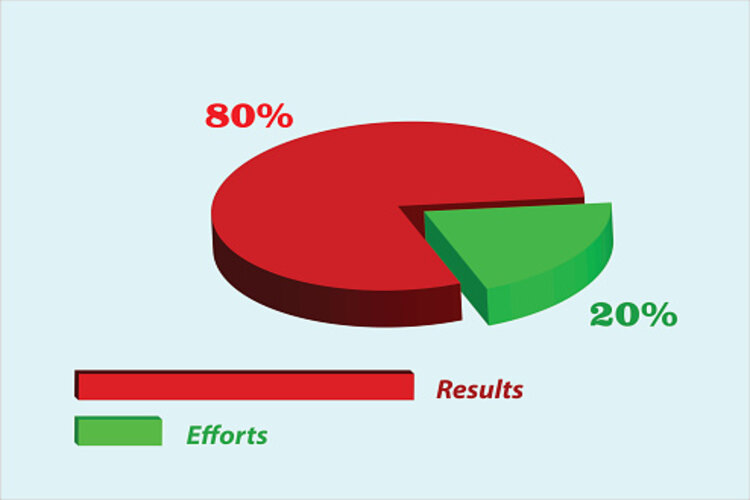
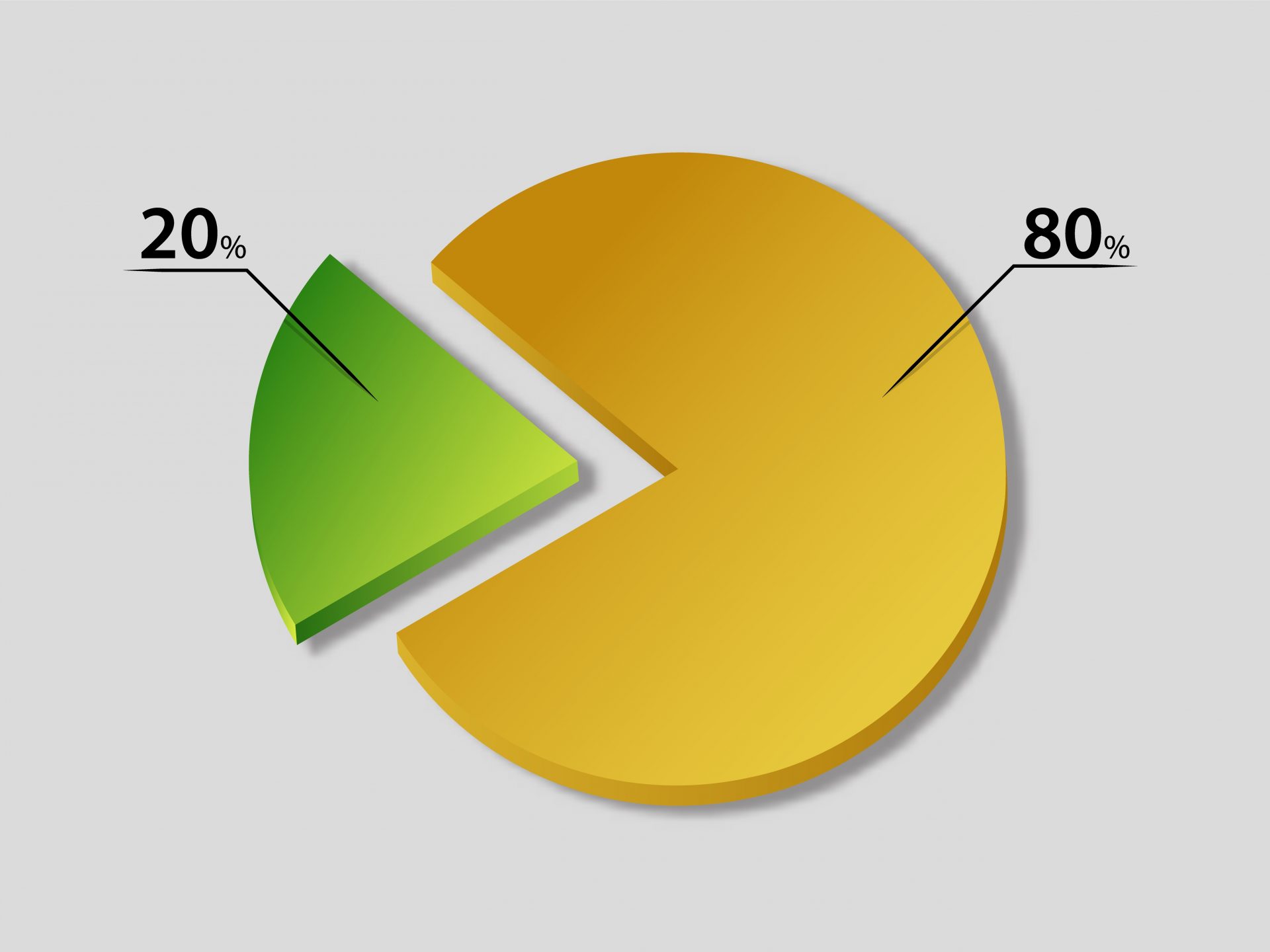
Pareto law is the one of the best techniques which is applied in the trading system. For many events, roughly 80% of the effects come from 20% of the causes? This law is also known as the 80-20 rule, the Pareto principle. It is the law of the vital few and the principle of factor sparsity. The 80/20 Rule was discovered in 1896 by the Italian economist Vilfredo Pareto, which is why the Rule is also called the Pareto Law, the Pareto Principle, and the 80/20 Principle. Pareto discovered the odd balance when he examined that 20% of his peapods contained 80% of the peas.

This article discusses how you can apply the simple logic of 80-20, which indicates that 20% of the input and effort will create 80% of the output or success.

Are the numbers always 80/20?

No, the 80/20 numbers are just an example used to illustrate this odd relationship between small and large. In reality the numbers can vary from case to case but the main characteristic is that they are unbalanced and far off from 50/50.

For instance, an ice cream shop might get 60% of its profits from 15% of its regular customers. This is also a valid example of the 80/20 Rule at work.

Traders and people in general tend to believe that each unit of effort or resource has (almost) an equal relevance for success. However, the 80/20 Principle bursts this bubble and shows that the numbers are highly skewed.

What are Pareto law measures?

Simply said, 20% (or equivalent) of the work or input will create 80% (or equivalent) of the success or output.

The work or input could be anything: resources, time, investment, effort, or skill in general, and your winners, losses, trades, or strategies for trading specifically.

The success or output can also be various: profit, revenue, mistakes, membership, customers, and ratings in general and for trading.

Here are a few more practical examples:

  • 20% of the peapods contain 80% of the peas (discovered by Pareto himself)
  • 33% of your hobbies will demand 90% of your time
  • 10% of tasks at work lead to 70% of your career achievement
  • 25% of your mistakes when trading lead to 75% of your losses
  • 20% of our the books can deliver 90% of new wisdom 


Pareto Principle in forex

80/20 rule pareto business concept with big word or text and team people with modern flat style - vector illustration

According to the Pareto 80/20 principle regarding forex, the following can be distinguished:

  • only 20% of transactions bring 80% of the profit.
  • 20% of analysis and market research contain 80% of the positive effect.
  • 20% intraday trading and 80% medium-term trading.
  • Only in 20% of cases, you need to be in a deal, in 80%, not so.
  • Your success depends on only 20% of the strategy and 80% of psychology and discipline.


Let’s further explain the above-mentioned points.

1. Only 20% of transactions bring 80% of the profit

Experts say that you should choose only the best deals. However, at the initial stage, we all try to conclude a lot of transactions in thirst for a quick profit. So you can look at your trading journal and see how usually 80/20 worked on your deposit.

2. 20% of analysis and market research contain 80% of the positive effect

It often happens that we spend too much time analyzing the market, looking for signals, and looking for trends and patterns. Because of this, subjectivity appears, we begin to look for signals that confirm our assumptions, and not signals that the market tells us. Leave the market all the dirty work and trade only on the system.

3. 20% intraday trading and 80% medium-term trading

Trading on a daily time-frame testifies the success of the trader, his/her confidence in his/her system, and trading style. We do not know a single billionaire who would have made his fortune on scalping strategies or trading on small time frames.

All successful traders traded or eventually switched to a longer time-frame. But, in order not to get bored, we advise you to open a small additional account to conclude transactions within a day.

4. Only in 20% of cases, you need to be in a deal, in 80% not so

This aspect has already been touched upon in the first paragraph. Still, it is worth adding that learning can help beginners correctly find the very 20% of the most profitable transactions, and bypass the remaining 80%.

5. Your success depends on only 20% of the strategy and 80% of psychology and discipline

The hardest part of trading is keeping your emotions in check. Also, you have to stick with the trading plan. And that’s how the Pareto Principle is applicable in Forex trading.

Conclusion

The implication here is clearly that you can eliminate about 80% of your trading losses by avoiding emotional or impulsive trading. The first step to trading with an ‘80/20 mindset’ is to master a simple trading strategy. You can choose any strategy from the list of trading strategies available. Just you need to focus more of your time on the real “money makers” in trading, which are money management and your own mental state. Thus, the 80/20 rule in trading is best applied by combining a simple trading strategy and a strong focus on money management and psychology. By following this principle, you can take your trading to the next level.

Japan’s trade balance favors the Yen

Japanese shares has made a gain on Friday, as a strong finish on the Wall Street made the traders to bet on cheap growth stocks, on the other hand stable U.S. interest rates also supported sentiment.

On Thursday, Japan published the April Merchandise Trade Balance Total, which did post a surplus of ¥255.3 billion, although the adjusted figure contracted to ¥65.2 billion, instead of exports soaring 38%, while imports were up 12.8%. March Machinery Orders declined 2% YoY, which has bet the expectations.

Elsewhere, The greenback has reached near milestone lows on Friday, and is heading for a weekly loss, as Investors initial concerns at taper talk in Federal Reserve minutes decreased – with actual tapering seeming distant and while pandemic recovery boosted other currencies.

On Wednesday, minutes from the April Fed meeting noted some committee members think that if the economy keeps improving, it might be appropriate, at upcoming meetings, to “begin discussing a plan for adjusting the pace of asset purchases”.

As per a recent data, The number of Americans filing new claims for unemployment benefits has dropped further below 500,000 last week, but jobless rolls increased in early May, which could hinder the expectations for an acceleration in employment growth this month.

Initial claims for state unemployment benefits fell 34,000 to a seasonally adjusted 444,000 for the week ended May 15, the Labor Department said. That was the lowest since mid-March 2020 and held claims below 500,000 for two straight weeks.

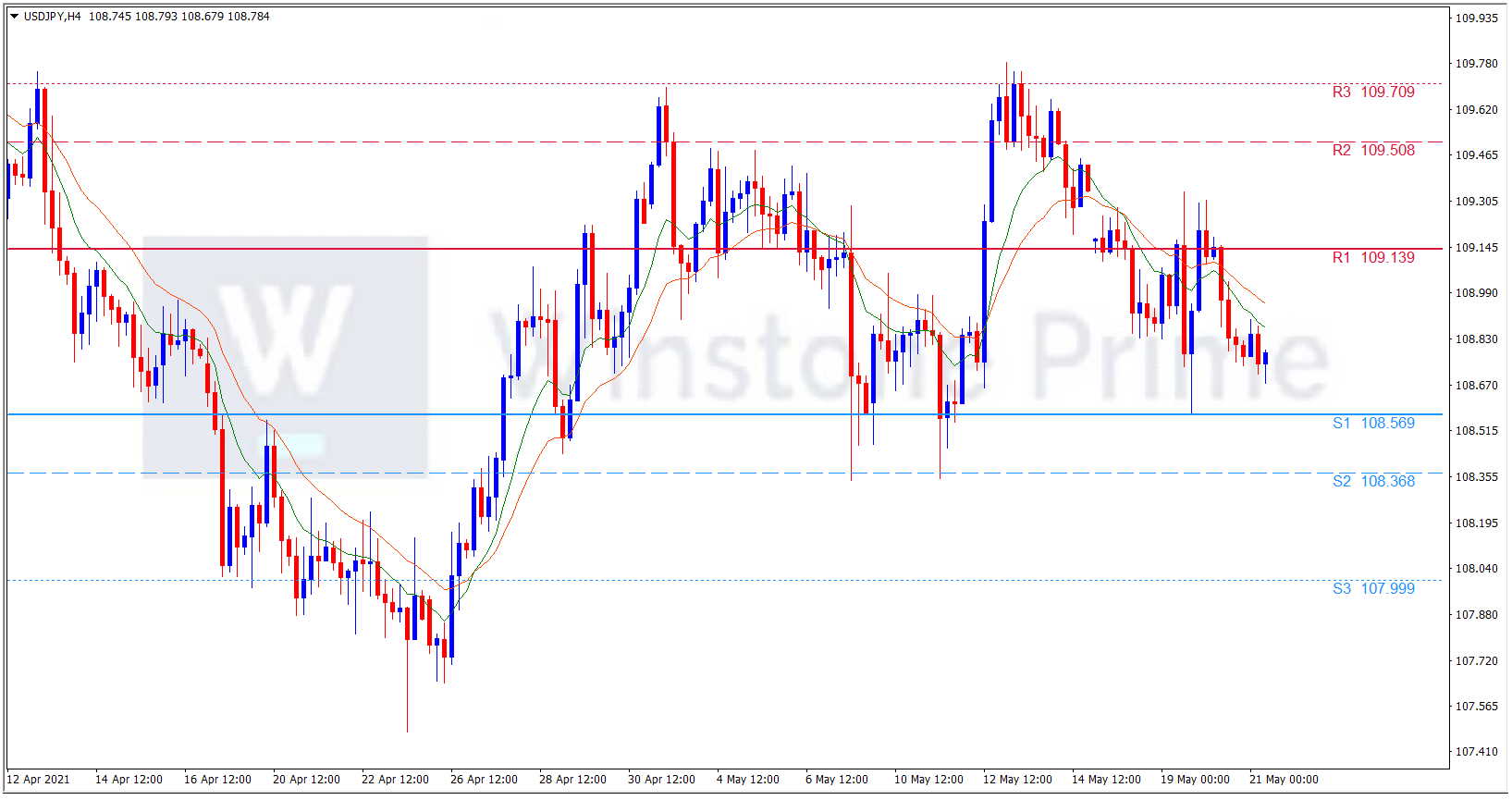
USD/JPY 4 Hour Chart:

Support: 108.57 (S1), 108.37 (S2), 108.00 (S3).

Resistance: 109.14 (R1), 109.51 (R2), 109.71 (R3).

Amidst all the catalysts favoring yen against the greenback. We expect a bearish trend for USD/JPY.

Yellow metal trades high after FOMC minutes

Gold prices are higher today after the FOMC minutes.

Safe-haven demand was featured in the yellow metal today as the U.S. stock market sold off and fall of US treasury yields. A selloff in the global equity markets provided a strong lift to traditional safe-haven assets and assisted the precious metal. The renewed weakness in the US Treasury yields offers fresh boost to gold price.

The FOMC April meeting’s minutes revealed that a debate on tapering of the bond-buying programme could be on the table “at some point.”

As per the FOMC meeting, Inflation pressures are increasing, with recent data showing the extent to which a supply/demand imbalance has made the prices to surge as materials producers struggle to keep pace with a reopening economy.

That has aroused fears that the Federal Reserve could hike interest rates sooner than expected despite the central bank’s assurances that current price spikes are temporary.  This inflationary worries has added support to the yellow metal.

On the other hand, Cryptocurrencies took the spotlight, plunging in the wake of regulatory moves from China.

“If there’s anything grabbing headlines at this hour it’s a crash in cryptocurrencies,” said Erik Bregar, head of FX strategy at Exchange Bank of Canada in Toronto. “That seems to be what everyone is focused on.”

The two main digital currencies, bitcoin and ether, fell as much as 30% and 45% respectively, but significantly pared losses after two of their biggest backers – Tesla Inc (TSLA.O) chief Elon Musk and Ark Invest’s (ARKK.P) Chief Executive Cathie Wood – indicated their support for bitcoin.

While many analysts thought the explosion in crypto interest this year was not sustainable, the trigger for the shake-out was China’s move on Tuesday to ban financial and payment institutions from providing cryptocurrency services. It also warned investors against speculative crypto trading.

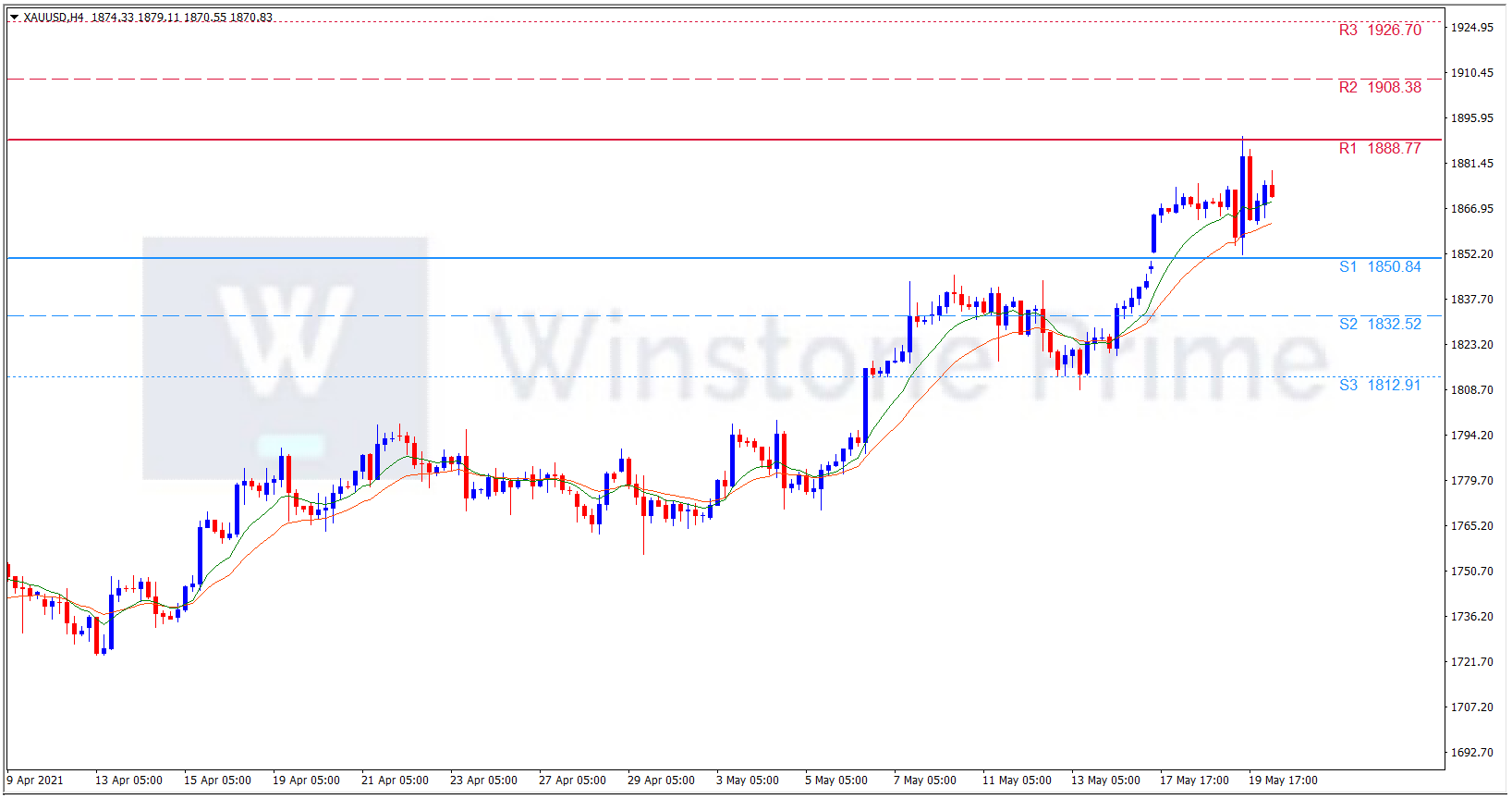
XAU/USD 4 Hour Chart:

Support: 1850.8 (S1), 1832.5 (S2), 1812.9 (S3).

Resistance: 1888.8 (R1), 1908.4 (R2), 1926.7 (R3).

The FOMC meeting minutes and the crash of crypto currency supported the yellow metal and we expect a bullish trend for XAU/USD.