
Future of crypto currency

Cryptocurrency has become a global phenomenom in recent years, although much is still to be learned about this evolving technology.

Cryptocurrencies have indeed proven resilient. Investor interest, both retail and institutional, in digital currencies has risen dramatically in recent months. Many early investors who were eager to make gains from the “cryptocurrency craze” have since moved on to other ventures, leaving a smaller group of stalwart HODL-ers behind. But there are still reasons to believe that the cryptocurrency industry has some fight in it left and there are many concerns and worries swirling around the technology and its capacity to disrupt traditional financial systems.

Belief in the crypto currency technology:

Supporters of Cryptocurrencies claim that these financial platforms are inherently not dependent on any systems – that is, they’re not directly tied to any nation-state, government, or body. They argue that cryptocurrency technology is far superior to traditional physical currencies because it is not dependent.

But it’s not entirely accurate. They are still reliant on the underlying infrastructure powering cryptocurrencies ,much of which is located in China. The Chinese government could theoretically make changes to cryptocurrencies at a fundamental level by imposing its will on the data miners who keep them running.

Institutional Investors gets in the Game

Along with increasing numbers of the retail investors, institutions are climbing on board in a significant way for the first time. Institutional investors allow for significantly larger trading volumes than most individual investors, meaning that even if fewer trading partners are transacting in the digital currency space, the industry can still sustain itself.

The beginning of Institutional Investors started when MicroStrategy CEO Michael Saylor first publicly endorsed Bitcoin. As a publicly traded company dating back to 1989 and known for having lots of capital in excess reserves, Saylor coming out and publicly ringing the alarm of crypto and even calling it “superior to cash” indeed raised some eyebrows among institutions and created a snowball effect. 

Tesla Invested $1.5 Billion Into Bitcoin

Elon Musk, the self-proclaimed “TechnoKing” of Tesla, has recently made quite a name for himself in headlines. From being a leader of the meme-coin Dogecoin and likely having a massive hand in pumping Bitcoin after updating his Twitter bio to include Bitcoin and subsequently buying $1.5 billion worth of Bitcoin for Tesla, Musk and Saylor have put a face to the institutional acceptance towards cryptocurrency. Recently, Tesla has also made a announcement that customers can now buy their vehicles using Bitcoin. 

Paypal as an early adopter

PayPal has origins as being one of the pioneers in the digital world. With a history of promoting and simplifying transactions across borders within minutes, it only makes sense for them to jump on the board for cryptocurrency. 

Recently, they have introduced the ability for people to both buy and make transactions with cryptocurrencies such as Bitcoin, Ethereum, Litecoin, and Bitcoin Cash. Even though crypto enthusiasts have criticized PayPal for not letting users transfer their coins to a private wallet. Perhaps this is a feature that can come in the future and it’s a step in the right direction.  

Mastercard and Visa have joined the flow

Two of the biggest platforms for making payments worldwide have both publicly endorsed the use of Bitcoin. Visa is allowing transactions with stablecoins on the Ethereum blockchain. 

Mastercard has then followed and recently announced that their customers would begin transactions with crypto sometime in 2021. With two big payment giants hopping on the train, it seems that the doors are now open for broader mainstream adoption and practical use among business owners in the upcoming years.

Stablecoins Take the Lead

Stable coins have grown in popularity as a way to back cryptocurrency with assets that hold real value, almost in the same way U.S. currency used to be on the gold standard. Those assets could be other currencies or commodities virtually anything, really.

Stable coins are digital tokens that are pegged to a fiat currency that act as hedging mechanisms against the potential decline of underlying cryptocurrency collateral prices—and they may just be the industry’s best hope going into 2021.

Future of crypto currency - 3

Stablecoins might see growth next year for two reasons. First one is a result of the long-term instability of non-centralized tokens and second is the current leader in the stablecoin industry, tether, is positioned to be dethroned.

As one of the earliest stablecoins to reach the mainstream, Tether (USDT) has suffered a number of highly publicized growing pains while the sub-industry developed. Other stablecoins have already entered the field, aiming to take away its dominance.

Launch of Bitcoin ETFs

For cryptocurrency enthusiasts and investors looking to capitalize on the growing popularity of exchange-traded funds (ETFs), the possibility of an ETF that tracks bitcoin is the best opportunity for this type of connection.

What is an ETF ?

An ETF is an investment vehicle that tracks the performance of a particular asset or group of assets. ETFs allow investors to diversify their investments without actually owning the assets themselves. For individuals looking to focus only on gains and losses, ETFs provide a simpler alternative to buying and selling individual assets.

A bitcoin ETF is one that mimics the price of the most popular digital currency in the world. This allows investors to buy into the ETF without going through the complicated process of trading bitcoin itself. Moreover, because holders of the ETF won’t be directly invested in bitcoin itself, they will not have to worry about the complex storage and security procedures required of cryptocurrency investors.

What we know about crypto future

While it’s difficult to say which, if any, digital currencies will see dramatic price gains in 2021, we can say for sure that cryptocurrency is not going away anytime soon. Blockchain which is the underlying technology behind many cryptocurrencies has spread far outside of the digital currency industry and is likely to see new applications this year. Governments and regulators will continue to tackle with how to best facilitate and control digital tokens.

The prosperity and productivity of cryptocurrencies might have come and gone, but it is also a  possible thing that the crypto market still has a lot of upsides to go. But one thing is still a mystery whether cryptocurrencies were once positioned to upend the entire financial system. The fame of cryptocurreny will not end easily, so expect to hear from cryptocurrency-or at least its number-one fans-for another year at least.

Final words:

The cryptocurrencies are a hot topic in the global financial system. Their growth has been able to gain the attention of many speculators. Only after cryptocurrencies gain trust, they will be used on a wider scale. If the cryptocurrencies fail to gain that trust, then their boom might decline. They are still in their infancy, and it is not sure as to when they will be maturely traded in the markets globally. Many different cryptocurrencies have gained the required attention. Some nations have started to issue national cryptocurrencies. It is quite possible that shortly, the bitcoins might have a way for cryptocurrencies to flourish.

Few historical examples are that the advent of the radio in fact led to increased record sales, and ereaders such as the Kindle have increased book sales. Now, we obtain news from the New York Times, blogs, Twitter, and personalized drone feeds alike. We consume media from both large entertainment companies and YouTube. Thus, over time, blockchain technology could exist in a larger ecosystem with both centralized and decentralized models.

There may be a large collection of both fiat currencies and cryptocurrencies existing side by side in future.

Pound is trading high ahead of CPI report

The re-opening of UK continues with people now allowed to be inside pubs and restaurants from Monday along with indoor socializing and a limited range of foreign travel. This should led a  helping hand to re-boot the service sector, an area that has been hit hard by coronavirus lockdowns, with people now able to spend in-store as well as online.

The recent covid-19 vaccination data showed nearly 70% of the adult population have had at least one dose, while just over 38% have had two doses. Thus this speedy action has enabled the UK government to stick to its re-opening plans, even though there are worries over a new Indian mutation. The government has said that while this new variant could cause the ongoing re-opening to a hault But the current vaccination program works against the new Indian variant.

The latest UK jobs data is optimistic and its release showed employment picking up and the unemployment rate falling which has also beat market expectations.

As per the recent news, the number of payroll employees has increased for the fifth consecutive month but remains 772,000 below pre-coronavirus (COVID-19) pandemic levels. Since February 2020, the largest falls in payrolled employment have been in the hospitality sector, among those aged under 25 years, and those living in London.

The cost of living in the UK as represented by the Consumer Price Index (CPI) for April month is due early on Wednesday at 06:00 GMT. The headline CPI inflation is expected to go to 0.1% from 0.7% prior on an annual basis while the Core CPI, which excludes volatile food and energy items, is likely to remain at the same level of previous reading 1.1. Talking about the monthly figures, the CPI could double from 0.3% prior to 0.6% during April.

Elsewhere UK is favoring the Aussie exporters. Boris Johnson is prepared to offer Australia tariff-free access to British food markets despite warnings that it could put farmers out of business. The prime minister is backing a plan to give Australian food exporters the same terms as those enjoyed by the European Union in what would be the first bespoke trade deal signed by the government since Brexit.

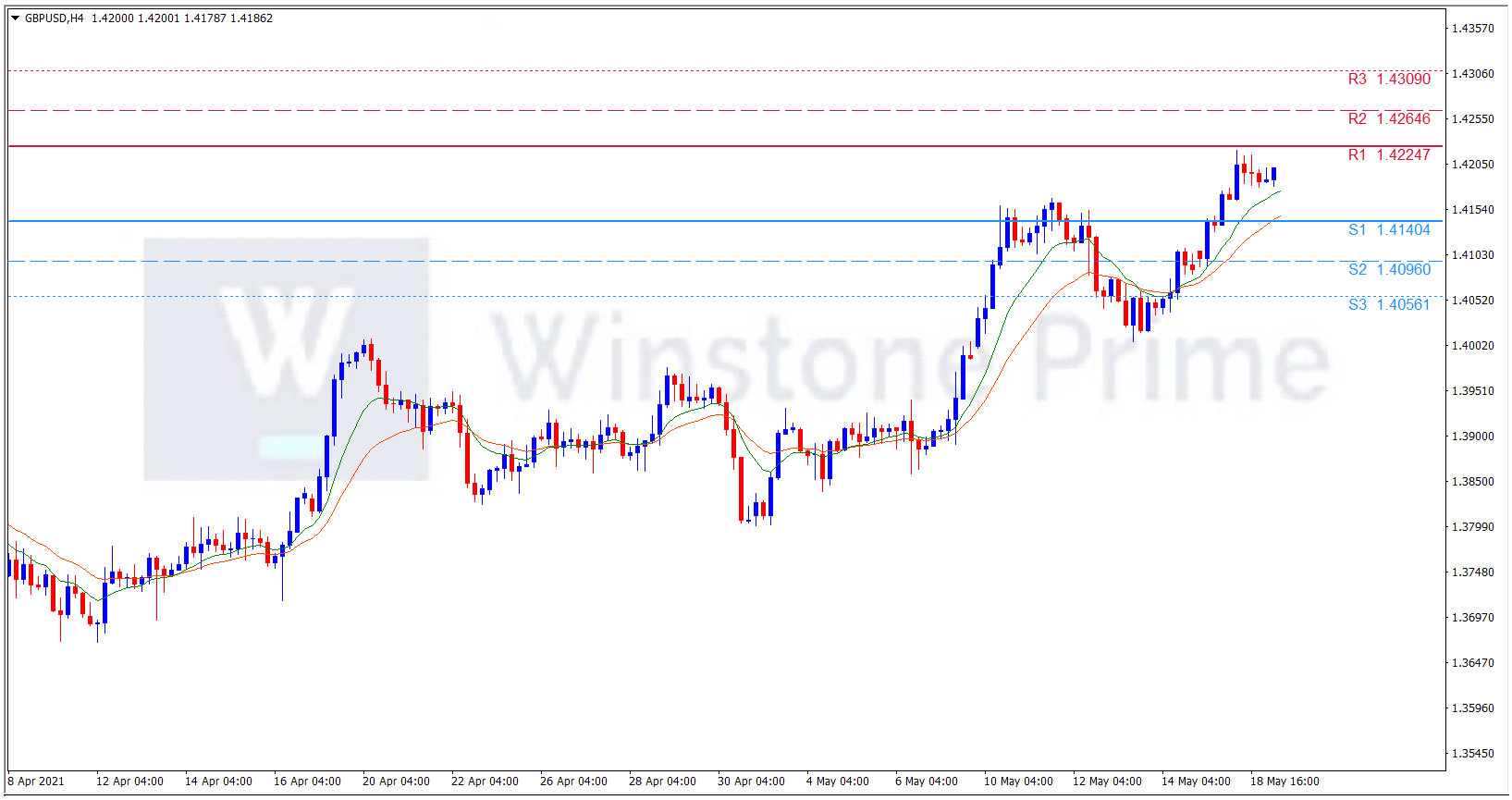
GBP/USD 4 Hour Chart:

Support: 1.4140 (S1), 1.4096 (S2), 1.4056 (S3).

Resistance: 1.4225 (R1), 1.4265 (R2), 1.4309 (R3).

The reopening of UK along with the favorable employment data favors the pounds. Traders will now keep an eye on the CPI report. In the meantime we expect a bullish trend for GBP/USD.

Rise in oil prices favors Loonie

The Canadian dollar is strong against greenback due to the upbeat Canadian economic data and greenback decline. A mixture of rising oil prices and rising Canadian wholesale sales for March has provided a boost for the Canadian Dollar.

Loonie seems  to be strong this week after Canada’s wholesale transactions beat forecasts and rose by 2.8% in March.

CIBC’s senior analyst, Royce Mendes, commented on Canada’s rising petroleum and coal products industry sales:

‘The good news is that the increase in March factory sales was relatively broad based, with 17 of 21 industries gaining ground, so not overly reliant on the pickup in motor vehicle production.’

The Canadian dollar has also benefited from an uptick in oil prices. The oil prices was lifted by European economic reopening’s and rising U.S. demand after prices fell earlier due to surging coronavirus cases in Asia.

Elsewhere as per the recent data, Canadian home sales, prices and starts all fell in April compared with the previous month, as some of the frenzy of recent months began to unwind, although activity remains strong,

Canada’s inflation report for April is due on Wednesday, which could offer clues on the Bank of Canada policy outlook. BoC Governor Tiff Macklem said last Thursday that “If the Canadian dollar continues to rise, it could create headwinds for exports and business investment as well as affecting monetary policy.”

On the other hand, Greenback suffered as Treasury yields fell amid renewed expectations the United States will not hike interest rates anytime soon.

Dallas Federal Reserve President Robert Kaplan on Monday reiterated his view that he does not expect interest rates to rise until next year, fueling a further decline in bets that inflationary pressure could force the Fed to act sooner.

This week a host of Fed policymakers are scheduled to speak, and the U.S. central bank will also release minutes from its most recent meeting, which may give indications about where monetary policy is headed this year.

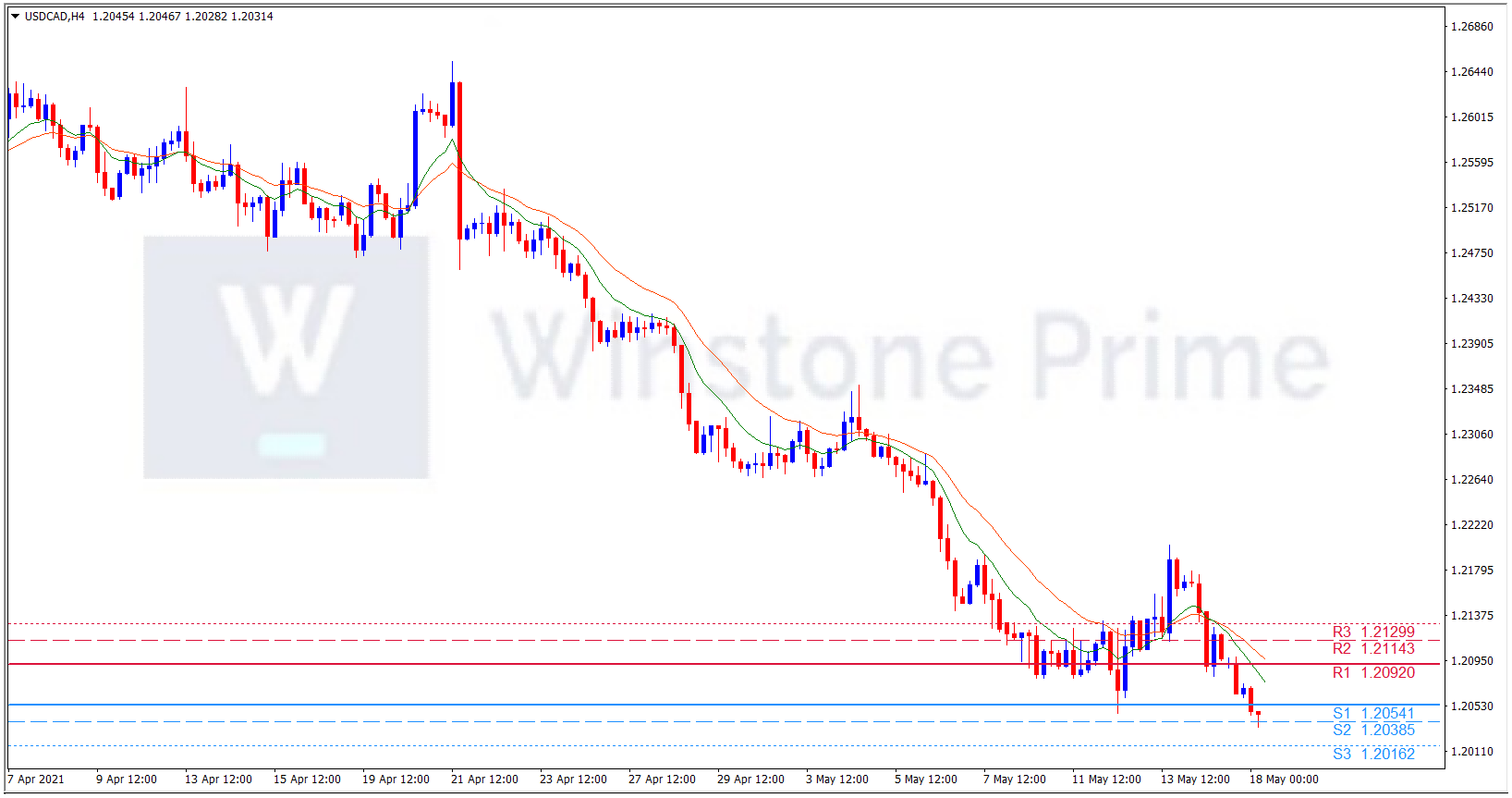
USD/CAD 4 Hour Chart:

Support: 1.2054 (S1), 1.2039 (S2), 1.2016 (S3).

Resistance: 1.2092 (R1), 1.2114 (R2), 1.2130 (R3).

The rising oil prices and Canadian economic data and US dollar weakness led to the strength of the loonie against greenback. We expect a bearish trend for USD/CAD.

How Yuan Become a Global Currency

In everyday speech, the yuan is on trend. Not only does it define the state of one of the world’s biggest economic superpowers, but it is also central to one of the most debated issues involving China today. Chinese money, however, comes by two names: the Yuan (CNY) and the people’s renminbi (RMB). The distinction is subtle: while renminbi is the official currency of China where it acts as a medium of exchange, the yuan is the unit of account of the country’s economic and financial system.

The world renminbi means, “the people’s currency.” There had been a consensus among economists that the Chinese currency has been undervalued in the 15% to 40% range for many years. Likewise, when checking the forex market, the Chinese currency must be read as Yuan and not Renminbi. Just like the Sterling is read as Pounds when checking the GBP pair.

China relationship between US Treasuries

China’s exporters receive dollars when they ship goods to the U.S. They deposit them into their local banks. The bank pays them renminbi in return, which they use to pay their workers and local suppliers.

The local banks then transfer dollars to the central bank. It uses the dollars to purchase U.S. Treasury bonds, which pay interest. As a result, China has become one of the largest foreign holders of U.S. Treasuries.

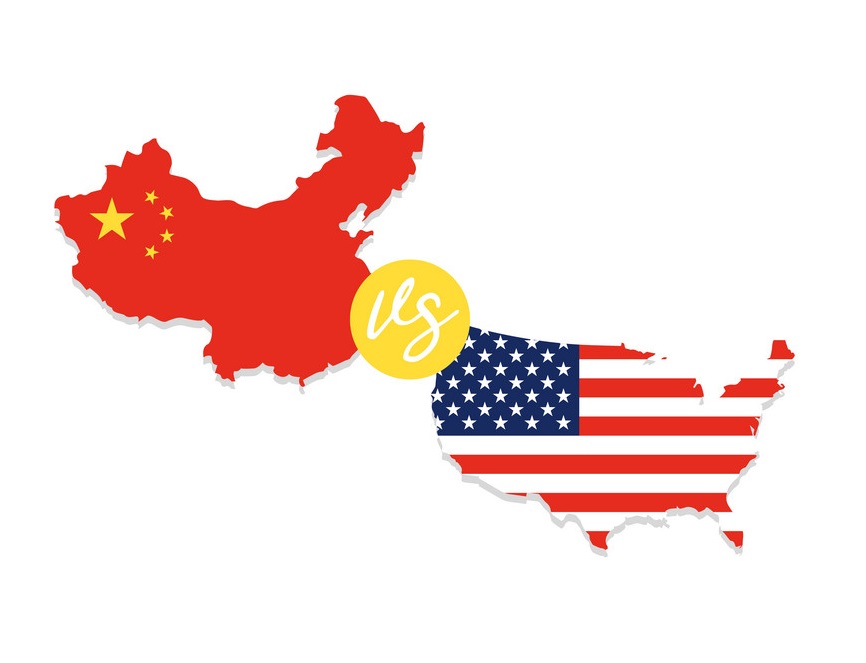
China’s leaders want to improve the standard of living and increase its economic output. The Chinese have “pegged the yuan” to the US dollar but via an adjustable peg or “managed peg”. This floating peg has generally been on a downward trend since 2015 implying that the yuan has been steadily devaluing against the dollar, making Chinese exports relatively more competitive against dollar prices around the world. That allowed China’s economic growth to soar thanks to low-cost exports to the United States. As a result, China’s share of international trade and gross domestic product grew to around 10%. This has been a source of trade friction between China and the US.

As trade grew, so did the yuan’s popularity. In August 2015, it became the fourth most-used currency in the world. It rose from 12th place in just three years. It surpassed the Japanese yen, Canadian loonie, and the Australian dollar. Central banks should increase their foreign exchange reserves of yuan to provide funds for that level of trade. Central banks alone should purchase about $700 billion worth of yuan. But banks never purchased all the euros they should have, even when the European Union was the world’s largest economy. Most international transactions are still done in U.S. dollars, even though its trade has dropped.

The IMF requires China to liberalize its capital markets. It should allow the yuan to be freely traded on foreign exchange markets. That allows central banks to hold it as a reserve currency. For that to happen, China’s central bank must relax the yuan’s peg to the dollar. China must have clearer communications about its future actions regarding the yuan. That’s what the Federal Reserve does at each of its eight Federal Open Market Committee meetings.

In August 2015, the PBOC relaxed the yuan to dollar conversion rate.

Instead of a fixed exchange rate, it would set the yuan’s value to its closing value on the previous day. Instead of rising, as many expected, the yuan fell 3% over the next two days. The PBOC stabilized the rate. It now has the freedom to allow the yuan to be a stronger tool in monetary policy. The drop also silenced critics of China’s reforms, many of whom were members of the U.S. Congress. In December 2015, the Bank announced it would begin to shift the dollar peg to a basket of currencies. That basket includes the dollar, euro, yen, and 10 other currencies.

Any country that keeps its currency artificially low to boost cheap exports can be accused of currency manipulation. Countries with low currency values export more because their products cost less than their competitors’ products.

Currency manipulation is difficult to prove. A fixed exchange rate, by its very nature, exposes a country to accusations of currency manipulation. To make its case, the accusing country must prove that the accused kept its currency low simply to increase exports. In August 2019, the U.S. designated China as a “currency manipulator.” According to the U.S. Treasury Department, China has a history of undervaluing its currency to gain an unfair competitive advantage. 

Since 2014, when the yuan reached an 18-year high, China has been lowering the value of its currency. There are many reasons for that. In 2014, the dollar rose 15% against most major currencies, dragging the yuan up with it. As a result, the yuan was overvalued compared with other trading partners not pegged to the dollar. 

In 2015, the International Monetary Fund (IMF) designated the yuan as an official reserve currency. The IMF required the yuan to be more driven by market forces. As China relaxed controls, the yuan experienced greater market volatility. But the yuan didn’t rise, as many thought it would. It fell, indicating that the market thought the yuan was overvalued.

In 2019, China lowered the yuan’s value. It might have been trying to offset the rising cost of tariffs imposed by President Trump’s trade war. Later that year, the U.S. made its declaration about China being a currency manipulator.

The level of trade is not the only reason the U .S. dollar is the world’s reserve currency. The strength of the U.S. economy instills trust. Most important are the transparency of U.S. financial markets and the stability of its monetary policy. 

On the other hand, Stuart Oakley, managing director of Nomura at that time, pointed out in a 2013 article that China owns $4-5 trillion of unallocated central bank reserves and these could be in yuan. As more bilateral swap lines are set up and China moves further down its path of capital market liberalization, central banks’ appetite to own this currency will grow.

Could China’s ambition to make the yuan the world’s currency lead to a dollar collapse? Probably not. Instead, it will be a long, slow process that results in a dollar decline, not a collapse. 

When the yuan’s value is low, it reduces the prices of many products imported in the U.S. and other countries from China, which can be seen as positive by consumers. The biggest categories are computers, cell phones, apparel, and toys/sporting goods. Low import prices also minimize the threat of inflation. 

But a low yuan value is one reason for the large U.S./China trade deficit. The other reason is that China can pay its workers less than U.S. companies can because China’s cost of living is lower.  China’s demand for Treasurys helps keep U.S. interest rates low. That boosts the U.S. economy by lowering the cost of loans and allowing Congress to increase federal spending. 

China’s peg also influences the value of the U.S. dollar. When China’s central bank sells Treasurys, it lowers the dollar’s value by increasing the supply of dollar-denominated assets.  A dollar collapse won’t likely happen, however, because it’s not in China’s best interests. Selling a big chunk of Treasurys would quickly devalue China’s own remaining holdings. Even so, it’s unwise for the U.S. to allow itself to become so indebted to any other country.

Conclusion

The Chinese currency, the yuan, is systematically transforming into a global currency despite seasonal fluctuations as well as political uncertainties, according to financial experts and currency data recorded by the Society for Worldwide Interbank Financial Telecommunications (SWIFT), the current international payments network. Currently, 60% of global foreign exchange reserves are held in US dollars, compared with just 4% for the yuan, while the US dollar had a 38% share as a global payments currency in January this year, compared to the yuan’s 2%.

But this balance could tip sharply in China’s favour if Beijing starts forcing other governments to make payments in e-yuan for trade and development projects. Already there are plans to use DCEP in the Beijing 2022 Winter Olympic Games and throughout the various Olympic venues.