XAU/USD Weekly Forecast (10th May 2021 – 14th May 2021)

Fundamental view:

During the initial half of the previous week, the yellow metal had to struggle to rise above $1,800 and it fluctuated in a horizontal channel. As the greenback came under sell trend in the second half of the week, yellow metal gained traction and touched its highest level of 1843 since March.

The higher impact on the yellow metal trading upside came as the U.S. posted much weaker-than-expected employ006Dent data. The U.S. saw only 266,000 jobs created in April. And even though that the number is still healthy, markets were expecting to see one million jobs. The disappointment was doubled when the March figures were revised from 916,000 to 770,000.

The major economic events deciding the movement of the pair in the next week are JOLTS Job Openings at May 11, Core CPI monthly report, EIA Crude Oil Stocks Change at May 12, Initial Jobless Claims at May 13, Retail Sales monthly report and Fed Industrial Production yearly report at May 14 for US.

XAU/USD Weekly outlook:
Technical View:

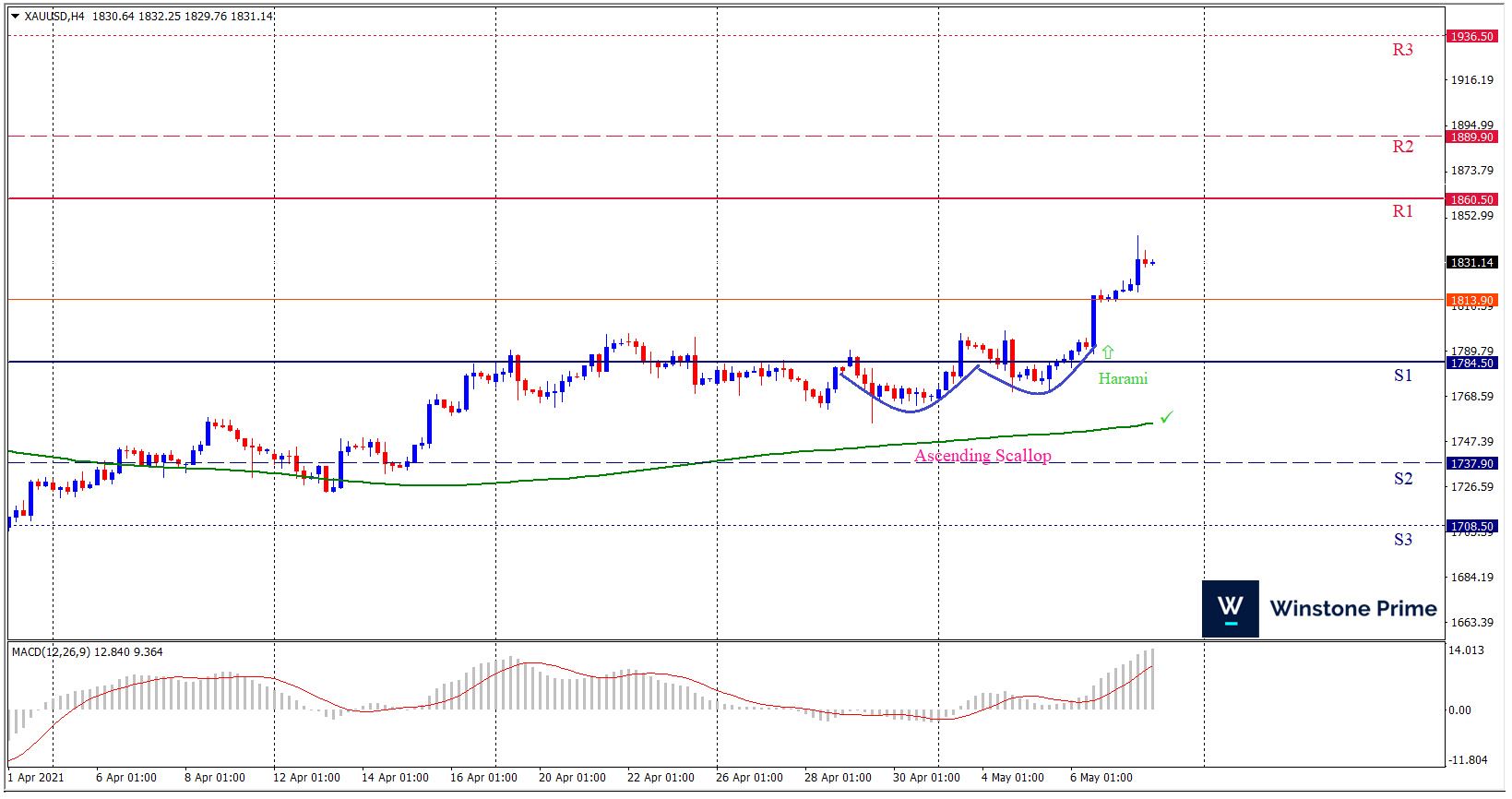
Last week’s high was 2.98% higher than the previous week. Maintaining high at 1843.3 and low at 1767.3 showed a movement of 760 pips.

In the upcoming week we expect XAU/USD to show a bullish trend.  The Instrument is trading above the 200 Simple Moving Average and the MACD trades to the upside. A solid breakout above 1860.5 may open a clean path towards 1889.9 and may take a way up to 1936.5. Should 1784.5 prove to be unreliable support, the XAUUSD may sink downwards 1737.9 and 1708.5 respectively. In H4 chart ascending scallop pattern favors prospects of a bullish trend. Also to be noted Bullish harami formation exerts the expectation of uptrend for the pair.

Preference
Buy: 1828.4 target at 1888.9 and stop loss at 1780.5


Alternate Scenario
Sell: 1780.5 target at 1709.7 and stop loss at 1828.4

Bonds: A low volatile product to be added in your profile

What is a bond?

A bond is a fixed income instrument that represents a loan made by an investor to a borrower (typically corporate or governmental). A bond could be thought of as an I.O.U. between the lender and borrower that includes the details of the loan and its payments. Bonds are used by companies, municipalities, states, and sovereign governments to finance projects and operations. Owners of bonds are debtholders, or creditors, of the issuer.

Investors purchase bonds at face value or principal, which is returned at the end of a fixed tenure. Issuers extend a percentage of the principal amount as periodical interest at fixed or adjustable rates.

Individual investors acquiring bonds have legal and financial claims to an organisation’s debt fund. Borrowers are therefore liable to pay the entire face value of bonds to these individuals after the term expires. As a result, bondholders receive debt recovery payments before stakeholders in case a company faces bankruptcy.

Fixed rate bond

A fixed rate bond is a bond that pays the same level of interest over its entire term. An investor who wants to earn a guaranteed interest rate for a specified term could purchase a fixed rate bond in the form of a Treasury, corporate bond, municipal bond, or certificate of deposit (CD). Because of their constant and level interest rate, these are known broadly as fixed-income securities.

 Floating-interest bonds

These bonds incur coupon rates which are subject to market fluctuations and elastic within their tenures. The return on investment through interest income is thus inconsistent as it is determined by market factors such as inflation, condition of the economy, and confidence of investors in an entity’s bonds.

Inflation-linked bonds

Inflation-linked bonds are special debt instruments designed to curb the impact of economic inflation on the face value and interest return. The coupon rates offered on inflation-linked bonds are usually lower than fixed-interest bonds.

ILBs thus aim to reduce the negative consequences of inflation by adjusting coupons concerning prevailing rates in the debt market.

Perpetual bonds

Perpetual bonds are fixed-security investment options whereby issuers do not have to return the principal amount to the purchaser. This investment type does not have any maturity period, and customers benefit from steady interest payments for perpetuity. These debt instruments are also called ‘consol bonds’ or ‘perp’.

Most bonds share some common basic features including:

Face value 

Face value is the money amount the bond will be worth at maturity; it is also the reference amount the bond issuer uses when calculating interest payments. For example, say an investor purchases a bond at a premium $1,030 and another investor buys the same bond later when it is trading at a discount for $950. When the bond matures, both investors will receive the $1,000 face value of the bond.

The coupon rate 

The coupon rate is the rate of interest the bond issuer will pay on the face value of the bond, expressed as a percentage. For example, a 5% coupon rate means that bondholders will receive 5% x $1000 face value = $50 every year.

Coupon dates 

Coupon dates are the dates on which the bond issuer will make interest payments. Payments can be made in any interval, but the standard is semiannual payments.

The maturity date 

The maturity date is the date on which the bond will mature and the bond issuer will pay the bondholder the face value of the bond.

The issue price 

The issue price is the price at which the bond issuer originally sells the bonds.

There are four primary categories of bonds sold in the markets. However, you may also see foreign bonds issued by corporations and governments on some platforms.

Corporate bonds 

Corporate bonds are issued by companies. Companies issue bonds rather than seek bank loans for debt financing in many cases because bond markets offer more favorable terms and lower interest rates.

Municipal bonds 

Municipal bonds are issued by states and municipalities. Some municipal bonds offer tax-free coupon income for investors.

Government bonds 

Government bonds such as those issued by the U.S. Treasury, Bonds issued by the Treasury with a year or less to maturity are called “Bills”; bonds issued with 1–10 years to maturity are called “notes”; and bonds issued with more than 10 years to maturity are called “bonds”. The entire category of bonds issued by a government treasury is often collectively referred to as “treasuries.” Government bonds issued by national governments may be referred to as sovereign debt.

Agency bonds 

Agency bonds are those issued by government-affiliated organizations such as Fannie Mae or Freddie Mac.

Advantages and disadvantages of Bond :

1. Low Volatility 

Bonds have a clear advantage over other securities. The volatility of bonds is lower than that of equities (stocks). Thus bonds are generally viewed as safer investments than stocks.

2. Capital Preservation 

Unlike equities, high-quality fixed income securities can serve as an all-weather foundation for a portfolio. This advantage can be seen even when looking at medium-term rolling returns for bonds or bond funds with capital preservation as their chief objective.

3. High Liquidity 

Bonds are often liquid. It is often fairly easy for an institution to sell a large quantity of bonds without affecting the price much, which may be more difficult for equities.

4. Diversification

Almost every investor has heard the phrase “don’t put your eggs in one basket.” It may be a cliché, but it’s time-tested wisdom nonetheless. Over time, greater diversification can provide investors with better risk-adjusted returns (in other words, the amount of return relative to the amount of risk) than portfolios with a narrower focus. More important, bonds can help reduce volatility – and preserve capital – for equity investors during the times when the stock market is falling.

1. Interest rates 

Bond prices rise when rates fall and fall when rates rise. Your bond portfolio could suffer market price losses in a rising rate environment. 

2. Volatility risk

Bond market volatility could affect the prices of individual bonds, regardless of the issuers’ underlying fundamentals.

3. Credit risk

Credit risk means that issuers could default on their interest and principal repayment obligations if they run into cash-flow problems.

How to trade Bonds ?

If you want to get started trading bonds, you’ll need a brokerage account. Bonds can be purchased through any forex brokerage account who offer bonds . In winstone prime you can trade 3 world’s famous bond – Eurobund, UK Long Gilt and US 10yr T-Note

Euro Bund 

The Euro Bund is a long-term bond issued by the Federal Republic of Germany, the Republic of Italy, the Republic of France, or the Swiss Confederation, with a fixed interest rate. It is a fixed-income debt instrument backed by the  government of Germany, so the product is considered minimal-risk security.

UK Long Gilt

A gilt is a UK Government liability in sterling, issued by HM Treasury and listed on the London Stock Exchange. This is a reflection of the fact that the British Government has never failed to make interest or principal payments on gilts as they fall due.

US 10yr T-Note

The 10-year Treasury note is a loan you make to the U.S. federal government. It’s the only one that matures in a decade. The note is a type of bond, which is the most popular debt instrument in the world.

Final Words :

In short, Bond trading is one way of making profit from fluctuations in the value of corporate or government bonds. It is viewed as an essential part of a diversified trading portfolio, alongside stocks and Forex. Open account in Winstone Prime and start trading Bonds.

The yellow metal hovers at high due to weaker dollar

The yellow metal prices on Friday has reached near a high of  2-1/2-month  and were on track for their best week in five months, which is aided by a weaker dollar and a pullback in Treasury yields as investors cautiously await U.S. non-farm payrolls report which will be released at 12.30 G.M.T later today.

Brian Lan, managing director at dealer GoldSilver Central said that “The weaker dollar and U.S. Treasury yields dropping below 1.6% has helped gold prices to go above $1,800.”

He also said “The U.S. jobs data is very important point .If data comes out really good, we can see people being more positive on the economy and it might lead to Federal Reserve increasing the interest rates earlier than expected, which will impact gold.”

The dollar index slipped to a one-week low against its major rivals, which made the yellow metal less expensive for other currency holders, while benchmark U.S. 10-year Treasury yields hovered close to a two-week low.

Investors now are awaiting for the U.S. monthly jobs report due at 12.30 G.M.T to measure the Fed’s strategy on monetary support going forward.  And the data released on Thursday showed weekly U.S. jobless claims dropped to a 13-month low.

Elsewhere, Fed Chairman Jerome Powell and others have been  repeatedly asked about whether they’re concerned over the rising prices. Powell specifically has said that as long as interest rates stay low, the valuations are justified. “High asset prices in part reflect the continued low level of Treasury yields. However, valuations for some assets are elevated relative to historical norms even when using measures that account for Treasury yields,” the report states. “In this setting, asset prices may be vulnerable to significant declines should risk appetite fall.”

In an accompanying statement, Fed Governor Lael Brainard said the situation bears watching and points out the importance of making sure the system has proper safeguards. She specifically mentioned having banks increase their capital requirements during economic expansions as a buffer against downturns.

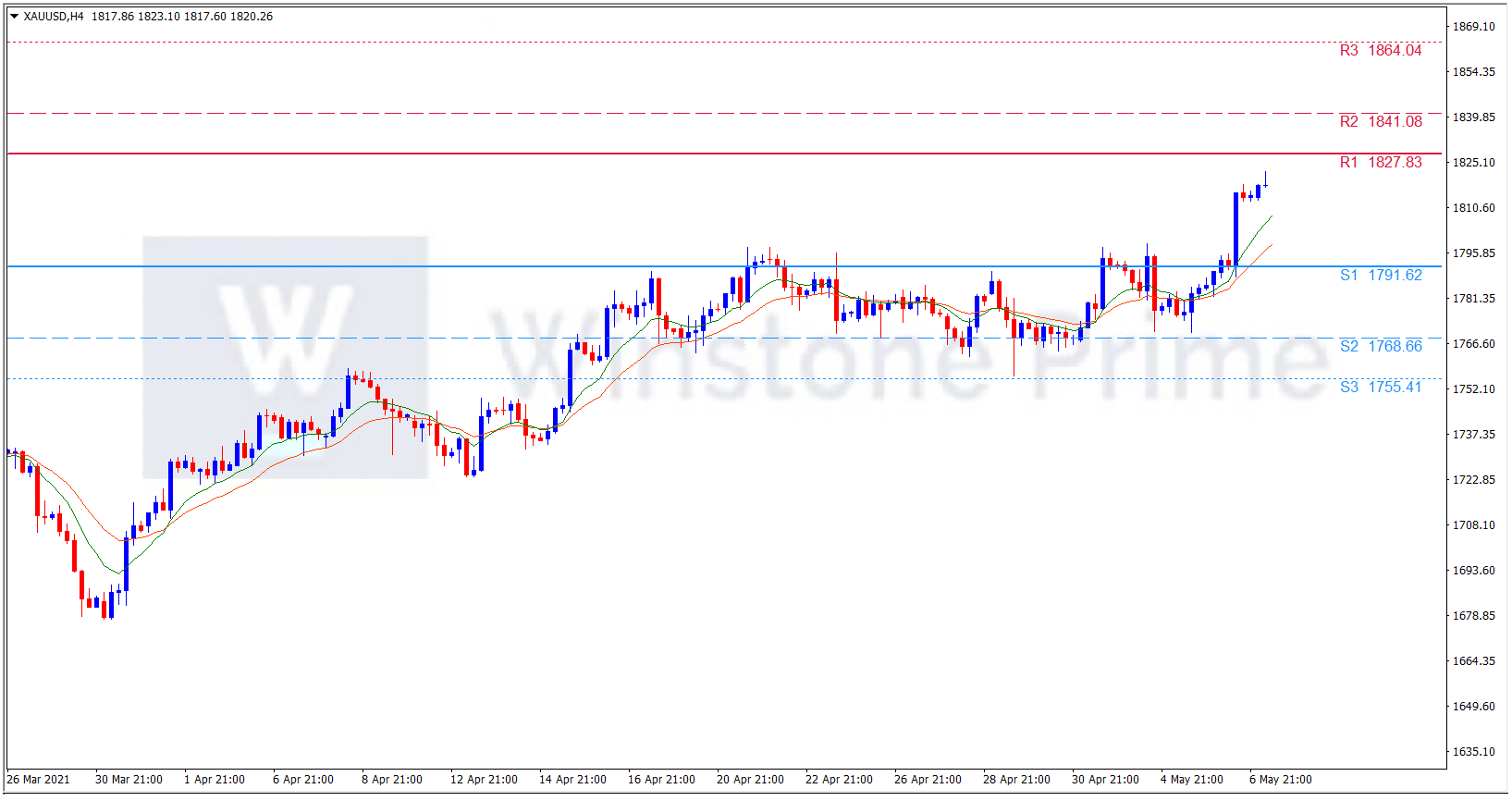
XAU/USD 4 Hour Chart:

Support: 1791.6 (S1), 1768.7 (S2), 1755.4 (S3).

Resistance: 1827.8 (R1), 1841.1 (R2), 1864.0 (R3).

Whether the US nonfarm payroll changes the direction of the greenback which is trading downside now, is yet to be seen. In the meantime we expect a bullish trend for XAU/USD.

Cable traders are cautious ahead of the Uk events

Cable traders are cautious ahead of the Uk events. The elections in the UK, including Scotland, as well as the Bank of England’s (BOE) Quarterly Inflation Report (QIR) could direct the cable further.

Britain holds its first local and regional elections since Brexit and the coronavirus pandemic on Thursday, In the recent years the United Kingdom has struggled to live up to its name, with tensions and old enmities flaring between the four nations that make up the kingdom – England, Scotland, Wales and Northern Ireland – and a resurgent threat that the union could disintegrate.

Votes on Thursday can lead to the opening of those divides further and the parliamentary election taking place in Scotland could even set the stage for a second referendum on independence, although public opinion on the debate is on a knife-edge.

The SNP’s leader, First Minister Nicola Sturgeon, is seeking a parliamentary majority after boosting her popularity with strong public engagement during the pandemic. She stressed in a televised debate on Tuesday: “Getting through this crisis is my priority.”

Elsewhere, the Bank of England is up for praising the economic recovery from the coronavirus (COVID-19), which in turn could brighten QIR forecasts. However, the tone of Governor Andrew Bailey will be watched closely for immediate direction.

On the other hand, The US dollar seem to gain some bid amid Asia as Beijing responds to the global leader anger over its political and trade behavior at the Group of Seven (G7) Ministerial Meeting. Also WHO Director- General Dr Tedros Adhanom Ghebreyresus has praised the commitment shown by Joe Biden’s administration to support the temporary waiver of intellectual property on Covid – 19 vaccines. This news also favors the greenback.

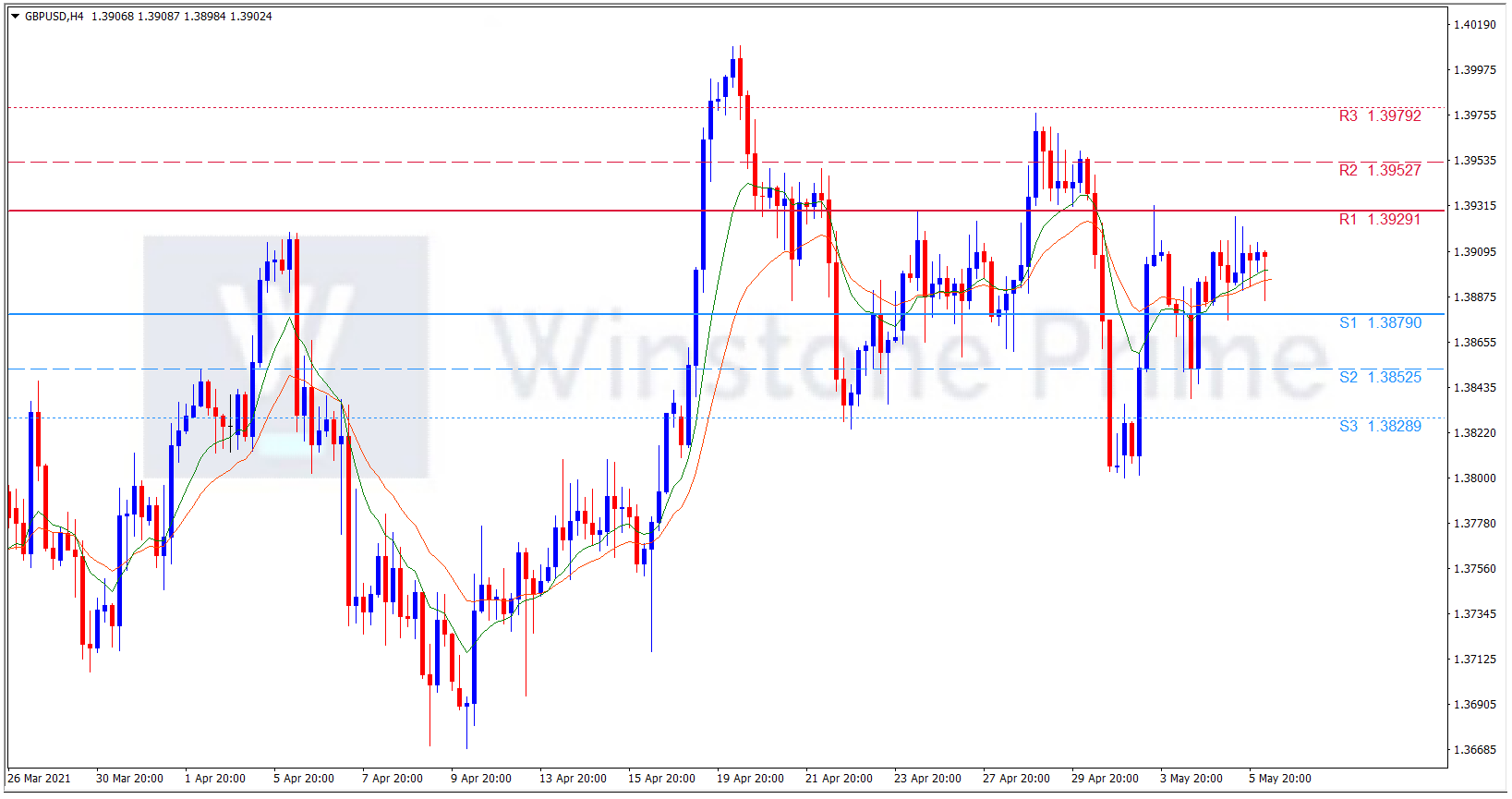
GBP/USD 4 Hour Chart:

Support: 1.3879 (S1), 1.3853 (S2), 1.3829 (S3).

Resistance: 1.3929 (R1), 1.3953 (R2), 1.3979 (R3).

The Uk election and BOE quarterly inflation report are about to shape the pound further. In the meantime, we expect a bearish trend for GBP/USD.