How To Use Economic Calendar Wisely

ECONOMIC CALENDER WISELY - 1

As a trader, the economic calendar is one of your best friends. You will only spend one minute with it a day (or less), but that one minute—every day—is crucial if you want to become a consistently profitable trader.

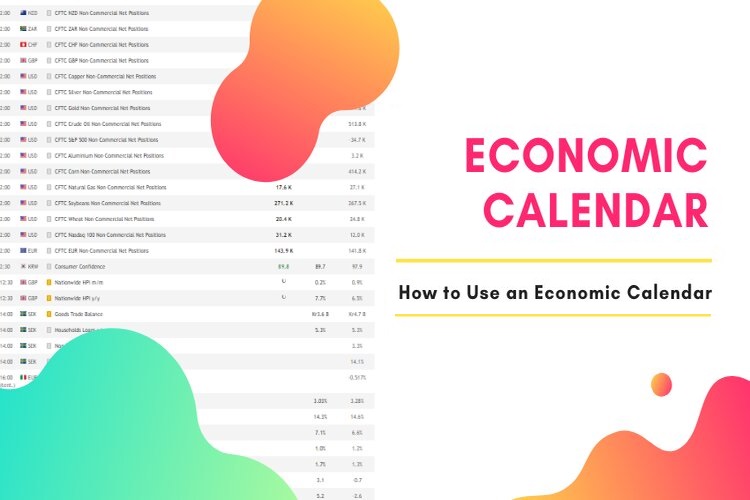
Defining an Economic Calendar

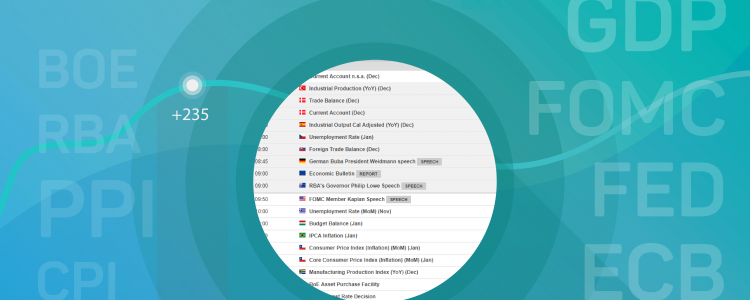
An economic calendar shows the scheduled news events or data releases related to the economy and financial markets. New GDP growth rate figures, the latest non-farm payroll numbers, and interest rate decisions—these are all examples of what you may find on an economic calendar. 

There are loads of these economic data releases—at least once a week on average, and sometimes every day during particularly busy weeks. These events are listed on the economic calendar, along with the scheduled time of the release.

Each event is graded, and those grades depend on which economic calendar website you use. Minor events that are expected to have a minimal market impact are either marked as “Low” (as in, “low impact”) or they may lack any special markings. Events that may have a market impact are marked as “Medium,” and they usually have a yellow dot or yellow star beside the event. Yellow indicates some caution is warranted at this time. Red stars, red dots, or “High” markings indicate a significant news/data release that is highly likely to move the market in a significant way and White indicates Market Holiday.

What to look for at an economic calendar?

Experienced traders examine future economic effects on a daily basis in an effort to predict the motion of a particular currency pair.

They usually stay way ahead of the announcements of crucial events and stimulate into action in a hasty manner, so that by the time a certain announcement is made, they will have already calculated the value of the currency pair they are interested in.

A simple, but efficient way for traders to keep following the information released from events, news, or statements are to have an economic calendar at their disposal. By utilizing such a vital trading tool, traders are able to follow key economic outcomes and also non-economic indicators, which may provide a clear vision to predict the market direction and also be aware of all the events expected to influence the motion of a particular currency. When these events are announced what needs to be considered is:  – were targets met, exceeded or missed?

If targets were met or exceeded, it can indicate that an economy is moving in a good direction, which can trigger buying.

If targets were missed, it can indicate that an economy is moving in a bad direction, which can trigger selling.

Events such as the above are announced usually in regards to the time of year. Often they will refer to the quarter of the year:

  • Quarter 1 (Q1): January to March
  • Quarter 2 (Q2): April to June
  • Quarter 3 (Q3): July to September
  • Quarter 4 (Q4)October to December


So you will end up with announcements such as GDP growth (Q2), for example, which will indicate the value of the country’s economic output in terms of services and products for that part of the year. That said, some events such as interest rates and inflation are announced every month.

How to wisely use Forex economic Calendar

Forex economic calendars are useful for all areas of forex trading. Let’s look at the top five reasons to have one. But before we start, we’d like to quickly mention that the best way to learn how to properly take advantage of a forex economic calendar

You can also take a look at our forex economic calendar here and our other market analysis tools here.

By properly utilizing a forex economic calendar, traders can craft an entry and exit strategy. You can pinpoint events that look like they may potentially be good to enter the market and pinpoint events that look like they may be good to exit. These entry and exit points could take place over the course of a day or a week or longer. But you need to bear in mind that unexpected events may take place between entering and exiting, especially if you leave that position open overnight. On top of that, you may incur fees. Ideally, though, you should enter and exit the market only when you can say for certain that the market movements you believe will happen can be confirmed.

For example, when the market is at a low point, wait for it to start to pull back before jumping on your anticipated movement. That way you can be sure what you have predicted will take place. Though you may miss the lowest possible point, you will be less exposed to risk. The same goes for the opposite.

There are a few strategies that work well alongside a forex economic calendar. Here are a couple we quite like.

Trade in the direction of the event

This strategy can work both ways, whether the news is good or bad. It works by waiting for the news event to occur and then immediately start trading.

If the news is good, you want to buy as quickly as possible and watch as the price sharply rises. When you see the market starting to return to normality, this is a signal to sell the instrument. You can work this out in a number of ways. Some suggestions may be to look for a double top or use Fibonacci retracements.

On the reverse, you can use this strategy to sell a currency pair before it depreciates or buy it after it makes a significant fall in price. But you have to believe that the currency will regain its strength. Further to that, you need to think about when this might be and if this is convenient for you. The longer you wait for a trade to become profitable, the more likely things can go wrong.

If the news is very severe, it is best to avoid the currency. An example of a highly severe situation could be the Greek banking crisis.

Scalping news with two pending orders

To do this you need to be very quick as the market will change fast and you need to be able to react to it. Once the change takes place, your strategy will need to change as well.

Here’s how you do it if you believe the news will be positive.

Create a buy order above and below the current market price. Set a target of around 20 pips from the price either way. This way you can enter the market if it climbs up or if it dips down first.

When one of your orders is activated, remove the other one and set up another order to take profit. Make sure you take profit order is reasonable and well-researched.

If the news is bad, it may be a good idea to cancel both orders and abandon the strategy. Either way, you should always place stop-losses, just in case and adjust them every so often if you feel it is necessary. If you use this strategy effectively, you stand the chance of making between 30-50 pips in profit in a very short time frame, sometimes in just a few minutes.

Volatile markets can present great opportunities to buy or sell. However, keep in mind that extremely volatile market conditions are far too unpredictable to enter and present too much risk. Highly active markets can be difficult to analyse effectively, and therefore it is hard to know what goals to set yourself in terms of entering and exiting. This is especially true for beginners who are still learning the basics.

In such markets, quotes may be incorrect. The market may be moving so much that the quote presented to you may be very wrong. Even in markets that supposedly show real-time prices, there can be discrepancies and you may buy or sell at a much higher or lower price than you initially wanted.

Then, even if you do decide to trade, there may be delays when your order is placed. Again, this may affect the price in which you buy or sell, further complicating your trading strategy. In worse case scenarios, online brokers may just stop working altogether.

If you know the news is going to be bad, you’ll know when it’s going to take place This also means you’ll know when you should take a day off and do something else for a while.

Not all events on your forex economic calendar will affect the market. Some events, if their outcome is known about for a long period of time, won’t move the market much at all. Use your forex economic calendar alongside fundamental and technical analysis.

Look at past similar events and compare them to the event you are looking at now. How have they previously affected the market? And if so, by how much? But don’t stop there. Why did they affect the market in that way? The circumstances may not be the same as before.

You can also go online and check articles and forums about the potential effect of the event. You may find that people are already talking about what is likely to be announced; it might already be a well-known fact. Despite the above, these kinds of events should still be closely watched, just in case a significant change takes place.

You won’t be like other inexperienced traders who ignored the news and fell victim to it. Their losses will be your gains. There are plenty of traders out there, many of which are newbies, who will overlook the importance of using a forex economic calendar. They may not actually understand how it works (big mistake!).

Using one will also make keeping a trading journal easier where you can record all your trades. These are very effective for traders, especially beginners, so they can learn how the market works and learn from their mistakes. Further to that, you can plan out your week while other traders wake up every morning unsure of where their trading journey will take them.

With a forex economic calendar, the large number of events can often make it confusing where and what to look for. Thankfully, many calendars allow traders to filter out different events by importance. By doing this, you can then focus on researching the most important events and estimate for yourself if you feel they are worth your time.

Shortlist the events you think show potential and then see if it is possible to build a strategy around them.

Many economic calendars work in similar ways. In most cases, events are labelled by colour:

  • Red – High impact event
  • Orange – Medium impact event
  • Yellow – Low impact event
  • White – Market Holiday

They will also likely display the actual value of an event, the expected value and the previous.

  • Actual – The current value of the market instrument.
  • Forecast – What the value of the instrument is expected to be when the event takes place.
  • Prior – The value of the instrument before the last event.

The wording of the above categories will vary depending on the forex economic calendar you use. And, of course, depending on the kind of data that is released, the way it is presented will look different.

Key points

If there’s anything you remember from this article, make sure it’s these points.

  • Use a forex economic calendar to strategise trades. Know what events can be used as great entry and exit points.
  • Keep track of the most important events. Not every event will have an effect on the market, focus solely on the ones you need.
  • Keep away from dangerous volatility. Some markets are just too unpredictable to be a part of, therefore you should know when to stay away.
  • Make smart decisions while everyone else is panicking. Be the one with a plan when other traders are struggling to understand why the market is acting so erratically.


Conclusion

By having a clear plan, you can be a much more effective trader, reduce risks and will be less likely to panic. A forex economic calendar can also help you with long-term trading goals as well. Forex trading should be looked at like a business and all businesses need a business plan. By properly understanding the events that will affect the market, you can plan out a whole year of potentially significant trades. Whether you trade forex, futures, or stocks, there is an economic calendar for you. Forex traders can use our economic calendar. Earnings have a significant impact on price, just like economic data releases.

Rise in Us treasury yield weighs on gold

Gold is trading low against greenback today the yellow metal is pressured by U.S. Treasury yields that are on the rise again, and by a slight rebound in the U.S. dollar index today.

Thursday’s report on first-quarter U.S. gross domestic product report showed a rise of 6.4% compared to market expectations for a rise of 6.5% from the fourth quarter.

Meanwhile, U.S. President Joe Biden recently proposed a sweeping new $1.8 trillion plan for families and education in a speech to a joint session of Congress.

U.S. jobless claims report showed 553,000 new claims, compared to expectations of 528,000 in new claims. Markets showed mild reaction to these reports that came in close to market expectations.

Elsewhere, more than 149.67 million people have been reported to be infected by the novel coronavirus globally and 3,290,675​ have died, according to a report.

A World Gold Council (WGC) official said on Thursday that China’s 2021 gold demand will see annual growth and will revert to pre-pandemic levels if there are no dramatic changes to the global economic and geo-political situation.

Japan’s industrial output posted a surprise increase in March, as a jump in car production helped keep an economic recovery from last year’s deep coronavirus slump on track.

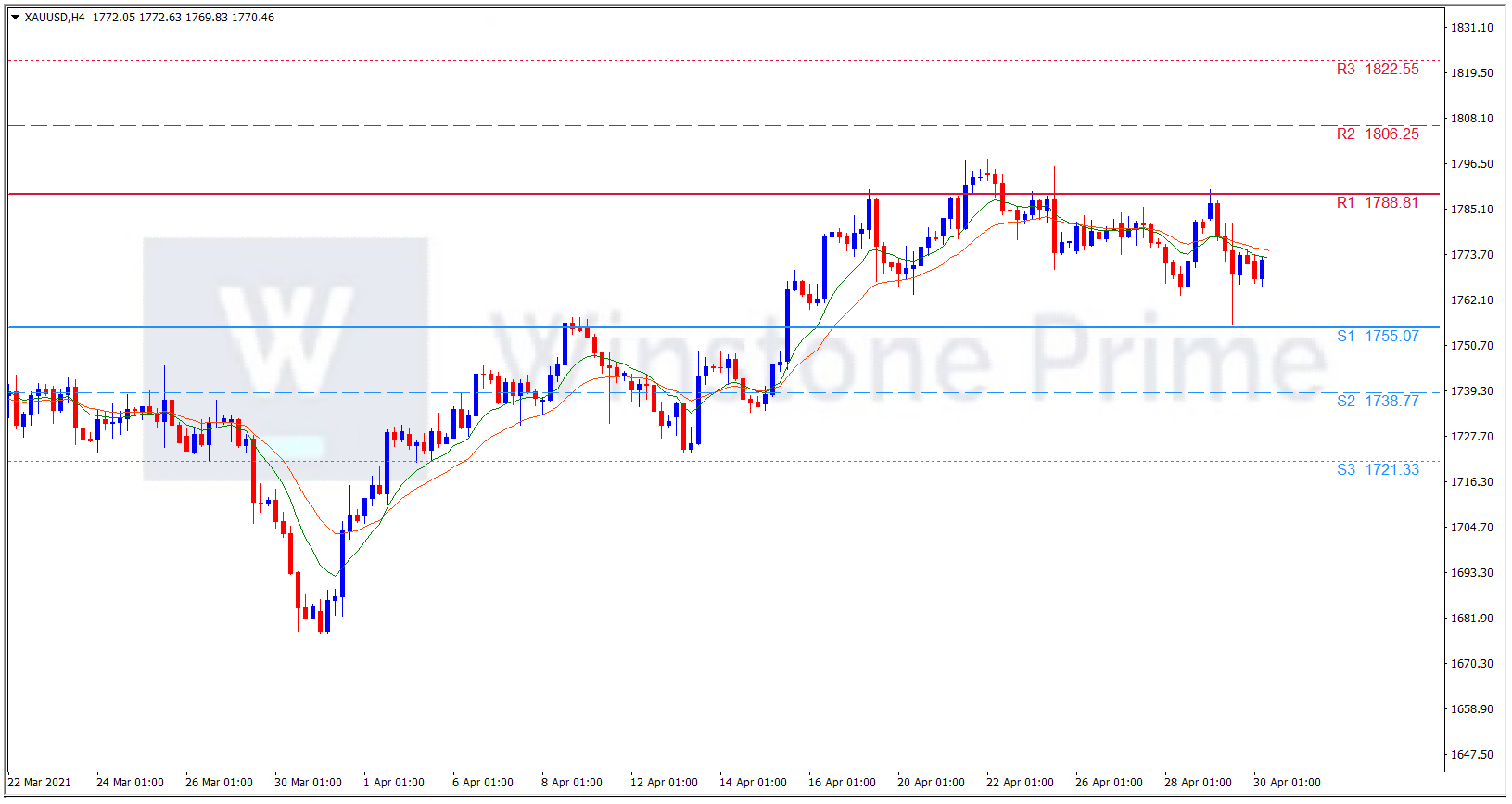
XAU/USD 4 Hour Chart:

Support: 1755.1 (S1), 1738.8 (S2), 1721.3 (S3).

Resistance: 1788.8 (R1), 1806.3 (R2), 1822.6 (R3).

Lack of major data in Asia adds to the sluggish markets which also weighs on the bright metal. We expect a bearish trend for XAU/USD.

Pound trades upside in a expense of US dollar index

The Pound has gained strength and accumulates a move showing its strong gains in the past few sessions.

The pound has made gains with the response to the US dollar index (DXY), which tracks the movement of the greenback against its counterpart. The index lost its ground on Wednesday and fell to multi-week lows, thus exerted pressure on the dollar and helped the pound. This move was sponsored with the help of the unchanged and widely anticipated tone of the US central bank approach on its current accommodative monetary policy with the Fed maintained status-quo on short term interest rates and a bond-buying program.

The comment from Fed Chair Jerome Powell came just before US President Joe Biden’s first speech to Congress on the unveiling of a sweeping package for families and education. Investors already reacted to this decision earlier and, thus, remained unfazed largely by the announcement.

“The risk is the Fed is very cautious and delays taking the first steps to normalising policy,” said Joseph Capurso, head of international economics at CBA. “Low interest rates amid an improving U.S. and global economy is a recipe for the dollar to continue decreasing.”

Even the outperformance of the U.S. economy had a sting in the tail for the dollar as it sucked in imports and drove the trade deficit to record highs in March.

Elsewhere, the sterling also seem to be benefited from better economic recovery prospects after the pick up in covid vaccine roll-out programme which  overcomes difficulties in the supply of the essential vaccine. Further,  the optimism around the Brexit deal, after the EU Parliament voted by a large majority to give the final approval to the Brexit deal amid confusions, complaints and a court challenge, lifted the sentiment around pound.

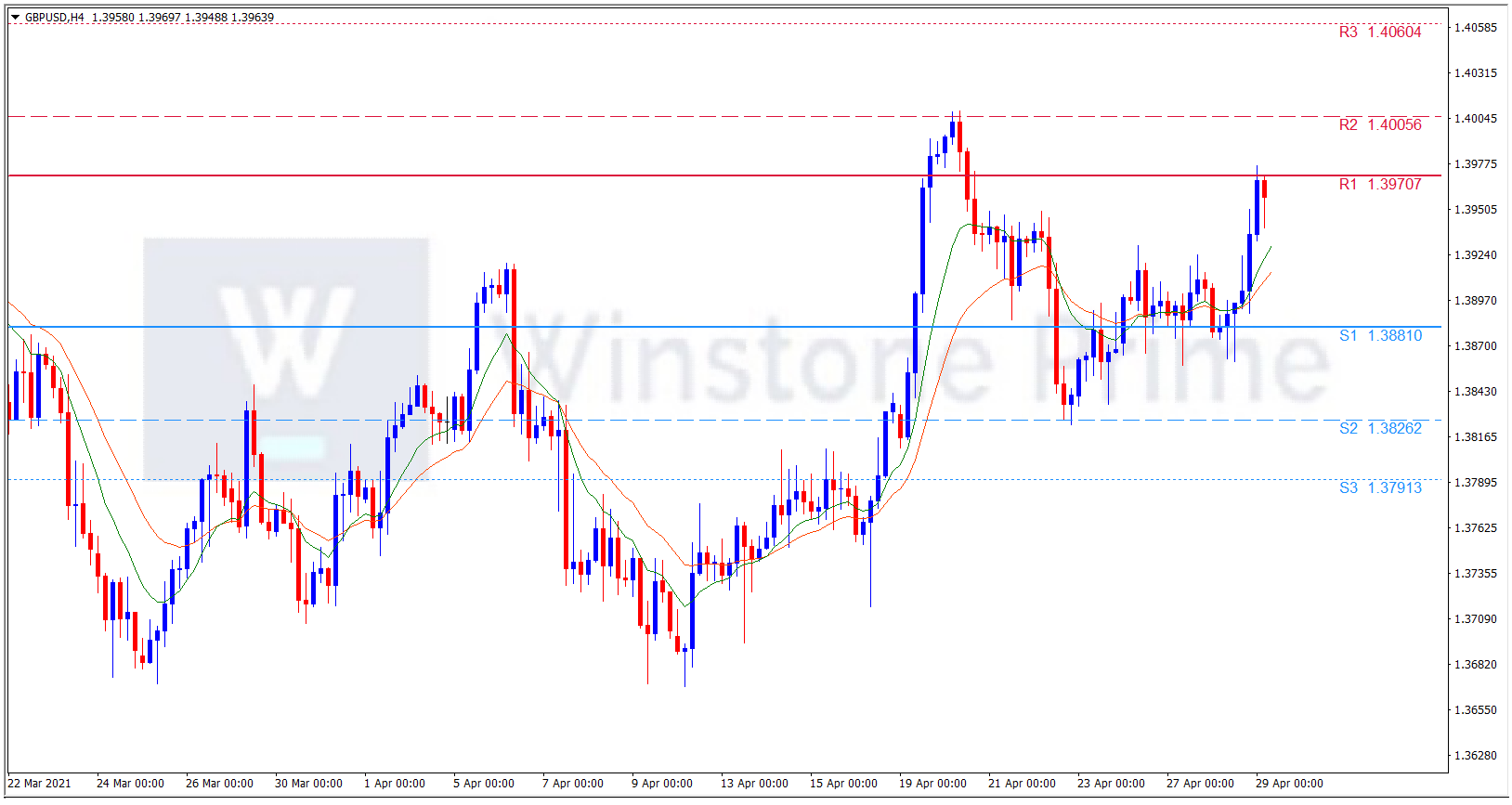
GBP/USD 4 Hour Chart:

Support: 1.3881 (S1), 1.3826 (S2), 1.3791 (S3).

Resistance: 1.3971 (R1), 1.4006 (R2), 1.4060 (R3).

Amidst all the catalysts favoring pound, we expect a bullish trend for GBP/USD.

Bonus – Use it Wisely and Nicely

Bonus - 1

Bonuses are highly coveted among customers, and you must have probably used a bonus or two in your life. Trading bonuses are also highly sought-after by traders

Understanding bonuses is very important for both the trader and the broker as each side has different goals in mind if used correctly, bonuses can be beneficial to both.

Types of Bonuses

There are many types of Forex Bonus which are being offered by Brokers. We have mentioned some bonuses below

1. No Deposit or Welcome Bonus 

The No Deposit or Welcome Bonus is a free Bonus which is offered by many Forex Brokers to attract new traders to open an account with them. It means that you can get free funds which you can use to trade with just by opening a new trading account. The amount of this bonus varies amongst Brokers but it is generally in the range of $10 to $100.

In order to qualify for the No deposit or welcome bonus certain conditions must be met before you have the possibility to withdraw any funds. Usually there is a certain volume of trading which you must meet and some brokers also ask you to make an initial deposit before you can withdraw any profits.

2. Margin Bonus or Rescue Bonus on deposits 

Forex brokers use a long time Margin Bonus to attract traders. But you can’t use Margin Bonus to trade. As long as you’re trading successfully the bonus will stay on your balance. But if you’re losing, the bonus will be removed once you hit about 10% of your deposit on your balance.

It acts as an extra venture capital that can be used for trading and covering your open positions. This bonus supports traders by increasing their venture capital. Margin Bonus cannot be withdrawn; it is not possible to trade it without own capital. 

3. Volume Bonus

If you are a trader who is trading high volumes then a Volume Bonus may be the best for you. A Volume Bonus allows you to receive up to 100% of your deposit to be available for withdraw after you will meet the set volume. In order to get the maximum benefit from this bonus you need to meet the volume and then make your withdraw.

This type of bonus is better suited for long term traders. If you withdraw money before you complete the volume a percentage of the bonus will be removed upon withdrawing the funds.

4. Birthday Bonus

Birthday Bonus is the bonus that is given as a gift to the traders on or before/after few days of their birthday. Birthday bonuses in some brokers are also given to traders to celebrate the anniversary of the brokers. Usually this bonus can be availed by depositing near to the birthday.

All bonuses come with a little T&C warning (terms and conditions). Brokers are required to explain all the terms that come along with getting the bonus and under which conditions you are allowed to use the bonus and withdraw your profits. Make sure you know what the terms and conditions are before you’re in it. Even if the terms are strict, knowing what they are ahead of using the bonus will make the process smoother.

Considerations with Bonuses

It goes without saying that when choosing between different brokers, the decent bonus is a plus. However, it is important not to make this the only decisive factor in the decision-making process.

A bonus cannot help you if the trading conditions are not in your favor. A free $50 or an extra 50% isn’t enough if the leverage is low and the spreads are too high, and you don’t have risk management tools. Understand the bonus correctly and make sure the broker you choose meets all your trading requirements before being engulfed with bonus-excitement.

1. Leverage :

A bonus will be of no use if the leverage provided by your Broker is extremely low. Leverage multiplies the value of every dollar of the traders own money they invest. Leverage increases the financial capabilities of traders and, as a consequence, the trading results. With extremely low leverage, traders fail to enjoy this advantages of leverage.

2. Commission if any :

The fact of the matter is that there are several other factors that can have a sizable impact on the trader’s earnings. Firstly, one thing traders might want to avoid is the commission per trade. The standard fee typically ranges from $5 to $10. However, if the market participant makes even a moderate amount of trades per day on a regular basis, then this expense can eventually add up to a significant amount.
 
Therefore, earning a $500 as a deposit bonus is helpful; however, if it ends up consumed by the trading commission in a month, then this might not be that useful. Luckily, there are plenty of commission free trading accounts which traders can make use of.

3. Spread :

Another major consideration here is the size of the spreads. Obviously, this is an unavoidable expense, since the brokerage companies also need to earn some income. However, the reality of the matter is that brokers have their own policy on spreads. Consequently, spreads with some brokerage companies tend to be more competitive than others.
 
It is a relatively less visible expense for traders; however, just like in the previous case, it can make a significant difference in the long term. This is especially true for scalpers and day traders, who typically execute the large volume of trades within a short period of time.

Therefore, when you make a choice between a broker with tight spreads and meager bonus, and the one with wider spreads and high deposit bonus, it might be a good idea for traders not to rush into favoring the latter category. It is a better idea to choose the one with meager deposit bonus, but with much more favorable spreads.

 4. Quality of the service :

Finally, it is also helpful to be mindful of the fact that the difference in the quality of the service, as well as the reliability of the broker, is important. If a broker has poor quality service, with slow execution of trades and dealing desk, it can create a lot of problems for traders.
 
For example, traders might find some good entry or exit points for their trades, but they might get rejected by the dealing desk, or the platform might not execute the trade soon enough. It is understandable that a couple of seconds worth of delay, might not pose serious problems most of the time.

The quality factor should never be underestimated. If there is a choice with a broker with a sizable deposit bonus, but with poor execution of trades and a dealing desk, and the broker with less deposit bonus, but high-quality service, then it might be a worthy decision to favor the second option.

The fact of the matter is that traders sooner or later will spend their bonuses; however, they will still have to deal with the poor quality of trade execution by the broker. Consequently, it makes sense to make the quality a priority over the size of the trading bonuses.

Advantages of a Bonus

  • Forex bonuses increase your trading equity and giving you greater control over your account
  • You are able to trade with higher leverage
  • Margin Bonuses allow you to trade with the broker’s funds and also can be used at times of margin call
  • Rebates help you to increase profits
  • It gives newbie traders a chance to test the experience of real Forex trading


Disadvantages of a Forex Bonus

  • Apart from margin other bonuses cannot be used as margins. If the equity goes below your deposited funds then bonus will be removed automatically by the brokers
  • No deposit bonuses have high volume requirements by some brokers which are really hard to meet


Sometimes the requirements of bonuses are not clear and you may end up losing equity. So every time it is important to read the terms and conditions of all bonuses

Don’t Just Chase the Bonus

Moving from one broker to the next just for the sake of a bonus may lead to more damage than reward in the long run. Every time you join a new broker, you’re losing time on starting over, going through the verification process again, getting used to the platform, getting to know the support team, and readjusting. Focus on finding a broker you can trust and use their bonuses when they offer them. This way, you are building momentum and trust and establishing a long-term trading career that isn’t solely based on bonuses.

Trading is really important

Don’t forget that trading should be exciting enough without any bonuses. Your trading plans should be able to tackle even a non-bonus environment, and you should build your trading plans upon the amounts you can afford to invest. The bonus is additional help that can make your day, but the absence of a bonus should never break it.

Conclusion:

Bonus can be beneficial to you and your broker if used efficiently. There are three main questions you must ask regarding the bonus: 1) Leverage 2) Spread 3) T/C of the bonus ?

In Winstone prime, you can avail many of the bonuses and gain handsome profits. Please read the T/C related to the bonus before availing.

Happy Trading !!!