GBP/USD Weekly Forecast (26th April 2021 – 30th April 2021)

Fundamental view:

The British pound has initially tried to rally during the last week but from Wednesday it gave up against the safe haven dollar.  The upbeat market sentiment and optimism about Britain’s vaccines have been effected by concerns about the virus and a hesitant market mood. The world seem to be concerned about India’s record daily cases which surpasses 300,000 – and increases in other countries. For developed countries such as Britain, it means a higher risk of incoming variants and also an economic slowdown due to falling demand. These concerns favored the safe-haven dollar.

On the other hand, UK Prime Minister Boris Johnson warns of a potential new COVID-19 wave in the winter. But his concerns had come amid a successful local vaccination campaign and a persistent drop in infections, hospitalizations and deaths. The situation looks like improving across the Western world. 

Britain Average Weekly Earnings on 20th April and US Existing Home Sales on 22nd April favored downtrend for the pair whereas Britain PPI Input monthly report on 21st April and Britain Retail Sales on 23rd April favored uptrend for the pair.

The major economic events deciding the movement of the pair in the next week are US Core Durable Goods Orders monthly report at April 26, UK Nationwide HPI monthly report, US CB Consumer Confidence Index at April 27, EIA Crude Oil Stocks Change, Fed Interest Rate Decision at April 28, US GDP quarterly report at April 29 and US Employment Cost Index at April 30.

GBP/USD Weekly outlook:

Technical View:

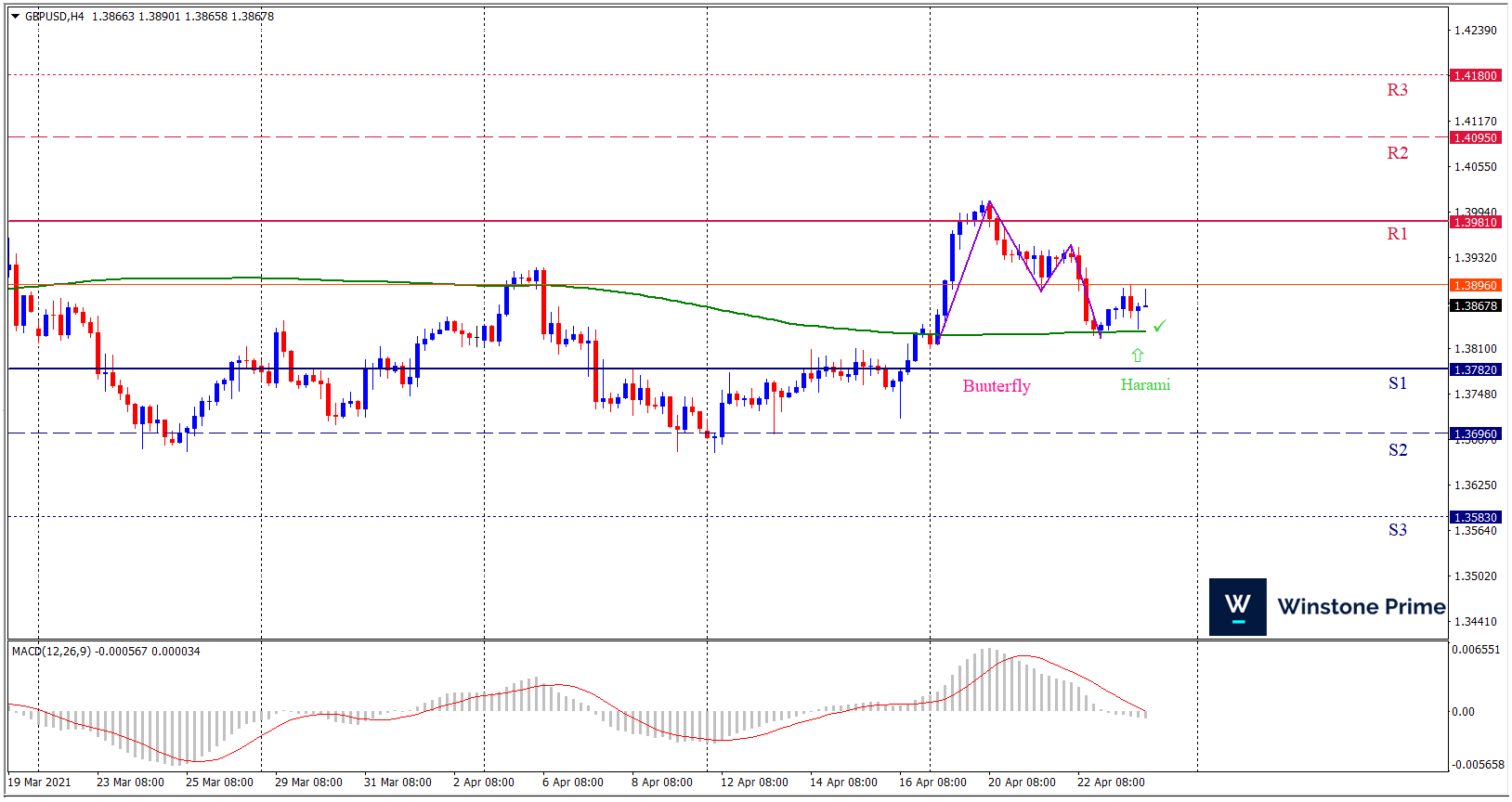
Last week’s high was 1.19% higher than the previous week. Maintaining high at 1.4009 and low at 1.3810 showed a movement of 199 pips.

In the upcoming week we expect GBP/USD to show a bullish trend.  The currency pair is trading above the 200 Simple Moving Average and the MACD trades to the downside. A solid breakout above 1.3891 may open a clean path towards 1.4095 and may take a way up to 1.4180. Should 1.3782 prove to be unreliable support, the GBPUSD may sink downwards 1.3696 and 1.3583 respectively. Chart formation of bullish butterfly pattern in H4 chart favors prospects of a bullish trend. Harami pattern formation escalates the expectation for a bullish trend.

Preference
Buy: 1.3885 target at 1.4075 and stop loss at 1.3777


Alternate Scenario
Sell: 1.3777 target at 1.3584 and stop loss at 1.3885

EUR/USD Weekly Forecast (26th April 2021 – 30th April 2021)

Fundamental view:

The Euro has advanced for a third consecutive week, now firmly moving above the 1.2000. During the past week, the US dollar attempted to overcome sentiment-related trading and advanced against the Euro mid-week, but dollar gave up on Thursday after speculative interest negatively reacted to news indicating that US President Joe Biden is planning a tax hike of up to 39.6% on investment gains for Americans making more than $ 1 million. The aim is to fund education spending and child care.

Elsewhere, The global battle against the coronavirus continues. When looking into each economy´s progress, no doubts the US is in much better shape than the EU. US has vaccinated with at least one shot over 34% of the population, while in the EU, the same measure is just 13.6%.  

Europe Construction Output monthly report on 19th April and US Initial Jobless Claims on 22nd April created a bearish trend for the pair whereas US EIA Heating Oil Stocks Change & US EIA Gasoline Stocks on 21st April and Europe Business Climate & Industrial Sales yearly report on 22nd April created bullish trend for the pair.

The major economic events deciding the movement of the pair in the next week are Europe Ifo Business Climate, US Core Durable Goods Orders monthly report at April 26, US CB Consumer Confidence Index at April 27, ECB President Lagarde Speech, Fed Interest Rate Decision at April 28, US GDP quarterly report at April 29, Europe GDP quarterly report and US Employment Cost Index at April 30.

EUR/USD Weekly outlook:

Technical View:

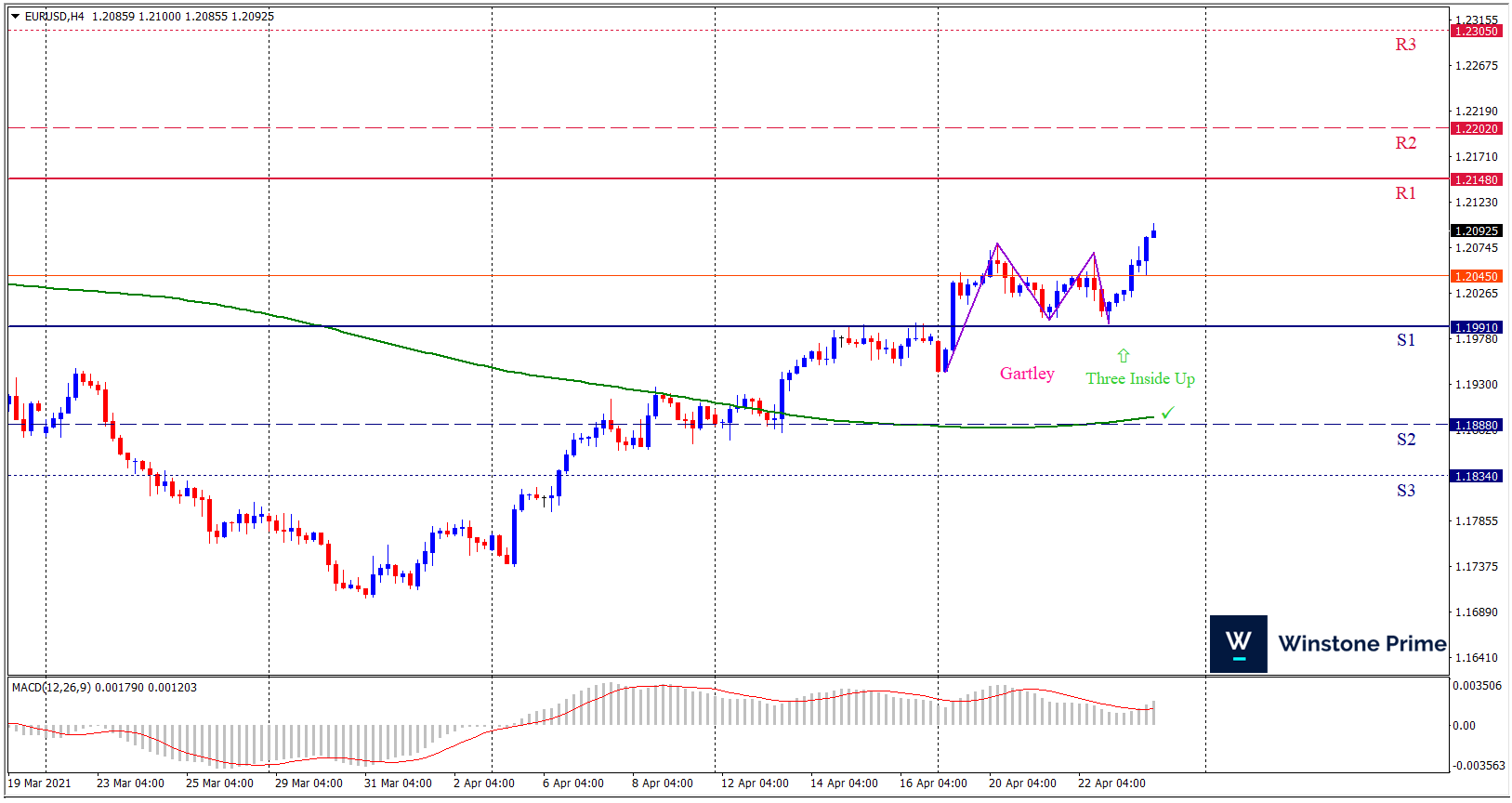
Last week’s high was 0.88% higher than the previous week. Maintaining high at 1.2100 and low at 1.1943 showed a movement of 157 pips.

In the upcoming week we expect EUR/USD to show a bullish trend. The currency pair is trading above the 200 Simple Moving Average and the MACD trades to the upside. A solid breakout above 1.2148 may open a clean path towards 1.2202 and may take a way up to 1.2305. Should 1.1991 prove to be unreliable support, the EURUSD may sink downwards 1.1888 and 1.1834 respectively. Chart formation of a bullish gartley pattern in H4 chart sets prospects for a bullish trend. Three inside up pattern formation in H4 chart escalates the expectation for a bullish trend.

Preference
Buy: 1.2082 target at 1.2201 and stop loss at 1.1986


Alternate Scenario
Sell: 1.1986 target at 1.1835 and stop loss at 1.2082

US economy under Joe Biden Presidency

US economy - 1

Joe Biden might certainly be the last U.S. president who was born as a member of the “silent generation” demographic group who were children during World War Two, came of age in an economic boom that built middle class wealth, and made the function of the United States as the world’s most leading industrial power.

At the age of 78, the second half part of his life, He saw the share of national wealth going to that middle class fall and the gains from U.S. growth concentrate in a handful of regions.

With his plan of $1.9 rescue plan and $2 trillion investment package, he wants to reverse that half century trend and steer capital to neglected people and parts of the country.

Biden’s plan harkens to the Democratic leaders of his young adult years in the 1960s – President John Kennedy’s aspirational focus on public ventures such as the moon landing, or Lyndon Johnson’s Great Society push to strengthen the social safety net.

Economic Plan of Jeo Biden :

President Joe Biden campaigned on an economic platform to shore up the middle class, extend healthcare, raise taxes on the wealthy, and invest trillions of dollars in green energy infrastructure, among other issues. He has made plan to deal with the rising costs of battling the coronavirus pandemic and the economic damage it has caused.

America’s Rescue Plan :

President Joe Biden made of a formal announcement of his $1.9 trillion COVID-19 stimulus plan on January 2021. On March 2021, he made it a reality. Biden signed the $1.9 trillion piece of legislation passed by Congress promising $1,400 stimulus checks, extended unemployment, a vaccine rollout, and more, all part of the promises he made in Wilmington, Del., in January.

Biden said in his speech in Wilmington  that “There is real pain overwhelming the real economy. You won’t see this pain if your scorecard is how things are going on Wall Street.” He referred to what many economists are calling a K-shaped recovery, adding that “the wealth of the top 1% has grown by roughly $1.5 trillion since the end of last year—four times the amount for the entire bottom 50%

After the signing of the American Rescue Plan into law, President Biden has proposed one more separate economic recovery plan of $2 trillion, which include investments in infrastructure, manufacturing, and other spending unrelated to COVID-19 to “create millions of additional good-paying jobs, combat the climate crisis, and build back better than before. The American Rescue Plan doesn’t mention tax increases, which mean the federal government, will pay for it with debt.

The main elements of the Rescue Plan are as follows:

  • Direct aid ($1 trillion) :  $1,400-per-person checks to supplement the $600 checks that went out recently. Extended emergency unemployment insurance through Sept, 2021, and additional funding for eviction and foreclosure moratoriums, set to expire March 2021. The plan includes $30 billion in emergency rent, $10 billion in mortgage assistance, and $5 billion in emergency assistance for the homeless. Childcare and food program funding along with an expansion of the child care tax credit for one year are also part of the program.
  • Public health effort and reopening schools ($400 billion) : A $20 billion national vaccination program, $50 billion “massive” expansion of testing, hiring 100,000 more public health workers, $30 billion into the Disaster Relief Fund for PPE, $130 billion to open most schools by spring.
  • Support local communities ($400 billion) : Help for governments dealing with revenue shortfall to keep front-line public workers on the job. Small business grants and loans. $20 billion for public transit agencies.
  • Beefing up cybersecurity ($2 billion) : In the wake of the SolarWinds hack, which affected federal agencies, Biden wanted $10 billion to modernize and secure federal information technology. Congress approved almost $2 billion


$2 trillion proposal:

Joe Biden’s administration as shifts its focus to bolstering the post-pandemic economy proposed the $2 trillion infrastructure package.

The plan Biden outlined includes roughly $2 trillion in spending over eight years and would raise the corporate tax rate to 28% to fund it. Speaking about the plan he called it a vision to create “the strongest, most resilient, innovative economy in the world” — and millions of “good-paying jobs” along the way.

The White House said the tax hike, combined with measures designed to off shoring of profits, would fund the infrastructure plan within 15 years.

The proposal would:

  • Put $621 billion into transportation infrastructure such as bridges, roads, public transit, ports, airports and electric vehicle development
  • Direct $400 billion to care for elderly and disabled Americans
  • Inject more than $300 billion into improving drinking-water infrastructure, expanding broadband access and upgrading electric grids
  • Put more than $300 billion into building and retrofitting affordable housing, along with constructing and upgrading schools
  • Invest $580 billion in American manufacturing, research and development and job training efforts


Joe Biden’s support to developing nations :

U.S. President Joe Biden announced that the U.S. would cut its greenhouse gas emissions by 50%-52% by 2030 relative to 2005 levels, in a clean break with the Trump administration policies on climate action.

Mr. Biden also made a announcement that the U.S. would double, by 2024, its annual financing commitments to developing countries, including a tripling of its adaptation finance by 2024.

The Biden administration is hoping to encourage other countries to increase their commitments. It is also seeking to bring America back into a leadership role on climate action after Mr. Trump had withdrawn the country from the Paris Agreement.

Mr. Biden’s financing announcements are part of a $100 billion a year commitment from developed countries to developing countries for the period 2020-25, “an investment that is going to pay significant dividends for all of us”, Mr. Biden said.

Americans view on Biden’s Presidency :

In the initial months of his presidency, majorities of Americans say a number of positive descriptions apply to Joe Biden. And Biden draws public confidence on most issues, especially his handling of the corona virus outbreak.

About two-thirds of adults (66%) say the phrase “stands up for what he believes in” describes Biden very or fairly well, and 62% say he cares about the needs of ordinary people.

Majorities also describe Biden as a good role model (58%), honest (57%) and mentally sharp (54%).

Overall, 65% of adults say they are very or somewhat confident in Biden to deal with the public health aspects of COVID-19. Democrats overwhelmingly express confidence in Biden on this issue (92% confident); a third of Republicans also have confidence in Biden to handle the coronavirus.

Biden draws less public confidence for his handling of other issues, though majorities say they are very or somewhat confident in him to make good decisions about foreign and economic policy (56% each); effectively address issues around race (55%); make wise decisions on immigration policy (53%); and effectively handle law enforcement and criminal justice (53%).

Large majorities of Democrats (80% or more) express confidence in Biden on each of these issues, compared with no more than about one-in-five Republicans.

Demographic wise view :

Majorities of most demographic groups approve of Biden’s job performance, with the exception of White Americans, who are roughly as likely to disapprove (51%) of Biden’s performance as to approve (48%). By comparison, nearly nine-in-ten Black Americans (89%) approve of Biden’s performance, as do 74% of Hispanic Americans and 72% of Asian Americans.

Women continue to view Biden’s performance more positively than men (62% vs. 56% approve, respectively), while Biden is seen more positively among college graduates – particularly those with postgraduate degrees – than among those with some college or less education. Adults under 50 are somewhat more approving of Biden’s job performance than those 50 and older.

Expectation in Joe Biden’s presidency :

Joe Biden (46th president of the United States) has been president for three months now. He inherited a terrible economy, people dying during a pandemic, children learning from home while many schools are still closed, businesses closing their doors whether temporarily or permanently, and yet he has received a lot of confidence in America and all over the nations.

World hopes for renewed cooperation with US under Joe Biden. Let’s hope that Joe Biden stands to the Americans and World’s expectation.

STR and RTS Trading Strategy

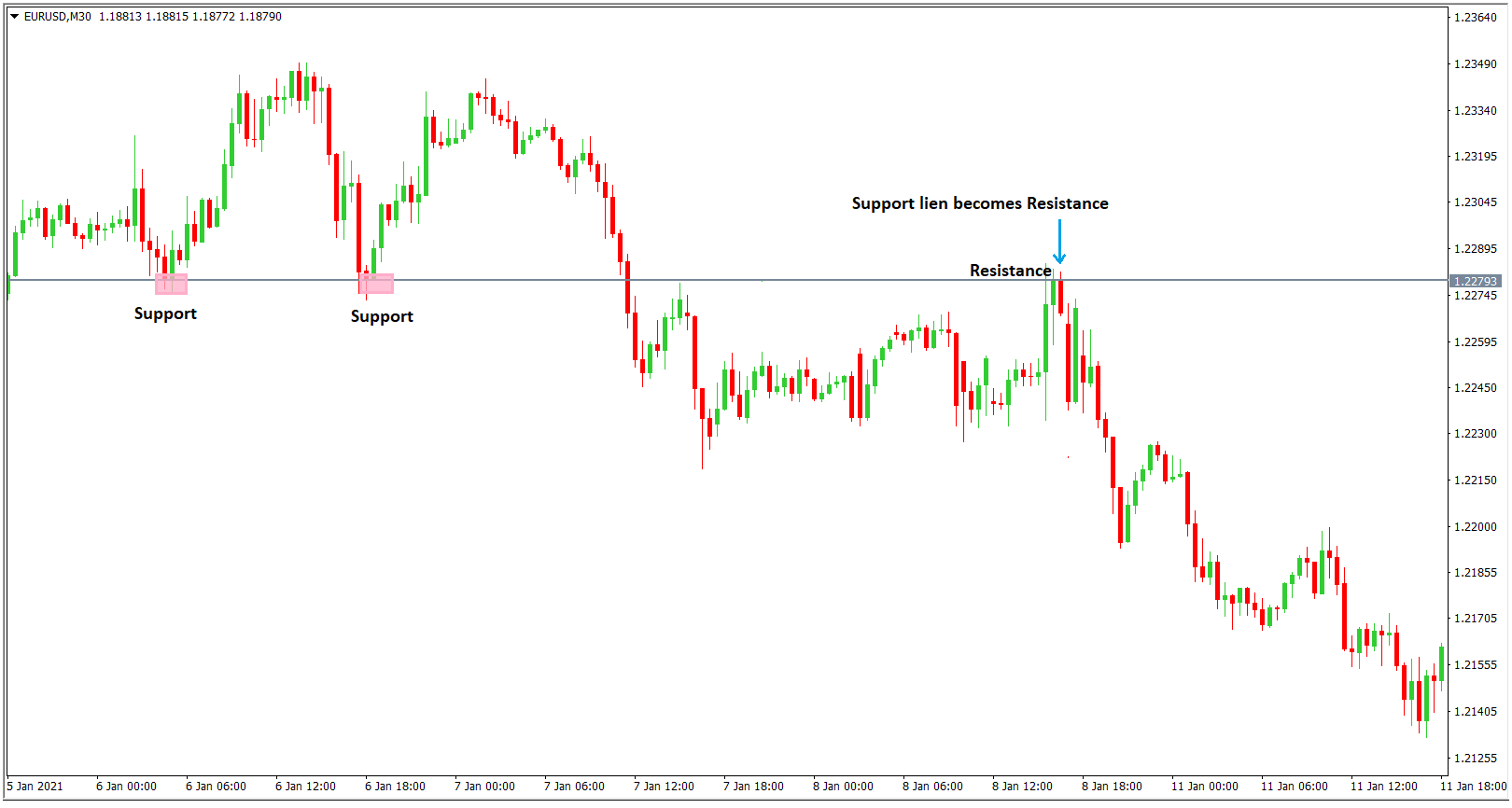
The Support Turned Resistance-Resistance Turned Support trading strategy is a based on the fact that sometimes, a support level which has been broken will act as a resistance level when price goes back up to it. Here’s an example of a STR.

On the chart below, Notice the blue area is the support zone that was broken.

Price went down and later came back up and was pushed back down in that zone. It became a resistance Zone.

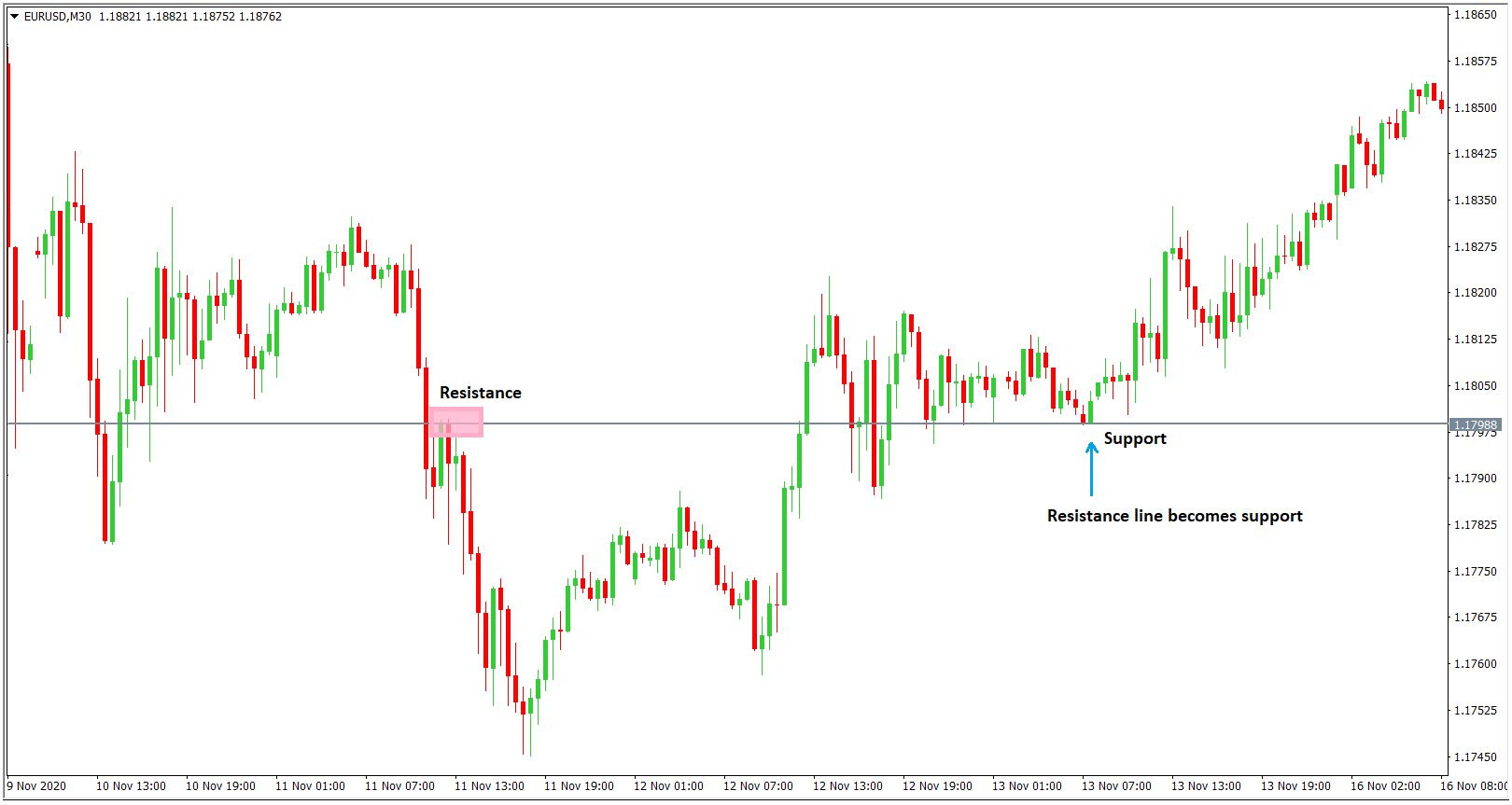
Similarly, a resistance level broken by price tends to act as a support level when price comes back down to the level. Here’s an example of a RTS:

So that is the basics of what this STR & RTS trading strategy is all about.

Timeframes : Any

Instrument : you can use this strategy any instrument

Indicators : None

Trading Rules :

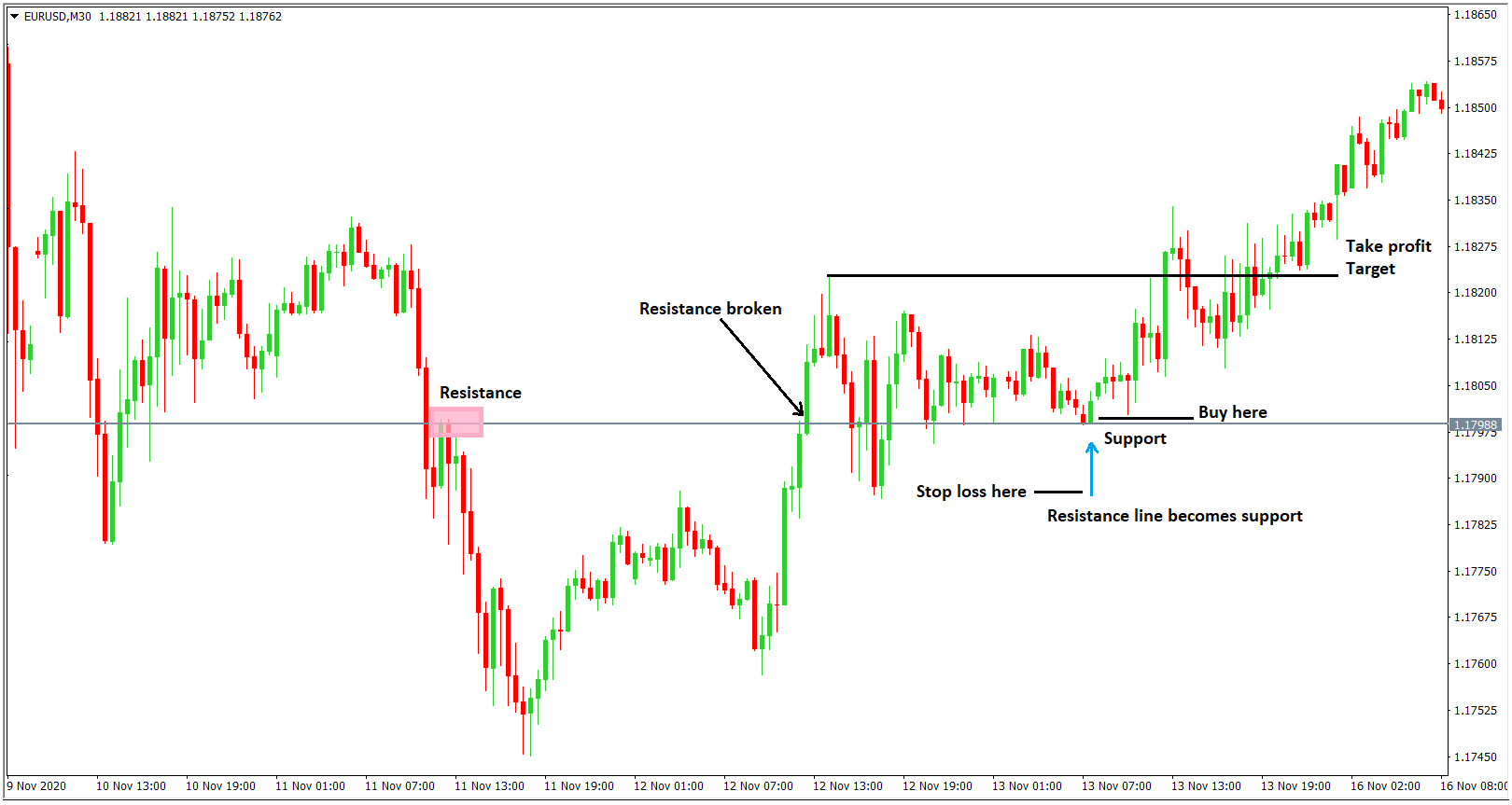
Long entry rules for resistance turned support:

  • Once resistance level is broken, wait until price starts to fall back down to the resistance level it broke.
  • Different types of orders can be used to enter into a trade: for buy stop order wait until a candlestick touches the level and place your order 2-5 pips above the high of that candlestick. Buy limit orders can be placed 2-5 pips above the resistance turned support line. Or you can buy immediately at market once price hits that level.
  • Place your stop loss 10-30 pips below the resistance turned support line if you use buy limit and market orders. For buy stop order, place 2-5 pips below the low of the candlestick that touches that line.
  • For take profit targets, look for previous significant swing high and place your profit targets within that.


Let us explain with a chart below:

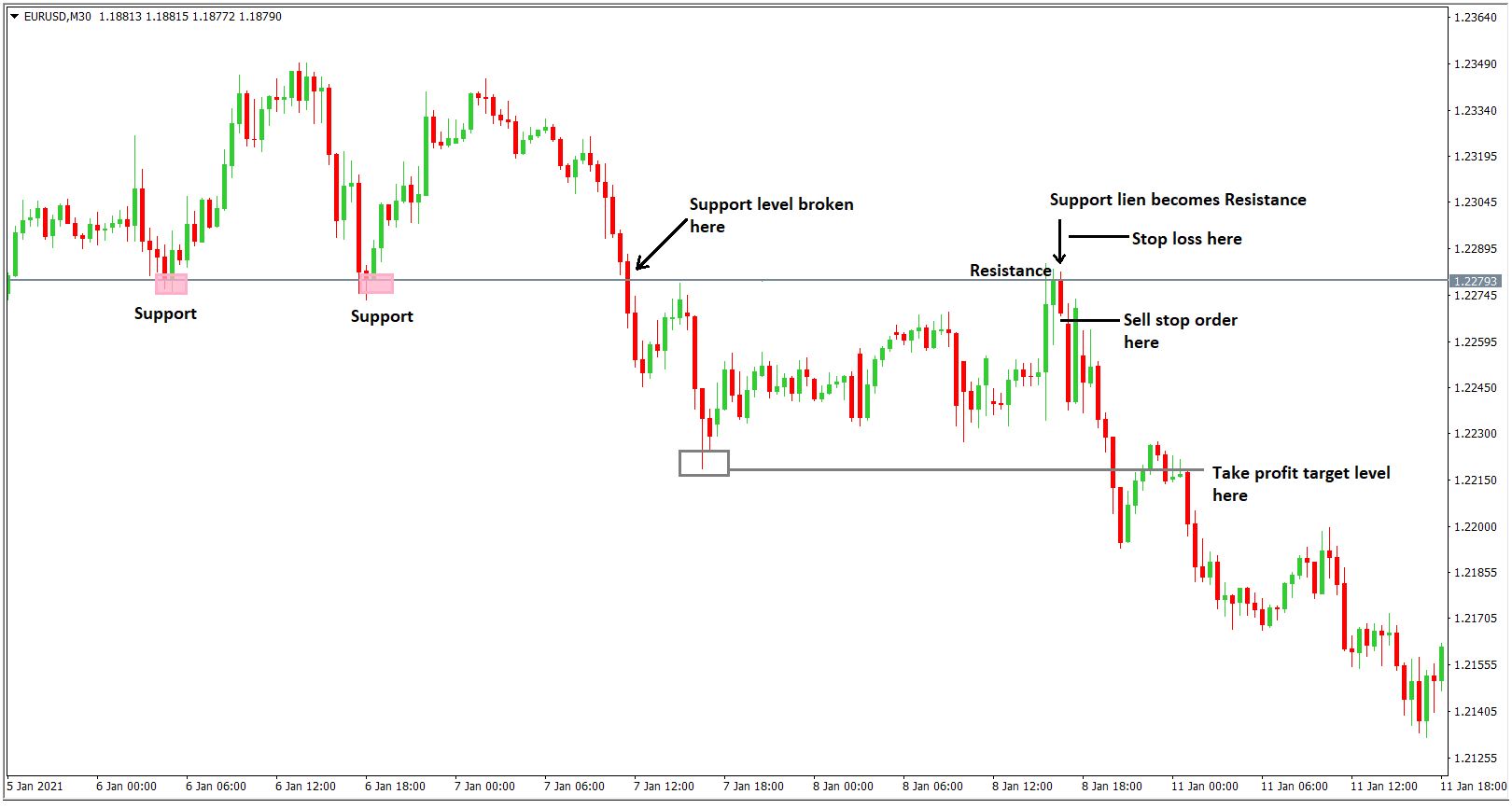
Short entry rules for support turned resistance:

  • Once support level is broken, wait until price starts to rise up to the support level it broke.
  • Different types of orders can be used to enter into a trade: for sell stop order, wait until a candlestick touches the level and place your order 2-5 pips below the low of that candlestick. Sell limit orders can be placed 2-5 pips below the support turned resistance line. Or you can sell immediately at market once price hits that level.
  • Place stop loss 10-30 pips above the support turned resistance line if you use sell limit and market orders. For sell stop orders, place 2-5 pips above the high of the candlestick that touches that line.
  • For take profit targets, look for previous significant swing lows and place your profit targets within that.


Let us explain with a chart below:

Pros :

  • Any trade that goes according to plan tends to give very good risk to reward ratio.
  • The use of reversal candlesticks can really enhance your sell or buy signal
  • This is one trading setup and method that many professional traders use and worth knowing
  • This is a 100% price action trading and you do not need any other indicators.


Cons :

  • Price does not always come back to a broken support level or resistance level
  • And when it does come, sometimes it does not obey it.