BOJ Kuroda’s optimistic speech favors yen

Bank of Japan (BOJ) Governor Haruhiko Kuroda while speaking before the parliament on Friday said that “Japan’s economy continued to expand gradually due to aggressive monetary easing, which has had a positive impact on bank profits.”

He also added that “Banks’ profitability has diminished as a trend due to prolonged low-rate environment, structural factors such as aging population.”

He also commented that the “government is ready to tap reserves set aside for covid relief to deal with further costs if infections rise more or battle with a pandemic is prolonged.”

Prime Minister Yoshihide Suga is set to declare a state of emergency Friday in Tokyo and the western Japan prefectures of Osaka, Kyoto and Hyogo in an effort to curb a surge in COVID-19 during the upcoming Golden Week Tougher restrictions such as the closure of establishments that serve alcohol and major commercial facilities will be in place from Sunday through May 11.holidays.

Although the state of emergency will not entail a hard lockdown like some other countries have imposed, spectators will effectively be banned from large events while train and bus operators will be asked to end operations earlier on weekdays, with fewer running on weekends and holidays.

Shigeru Omi, an infectious disease expert who chairs a government subcommittee on the coronavirus response said that “The state of emergency may be extended if the situation does not improve sufficiently.”

Suga said  “We must take strong measures in a focused manner while many people are on break during Golden Week to bring the virus under control.”

On the other hand, US dollar index (DXY) prints mild losses of 0.08% while taking offers around 91.22 during early Friday.

USD/JPY 4 Hour Chart:
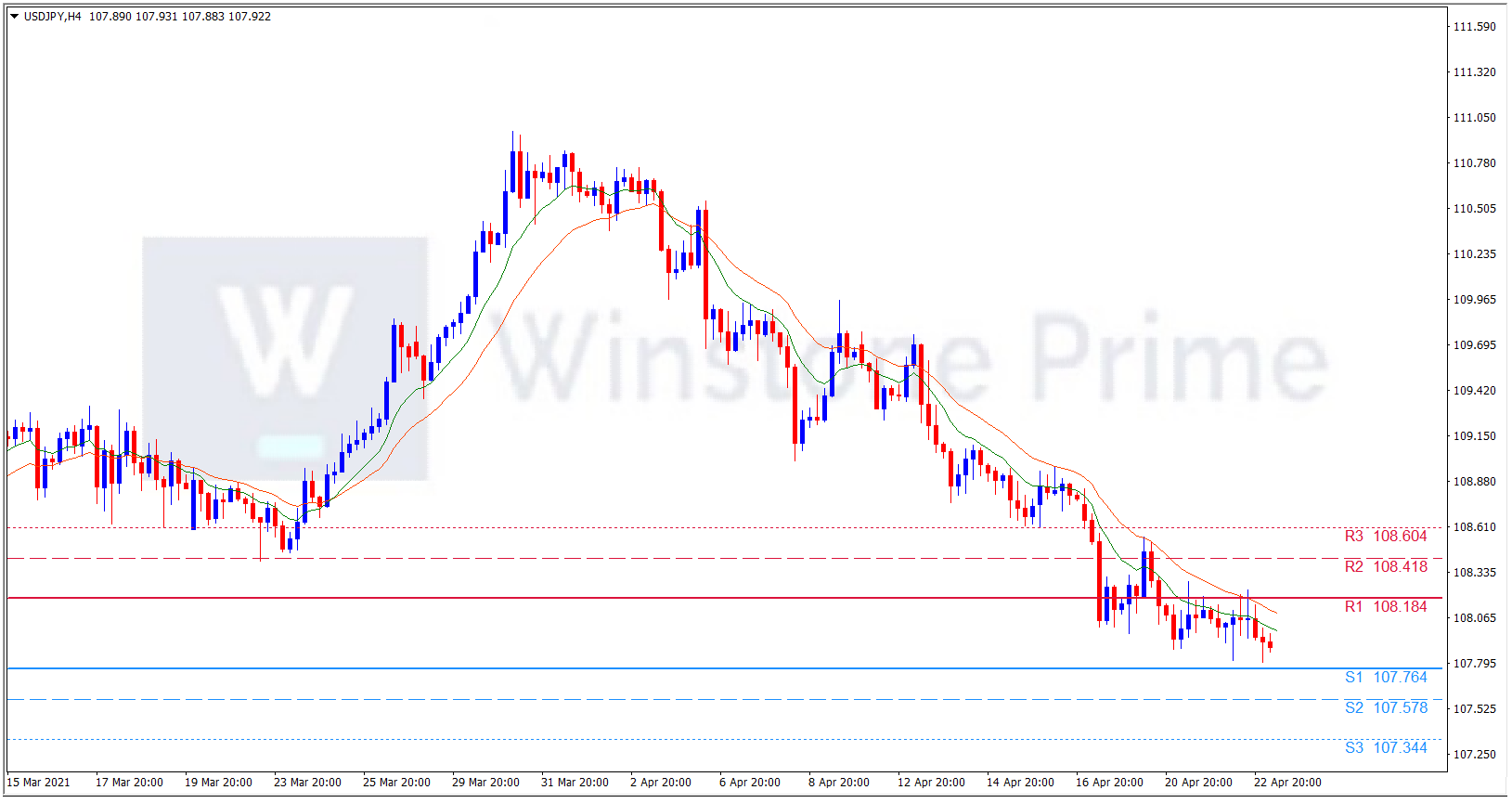
Support: 107.76 (S1), 107.58 (S2), 107.34 (S3).

Resistance: 108.18 (R1), 108.42 (R2), 108.60 (R3).

Traders are now waiting for the official announcement of the Japan lockdown news and  US President Joe Biden’s proposal for the capital gains tax hike. With this news in line, we expect a bearish trend for USD/JPY as of now.

Euro trades upside ahead of ECB’s meeting

The euro seems to be in focus ahead of a European Central Bank (ECB)meeting later on Thursday, where any positive comments about the economic outlook or hints of tapering bond purchases are expected to help the euro.

Analysts at National Australia Bank give their view on the ECB monetary policy announcement. “Meeting should be without any controversy without any change in policy settings, no new forecasts, all against a rather benign market background.”

“The question will be, is this a meeting where the overall message is the ECB is sufficiently encouraged by the outlook to allow markets to think an upgrade is coming in June, or will developments such as the Euro bounce (itself a sign of a global recovery) and the limited progress in the Recovery Fund, ensure the ECB toes an ongoing cautious line?”

On the other hand, The dollar is trading downside against many majors as fading gains in U.S. Treasury yields reduced the greenback’s interest rate advantage.

Sentiment toward the dollar has decreased as last month’s spike in Treasury yields reverses course, but few analysts say the outlook over the longer term remains positive due to a strong U.S. economy and an improved coronavirus vaccination programme.

Economists say that “The US economy will grow at its fastest annual pace in decades this year and outperform most of its major peers, with the outlook upgraded sharply.” But It has to noted that the survey also mentioned the COVID-19 surge as the biggest risk over the next three months.

There is a optimism among the economists predicting a boost to economic activity from the $1.9 trillion pandemic relief package already passed and also from U.S. President Joe Biden’s proposed $2 trillion-plus infrastructure plan

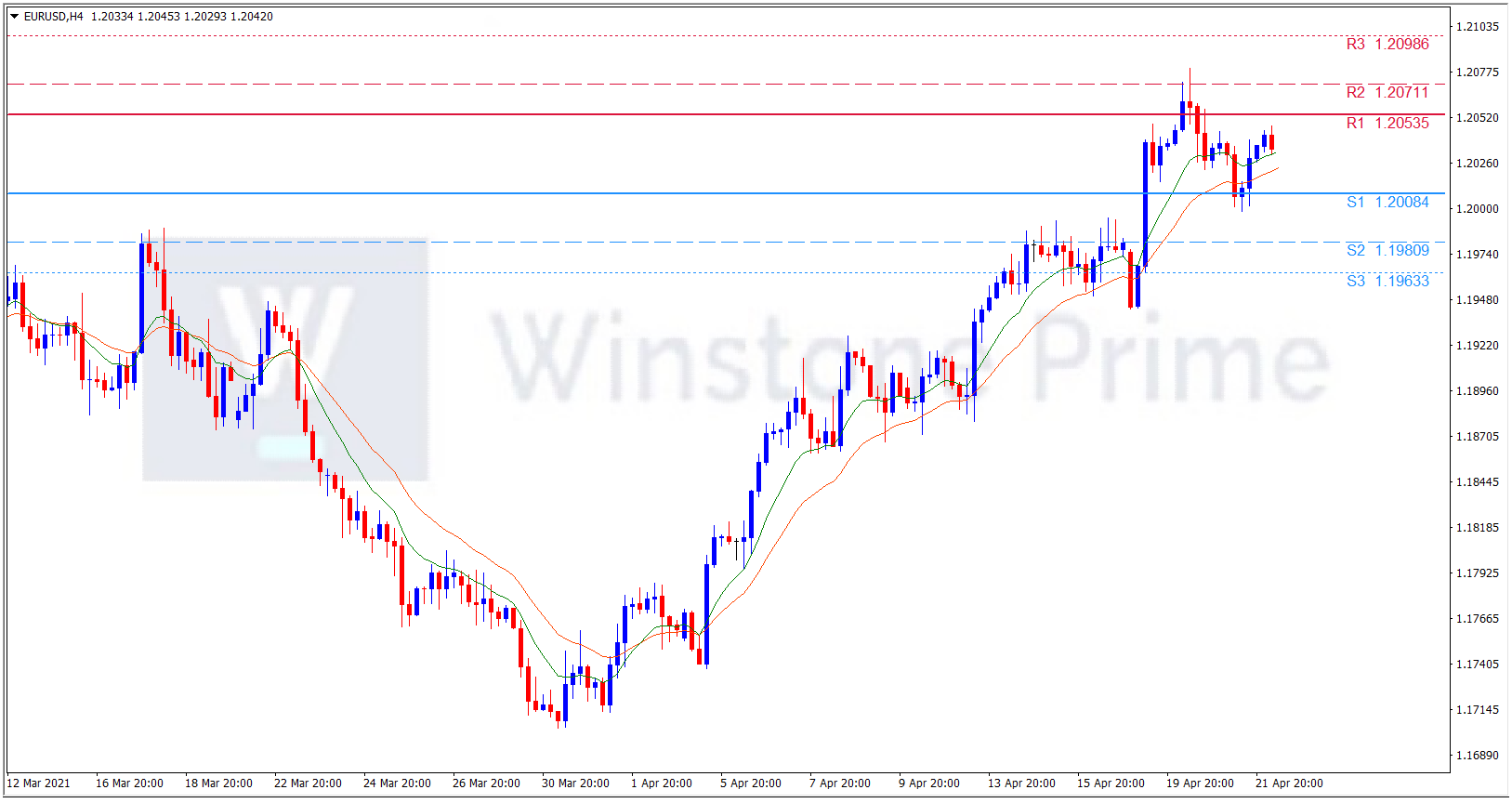
EUR/USD 4 Hour Chart:

Support: 1.2008 (S1), 1.1981 (S2), 1.1963 (S3).

Resistance: 1.2054 (R1), 1.2071 (R2), 1.2099 (R3).

The ECB’s monetary policy expectation gives a positive outlook towards Euro and we expect a bullish trend for EUR/USD.

The secret of trading indices – why and How?

What are Indices ?

Indices are a measurement of the price performance of a group of shares from an exchange.  For example, the FTSE 100 tracks the 100 largest companies on the London Stock Exchange. Trading indices enables you to get exposure to an entire economy or sector at once, while only having to open a single position.

How are stock market indices calculated?

Most stock market indices are calculated according to the market capitalisation of their component companies.

The formula looks like this: Stock weight = Stock price x Number of stocks / Market capitalization of all stocks

This method gives greater weighting to larger cap companies, which means their performance will affect an index’s value more than lower cap companies.

But, some popular indices – including the Dow Jones Industrial Average (DJIA) – are price-weighted. This method gives greater weighting to companies with higher share prices, meaning that changes in their values will have a greater effect on the current price of an index. Today, the Dow Jones consists of 30 stocks, and since the index is price-weighted, the higher-priced stocks have a greater impact of the Dow’s value than the lower-priced stocks.

Popular Indices across the globe

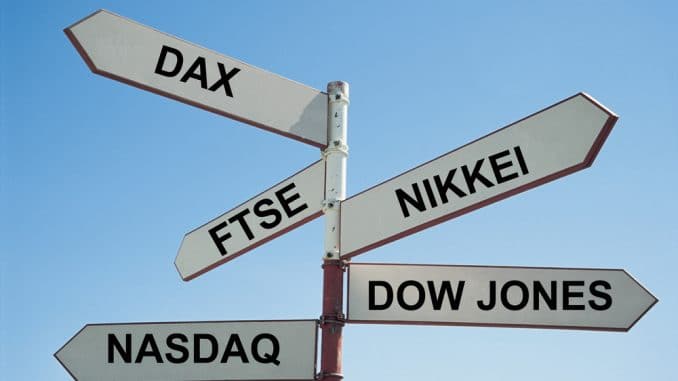
  • Dow Jones (DJ 30), also known as Dow Jones Industrial Average, is made up of the 30 biggest industrial companies in the U.S.
  • S&P 500, it’s the biggest index in the world. It represents 500 companies from the U.S.
  • NASDAQ 100, measures the 100 major tech companies in the U.S.
  • DAX 30, it’s the German index. It includes the 30 leading German companies.
  • FTSE 100, groups the top 100 companies of the U.K.
  • CAC 40, represents the best 40 French companies.
  • NIKKEI 225, it’s the index from Japan. It contains the 225 biggest companies in the country.

An index’s value changes as the prices of its constituent shares fluctuate, so it will mirror any general upward or downward trend in stocks. 

The factors that move indices are therefore essentially the same as those that influence individual shares. The difference is that an event affecting just a single company will generally have only a minor impact on the value of any index that includes the stock.

However, economic or political events relevant to a group of companies or a business sector, such as mining companies, technology firms or banks, can have a significant effect on an index that contains these shares. As the balance of supply and demand for the stocks shifts, the collective change in share prices can cause a move of multiple points in the index. 

Of course, when an event has implications for an entire country or region’s businesses, or even the outlook for the global economy as a whole, its impact on stock indices can be dramatic.

1. Influential events

You can expect movement in the value of an index when the following events occur in a related country or business area:

  • Economic data releases
  • Natural disasters
  • Geopolitical events and wars
  • Central bank announcements
  • Corporate news either good or bad
  • Government policy, legal and regulatory updates

All of these can affect investors’ confidence in the prospects of companies to grow and generate profit, which in turn directly shapes market sentiment.

2. Market sentiment 

The collective mindset of traders and investors affects the movement of all indices. 

Major or unexpected events in particular can sometimes cause a surge in bullish or bearish sentiment, leading to pressure from buyers or sellers that forces share prices and eventually index values – up or down. A correction is often seen later, as traders calm down and equilibrium is restored.

Index trading is a relatively secure form of trading with integrated money management. The risks of trading indices are always lower than the risks of investing in individual stocks.

  • Indices are the least manipulative financial instruments. The price of an index changes according to the price fluctuations of the constituent companies that make up that index.
  • Embedded money management scheme. Trading indices, you are diversifying your investment; you simply don’t put all your eggs into one basket. With the NASDAQ 100 index, you diversify into the most-prominent American high-tech companies.
  • Lower risks. Though indices can also be volatile due to factors like geopolitical events, economic forecasts and natural disasters, an index losing or gaining 10% is already a huge historical event that will often hit the news.
  • Benefit from the global economic situation. By investing in a group of companies, you benefit from the positive or negative dynamics of the global economy. If one company fails, the index can still rise.
  • No risk of bankruptcy. Unlike an individual company, an index can’t go bankrupt. If a FRA40 constituent goes bankrupt, it is replaced by the 41st company in the list of leading France companies.

1. Choose way to trade indices

2. Choose from cash indices or index futures

3. Open an account and log in

4. Choose the index you want to trade

5. Decide on long or short entry

6. Set your stops and limits

7. Open and monitor your position

1. Choose way to trade indices

With Winstoneprime, you can use CFDs to trade indices. CFDs are financial derivatives, which mean you can use them to speculate on indices that are rising in value, as well as falling.

2. Decide whether to trade cash indices or index futures

While trading with Winstone prime, there are two ways to get exposure to an index’s price: by trading cash indices or index futures.

Cash indices

Cash indices are favoured by traders with a short-term outlook – such as day traders – because they have tighter spreads than index futures. Cash indices are traded at the spot price – which is derived by taking the front month futures price and applying fair value.

Many traders will close their cash indices positions at the end of the trading day and open new positions the following morning to avoid paying overnight funding charges.

Index futures

Index futures are usually preferred by traders with a long-term market outlook. This is because, while they have wider spreads than cash indices, the overnight funding charge is included. Index futures are traded at the futures price – the price that futures traders agree in the present for delivery in the future.

If you plan on holding on to an index position for a long time, trading index futures will mean that you don’t incur frequent overnight funding charges.

3. Open an account and log in

To start trading indices with CFDs, open an account with Winstone Prime. A brokerage firm that provides 15+ world’s famous stock indices with tight spread.

4. Choose the index you want to trade

It’s crucial to choose an index that suits to your trading style. This will depend on your individual appetite for risk, available capital and whether you prefer taking short-term or long-term positions.

For example, the Germany 30 is usually a volatile index which is favoured by traders with high risk appetites and who prefer short-term trading. On the other hand, the US 500 is largely known for its steady returns over time, making it a favourite with traders with lower appetites for risk and a long-term outlook.

5. Decide on long or short entry

Going long means that you are speculating on the value of an index increasing, and going short means that you are speculating on its value decreasing.

If you find the economic outlook for an economy or sector is good based on the performance of the companies on an index, a long position could help you realise a profit if the index increased in value.

If the outlook is poor – possibly because large companies on a capitalisation-weighted index are underperforming – you might want to go short on the expectation that the index will fall in value.

6. Set your stops and limits

Stops and limits are essential tools for managing your risk while trading indices. A stop order will close your position automatically if it goes to a less favourable level than the current market price, while a limit order will close your position automatically if it goes to a more favourable market price.

7. Open and monitor your trade

When you think you’re ready to start indices trading, it’s time to open your trade. Open Winstone Trading Platform, Enter your position size, and click ‘place deal’ to open your trade.

Final words:

Index trading is a secure form of trading with integrated money management. The risks of index trading are lower than on other instruments. Open account with Winstone Prime to speculate easily predictable sector and make profits.

Pound has dropped despite upbeat Uk jobs report

The pound has dropped despite upbeat Uk jobs report and weaker US dollar. The Uk unemployment rate report showed a drop to 4.9% which is 0.1% less than the expectation of 5% whereas the Claimant count has dropped to 10.2 k which is significantly less than the expectation of 113 k ,The figure is also less than the previous record of 67.2 k.

The global covid infections has grew to a alarming level of 12% on the weekly basis, which is led by the jump in India’s new cases. Thus the US has decided to put over 80% of the globe under the “not to travel” list and the UK has also being following travel restrictions. The same virus woes push Japan towards recalling the emergencies once led in Tokyo and surrounding prefectures.

The UK has announced relief for the British truckers over Brexit norms on Tuesday. As per a news “Britain on Tuesday eased controls designed to prevent a backlog of trucks in southern England caused by new post-Brexit paperwork, saying vehicles taking goods to the European Union would no longer need a special permit to enter the port region.”

The Consumer Price Index (CPI) for March month is due by early today at 6.00 GMT. The headline CPI inflation is expected to move from 0.4% prior to 0.3% on an annual basis while the Core CPI, which excludes volatile food and energy items, is likely to improve from 0.9% previous readouts to 1.2%. To see on the monthly figures, the CPI could jump from 0.1% to 0.3% during March.

Elsewhere, Johnson & Johnson announced Tuesday that it will resume the distribution of its COVID-19 vaccine in Europe after the European Union’s (EU) medical regulator approved of the same but with a safety warning. J&J Chief Scientific Officer Paul Stoffels said: “It’s an extremely rare event. We hope by making people aware as well as putting clear diagnostic and therapeutic guidance in place that we can restore the confidence in our vaccine.”

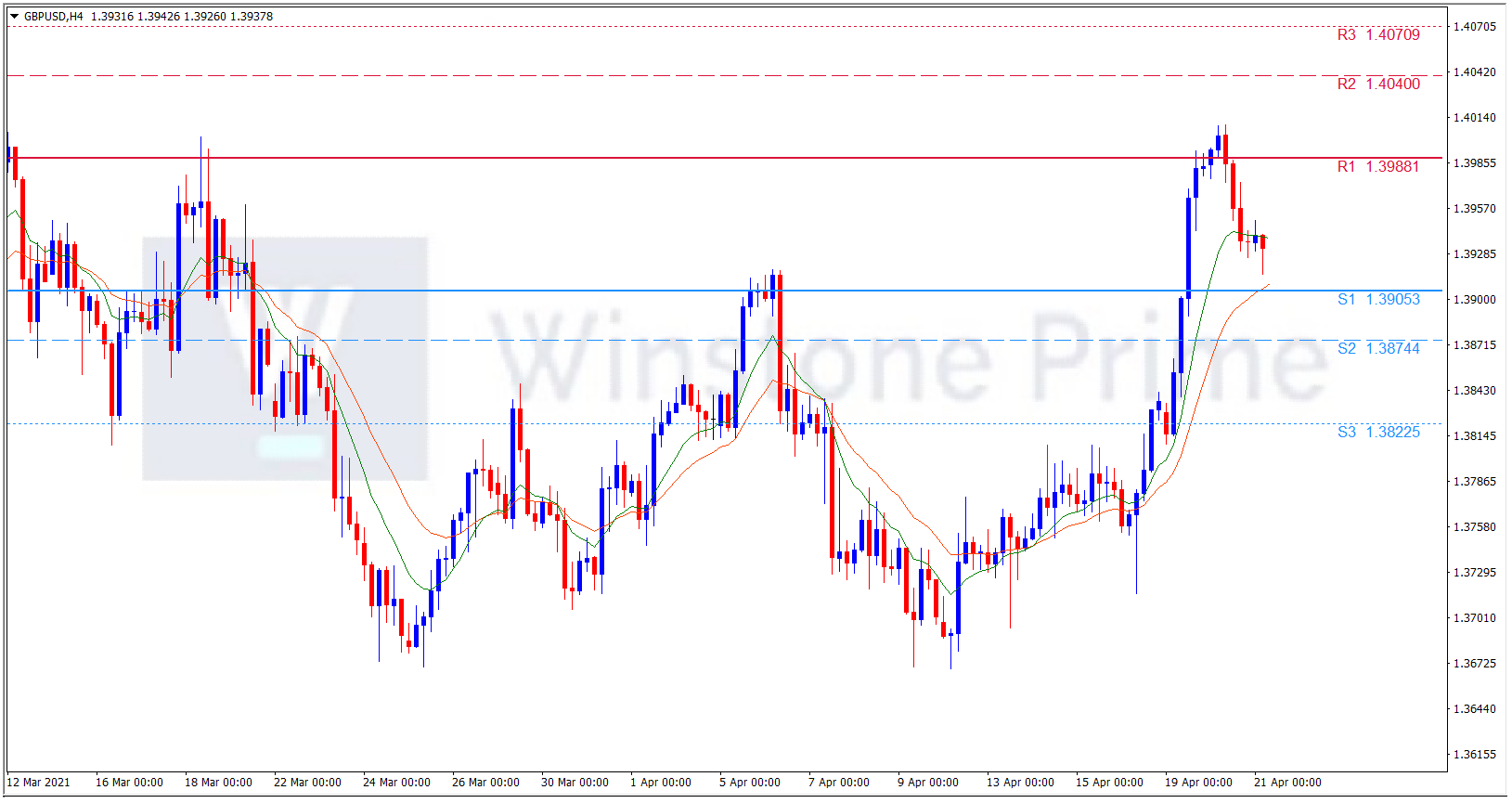
GBP/USD 4 Hour Chart:

Support: 1.3905 (S1), 1.3874 (S2), 1.3823 (S3).

Resistance: 1.3988 (R1), 1.4040 (R2), 1.4071 (R3).

The Uk’s CPI report will be closely watched by the pound traders to direct their move. In the meantime we expect a bearish trend for GBP/USD.