Pound struggles amid US dollar strength

The pound is trading downside against the greenback on Monday. The sterling seems to be under pressure mainly due to the renewed strength in the US Dollar Index (DXY). The US Treasury yields has seen some recent pullback and are trading near 1.66%, which offers a boost to the US dollar.

Whereas, Asian shares became weak on Monday as investors wait to see if U.S. earnings can justify sky-high valuations, while bond markets could be tested by what should be very strong readings for U.S. inflation and retail sales this week.

There was a rise in the US 10-year rates due to the anticipated inflation which helped the US dollar to gain as an attractive investment.

Early Monday, The Federal Reserve Chair Jerome Powell said that the US economy was ready to move but not moving for a stronger recovery COVID-19 remains a threat. The economy is at an “inflection point”, with accelerated output and job growth owing to the government’s support measures and a rapid vaccination program. 

On the other hand, Data wise, the UK published on Friday, March Halifax House Prices, which were up 6.5% in the three months to March. The economy of UK showed signs of recovery but slow pace of vaccination due to the AstraZeneca coronavirus vaccine issues effected the recovery speed. The UK vaccine rollout with the shot was considered successful until concerns related to blood clots arose, leading to a slowing pace of vaccination.

Another factor weighing on pound is the effects of Brexit in Northern Ireland. The protocol agreed after the UK’s departure from the Union has resulted in trade barriers between Britain and Northern Ireland. Unionist riots have been hitting the area since late March, escalating as time goes by.

GBP/USD 4 Hour Chart:
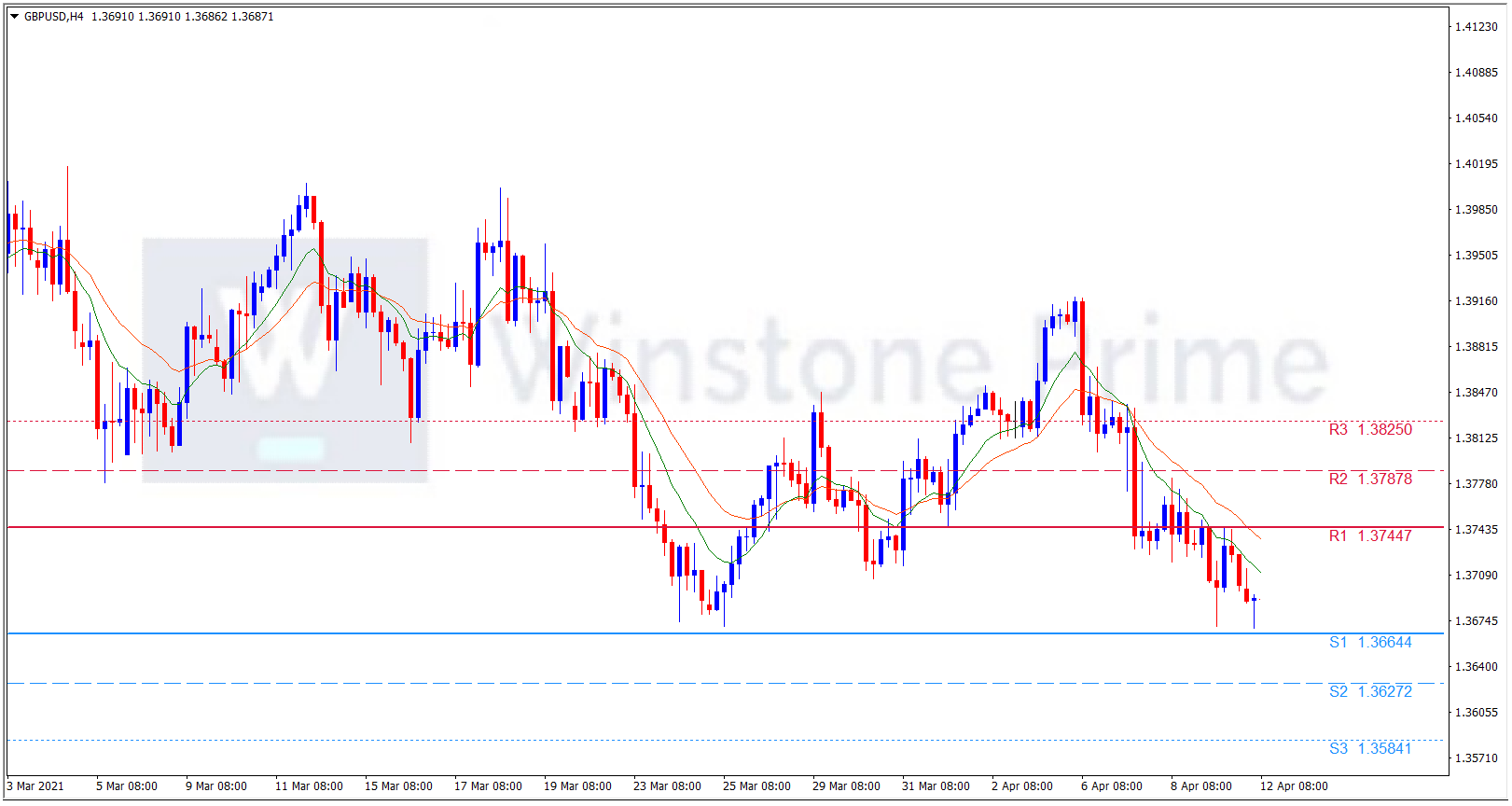
Support: 1.3664 (S1), 1.3627 (S2), 1.3584 (S3).

Resistance: 1.3745 (R1), 1.3788 (R2), 1.3825 (R3).

All the catalysts favors greenback against the pound. We expect a bearish trend for GBP/USD.

Crypto mining & How does it work

Now a days Crypto mining is a popular topic in anywhere. Mining in the crypto world is the process of keeping blockchain data in check. It involves hard work (done by computers) and results in a slow accumulation of resources – just like mining for minerals.  

Anyone can become a miner, but mining is not for everyone. Over 70% of Bitcoin mining happens in China, where dirt cheap electricity makes running mining computers extremely profitable.

So, what is cryptocurrency mining (in a more technical sense) and how does it work? Let’s break it down.

Decentralised system

With cryptocurrencies, there’s no central authority, nor is there a centralized ledger. That’s because cryptocurrencies operate in a decentralized system with a distributed ledger (more on this shortly) known as blockchain. Unlike the traditional banking system, anybody can be directly connected to and participate in the cryptocurrency “system.” You can send and receive payments without going through a central bank. That’s why it’s called decentralized digital currency.

But in addition to being decentralized, cryptocurrency is also a distributed system. This means the record (ledger) of all transactions is publicly available and stored on lots of different computers. This differs from the traditional banks we mentioned earlier, which are centralized systems.

But without a central bank, how are transactions verified before being added to the ledger? Instead of using a central banking system to verify transactions (for example, making sure the sender has enough money to make the payment), cryptocurrency uses cryptographic algorithms to verify transactions.

And that’s where bitcoin miners come in. Performing the cryptographic calculations for each transaction adds up to a lot of computing work. Miners use their computers to perform the cryptographic work required to add new transactions to the ledger. They get a small amount of cryptocurrency themselves.

Cryptocurrency mining, or cryptomining, is a process in which transactions for various forms of cryptocurrency are verified and added to the blockchain digital ledger. Also known as cryptocoin mining, altcoin mining, or Bitcoin mining (for the most popular form of cryptocurrency, Bitcoin), cryptocurrency mining has increased both as a topic and activity as cryptocurrency usage itself has grown exponentially in the last few years.

Each time a cryptocurrency transaction is made, a cryptocurrency miner is responsible for ensuring the authenticity of information and updating the blockchain with the transaction. The mining process itself involves competing with other cryptominers to solve complicated mathematical problems with cryptographic hash functions that are associated with a block containing the transaction data.

We’ll talk more about what makes cryptocurrencies and crypto mining so appealing in a bit. But first, let’s break down how cryptocurrency mining actually works. To do this, we’ll explore the technologies and processes that are involved in it.

A miner is a node in the network that collects transactions and organizes them into blocks. Whenever transactions are made, all network nodes receive them and verify their validity. Then, miner nodes gather these transactions from the memory pool and begin assembling them into a block (candidate block). 

The first step of mining a block is to individually hash each transaction taken from the memory pool, but before starting the process, the miner node adds a transaction where they send themselves the mining reward (block reward). This transaction is referred to as the coinbase transaction, which is a transaction where coins get created ‘out of thin air’ and, in most cases, is the first transaction to be recorded in a new block.

After every transaction is hashed, the hashes are then organized into something called a Merkle Tree (or a hash tree) – which is formed by organizing the various transaction hashes into pairs and then hashing them. The outputs are then organized into pairs and hashed once again, and the process is repeated until “the top of the tree” is reached. The top of the tree is also called a root hash (or Merkle root) and is basically a single hash that represents all the previous hashes that were used to generate it.

The root hash – along with the hash of the previous block and a random number called nonce – is then placed into the block’s header. The block header is then hashed producing an output based on those elements (root hash, previous block’s hash, and nonce) plus a few other parameters. The resulting output is the block hash and will serve as the identifier of the newly generated block (candidate block). 

In order to be considered valid, the output (block hash) must be less than a certain target value that is determined by the protocol. In other words, the block hash must start with a certain number of zeros.

The target value – also known as the hashing difficulty – is regularly adjusted by the protocol, ensuring that the rate at which new blocks are created remains constant and proportional to the amount of hashing power devoted to the network.

Therefore, every time new miners join the network and competition increases, the hashing difficulty will raise, preventing the average block time from decreasing.  In contrast, if miners decide to leave the network, the hashing difficulty will go down, keeping the block time constant even though there is less computational power dedicated to the network.

The process of mining requires miners to keep hashing the block header over and over again, by iterating through the nonce until one in the network miner eventually produces a valid block hash. When a valid hash is found, the founder node will broadcast the block to the network. All other nodes will check if the hash is valid and, if so, add the block into their copy of the blockchain and move on to mining the next block.

However, it sometimes happens that two miners broadcast a valid block at the same time and the network ends up with two competing blocks. Miners start to mine the next block based on the block they received first. The competition between these blocks will continue until the next block is mined based on either one of the competing blocks. The block that gets abandoned is called an orphan block or a stale block. The miners of this block will switch back to mining the chain of the winner block.

While the block reward is granted to the miner who discovers the valid hash first, the probability of finding the hash is equal to the portion of the total mining power on the network. Miners with a small percentage of the mining power stand a very small chance of discovering the next block on their own. Mining pools are created to solve this problem. It means pooling of resources by miners, who share their processing power over a network, to split the reward equally among everyone in the pool, according to the amount of work they contribute to the probability of finding a block.

In general, the answer is yes. Determining whether crypto mining is legal or illegal primarily depends on two key considerations:

1.  Your geographic location, and

2.  Whether you mine crypto through legal means.

However, where you start to tread into the territory of illegal activities is when you use illicit means to mine cryptocurrencies. For example, some cybercriminals use Javascript in browsers or install malware on unsuspecting users’ devices to “hijack” their devices’ processing power. This type of cyber attack is known as cryptojacking.

But it’s important to note that cryptocurrency mining is viewed differently by various governments around the globe. The U.S. Library of Congress published a report stating that in Germany, for example, mining Bitcoin is viewed as fulfilling a service that’s at the heart of the Bitcoin cryptocurrency system. The LOC also reports that many local governments in China are cracking down on Bitcoin mining, leading many organizations to stop mining Bitcoin altogether.

Furthermore, some countries view cryptocurrency mining profits as being taxable while other countries view the fruits of such activities as non-taxable income.

Conclusion

Crypto mining is an interesting alternative to the traditional centralized systems that currently operate throughout the world. However, it’s very taxing in terms of computer and power resources and isn’t feasible for many users as a result. Stay tuned for our new article with new topics and don’t forget to signup with winstone Prime.

AUD/USD Weekly Forecast (12th April 2021 – 16th April 2021)

Fundamental view:

The Aussie finished a second consecutive week pretty much unchanged near the 0.7670 level. The commodity-linked currency has remained away from investor’s radar this week, although it’s quite notable that with the broad greenback’s weakness and record levels in Wall Street, the pair was unable to advance. The American currency traded with a weak tone after unfavorable employment figures.

In the last week, The Reserve Bank Australia had a monetary policy meeting as per anticipation, the central bank held the cash rate and the 3-year yield target at 0.10%. The accompanying statement repeated that policymakers don’t expect to change interest rates at least until 2024 while noting that “the economy is operating with considerable spare capacity and unemployment is still too high.”

US ISM-NY Business Conditions Index & US Factory Orders monthly report on 5th April and US EIA Crude Oil Imports Change on 7th April created downtrend whereas US Initial Jobless Claims on 8th April, US Wholesale Inventories monthly report on 9th April created uptrend for the pair.

The major economic events deciding the movement of the pair in the next week are NAB Business Confidence, US CPI monthly report at April 13, US EIA Crude Oil Stocks Change, Fed Chair Powell Speech at April 14, Australia Employment Change, US Retail Sales monthly report, US Initial Jobless Claims at April 15 and US Building Permits at April 16.

AUD/USD Weekly outlook:

Technical View:

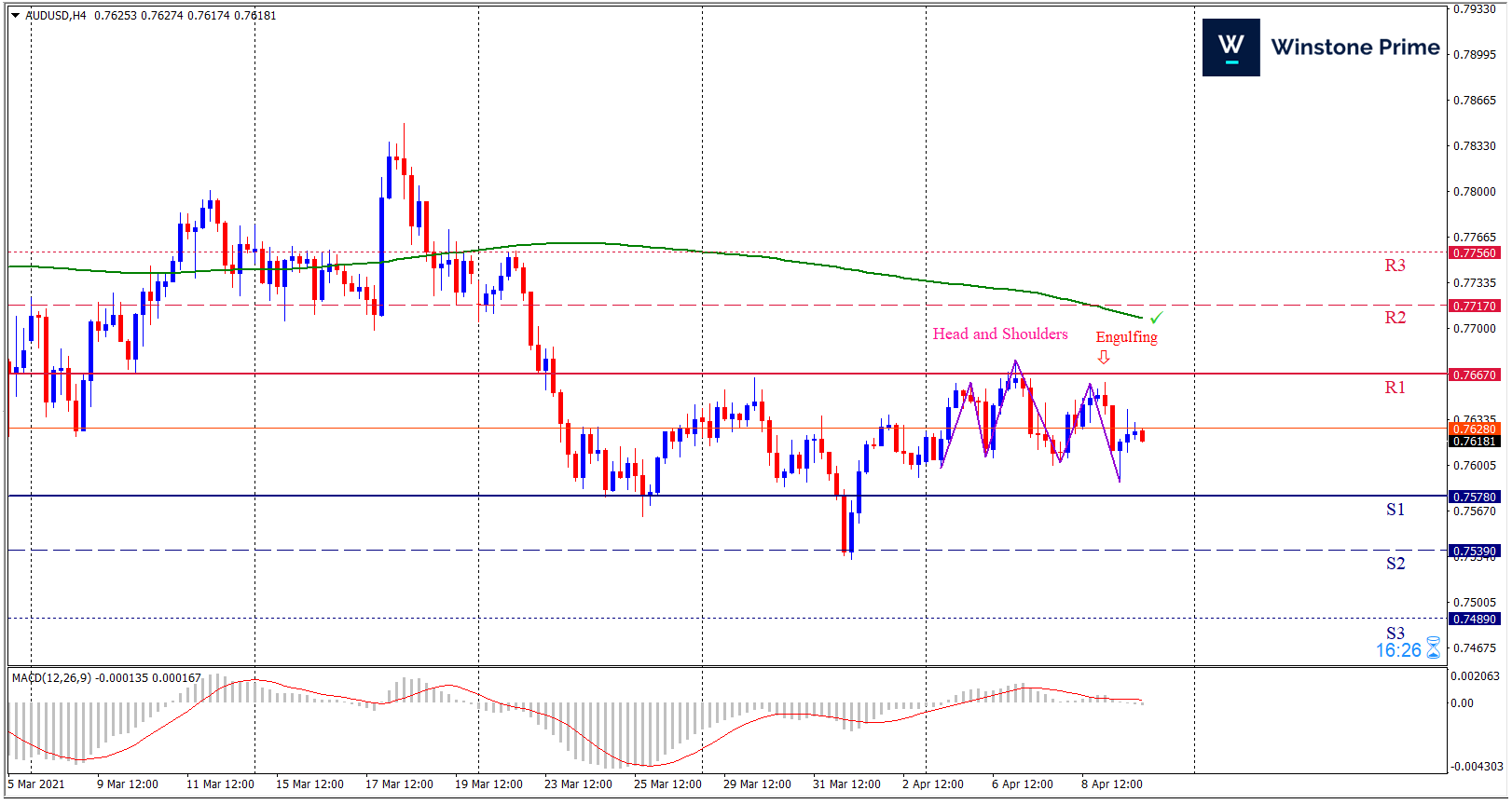
Last week’s high was 0.42% higher than the previous week. Maintaining high at 0.7677 and low at 0.7588 showed a movement of 89 pips.

In the upcoming week we expect AUD/USD to show a bearish trend.  The currency pair is trading below the 200 Simple Moving Average and the MACD trades to the downside. A solid breakout below 0.7578 may open a clean path towards 0.7539 and may take a way down to 0.7489. Should 0.7667 prove to be unreliable resistance, the AUDUSD may raise upwards 0.7717 and 0.7756 respectively. In H4 chart head and shoulders pattern formation favors prospects of a bearish trend. Also to be noted bearish engulfing formation exerts the expectation of downtrend for the pair.

Preference
Sell: 0.7624 target at 0.7540 and stop loss at 0.7672


Alternate Scenario
Buy: 0.7672 target at 0.7755 and stop loss at 0.7624

XAU/USD Weekly Forecast (12th April 2021 – 16th April 2021)

Fundamental view:

The yellow metal was trading tight range at the beginning of the week due to the thin trading conditions because of Easter on the week beginning which allowed financial markets to remain calm. After that, the sharp drop witnessed in the US Treasury bond yields weighed heavily on the greenback and triggered a rebound in the pair. Decline noted in the benchmark 10-year US T-bond yield also provided a boost to the precious metal.

During last week, FOMC Chairman Jerome Powell acknowledged that the traditional tool to deal with inflation would be to raise rates but said that a one-time increase in prices does not necessarily point to persistent inflation.  Powell downplaying inflation concerns, greenback saw the pressure favoring the XAU/USD pair.              

The major economic events deciding the movement of the pair in the next week are CPI monthly report at April 13, EIA Crude Oil Stocks Change, Fed Chair Powell Speech at April 14, Retail Sales monthly report, Initial Jobless Claims at April 15 and Building Permits at April 16 for US.

XAU/USD Weekly outlook:

Technical View:

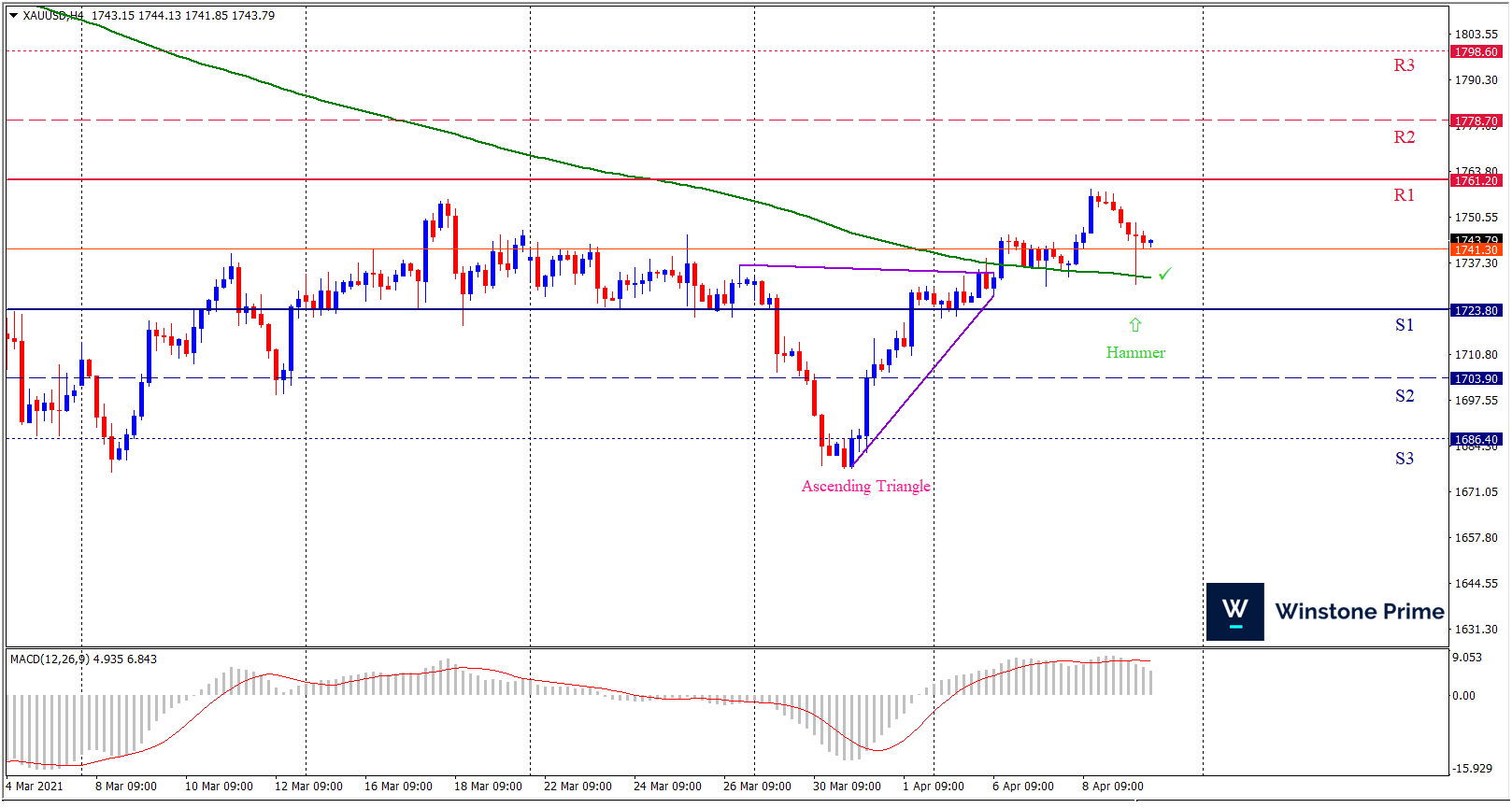
Last week’s high was 1.47% higher than the previous week. Maintaining high at 1758.7 and low at 1721.3 showed a movement of 374 pips.

In the upcoming week we expect XAU/USD to show a bullish trend.  The Instrument is trading above the 200 Simple Moving Average and the MACD trades to the upside. A solid breakout above 1761.2 may open a clean path towards 1778.7 and may take a way up to 1798.6. Should 1723.8 prove to be unreliable support, the XAUUSD may sink downwards 1703.9 and 1686.4 respectively. In H4 chart Ascending Triangle breakout favors prospects of a bullish trend. Also to be noted Bullish hammer formation exerts the expectation of uptrend for the pair.

Preference
Buy: 1741.6 target at 1777.7 and stop loss at 1718.8


Alternate Scenario
Sell: 1718.8 target at 1687.4 and stop loss at 1741.6