Japan shares gain favors yen

Japanese stocks had a rise on Friday in broad-based buying which is driven by expectations that the companies will make healthy profits and issue upbeat forecasts in the coming days as corporate earnings reports start to roll in .The Nikkei 225 Index .N225 rose 0.43% to 29,837.54.

The Industrial robot and the semiconductor manufacturing equipment maker Yaskawa Electric Corp 6506.T is scheduled to release its earnings report on Friday. The Shares of it rose by 0.34%.

Analysts said this could set the tone for Japan’s industrial sector, which is expected to benefit from a rebound in global capital expenditure and rising investment to ease a shortage in semiconductors. Junichi Inoue, head of Japanese equities at Janus Henderson Investors, said that “This is just the beginning of the (equities) cycle.” “This is going to be capex-driven and a bigger cycle than previously. Japanese companies are very strong in capital equipment. In general, the machinery sector should benefit.”

Elsewhere, Japan’s industry minister said on Friday that there was no truth to a media report that the government was claiming for a 2030 greenhouse gas (GHG) emissions reduction of 45% from fiscal year 2013 levels, against the current 26% target.

“The medium-term target for 2030 is still being discussed in light of the long-term goal of becoming carbon neutral by 2050,” Industry Minister Hiroshi Kajiyama told a news conference. “It’s the government’s plan to announce an ambitious goal by COP26 in November and there is no truth that the government has finalised any specific figures as reported in the media.”

On the other hand, Yesterday, the U.S.  reported that Initial Jobless Claims increased from 728,000 (revised from 719,000) to 744,000 compared to analyst consensus of 680,000. Continuing Jobless Claims declined from 3.75 million (revised from 3.79 million) to 3.73 million compared to analyst consensus of 3.65 million.

USD/JPY 4 Hour Chart:
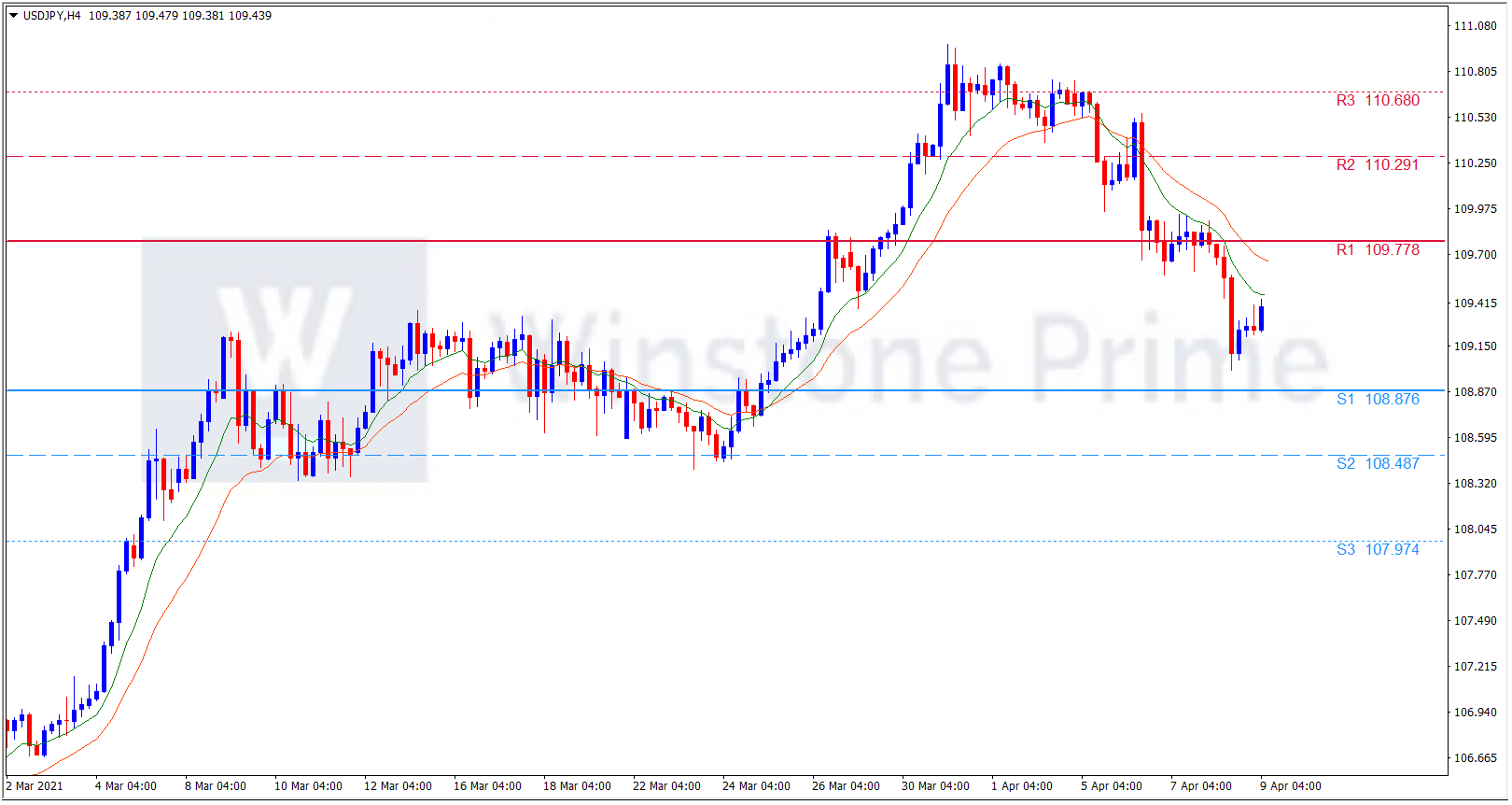
Support: 108.88 (S1), 108.49 (S2), 107.97 (S3).

Resistance: 109.78 (R1), 110.29 (R2), 110.68 (R3).

All the catalysts favors the Japanese yen against greenback and we expect a short term bearish trend for USD/JPY.

FOMC meeting minutes favors greenback

Euro started with a downtrend in the Asian session since the U.S. Federal Reserve’s latest meeting minutes indicates continued policy support and cemented hopes of a quick economic turnaround. Minutes from the latest FOMC meeting held on March 16-17 confirmed that the central bank is no rush to hike rates.

Federal Reserve officials remain cautious about the ongoing risks of the coronavirus pandemic and are committed to bolstering the economy until its recovery is more secure, minutes of the policy meeting showed.

However, Investors looked convinced that a faster US economic recovery from the pandemic will force the Fed to raise interest rates sooner than anticipation.

Only a couple of the officials cited possible financial stability risks flowing from the Fed’s current policy of maintaining its overnight benchmark lending rate near zero and buying $120 billion in bonds every month – a setting the Fed says is locked in until the economy is well on its way to being healed.

The positive outlook for the US economy remains supported by the impressive pace of coronavirus vaccinations and infrastructure spending plan of US President Joe Biden.

The positive sentiment creates speculations on the US inflation and raised doubts that the Fed will retain ultra-low interest rates for a longer period. This led to the push of US Treasury bond yields higher, which helped revive demand for the US dollar.

In other news, JP Morgan CEO Jamie Dimon said in his annual letter to his shareholders that the U.S. economy is emerging from the pandemic in strong fashion and that the economic boom could last until 2023. He said a “Goldilocks moment” is coming fast, amid sustained economic growth and non-problematic inflation.

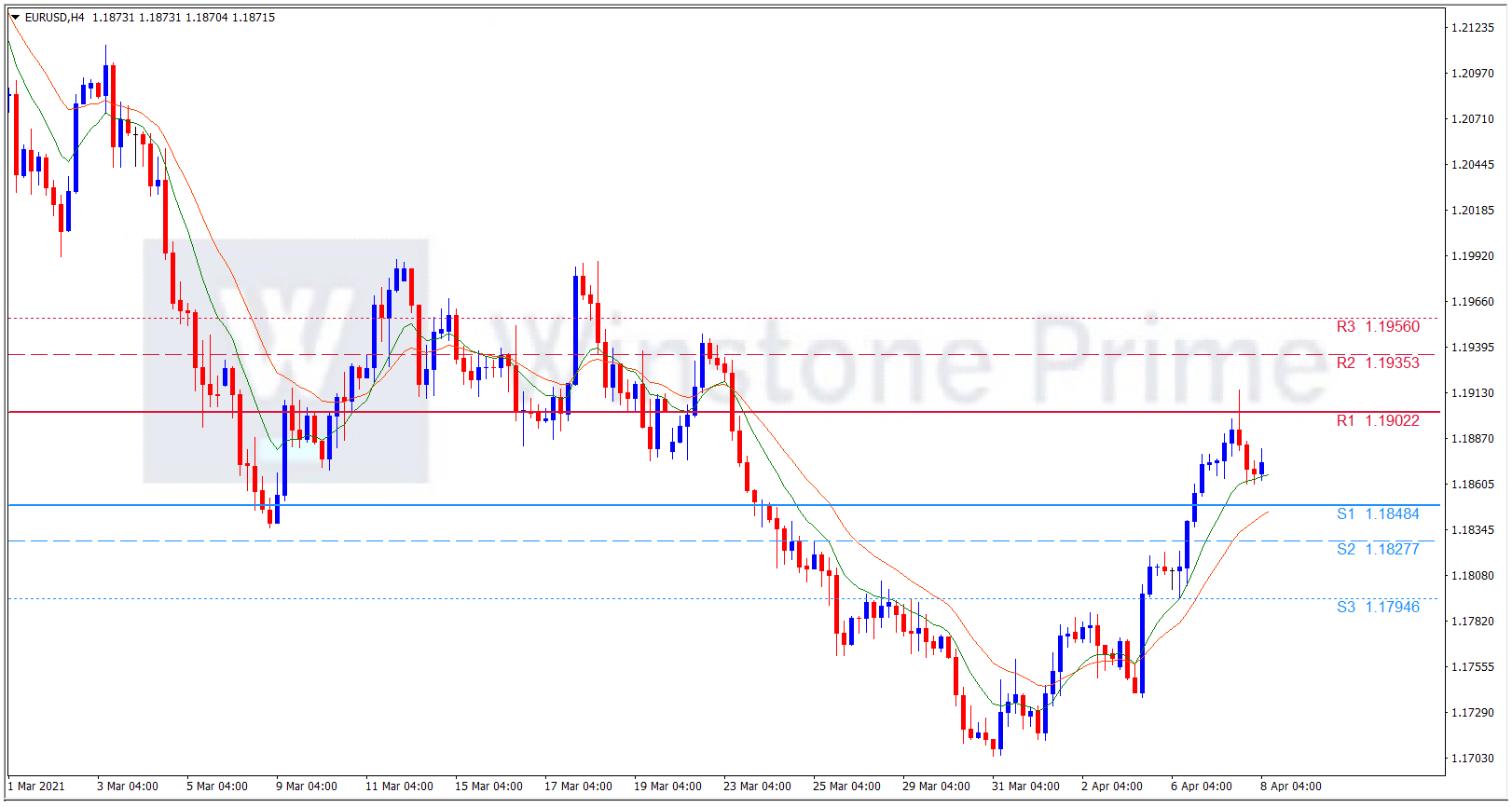
EUR/USD 4 Hour Chart:

Support: 1.1848 (S1), 1.1828 (S2), 1.1795 (S3).

Resistance: 1.1902 (R1), 1.1935 (R2), 1.1956 (R3).

Investors are now waiting for the Fed powell speech to direct their trades, in the meantime all the catalysts are favoring the greenback. We expect a bearish trend for EUR/USD.

Third Strike Trading Strategy

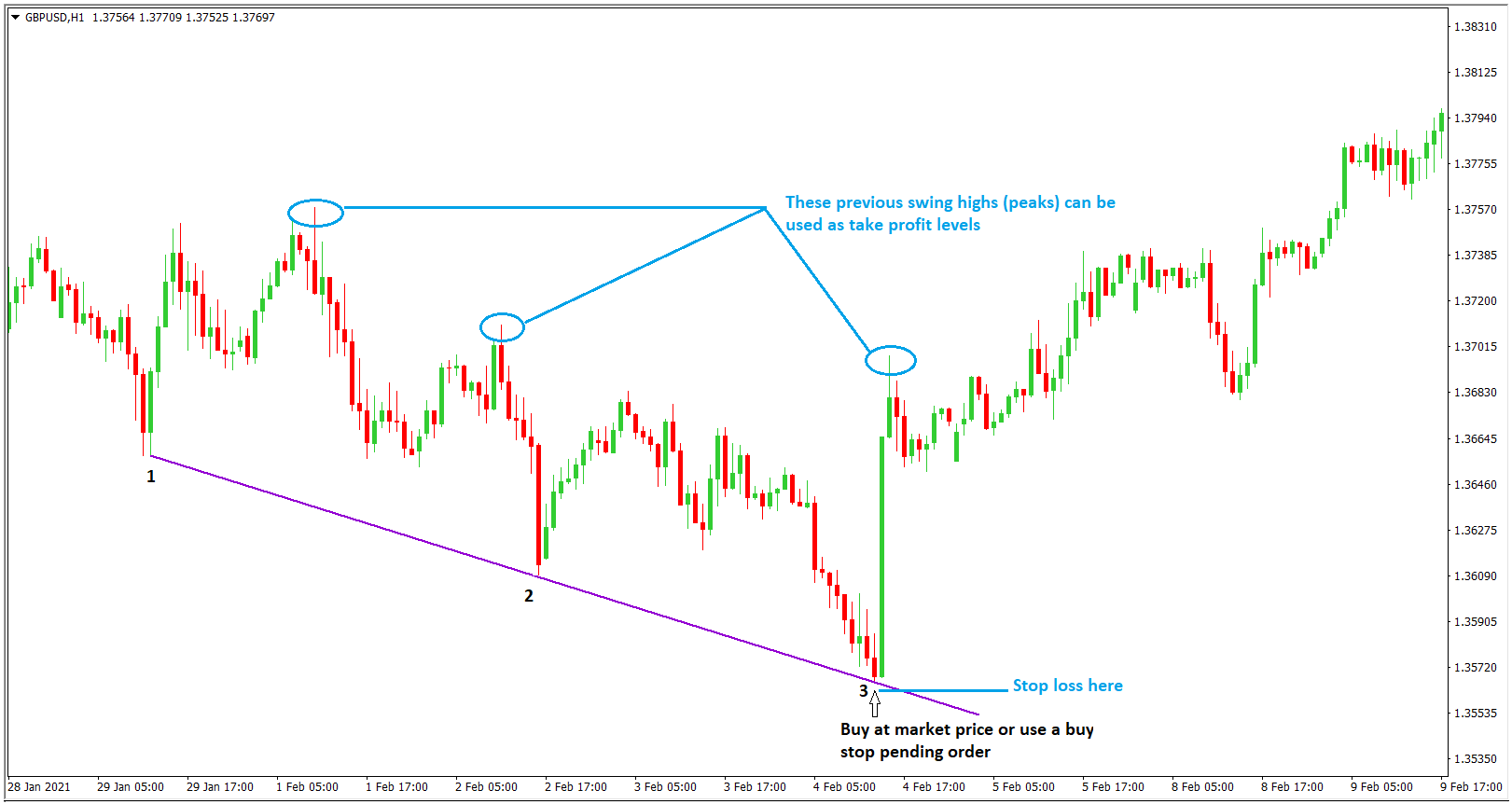
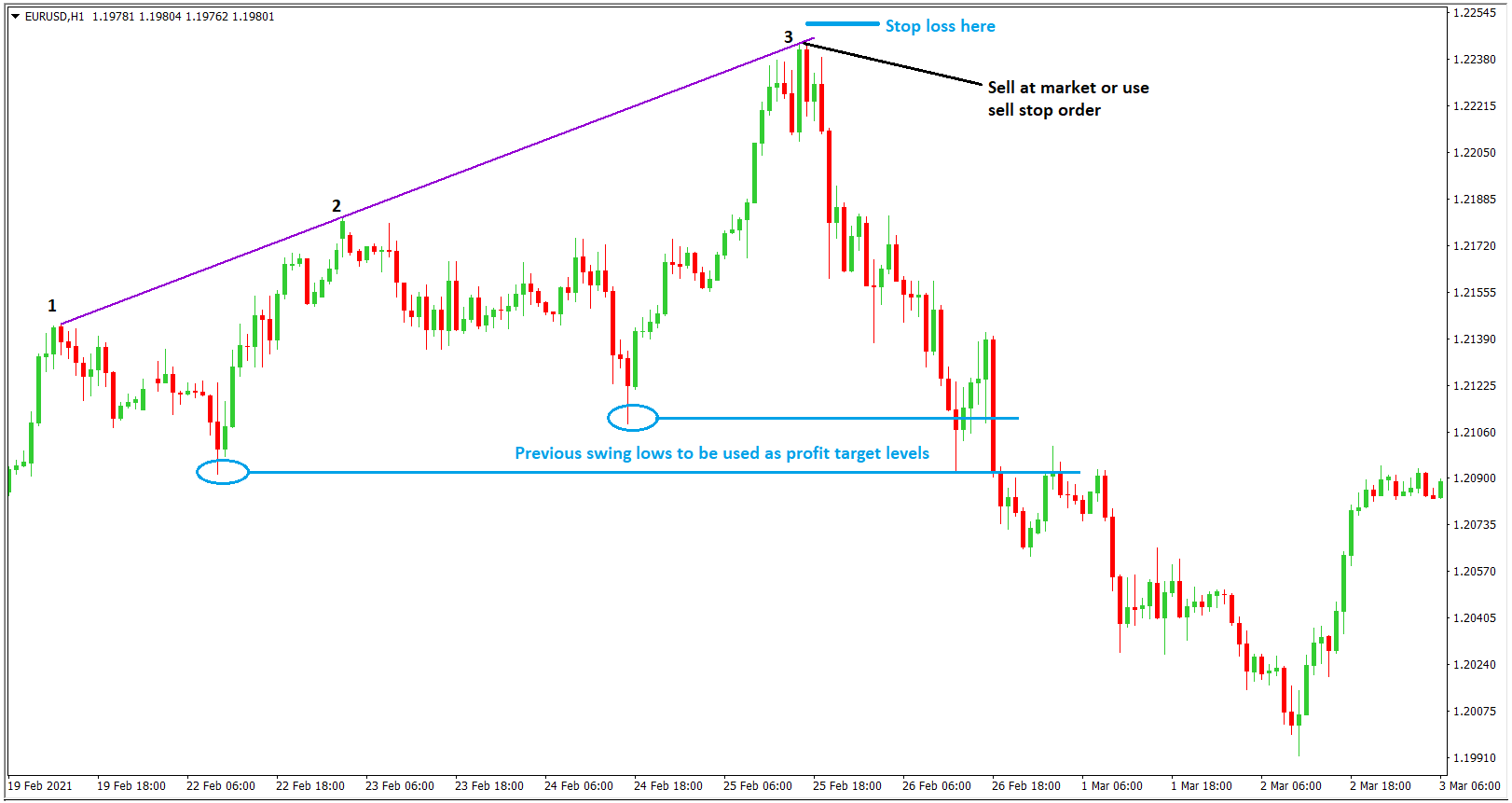
The third strike trading strategy is based on this reversal chart pattern where:

  • In a downtrend, price will be making those decreasing swing lows and then on the third swing low, it makes a drastic move upwards.
  • Similarly, in an uptrend, price will be making peaks of increasing heights and then on the third peak, it tends to make a drastic move dowards.
  • The key to finding out where this 3rd swing low or peak would be is to use a trendline.

Timeframes : All

Instrument : you can trade any instrument

Trading Rules:

Long entry :

  • Market will be in a downtrend
  • Lower swing lows will form
  • When two lower swing lows form, you connect them with a trendline and wait to see if price comes to touch that trendline on the 3rd point, if it does so go to step 4.
  • Buy immediately at market price as soon as trendline is touched or you can wait until the candlestick that touch point 3 has closed before using a buy stop order.
  • Place your stop loss at least 10-20 pips under the low of the candlestick if you used the market order or if you use the buy stop order then place it at least 5-10 pips under the low of that candlestick.
  • Your take profit target options would be the previous peaks or swing highs that the price made.


Let us explain with a chart below:

Short Entry :

  • Market will be in an uptrend
  • Higher swing highs (increasing peaks) will form
  • When two peaks form, you connect them with a trendline and wait to see if price comes to touch that trendline on the 3rd point, if it does so go to step 4.
  • Sell immediately at market price as soon as trendline is touched or you can wait until the candlestick that touch point 3 has closed before using a sell stop order.
  • Place your stop loss at least 10-20 pips above the high of the candlestick if you used the market order or if you use the sell stop order then place it at least 5-10 pips above the high of that candlestick.
  • Your take profit target options would be the previous swing lows that the price made.


Let us explain with a chart below:

Pros :

  • The risk reward of this trading strategy is really good when trade goes as planned. Even if you lose, your loss will be small because stop loss is tight.
  • Can easily bag hundreds of pips easily in a hours in a market that is strongly trending.


Cons :

  • As usual, there will be false signals and you can get stopped out with a loss and hopefully loss is manageable if you trade with money management in mind.

Housing price strengthens Aussie

Australian shares on Wednesday extended its gains continuously for a fourth session, with the help of commodity-exposed stocks on firm crude and metals prices and as the investors placed bets on improving prospects for a global economic recovery.

Yesterday, the International Monetary Fund raised its global economic growth forecast to 6% this year, a rate which is not seen since 1970s.

Elsewhere, strong economic data from China and the United States lifted oil prices by 1%, While copper prices climbed on supply concerns after top producer Chile closed its borders following a spike in coronavirus infections. strong commodities lifted the Aussie traders sentiment.

Reserve Bank of Australia (RBA) highlighted the recent strength in the housing markets at its monetary policy meeting on Tuesday. The country’s Treasurer Josh Frydenberg gave upbeat comments on the hot property market.

Frydenberg said that “he believes as price values go up, it gives people more faith in the economy and confidence to spend.”

RBA’s Governor Phillip Lowe said on Tuesday, “housing markets have strengthened further, with prices rising in most jurisdictions, while housing credit growth to owner-occupiers has picked up, with strong demand from first home buyers.

On the other hand, greenback fell suddenly with the Treasury yields on Tuesday after markets re-priced the Fed tightening bets that firmed up following Friday’s NFP blowout.

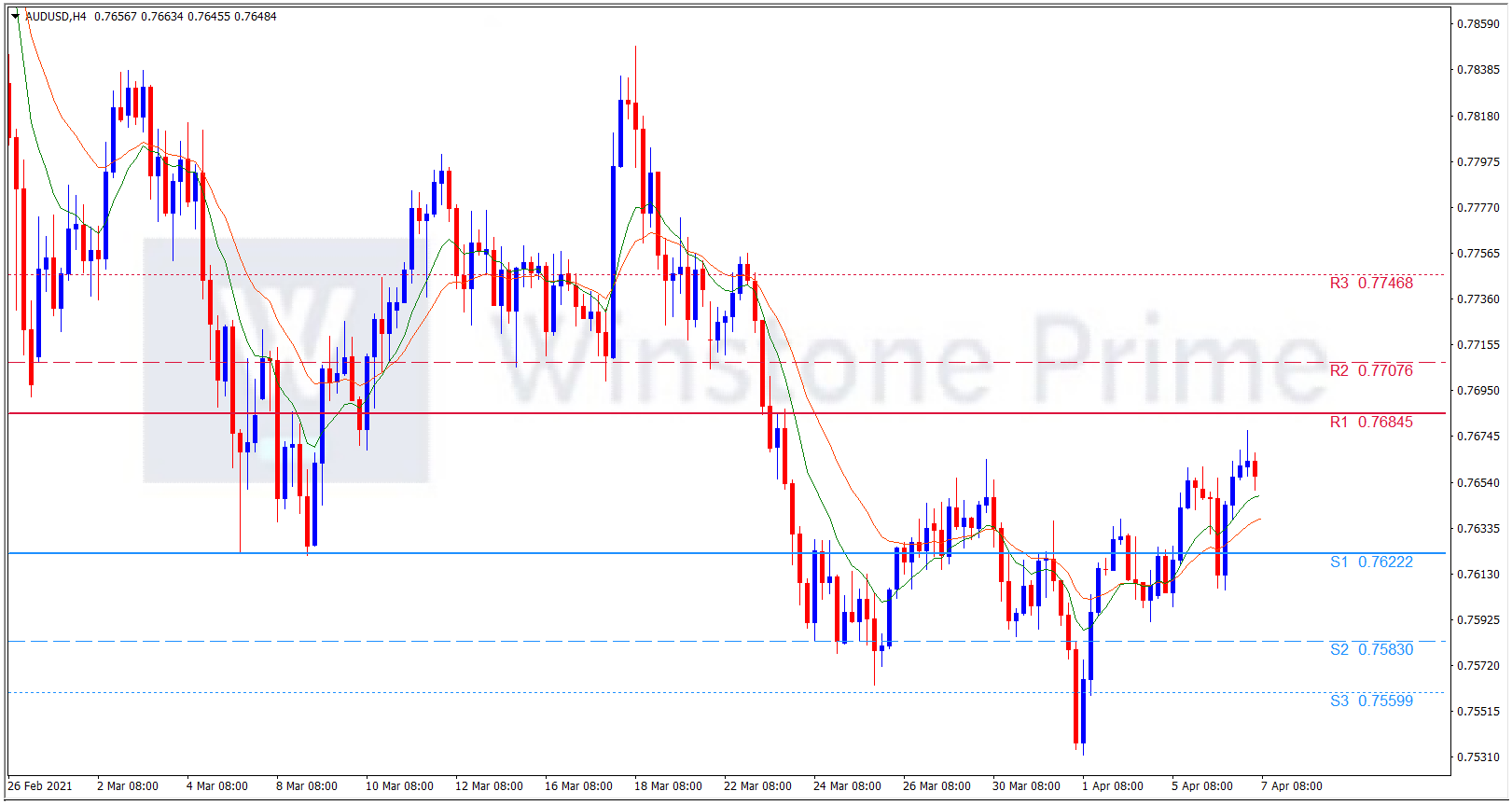
AUD/USD 4 Hour Chart:

Support: 0.7622 (S1), 0.7583 (S2), 0.7560 (S3).

Resistance: 0.7685 (R1), 0.7708 (R2), 0.7747 (R3).

The Housing prices confidence and the Australian shares extending its gain attracts investors towards Aussie and we expect a bullish trend for AUD/USD.