Dollar’s drop encourages Euro traders

Euro seem to be in the uptrend as greenback weakens amid a return of risk-off mood ahead of the Eurozone data.

The futures linked to the US indices flipped to losses, suggesting risk-aversion.  Investors are doubtful on the prospects of the post-pandemic economic recovery and on the US President Joe Biden’s $2.25 trillion infrastructure plan.

Elsewhere, US Nonfarm Payroll report released last Friday showed a positive data ticking at 916k against the expectation of 409k and previous record of 468k which went unnoticed on Good Friday. The DJIA and the S&P reached record highs, with the three US major indexes adding over 1.0% each. Meanwhile, US Treasury yields ticked modestly lower, with that on the 10-year note at around 1.70%. On Monday, US published the February Factory Orders, which fell by 0.8%, worse than the -0.5% expected.

In the meantime, US published the March ISM Services PMI yesterday, which surged to an all-time high of 63.7, largely surpassing the 58.5 expected.

On the other hand, today the EU will publish April Sentix Investor Confidence, foreseen at 1.9 from 5 previously.

Across the Atlantic, rising cases of covid across Europe and strict restrictions in France, Germany and Italy continue to fuel the economic growth concerns among the EUR/USD traders which also questions on the ongoing uptrend of the pair.

EUR/USD 4 Hour Chart:
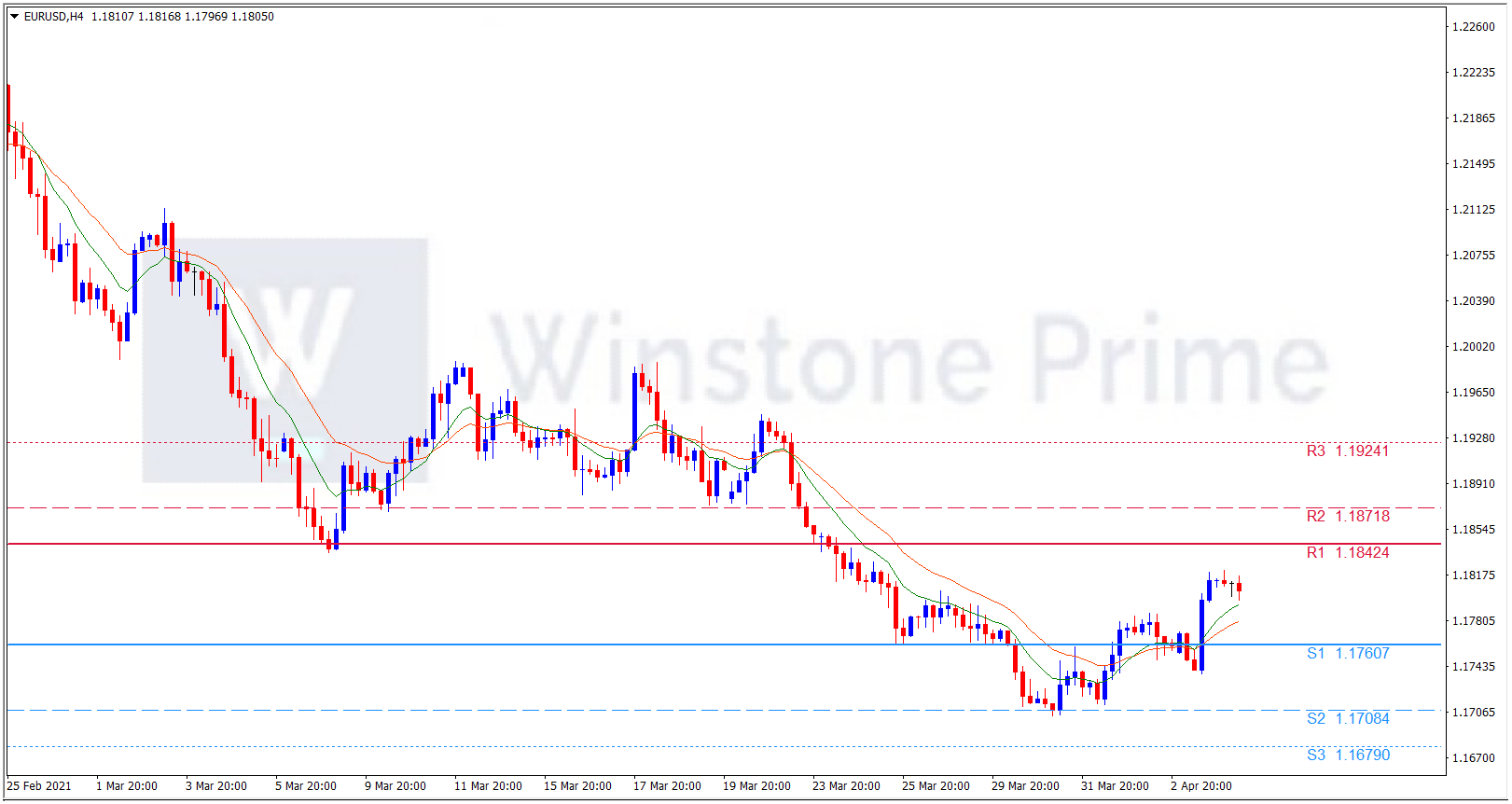
Support: 1.1761 (S1), 1.1708 (S2), 1.1679 (S3).

Resistance: 1.1842 (R1), 1.1872 (R2), 1.1924 (R3).

Now the attention of the investors is towards the EU sentix investors confidence which direct the EUR/USD further. As of now the Euro seem to enjoy the cautious positive sentiment and we expect a  bullish trend for EUR/USD.

Decline of Japan’s services sector impacts yen

Japan’s services sector activities declined in March as businesses is struggling to fully shake off the impact of the coronavirus pandemic which was showed by a private survey showed, but the pace of the downturn was the slowest since January last year.

The final au Jibun Bank Japan Services Purchasing Managers’ Index (PMI) rose to a seasonally adjusted 48.3 from the previous month’s 46.3 and a preliminary 46.5 reading. That meant service-sector activity stayed below the 50 level.

Businesses are set for more challenges over the short term. On Thursday, the government has decided to impose emergency measures, such as shorter business hours and refrain from activities like karaoke, in parts of some prefectures, including Osaka in western Japan in response to a resurgence of COVID-19 cases.

Elsewhere, Japan might need to compile a supplementary budget for the current fiscal year to combat the economic blow from the coronavirus pandemic, a senior ruling party official was saying in a television programme on Sunday.

Toshihiro Nikai, the ruling Liberal Democratic Party’s secretary general, said in the programme that “If there’s any shortage of funds, we’d like to always respond aggressively including by compiling a supplementary budget.”

But Prime Minister Yoshihide Suga raised concern over the idea of compiling a supplementary budget, by stressing that the existing pool of funds would be sufficient to meet any unforeseen costs.

On the other hand, The dollar was keeping steady on Monday as investors overcame last week’s strong U.S. employment report and looked ahead to upcoming data on the U.S. services sector for affirmation of a solid economic rebound from the coronavirus shock.

The U.S. currency is likely to build on those gains as investors look for ways to bet on a global economic recovery from the worst of the coronavirus pandemic, analysts said.

USD/JPY 4 Hour Chart:

Support: 110.41 (S1), 110.20 (S2), 110.03 (S3).

Resistance: 110.78 (R1), 110.95 (R2), 111.16 (R3).

Amidst all the catalysts favoring greenback against yen, we expect a bullish trend for USD/JPY.

GBP/USD Weekly Forecast (5th April 2021 – 9th April 2021)

Fundamental view:

GBP/USD has been seeing a rock and roll trend in response to US yields and Jeo Biden’s plan. The main development of the past week has been President Joe Biden’s $2.25 trillion infrastructure plan. Treasuries fluctuated and caused jitters which allowed each currency to trade somewhat differently against it. For sterling, that was an advantage.  In the UK, which is more advanced in its immunization drive, the situation of Covid -19 is improving.

US Dallas Fed Manufacturing Index on 29th March and US S&P/CS HPI Composite-20 y/y & US CB Consumer Confidence Index on 30th March created downtrend for the pair whereas Britain Business Investment quarterly report & Britain GDP quarterly report on 31st March and Britain Markit/CIPS Manufacturing PMI on 1st April created uptrend for the pair.

The major economic events deciding the movement of the pair in the next week are IMF Meeting, US ISM Non-Manufacturing PMI at April 05, US JOLTS Job Openings at April 06,UK Markit/CIPS Services PMI, FOMC Minutes at April 07, US Initial Jobless Claims, Fed Chair Powell Speech at April 08 and BoE Quarterly Bulletin at April 09.

GBP/USD Weekly outlook:

Technical View:

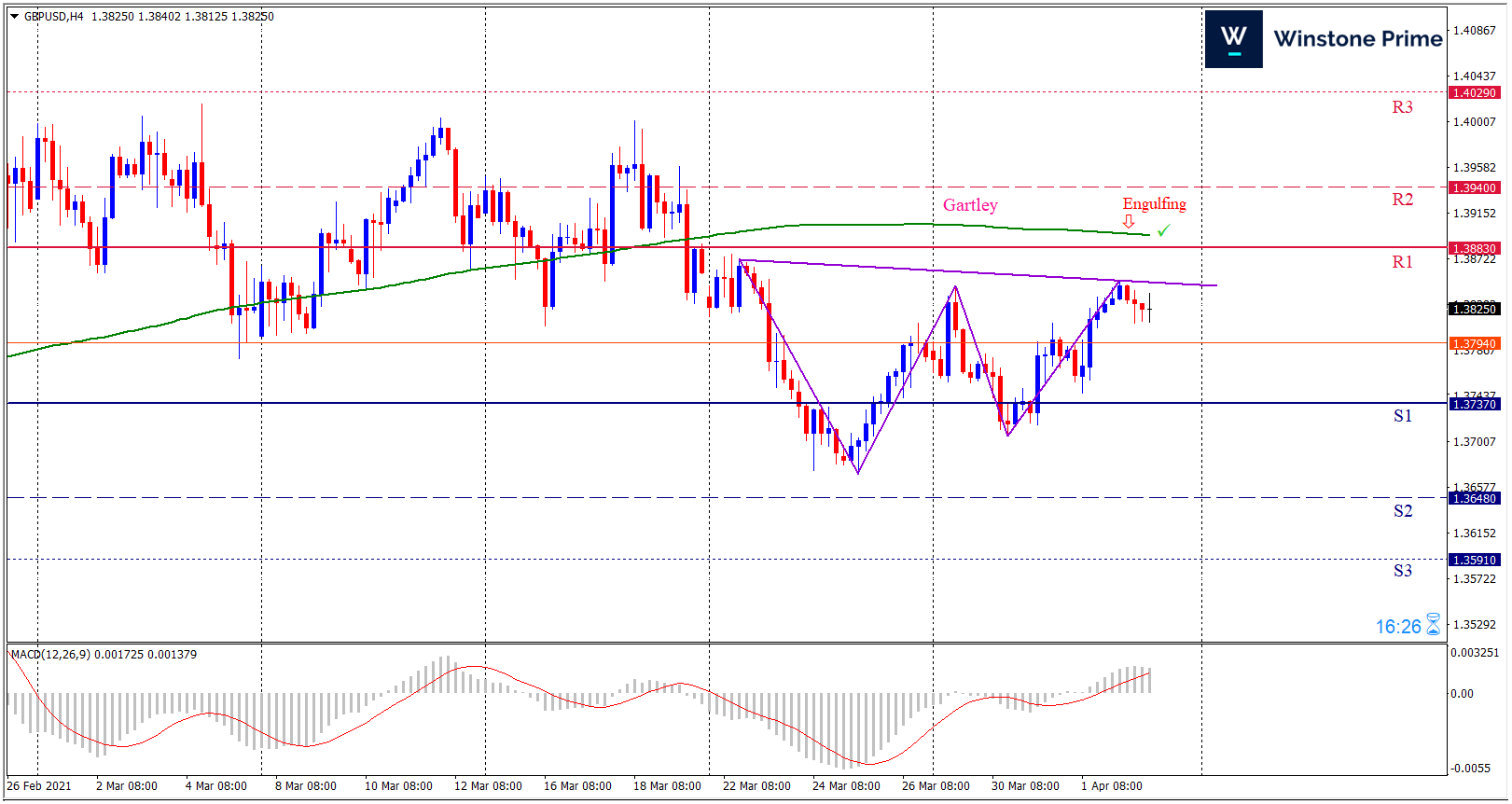
Last week’s high was 0.18% lower than the previous week. Maintaining high at 1.3852 and low at 1.3706 showed a movement of 146 pips.

In the upcoming week we expect GBP/USD to show a bearish trend.  The currency pair is trading below the 200 Simple Moving Average and the MACD trades to the upside. A solid breakout below 1.3737 may open a clean path towards 1.3648 and may take a way down to 1.3591. Should 1.3883 prove to be unreliable resistance, the GBPUSD may raise upwards 1.3940 and 1.4029 respectively. Chart formation of bearish gartley pattern in H4 chart favors prospects of a bearish trend. Bearish engulfing pattern formation escalates the expectation for a bearish trend.

Preference
Sell: 1.3804 target at 1.3649 and stop loss at 1.3888


Alternate Scenario
Buy: 1.3888 target at 1.4028 and stop loss at 1.3804

USD/JPY Weekly Forecast (5th April 2021 – 9th April 2021)

Fundamental view:

USD/JPY has a bullish rally in the past week. As the US yield engine continued to power the USD/JPY as the differential between Treasuries and Japanese Government Bonds almost guarantees flows into the American currency. An excellent March US payroll report also helped keep the USD/JPY stable at its high on Friday after continuous week of gains.

US Pending Home Sales m/m & EIA Cushing Crude Oil Stocks Change on 31st March and Japan BoJ Tankan Large Manufacturing Index on 1st April framed bearish trend whereas US Dallas Fed Manufacturing Index on 29th March and Japan Unemployment Rate & Japan Retail Sales yearly report on 30th March framed bullish trend for the pair.

The major economic events deciding the movement of the pair in the next week are IMF Meeting, Japan Markit Services PMI, US ISM Non-Manufacturing PMI at April 05, US JOLTS Job Openings at April 06, Japan Current Account n.s.a., FOMC Minutes at April 07, US Initial Jobless Claims and Fed Chair Powell Speech at April 08.

USD/JPY Weekly outlook:

Technical View:

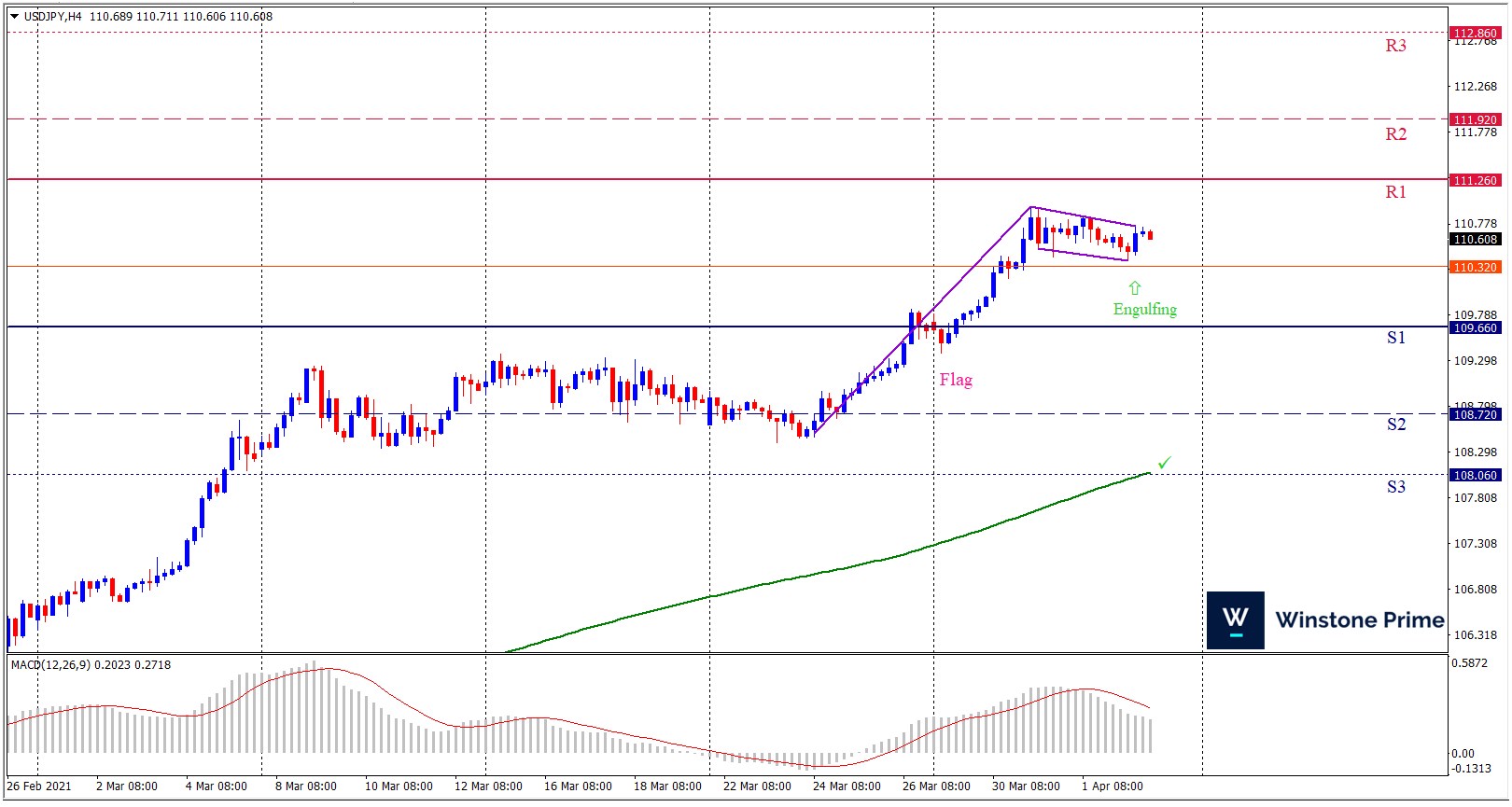
Last week’s high was 1.02% higher than the previous week. Maintaining high at 110.97 and low at 109.37 showed a movement of 160 pips.

In the upcoming week we expect USD/JPY to show a bullish trend. The currency pair is trading above the 200 Simple Moving Average and the MACD trades to the upside. A solid breakout above 111.26 may open a clean path towards 111.92 and may take a way up to 112.86. Should 109.66 prove to be unreliable support, the USDJPY may sink downwards 108.72 and 108.06 respectively. In H4 chart, Formation of bullish flag pattern indicates reversal of the trend creating prospects of a bullish trend Along with a bullish engulfing formation braces our expectation.

Preference
Buy: 110.53 target at 111.91 and stop loss at 109.61


Alternate Scenario
Sell: 109.61 target at 108.07 and stop loss at 110.53