New Research weighs on Pound

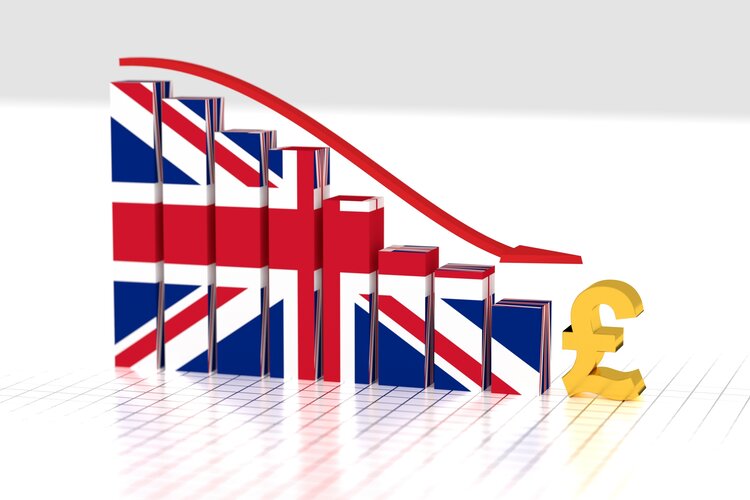
As per new research published on Monday, The United Kingdom lost market share in the United States, Germany and China during the COVID-19 pandemic due to global trade chaos, Brexit and poor productivity. And as per the report by Aston University’s Lloyd’s Banking Group Centre, The United Kingdom performed particularly badly due to a long-term stagnation in productivity growth.

While all countries fought with the tumult of COVID-19, the United Kingdom lost market share in its biggest export markets – the United States and Germany as per the research. “In some key export destinations – Germany, the UK and China – the UK seems to have suffered a sharper decline, experienced a slower recovery, and seen its global competitiveness dwindle,” the report said.

On the other hand, The U.S. Dollar traded positively on Friday after a government report showed jobs growth came in above expectations in February. The news helped drive the benchmark 10-year Treasury yield into a one-year high of 1.625%.

As per the US employment report, the 379k rise in headline non-farm payrolls augmented by a 38k net upward revision to the prior two months. Private sector hiring rose by 465k, dominated by the hospitality sector (+355k).  The unemployment rate fell to 6.2% against expectations from an unchanged 6.3%, while average hourly earnings rose by 0.2% as expected to be 5.3% up on a year ago – a figure still grossly distorted by the fact it is mostly lower paid workers who have lost their jobs during the pandemic, the data not being mix-adjusted.

The jobs improvement came amid falling new COVID-19 cases, quickening vaccination rates and additional pandemic relief money from the government, putting the labor market recovery back on firmer footing and on course for further gains in the months ahead.

As a added support to the greenback, Over the weekend the U.S. Senate passed a $1.9 trillion coronavirus relief package on Saturday as Democrats rush to send out a fresh round of aid.

GBP/USD 4 Hour Chart:
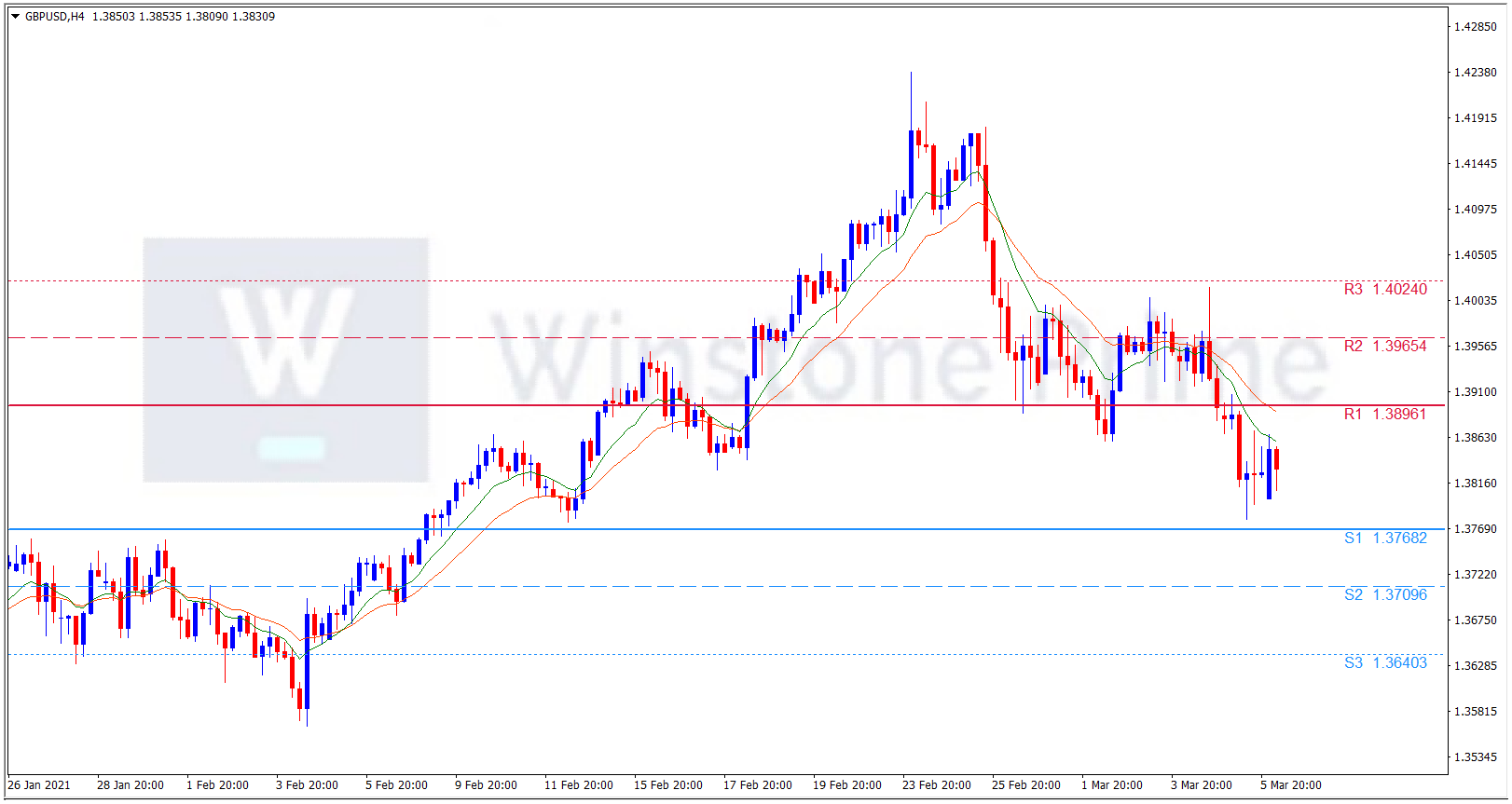
Support: 1.3768 (S1), 1.3710 (S2), 1.3640 (S3).

Resistance: 1.3896 (R1), 1.3965 (R2), 1.4024 (R3).

The new research weighs on the pound while the rest catalysts tend to favor the greenback. We expect a bullish trend for GBP/USD.


Expected trend of blockchain in 2021

The innovative technology of the blockchain has unique features of functioning in almost any area of society. Its distinguishing feature is the organization of the process without intermediaries. The past three years have brought about fairly consistent chatter about blockchain technology entering the forex market. While the currency trade typically occurs in a fairly traditional manner, many believe a tech upgrade of this nature has been a long time coming. And lately, specific examples have been coming to light. In some cases, brand new platforms are being created. In others, governments and banks are testing blockchain methods for forex trading; EuroNews revealed a Chinese study in 2019, indicating that China is at the forefront of this sort of innovation and is actively exploring blockchain and AI applications for cross-border financing.

These are fascinating developments, and ones that would seem to have the potential to bring about genuine improvements in the global forex market. More specifically, the following are some of the benefits blockchain tech could bring about.

Blockchain trends in 2021: Expect the unexpected

Although the mechanics of blockchain are extremely complex, the basic idea is simple: to decentralize the storage of data so that such data cannot be owned, controlled or manipulated by a central actor. The architecture and functioning of blockchain go hand in hand. As already mentioned, blockchain is a chain of blocks containing some valuable information. The type of blockchain depends on the data that is present inside a block. For example, a block in a Bitcoin contains information on who is sending how many bitcoins to whom.

The year 2021 has almost with many events. And last year has been a historically tough year for many. A number of events happened that were not included nor expected by many of us. Especially the COVID-19 pandemic that not only intensified trends that were already underway, but also generated new trends. It is a tradition to on what to expect in this year. We will look at the top trends we may expect for the blockchain and cryptocurrency landscape to watch out in 2021 and beyond? So, how will the landscape be look like for blockchain technology in the years to come?

What was not forecasted is that blockchain technology exploded in popularity this year. Businesses from a multitude of industries showed a growing interest to adopt this technology for enhancing their business processes. The COVID-19 pandemic accelerated the digital transformation drive in many areas, especially via the use of blockchain or distributed ledger technology. The global blockchain technology market size was valued at USD 3.67 billion in 2020. It is expected to expand at a compound annual growth rate (CAGR) of 82.4% from 2021 to 2028. “Expectations for 2021 are positive” “It is estimated that next year, at least 25 percent of the Forbes Global 2000 will use blockchain as a foundation for digital trust at scale.” 

We will see a reorientation of the various blockchain projects. Experts predict that 90% of blockchain projects will require replacement within a year. That is because most are ignoring key features such as tokenization, smart contracts, and decentralised consensus. Next to that, the pandemic has caused more realistic and pragmatic approaches to blockchain initiatives specifically focused on the day-to-day business “to continue their growth path”. Blockchain projects with clear benefits are expected to do that next year at an even faster pace. There has also been an uptick in the number of companies interested in participating in networks that specifically help to address some of the supply chain issues that the pandemic has put forward.  

Digital transformation is no longer a choice for businesses – it is essential to survival. Due to the increased strain that the COVID-19 pandemic put on day-to-day business, there is a dire need at corporates to accelerate their digital transformation process to emerge stronger than before. Blockchain technology is very likely to make the most transformative and dramatic changes in the way businesses function, during the coming years. Many industries are therefore intensively looking at blockchain as a helpful tool to become all the more digital.

Another trend we will observe is that private blockchains will become the main contributor to the blockchain market growth and are assumed to retain the largest market size in 2021. Enterprise blockchain solutions are developed customized according to a corporate’s business needs. Private blockchain provide more opportunities to corporates in terms of utilizing the blockchain technology for business-to-business use cases. They deliver higher efficiency, privacy, reliability, and transparency, while security is provided to a private blockchain using private keys that are known only to authorize persons in the organization.

From  a regional perspective China is leading the global blockchain game and will continue this role in 2021. Blockchain is taking China to the level, which is well beyond the present reach of other global market players. China’s “new infrastructure” national initiative, its state-backed Blockchain Based Service Network, is aimed to make blockchain an integral part of the country’s digital infrastructure. China’s further ambition is to provide a global public infrastructure via this Network. Beyond that, while other countries or regions like Europe are thinking to launch their own Digital currency, China is almost ready to issue their Crypto yuan.

Amongst all the industries affected by the COVID-19 pandemic, the financial sector is one area that has been hit particularly hard. Falling profits and tightening margins have forced banks to adapt and increasingly meet their customers need in a growing digital world. The adoption of fintech and blockchain technology, enables them to streamline their operations and modernize their operations. This may lead to a firm growth in contactless transactions and redesigned financial services. The banking and financial sector is expected to show exponential growth in blockchain adoption in the coming years. As a result this sector is going to hold the largest market size in the global blockchain market during the coming years.

Next to a firm acceleration that is expected in the acceptance of tokenisation i.e. the digital storage of assets on blockchain, another interesting upcoming trend in 2021 and further on will be DEFI or decentralised financial services. If we look at DEFI it shows how blockchain could be used for financial use cases which up till now have been “the missing point” for enterprise blockchain offerings. DEFI illustrates successful process of smart contracts for financial services. This alternative form of financing perfectly fits into the fintechisation of the economy.

This year we already have seen a firm rose of DEFI services. The total value of fulltime decentralised financial services (based on cryptocurrencies) witnessed an impressive growth and even surpassed USD 10 billion. It is seen to be further speeding up in 2021 and beyond.

Cryptocurrencies may reach new heights

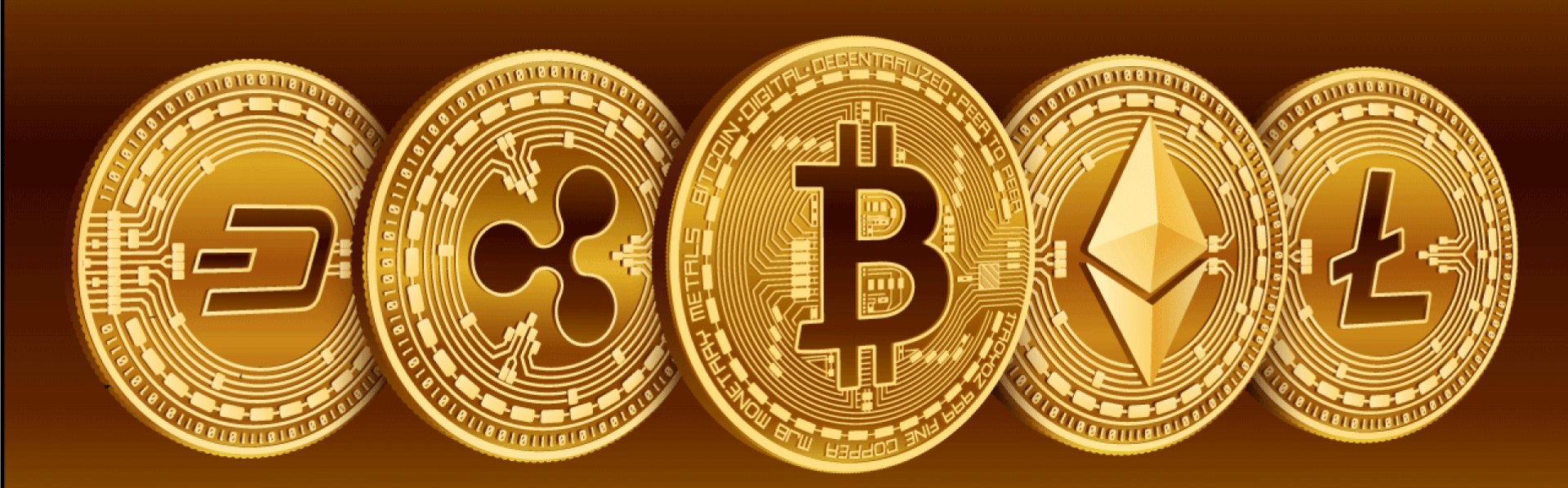
2020 has proven to be a good year for all crypto markets, and expectations are for 2021 to be even a better year for Bitcoin and other cryptos. These cryptocurrencies have taken center stage as investors search for new safe haven assets, driven by the COVID-19 pandemic. With so much uncertainty in the market, and being largely unaffected by external factors like government policy thanks to its decentralized nature, Bitcoin has proven itself to be a “valuable form of digital gold”, qualifying itself as one of the strongest players in the digital currency world.

As we started 2021 and adapted to a new normal, social distancing and cashless transactions may further set the stage for cryptocurrencies. However, with the constant fluctuations in the crypto space, anything could be expected.

USD/JPY Weekly Forecast (08th March 2021 – 12th March 2021)

Fundamental view:

The US dollar has rallied again against the Japanese yen. The interest rate differential between the United States and Japan, is the main driver of this market.  Non-Farm Payroll numbers coming out, and that of course can cause a lot of noise in this pair.

US ISM Manufacturing Prices Paid on 1st March and Japan Jobs to Applicants Ratio & USISM-NY Business Conditions Index on 2nd March favored bearish trend whereas  US Markit Services PMI & ADP Nonfarm Employment on 3rd March and US Initial Jobless Claims & Factory Orders on 4th March favored bullish trend for the pair.

The major economic events deciding the movement of the pair in the next week are Japan GDP quarterly report at Mar 08, BoJ Corporate Goods Price Index monthly report, US CPI monthly report, EIA Crude Oil Stocks Change at Mar 10, US JOLTS Job Openings, Initial Jobless Claims at Mar 11, and US Michigan Consumer Sentiment at Mar 12.

USD/JPY Weekly outlook:

Technical View:

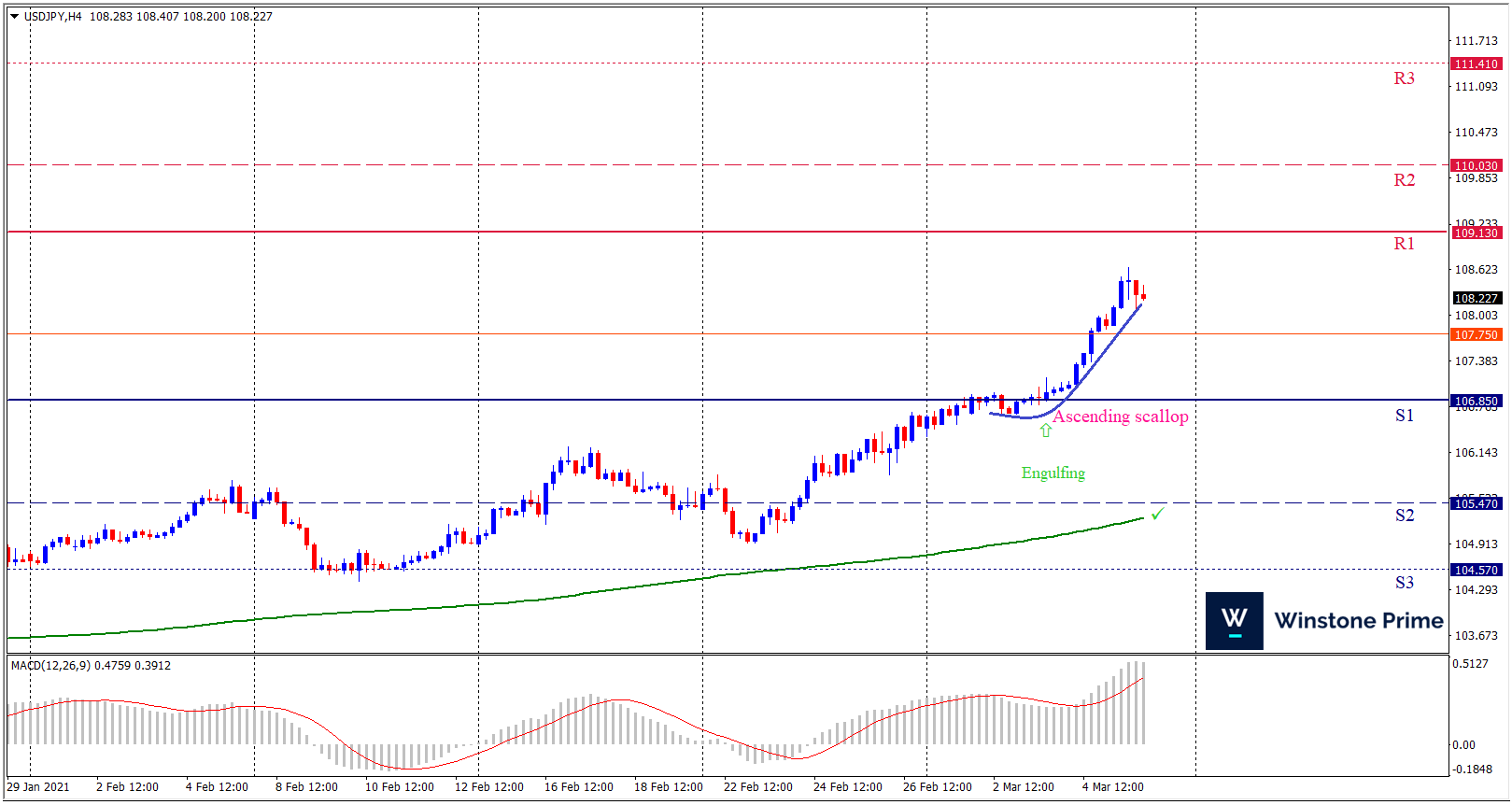
Last week’s high was 1.80% higher than the previous week. Maintaining high at 108.65 and low at 106.37 showed a movement of 228 pips.

In the upcoming week we expect USD/JPY to show a bullish trend. The currency pair is trading above the 200 Simple Moving Average and the MACD trades to the upside. A solid breakout above 109.13 may open a clean path towards 110.03 and may take a way up to 111.41. Should 106.85 prove to be unreliable support, the USDJPY may sink downwards 105.47 and 104.57 respectively. In H4 chart, Formation of ascending scallop pattern indicates prospects of a bullish trend; Along with a bullish engulfing formation braces our expectation.

Preference
Buy: 108.15 target at 110.02 and stop loss at 106.80


Alternate Scenario
Sell: 106.80 target at 104.56 and stop loss at 108.15

EUR/USD Weekly Forecast (08th March 2021 – 12th March 2021)

Fundamental view:

The Euro fell to the fresh 2021 low of 1.1890 this week. The dollar was supported across the board following comments from the head of US Federal Reserve Jerome Powell. In interview on Thursday, Powell repeated that the outlook is becoming more positive but remarked that “sustained” progress toward the Fed goals on employment and inflation. A rate hike won’t occur until inflation runs above 2% for some time.

Europe Markit Manufacturing PMI & Europe HICP monthly report on 1st March and Europe Unemployment Rate and Europe Core CPI monthly report on 2nd March created uptrend for the pair whereas Europe Markit Services PMI on 3rd March and  Europe Retail Sales monthly report & Initial Jobless Claims on 4th March created downtrend for the pair.

The major economic events deciding the movement of the pair in the next week are Europe Employment Change quarterly report at Mar 09, US CPI monthly report, EIA Crude Oil Stocks Change at Mar 10, ECB Interest Rate Decision, US JOLTS Job Openings, Initial Jobless Claims at Mar 11, and US Michigan Consumer Sentiment at Mar 12.

EUR/USD Weekly outlook:

Technical View:

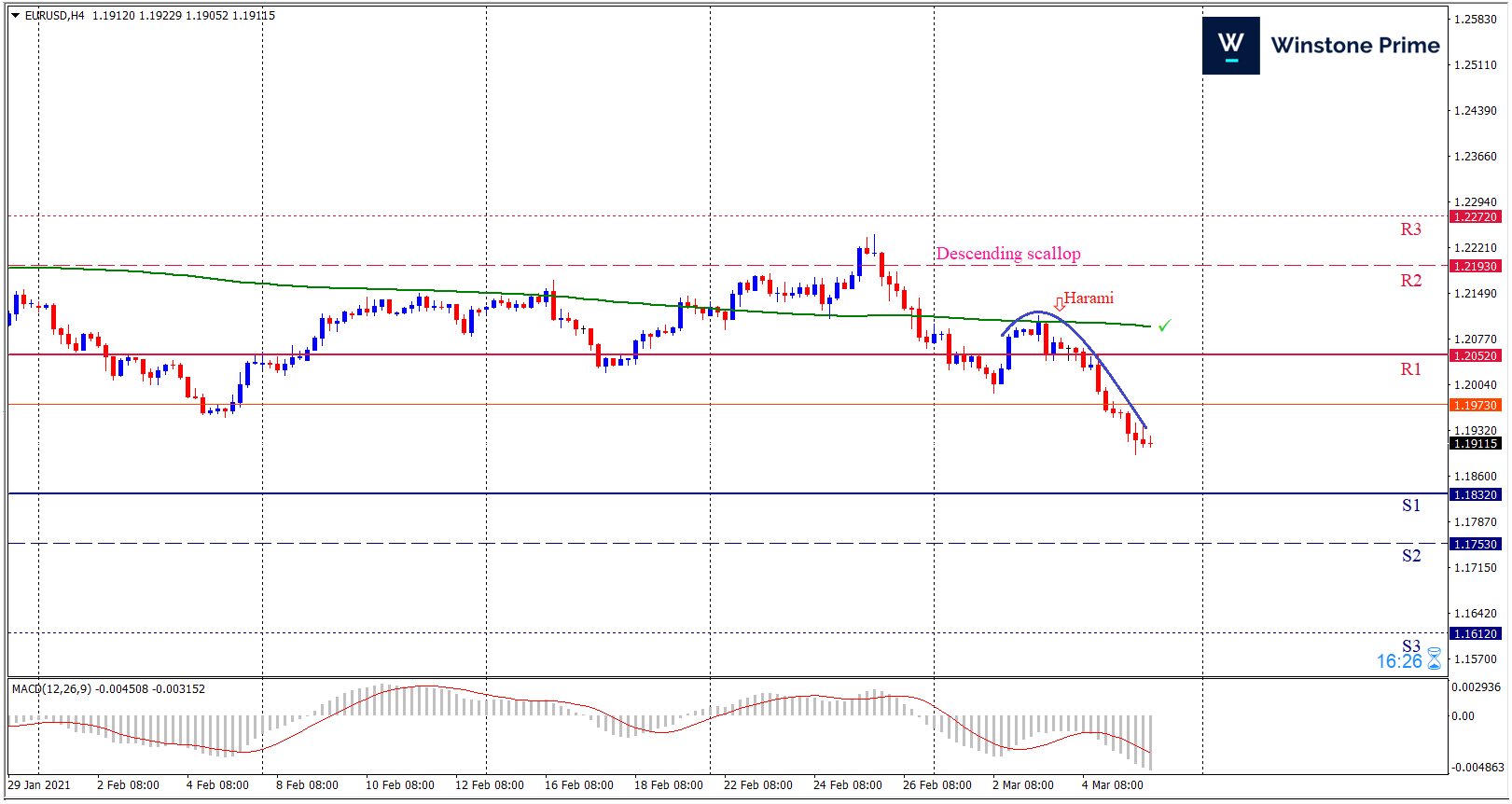
Last week’s high was 1.06% lower than the previous week. Maintaining high at 1.2113 and low at 1.1893 showed a movement of 220 pips.

In the upcoming week we expect EUR/USD to show a bearish trend. The currency pair is trading below the 200 Simple Moving Average and the MACD trades to the downside. A solid breakout below 1.1832 may open a clean path towards 1.1752 and may take a way down to 1.1612. Should 1.2052 prove to be unreliable resistance, the EURUSD may raise upwards 1.2193 and 1.2272 respectively. Chart formation of a descending scallop pattern in H4 chart sets prospects for a bearish trend. Harami pattern formation in H4 chart escalates the expectation for a bearish trend.

Preference
Sell: 1.1920 target at 1.1754 and stop loss at 1.2057


Alternate Scenario
Buy:  1.2057 target at 1.2271 and stop loss at 1.1920