Turmoil in the bond market impacts greenback

The yellow metal is on a bearish trend as the control after Fed Chair Jerome Powell downplayed the recent turmoil in the bond market. Powell said that the recent bond market will create nervousness which disappointed markets and triggered a renewed uptick in the US dollar alongside the Treasury yields. After that Gold and stocks suffered.

Along with that, with the US $1.9 trillion stimulus is now just a step away from the Senate approval, Treasury yields could continue with its surge, exacerbating the pain in the non-yielding gold. The next risk for the yellow metal is the US NFP release, which could shape the market in the next week.

Powell on Thursday repeated his pledge to keep credit loose and said although the rise in yields was “notable”, he did not believe the Fed will have to intervene to bring them down.

Elsewhere, Italy blocks Australia’s 250K AstraZeneca vaccine jabs while terming the OZ nation “non-vulnerable” as per the latest EU governing rules.

The Wall Street benchmarks dropped below 1.0% each whereas US 10-year Treasury yields rise to 1.569%, the fresh high since February 2020 and the dollar surged to three-month highs. Higher yields increase the opportunity cost of holding non-interest paying bullion.

Looking forward, global markets are likely to witness the pre-NFP trading lull unless American policymakers offer any major progress on the covid stimulus voting in the Senate. Also of significance is the coronavirus (COVID-19) updates and vaccine news that has flashed fresh risks off-late.

XAU/USD 4 Hour chart:

Support: 1683.3 (S1), 1670.5 (S2), 1650.5 (S3).

Resistance: 1716.1 (R1), 1736.1 (R2), 1748.9 (R3).

The greenback seems to be in the lime light creating pressure on the yellow metal and we expect a bearish trend for XAU/USD.


Rise in U.S. Treasury yields supports dollar

The dollar hit a seven-month high on Thursday as an orderly rise in U.S. Treasury yields lent support before speech by Federal Reserve Chairman Jerome Powell that may determine the trend for global bond markets and currencies.

Investors seem to boost bets on U.S. growth and inflation as the government prepares new fiscal stimulus, and speculation is rising that the Federal Reserve could also be closer to normalizing monetary policy than previously expected.

“What the market is looking at today are growth differentials between a recovering U.S. and more of a sputtering Europe,” said an analyst.

As per US data showed that private payrolls rose by 117,000 jobs last month, according to the ADP National Employment Report, missing expectations. However, “expectations are for stronger hiring” when the U.S. releases jobs data for February on Friday, continued an Analyst.

The U.S. economic recovery continued at a modest pace over the first weeks of this year, with businesses optimistic about the months to come and demand for housing “robust,” but the job market only showing slow improvement, the Federal Reserve reported on Wednesday.

The U.S. currency has also benefited from a rise in U.S. Treasury yields. Benchmark 10-year yields US10YT=RR on Wednesday rose to 1.469%, though they are below a one-year high of 1.614% reached last week.

Comments by Federal Reserve Chairman Jerome Powell on Thursday will be closely monitored for look for any indications that the Fed is uncomfortable with the recent yield increases. He will be speaking at an event on the U.S. economy.

Whereas Chicago Federal Reserve Bank President Charles Evans on Wednesday said he sees the recent rapid rise in bond yields as mostly reflecting improvements in the economy.

GBP/USD 4 Hour Chart:

Support: 1.3913 (S1), 1.3874 (S2), 1.3827 (S3).

Resistance: 1.3998 (R1), 1.4045 (R2), 1.4084 (R3).

All the catalysts supports greenback, greenback is in uptrend. We expect bearish trend for GBP/USD.

Japan’s service sector shrink weighs on yen

Japan’s services sector extended declines in February for a 13th straight month, as the business activities was hit by many restraints which are put in place to stop the spread of the coronavirus pandemic, leading to the weak demand. The contraction was hit the services sector came as a state of emergency for Tokyo and three surrounding prefectures put in place in part to take pressure off the nation’s medical system is set to end on Sunday.

The final au Jibun Bank Japan Services Purchasing Managers’ Index (PMI) came in at a seasonally adjusted 46.3, staying below the 50 level that separates contraction from expansion for the 13th month. The survey result, which compared to the prior month’s 46.1 and a preliminary 45.8 reading, was largely the result of a faster decline in new business and due to continuing contraction in export business.

Elsewhere, Board member Goushi Kataoka said that The Bank of Japan must lay out a new strategy for hitting its 2% inflation target at this month’s policy review, and will create warning the drag to growth from the COVID-19 pandemic could prolong price stagnation.

Kataoka said the pandemic’s hit to demand will likely delay Japan’s economic recovery and weigh on inflation expectations, which have been falling since the end of 2019. “If we see a repeated rise in infections, that would negatively affect both the output gap and inflation expectations. This, in turn, will prolong price stagnation,” Kataoka said in a speech.

On the other hand, Benchmark U.S. yields dipped on Tuesday for a third straight day after jumping to a one-year high last week, as the comments from two Federal Reserve officials failed to spark a move higher while investors look for a pickup in economic data later this week.

In a prepared comments, Federal Reserve Board Governor Lael Brainard said that while the U.S. economic outlook has markedly improved, the central bank “will need to be patient” before thinking about policy changes. However, Brainard also noted she is “closely watching the bond market” and would be concerned if the rise in yields continued.

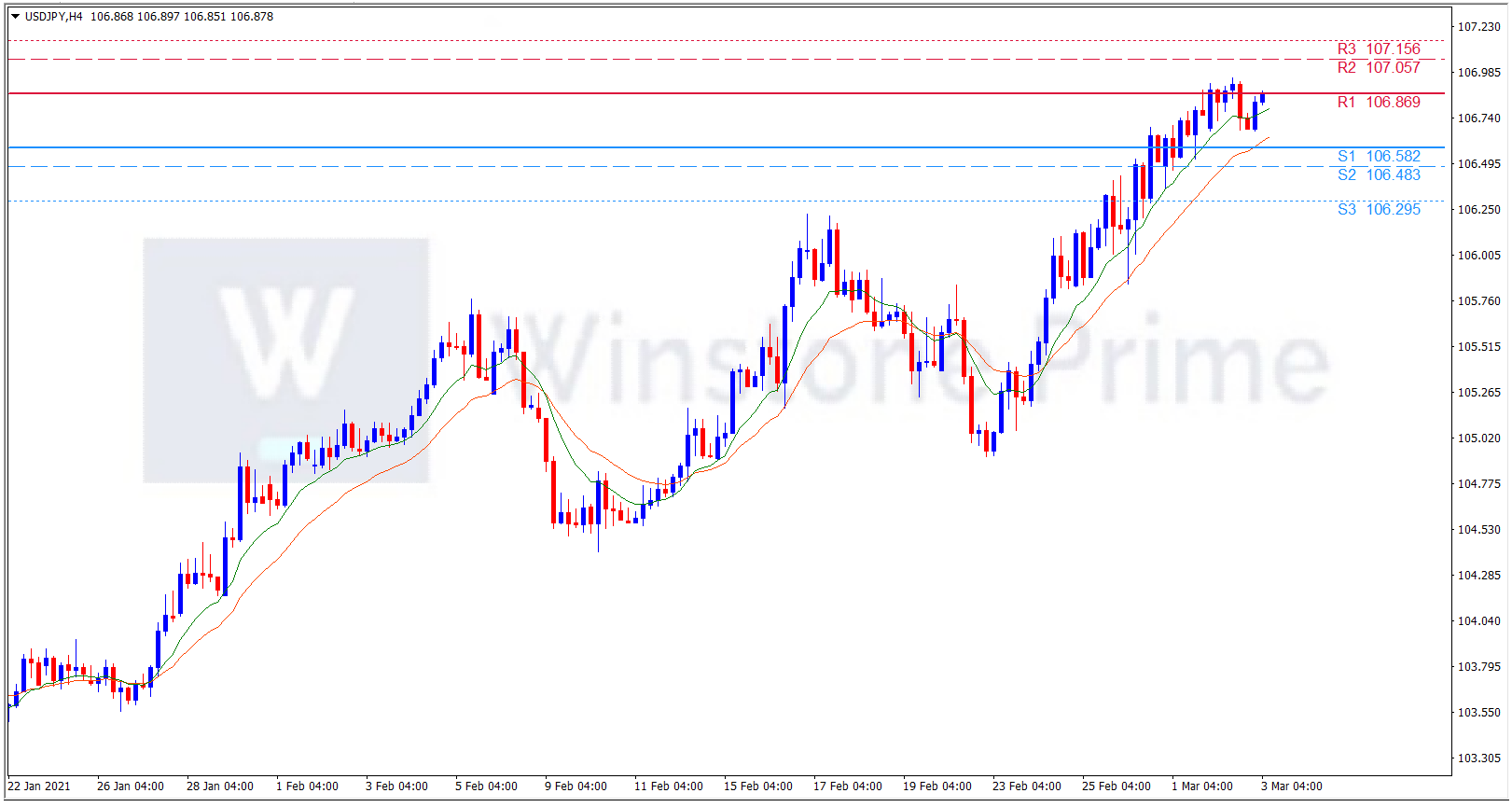
USD/JPY 4 Hour Chart:

Support: 106.58 (S1), 106.48 (S2), 106.30 (S3).

Resistance: 106.87 (R1), 107.06 (R2), 107.16 (R3).

The shrinking of Japan’s s service sector weighs on the yen and we expect a bullish trend for USD/JPY.

10 Essential Things about Blockchain Technology

Blockchain technology promises to revolutionize practically every sector of the digital economy. In this post, we take a look at why everyone’s so excited about blockchain and what do all the wide applications of blockchain really boil down to.

To create a basic level understanding of what blockchain is capable of, let’s look at the 10 things blockchain can do.

They are blocks where data is stored in linear containers so the name called Blockchain. These blocks form a chain, so the name blockchain. Anyone can notice that you’ve placed data there, since it is semi-public and carries your signature. However, only you can unlock what’s there in the block (container). You can do so securely by using the private keys to that data block. Essentially, blockchain is a database with the “header”, where the information is stored as public.

Firstly, blockchain is a semi-public and therefore distributed ledger. That makes it shareable across multiple entities without sacrificing security. What’s more, the ledger is time-stamped. This makes every single transaction verifiable and traceable. All computers on the network can validate every single transaction. That becomes one of the key strengths of blockchain – it automatically prevents double-counting. As a result, the chances of both errors as well as fraudulent transactions are virtually zero. This may appear to be the single most important application of blockchain but there are many more, equally powerful uses of blockchain.

You would’ve noticed by now that being shareable, there’s nothing that is “central” about blockchain. It’s architectured in a way that there’s no central server that dictates transactions – it remains a peer-to-peer network over nodes. Your computer, if a part of the network, can verify transactions happening over the network. You could call it thin computing in its best decentralized format.

Because of this, users can reach out to other users and transact with each other instantly, irrespective of geographical or time-zone differences. There are no intermediaries like a main server to filter or slow down the transaction. Hence, the transaction happens without delay. All nodes on the network have equal importance and can offer their knowledge of all transactions over the network. This goes beyond just being a peer-to-peer network and creates a marketplace for users, a distributed economy. The size of such marketplaces varies greatly in size without compromising the integrity of blockchain.

Though often mentioned in the same discussion, Bitcoin and blockchain are not the same thing. Bitcoin is a virtual currency (or cryptocurrency), while blockchain is the tool that makes virtual currency viable. But while Bitcoin may be the best-known use case for blockchain, there are many others besides.

For example, blockchain allows musicians to get paid directly when consumers buy or listen to a song. The purchasing platforms can be cut out of the process, which also means they don’t take a cut of the revenue. Musicians benefit both financially and from a more direct relationship with their fans.

Another example is online voting. When a vote is cast and recorded in the blockchain, it is very hard to alter. That makes it difficult to commit voter fraud by manipulating votes. Furthermore, every voter would have a complete record at hand and could track the outcome as the vote takes place.

Whenever a transaction is conducted as part of a blockchain, it is recorded and visible to all participants. Blockchain participants can be, but do not necessarily have to be, anonymous. When talking about Bitcoin, the term “pseudonymity” often crops up, referring to a kind of anonymized pseudonym. Even though each user has a unique Bitcoin address, this pseudonym can be linked to their personal information in different ways. A simple example would be a user providing their home address to receive a delivery paid for with a Bitcoin transaction.

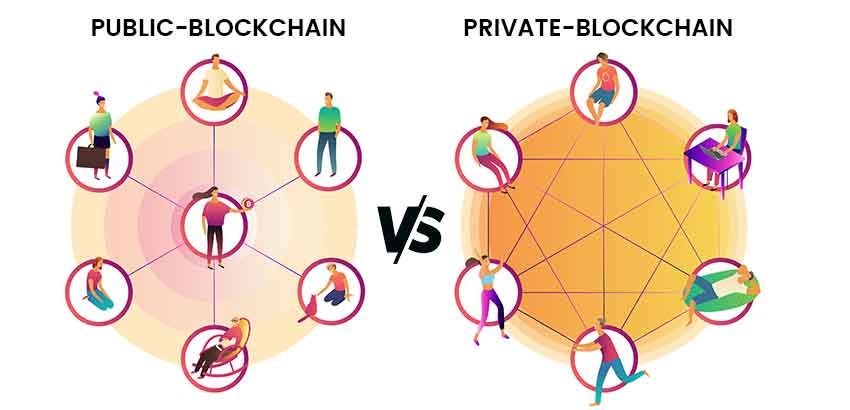
Public and private blockchains generally work in the same way; the main difference is who is allowed to participate. A public blockchain is open to anyone who wants to be part of it. The downside is that, due to the large number of participants, verifying transactions takes more time. Bitcoin is a well-known implementation of a public blockchain.

Private blockchains, on the other hand, are controlled by one entity that decides who is allowed to participate. This entity may also set up rules and regulations to govern transactions. Transactions are generally conducted faster within a private blockchain because of the limited number of participants.

In a business context, there is a third option: the consortium blockchain. Here, no single entity has full control; instead, a predetermined set of nodes are allowed to participate. A hypothetical case would be a consortium of ten different companies, with each one authorized to operate a node. This type of blockchain ensures that the transaction information stays among its participants without consolidating power in one place.

Cryptocurrency is ultimately a form of money – it’s just that it happens to be based on a relatively new technology, i.e. blockchain. Because it’s treated as money, one can easily build investment, loan and insurance web aggregator software platforms where transactions can be done using Cryptocurrencies. Thus Cryptocurrencies can become a part of a financial instrument, which would lead to a variety of financial products, both traditional and new-age. That is the innovative power of blockchain.

Loans, investments, trading with options and derivatives and even synthetic instruments can have their blockchain versions. Exchange Traded Funds (ETFs) are one of the many ways.

Anyone reading this post would be clear that the blockchain network basically validates transactions. They could be related to digital money or digital assets. When the network reaches a consensus, the transaction is considered valid. It’s then put into a block (a storage space). This block is added at the end of the chain of previous transactions (if any) to indicate this is the latest block. The entire chain of blocks can be verified at any point of time in future to validate any transaction stored in any block.

So blockchain is a giant transaction processing platform, one that verifies and approves legit transactions, no matter what size the transaction is.

A good way to compare various transaction processing networks is the processing capability, measured in transactions per second (TPS). In 2015, VISA clocked an average of 2,000 TPS on VisaNet, the peak capacity being 56,000 TPS. The same year, PayPal recorded about 155 TPS.

Bitcoin, even a year later, wasn’t impressive. Its TPS ranged around a tiny 5 to 7. But that’s not disappointing. Rapid strides in technology and expected increase in Bitcoin blocks would quickly change this picture. Besides, many blockchains are faster than Bitcoins. Ethereum started with just 10 TPS in 2015, but advanced to 50-100 TPS in 2017 and is targeting 250,000 to 300,000 TPS by 2021.

Besides, private blockchains, for instance, may have fewer restrictions and have operated at 1,000 to 10,000 TPS in 2016. Optimistic figures peg this number at 2,000 to 15,000 TPS in 2017 and almost to unlimited capacity beyond 2021. Linking blockchain output to clustered database technology is expected to reach such ambitious targets set.

While blockchain is a software technology, it can also be thought of as a design approach for software, an approach that attaches a large number of computers to one another and requires them to follow a certain ‘code of conduct’ on how to share or accept information. This ‘code of conduct’ will tell them how to validate interactions and transactions verified by cryptography.

It sounds so natural because that’s what blockchain actually is – networked computers with equal value and following a common set of rules. The important part here is that developers will no longer need to set up servers since all computers in the network have equal rights.

For a perspective, you can compare the Web. In the Web, the HTTP protocol request is forwarded to the server and the server approves or disapproves it. That’s because it enjoys server rights. In the case of blockchain, the same request will be sent to the entire blockchain network.

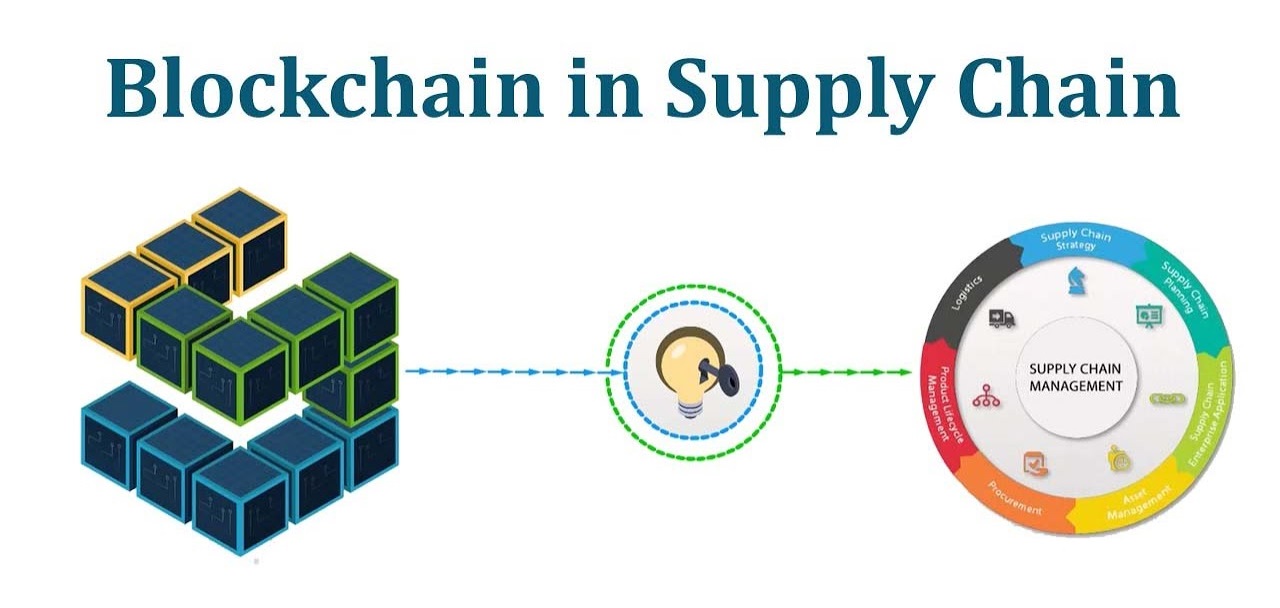
Blockchain can be implemented to overcome challenges in the existing Supply Chain industry. From complicated record-keeping and tracking of products to producing a less corruptible and better-automated alternative to centralized databases, blockchain can be seen as a one-stop solution that can revolutionize supply chain processes.