GBP/USD Weekly Forecast (22nd February 2021 – 26th February 2021)

Fundamental view:

The British pound has rallied significantly to take out the 1.40 level. Reaching this level is a mix of British of upbeat UK corona virus statistics and a twist lower in the dollar amid yield-moving stimulus speculation. The British variant is the reason or excuse of several countries struggling to cope with COVID-19. In the UK, where this strain known as the Kent variant originated, victory seems to be at hand. Recent coronavirus infections, hospitalizations, and deaths are all falling sharply.

US NY Fed Empire State Manufacturing on 16th Feb and US TIC Net Long-Term Transactions on 17th Feb favored bearish trend for the pair whereas Britain HPI yearly report on 17th Feb and  US Housing Starts on 18th Feb favored bullish trend for the pair.

The major economic events deciding the movement of the pair in the next week are UK Claimant Count Change, Fed Chair Powell Testimony, US CB Consumer Confidence Index at Feb 23, BoE Governor Bailey Speech, Fed Chair Powell Testimony at Feb 24, US GDP quarterly report, US Core Durable Goods Orders monthly report, and US Initial Jobless Claims at Feb 25.

 GBP/USD Weekly outlook:
Technical View:

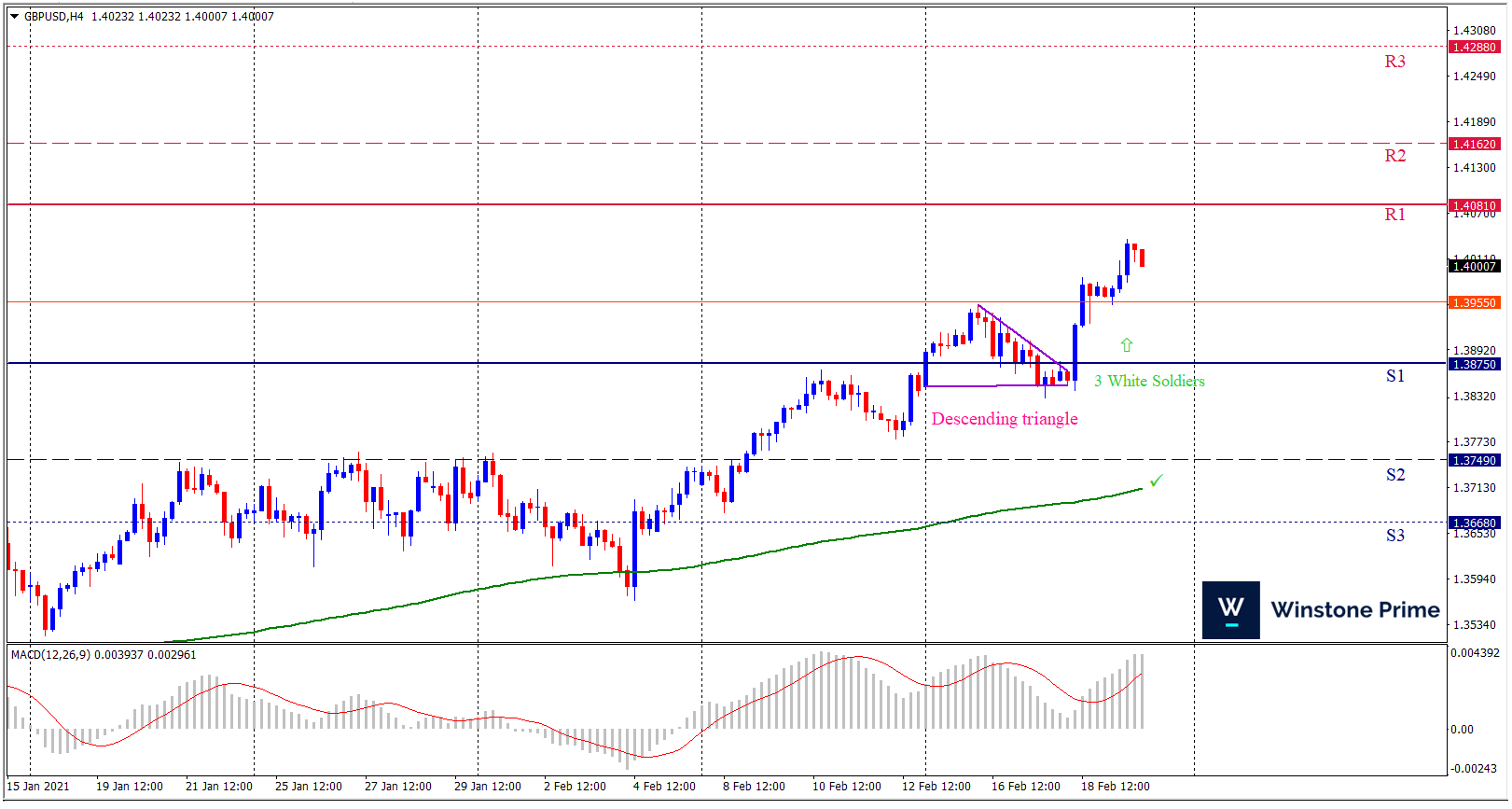
Last week’s high was 1.21% higher than the previous week. Maintaining high at 1.4036 and low at 1.3830 showed a movement of 206 pips.

In the upcoming week we expect GBP/USD to show a bullish trend.  The currency pair is trading above the 200 Simple Moving Average and the MACD trades to the upside. A solid breakout above 1.4081 may open a clean path towards 1.4162 and may take a way up to 1.4288. Should 1.3875 prove to be unreliable support, the GBPUSD may sink downwards 1.3749 and 1.3668 respectively. Chart formation of descending triangle breakout upside in H4 chart favors prospects of a bullish trend. Three white soldiers pattern formation escalates the expectation for a bullish trend.

Preference
Buy: 1.3996 target at 1.4161 and stop loss at 1.3870


Alternate Scenario
Sell: 1.3870 target at 1.3669 and stop loss at 1.3996

RBNZ’s cash rate impacts kiwi

The Reserve Bank of New Zealand (RBNZ) is about to keep the Official Cash Rate (OCR) on hold at its first monetary policy decision of 2021 next week, as the economy stages a swift turnaround from the coronavirus crisis.

All of the 12 economists concluded that the Reserve Bank of New Zealand (RBNZ) will be with the same opinion on Wednesday, and will continue to keep the official cash rate (OCR) at the historic low of 0.25% for the rest of the year.

Out of all the economists, Three economists expect rates to be hiked by the end of next year, while others see the RBNZ holding through the forecast period until the fourth quarter of 2022. Westpac Bank says it sees the first hike only in 2024.

RBNZ may revise up its forecasts for growth, employment and inflation, and add forward guidance for the OCR, but stress that hikes remain a long way off and potentially even putting a date on it.

New Zealand’s (NZ) Treasury is out with its latest Economic Update. The latest New Zealand Activity Index (NZAC) continues to show modest growth. Activity in January was up 0.8% compared to January 2020.

On other hand, The U.S. dollar is facing its biggest loss in 10 days on Friday after disappointing U.S. labour market data effected the optimism for the country’s speedy recovery from the COVID-19 pandemic. The greenback continued to buck its traditional role as a safe-harbour currency, falling in sympathy with U.S. stocks overnight after an unexpected increase in weekly jobless claims soured the economic outlook.

“The prospect of a massive U.S. fiscal stimulus plus a successful vaccine roll-out are solid arguments to bet on a U.S. recovery this year,” Rodrigo Catril, senior foreign-exchange strategist at National Australia Bank in Sydney, wrote in a client note. “But the overnight jobless claims data serve as a reminder of the unevenness of the recovery so far.”

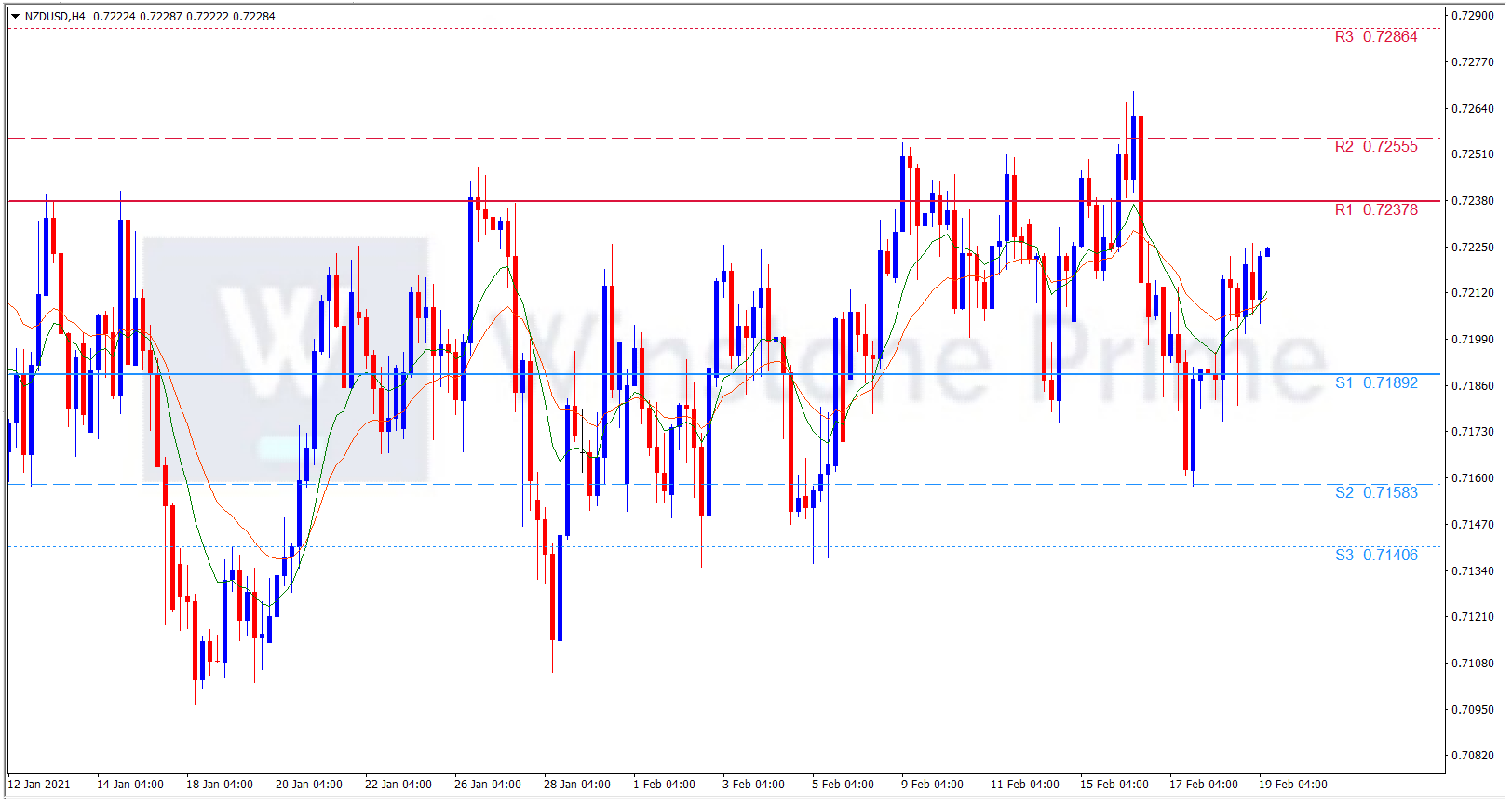
NZD/USD 4 Hour Chart:

Support: 0.7189 (S1), 0.7158 (S2), 0.7141 (S3).

Resistance: 0.7238 (R1), 0.7256 (R2), 0.7286 (R3).

Amidst all the catalysts favoring NZD against greenback, we expect a bullish trend for NZD/USD.

Japan’s Governor Speech favors Yen

Japan’s central bank governor said that he told the country’s prime minister the bank would conduct a review of its policy tools in March to make sure that it can maintain ultra-loose monetary settings for a long period. Governor Haruhiko Kuroda said he also told Prime Minister Yoshihide Suga that the global economy appeared to be picking up, based on estimates issued by the International Monetary Fund.

 Kuroda told reporters after meeting with Suga that “I explained to the prime minister the Bank of Japan would conduct a review (of its tools) to make its policy more effective and sustainable, and announce the findings at its March rate review.”

The BOJ governor and the prime minister hold meetings every few months as a regular practice to exchange views on the economy and policy.

Governor Haruhiko Kuroda’s comments about the review follow the BOJ’s December announcement that it would assess its policy tools in March as the hit to growth from the pandemic forces the central bank to maintain a huge and extended stimulus programme. He also said Suga did not have any particular comment on the BOJ’s March review and the two did not discuss the Tokyo Olympic Games.

Elsewhere, Japan’s Nikkei went a inch up on Thursday, led by a sharp jump in Uniqlo-operator Fast Retailing, but gains were restricted as investors weighed the sustainability of the benchmark’s recent rally above 30,000.

Soichiro Matsumoto, chief investment officer Japan at Credit Suisse Private Banking said “Investors want to evaluate whether Nikkei’s rally to the psychologically important 30,000 mark reflects the real market or not.” “They are trying to see if the market maintains the momentum toward the end of the fiscal year in March and beyond.”

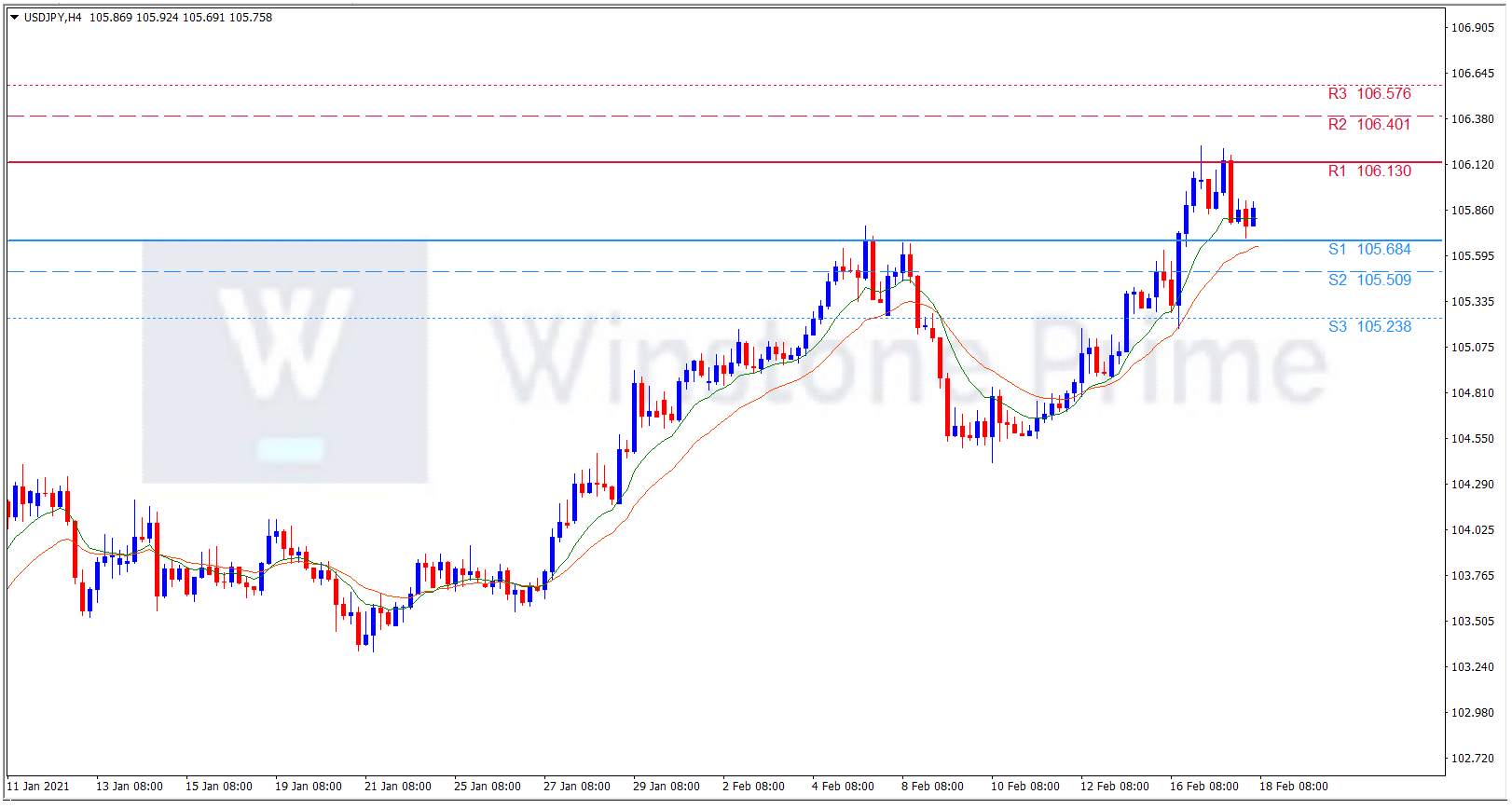
USD/JPY 4 Hour Chart:

Support: 105.68 (S1), 105.51 (S2), 105.24 (S3).

Resistance: 106.13 (R1), 106.40 (R2), 106.58 (R3).

Nikkie inching up and the speech of Japan’s central bank governor favors yen against greenback. We expect a bearish trend for USD/JPY.

Crowd Behavior & Trading against the crowd strategy

The concept of the market crowd has long been known by traders. For many, it is a symbol of inefficient and erroneous trading decisions.  And if you have ever found yourself thinking that you are part of a crowd, it is time to leave this abstract society. Trading from home makes one feel independent from everything around. But what kind of autonomy can there be if all traders read the same news and monitor the same quotes? Psychology is the most important segment of trading and foundation for success. Without well-established discipline and tolerance toward losses, each trader is prone to a much higher level of risk and therefore, losing money. As we know, humans are very impulsive and emotional beings. 

Being a Part of the Group

A crowd is a definable group of people who have a common purpose or set of emotions and share a common behavior. Despite their current similarities, each one of the individuals is prone to competing and conflicting emotions and such changes could cause others to follow up and shift the crowd’s behavior. The same event can be observed on the financial markets. One way to picture the financial markets is as a crowd of unorganized individuals whose goal is to predict the future mood of the crowd, or to estimate the balance between bulls and bears on the market, and position themselves.

Most of the books and learning centres advise new traders to always follow the trend and never fight the market in order to secure their lasting on the market. Although this is true in general, following the crowd behavior blindly can be as much devastating as going against the market unprepared, which would almost always result in a loss. By default, each inexperienced trader should always enter positions in the trend direction by following proper risk management strategies. Newbies main goal should be to minimize risks and avoid losing positions as much as possible in order to persist on the market and keep learning from first hand.

Why people like to act as others?

There are a couple of reasons why people are drawn to the overwhelming power of the crowd. The first one is probably the strongest feeling, which drives the financial markets, but also one of the hardest to overcome – greed. Greed has led many people to bankruptcy and it requires a lot of trading experience in order to establish such discipline that would overthrow it. Human behavior analysts have found that people experience greater fear of missing an opportunity for profits than the possibility of losing their life savings.

Many people also fear that by having a contrary opinion and doing something different, they could make a mistake and fail, whereas others could succeed. That concern of falling behind your friends, neighbors or competitors is what drives many to act as the mass, so that if they lose, others will lose as well and wont outstrip them.

Seeking leadership

Another powerful motivator behind crowd behavior is peoples tendency to look for and follow a leader, which is actually quite normal for all social creatures. Leadership can be found in a single person, a group of individuals or it could just be the balance of the crowds opinion, thinking that the majority should be right. People look for a leader to guide them especially through times of uncertainty. History however has shown that blindly following someone without conducting a proper unbiased assessment could lead to devastating results, especially when your money is at stake.

Many traders prefer a contrarian strategy, that is to go against the crowd and in effect to go against the trend. It can work equally well but often requires stronger conviction and a more robust money management system. Here are some things traders look for when trading against the crowd:

COT reports and open position data

One of the best ways to trade against the crowd is to look at the data itself. The Commitment of Traders (COT) report is provided weekly by the CFTC (the US Commodity Futures Trading Commission) and divulges how many contracts were bought and sold of a specific contract by commercial, non-commercial and private investors. When there are way more non-commercial traders holding trades than the historical average, it’s a clear-cut sign that the crowd is positioned on just one side. And this can indicate excellent reversal opportunities. Open position data from many forex broker’s are also a good source for seeing how traders are positioned in the currency markets.

Magazine covers & sentiment surveys

Sentiment surveys, the kind provided by Barrons and Investors Intelligence, are simple enough to evaluate. They provide reliable survey data of whether traders are bullish or bearish on certain markets which can be used to evaluate the crowd. Simply, if the majority of traders are bullish, say over 70%, then it could be time to go against the herd. Similarly, magazine covers have also been used as a contrarian indicator.

When a news story makes the front pages of a major magazine or newspaper, it signals that something big has happened, and this is usually a time to go against the crowd, since by the time the media pick up on a story much of the move will have taken place and all the information will be in the public realm.

For example, if TIME magazine decide to run a ‘shock’ story on the cover about the demise of the Japanese; it’s usually a signal to go long JPY.

Scan a chart

It is possible of course, to go against the crowd just by looking at a chart. Economic cycles typically take a while to play out but markets can over-react when too many traders move to one side of the trade. Sometimes the chart will show a situation where the price is becoming parabolic; in other words it is heading down, or up, in a near vertical fashion. Clearly, such moves are unsustainable and these are some of the best opportunities to go against the crowd in the forex markets.

Here lie the reasons for investors’ common emotional state, which makes for opening trades in the same direction. And what can you do when you do not have many skills but still have a desire to leave the unpleasant community straight away? Start with two specific rules.

Don’t make trading decisions at critical moments

The moments of abnormally high volatility are the most interesting situations in the market. This is when the asset determines the trend direction. Traders lose money due to the tottering movements. Most often, bursts of activity occur at the moment of news releases. It may be either economic calendar updates or the news that comes in unexpectedly. For example, the U.S. president spontaneously imposed sanctions on a country. This will result in a weakening of the currency of the state, which has got under pressure. A breakout through an important level also leads to increased volatility. Such benchmarks play a strategic role in the market.

Stock indices are most active during the first 5-10 minutes since the beginning of the trading session and during the same period before it closes. This pattern resulted from the specifics of trading these instruments. To keep calm and not to succumb to provocations of price spikes, avoid trading at critical moments. This does not imply that you should forget about trading.

Trade when the market is balanced

The price chart provides lots of useful information, but you can get even more of it when using such oscillators as RSI, Stochastic, and DeMarker. Each of them is divided into three zones: overbought, oversold, and the zone between them. Many traders focus on oscillators only when the signal lines are in the overbought or oversold zones. Indeed, the indicators often give the right signals. The only thing is that too many traders use this scheme.

Of course, such a method helps to earn money, but sometimes we receive just too many false signals. That is why it’s worth using these indicators to find the zone of the market balance to leave the crowd.

The RSI, Stochastic, and DeMarker will help you find the balance between the overbought and the oversold areas. Try to make trades at moments when other traders are not so active. Nothing huge, but few people see their independence in such things. Remember that trading in the new environment is a very useful experience. Put this advice into practice — and you will leave the market crowd.

Conclusion

As we know, humans are very impulsive and emotional beings. Some people say that we are also irrational, but in fact this is not the case. An interesting fact is that we actually tend to be very rational when thinking for ourselves, that is, when we are not blindly following someone. When a person knows everything depends solely on him, he/she would take time to consider all the possibilities and outcomes of his/her actions, at least in general. Things however look very different when we find ourselves in a group, or our doings become a part of the so-called crowd behavior.