
How to trade in summer time

If you have spent any time looking at the forex market, you may have noticed that the markets drop significantly between June and August because you are going on vacation and need to find a cheaper place to buy the currency you have chosen, or because you are a true forex trader or may be interested in stock charts. Yes, that’s right; There is a big season in financial markets that you may not have considered before, but it will be more important to you now than ever before when you start or continue your trading journey.

Now that we have fully entered the summer trading months, they are traditionally starting slowly. When you connect to the summer + you have an environment of low volatility, small moves and high misalignment systems due to the lack of ‘flow information’ shared by bank traders under investigation.

That being said, how can we increase our time while being active and consistently profitable? Below is a mini guidance on summer forex trading. In this article, We will share 2 simple tips to help you stay consistent, big moves and active during the slow summer months.

Trading Tips 1: Switching to low volatility Pairs & Instruments

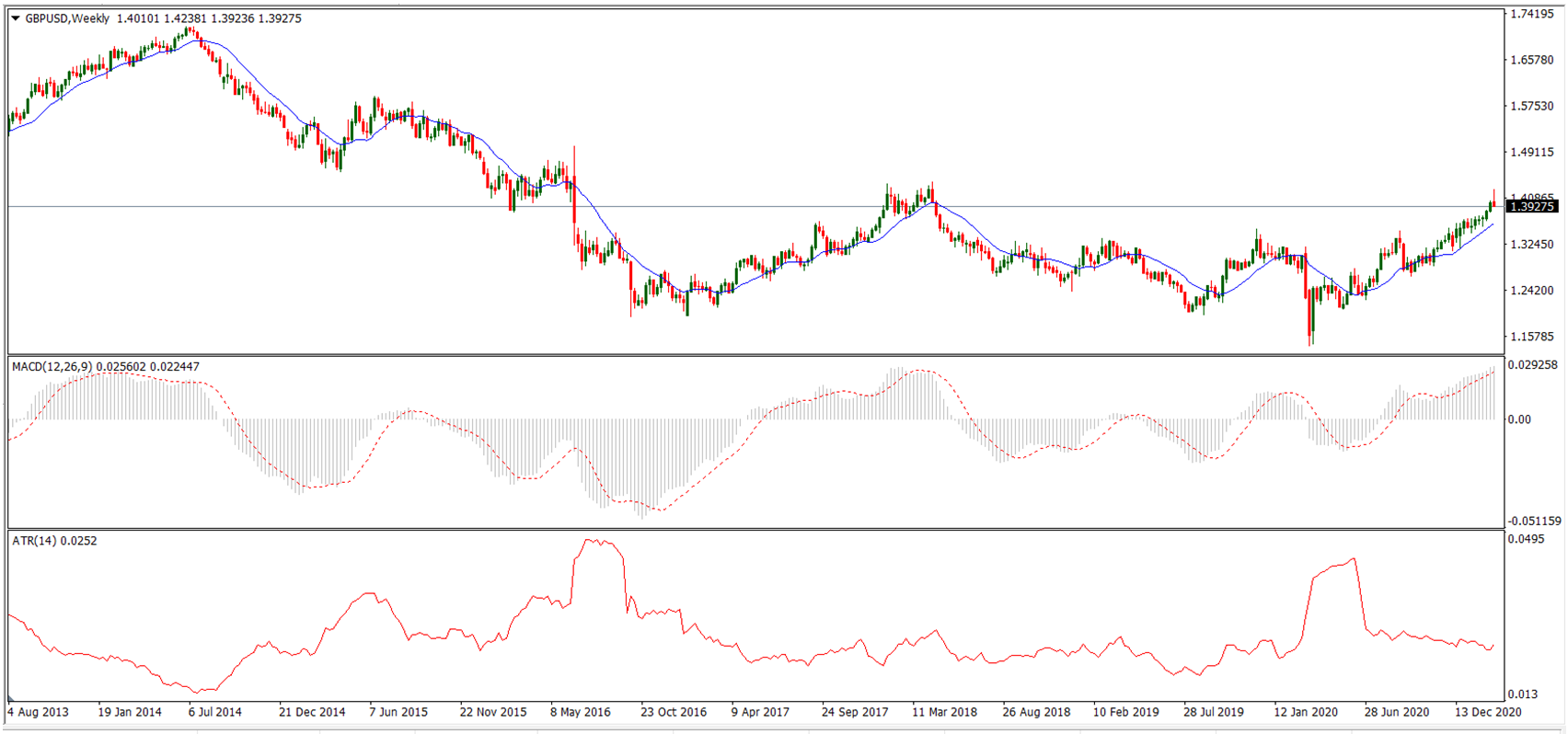
Below we explained the weekly chart of GBPUSD, the most heavily traded pair on the planet. Do you see that red line under the price action part of the chart? That is the weekly ATR which measures the average trading range (in pips) per week. The average range of the pair on a week to week basis has been declining for years with it currently being at an average. It is the same for most majors, including the USDJPY and GBPUSD. If you are expecting a few hundred pip move on any of the above pairs, you could be sitting on your hand for days which is not the best use of your time. So what can you do about this?
Our suggestion is to switch pairs that are more volatile. For example, instead of trading the GBPUSD or the AUDUSD, why not switch to the GBPAUD? It is far more volatile due to the ‘weighting’ of the pair. If you can learn to spot good moves on the AUDUSD, then it will usually correspond to a directionally opposite move in the GBPAUD.

Take a look at the two charts below to get a better idea of this concept.
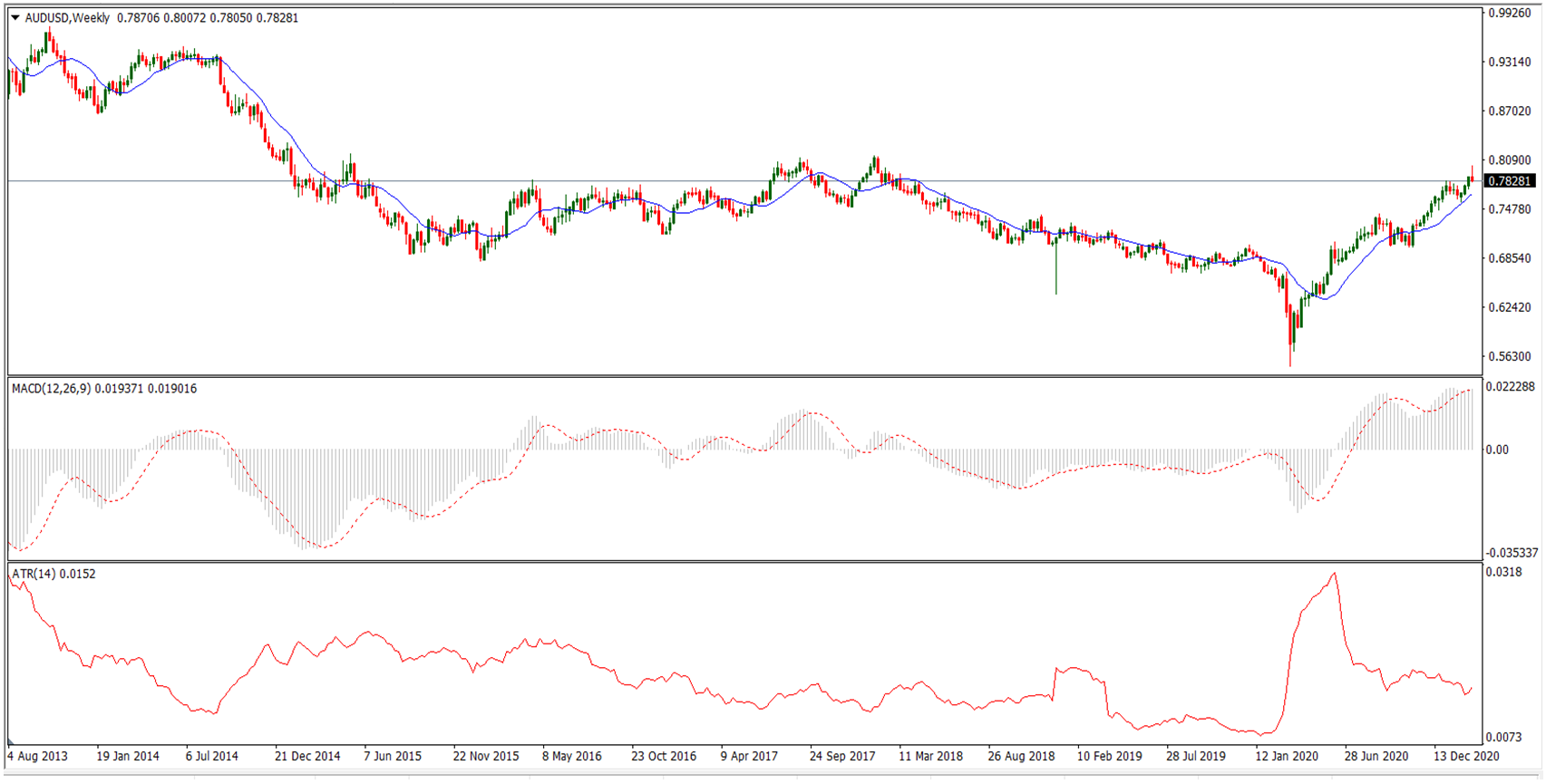
The above chart we are looking at the AUDUSD Weekly chart.
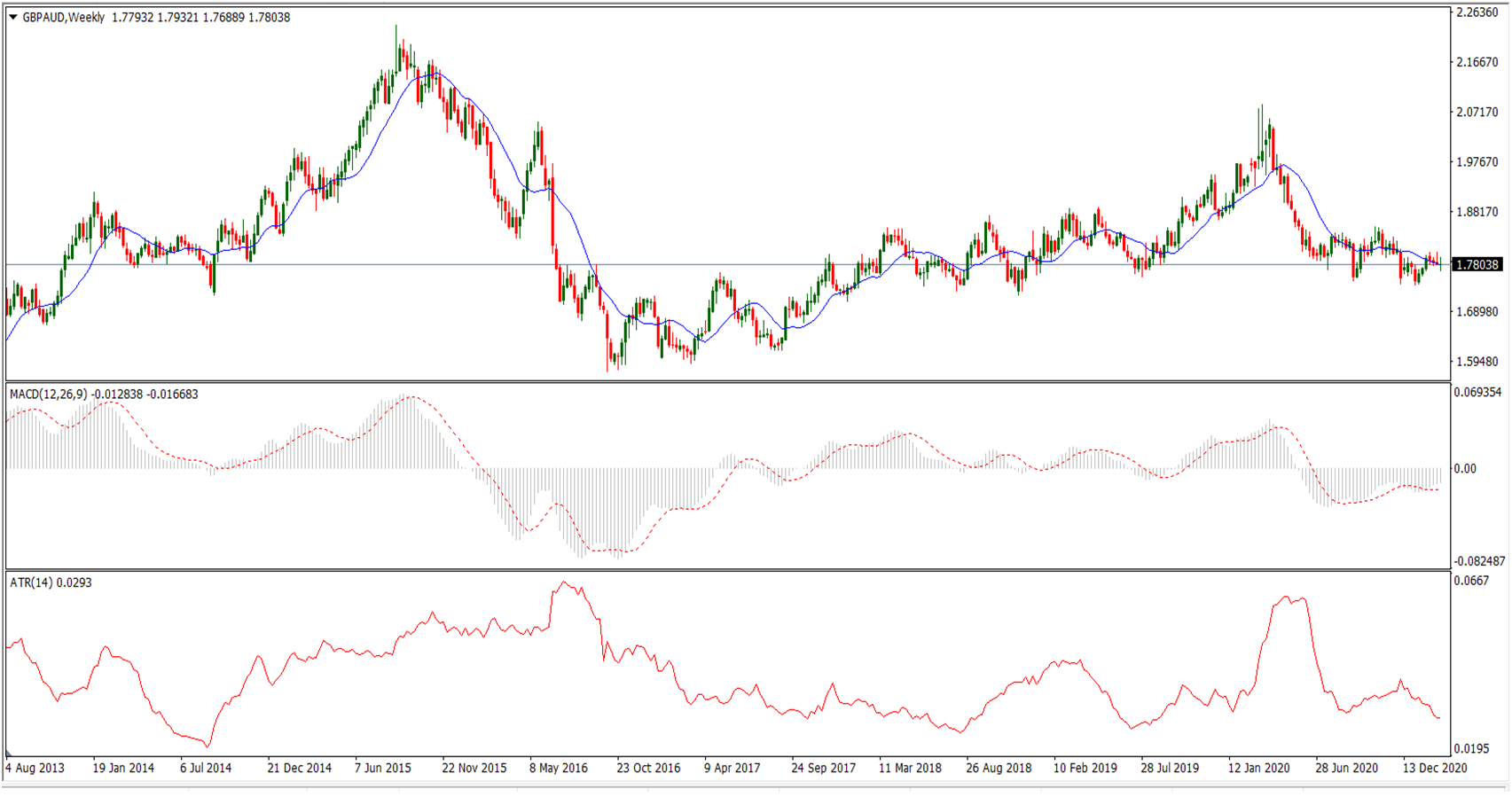
The above chart we are looking at the GBPAUD Weekly Chart

Thus start looking at pairs which are naturally more volatile, and will be less affected by the lack of ‘flow information’ shared by bank traders who are currently less active.

An additional suggestion would be to add other instruments, such as global indices and commodities. Gold and WTI Crude Oil will also offer some greater volatility. So consider and expanding your instruments giving you multiple options to trade.

Trading Tips 2: Spend More Time Training

Since you are naturally less active during the summer months, why not use that time to build your trading skill set? Forget the idea of walking away when there are no trades to play golf, watch a movie, or read a book. You want to be a professional trader who has the freedom of working from home, not having a boss who tells you what to do, what to wear and how much you get paid.

Do you get better at golf by sitting on the beach? Do you get better at playing guitar by reading novels? Do you get better at martial arts by playing video games? No, so why in the world do you think this applies to trading? It doesn’t, hence take advantage of the time available.

As you may learn over time, nothing beats experience, and if you want to learn forex trading, experience is the best teacher. A fundamental thing you may learn through experience, that no amount of books or talking to other traders can teach, is the value of closing your trade and getting out of the market when your reason for getting into a trade is invalidated.

It is very easy for traders to think the market will come back around in their favor. You would be surprised how many traders fall prey to this trap and are amazed and heartbroken when the market only presses further against the direction of their original trade. So take advantage of the Summer Time.

Conclusion

The best way to keep current on the direction and strength of your correlation pairings is to calculate them yourself. This may sound difficult, but it’s actually quite simple. To be an effective trader and understand your exposure, it is important to understand how different currency pairs move in relation to each other. Some currency pairs move in tandem with each other, while others may be polar opposites. If we’re talking actual learning of the practice, then you are never fully finished. I really think you shouldn’t be comparing your journey with someone else’s. That is one common mistake made by many traders. Comparing the time it took for someone else to get the hang of it or copying a strategy that’s working for someone else is a bad way to approach the market. It leads to frustration and discouragement. Emotions get involved and that’s never a good thing.

Events are ultimately unpredictable but not uncommon during the Summer months. Most traders will reduce trade volume, order size and tighten their stop loss levels to avoid any surprises. More experienced and confident traders will seek to take advantage of these unusual market moves but it does take a lot of skill, a little luck and involves significant risk. Investment and trading should not be done emotionally and also not in comparison with someone else. This is because people have their individual strengths and weaknesses and they use those to formulate their trading strategies. Your temperament and style will not be exactly like someone else’s and so it’s a bad move to rely on doing what they’re doing.

Happy Trading!!

China’s Inflation figure impacts NZD

Kiwi is trading downside due to the China’s inflation figures extending the losses by following the comments from Reserve Bank of New Zealand (RBNZ) Governor Adrian Orr. China’s Consumer Price Index (CPI) reduced more than 0.0% expected to -0.3% whereas the Producers Price Index (PPI) eased below 0.4% market consensus to 0.3% YoY in January. The data joins the latest downbeat economic signals from the world’s largest commodity user, also New Zealand’s major customer, which in turn weigh on the NZD/USD prices.

New Zealand’s recent inflation data have been upbeat, and on the positive note, strong employment figures, the RBNZ boss didn’t rule out the coronavirus (COVID-19) risks while also praising the moves to control housing market loans via the Loan-To-Value ratios.

On the other hand, market risks remain somewhat positive as traders await the US stimulus while debate continues in the Congress. Also important are the latest positive developments over the covid vaccines and chatters surrounding trade-tier among the western countries.

As far the yen is concerned,  Japanese stocks erased early losses and rose on Wednesday as an earnings forecast upgrade from Honda backed expectations for an improving outlook for corporate profits amid an improving global economy. Since the start of the year, the Nikkei has rallied more than 7% to its highest level since 1990 as investors and the Japanese exporters that are expected to benefit as the global economy recovers from the COVID-19 pandemic.

The Bank of Japan must be mindful of the potential demerits of its huge asset purchases, board member Toyoaki Nakamura said in a sign the central bank will seek ways to make its asset-buying programme more flexible in a policy review due in March. Nakamura, a former business executive who joined the board in July, said the BOJ’s purchases of exchange-traded funds (ETF) has helped eradicate Japan’s deflationary mindset by keeping stock markets stable.

“The BOJ’s ETF purchases … will remain a necessary tool,” Nakamura said in a speech at an online meeting with business leaders on Wednesday.

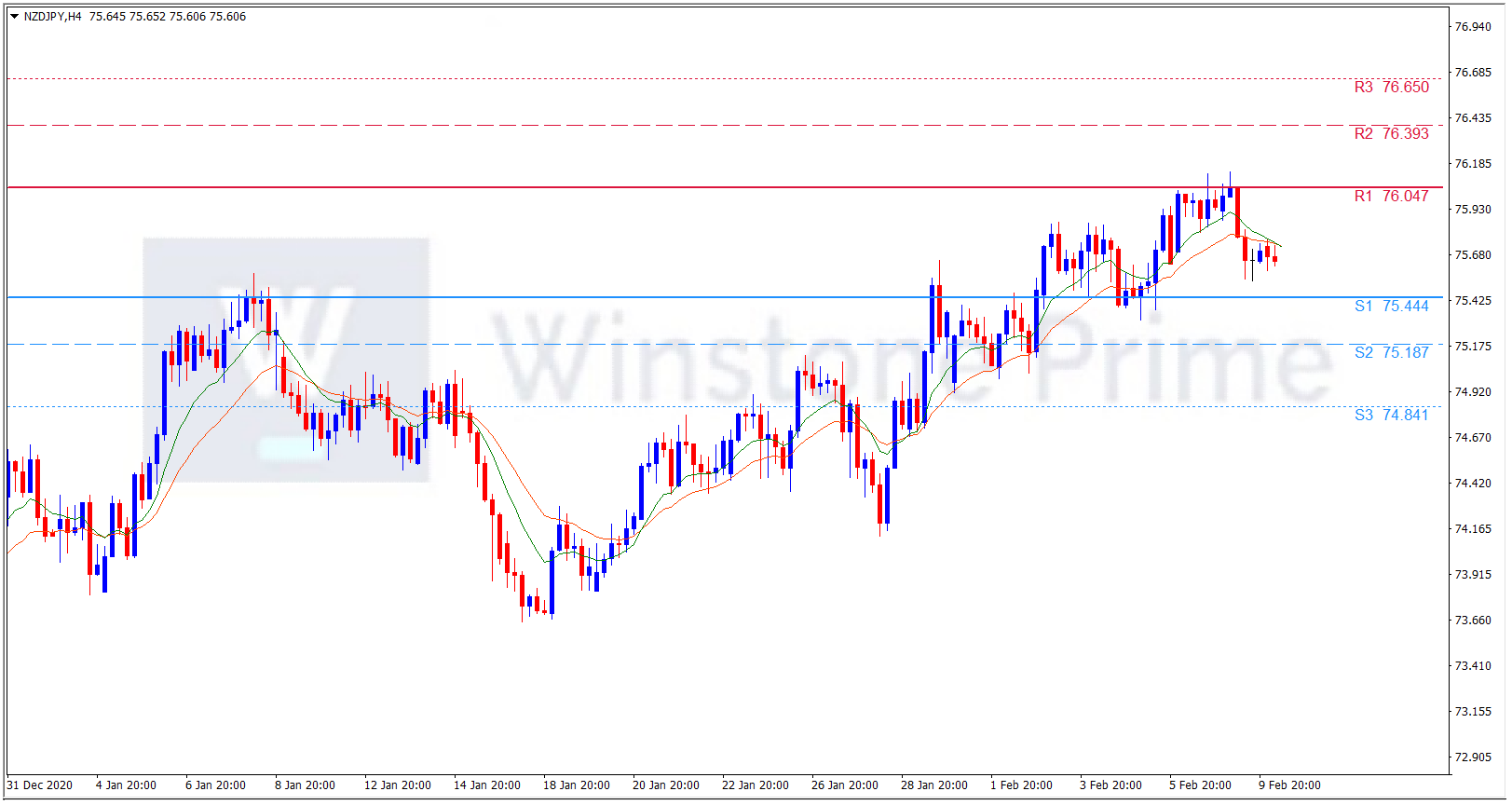
NZD/JPY 4 Hour Chart:

Support: 75.44 (S1), 75.19 (S2), 74.84 (S3).

Resistance: 76.05 (R1), 76.39 (R2), 76.65 (R3).

As all the factors favors Yen and NZD remains in the downtrend despite some positive catalysts, we expect a bearish trend for NZD/JPY.

Pound is in uptrend despite Brexit issue

The cable breaks the 13-day-old trading range as broad US dollar weakness supersede uncertainty over Brexit and the coronavirus (COVID-19) vaccine news from the UK.  US dollar index (DXY) fell for the third day as the market’s risk-on mood joins reflation fears and directs the traders to the bonds from the greenback. To check the risk catalysts, the US Democratic Party’s readiness to go ahead with the $1.9 trillion covid stimulus without waiting for the Republicans’ assent to the details favor mainly favors the mood. Also backing expectations was the latest tweet from US President Joe Biden saying, “I know a lot of folks out there are losing hope, so I want to make one thing clear: I’m going to act as fast as I can to get Americans the relief they so desperately need.”

Further, the World Health Organization (WHO) stressed upon the use of the AstraZeneca vaccine instead of the claims over its efficacy on the South African variant of the coronavirus (COVID-19). Vaccine Optimism is boosted by the BBC’s news suggesting UK scientists are developing booster jobs to tackle Covid-19 variants, per the British Health Minister. The Guardian came out with the news, quoting British scientists, which says, “Leading vaccine scientists are calling for a rethink of the goals of vaccination programs, saying that herd immunity through vaccination is unlikely to be possible because of the emergence of variants like that in South Africa.”

The UK-EU tussle over the Northern Ireland border said, “Britain called on Monday for a reset in relations with the European Union and a refinement of a Brexit deal covering trade with Northern Ireland (NI), saying trust was eroded when Brussels attempted to restrict COVID-19 vaccine supplies.” Although Britain asked for a two-year extension to the NI border issue, The Telegraph says Brussels is poised to reject UK’s calls for an extension to Northern Ireland grace periods. The economic forecast from the UK’s National Institute of Economic and Social Research (NIESR) has cut growth forecast for 2021 to 3.4% from a previous estimate of 5.9%.

On the other hand, In the view of the economists at Goldman Sachs, the US economic recovery is likely to strengthen in the second quarter of 2021. Q2 GDP has improved at an 11% pace with a 10% forecast previously.

Expectations have been building that inflation would pick up as governments and central banks continue massive spending and easy money policies until officials are certain that their economies will recover from the coronavirus pandemic.

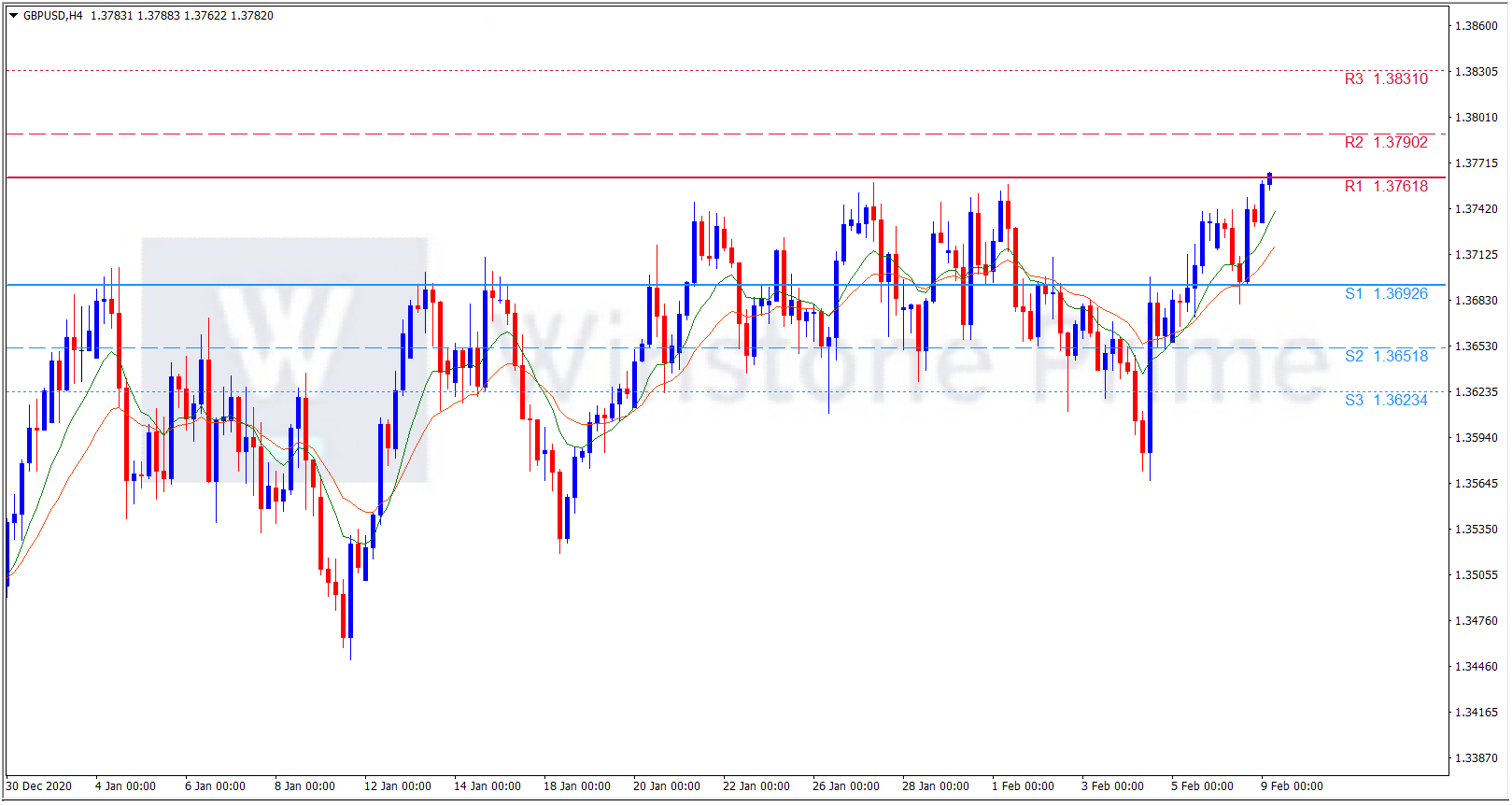
GBP/USD 4 Hour Chart:

Support: 1.3693 (S1), 1.3652 (S2), 1.3623 (S3).

Resistance: 1.3762 (R1), 1.3790 (R2), 1.3831 (R3).

Amidst all the catalysts directing towards broad US dollar weakness, we expect a bullish trend for GBP/USD.

US stimulus and Virus in Japan impacts yen

Greenback has bounced-off lows against the yen but remained in a narrow range around mid-105s, as markets remain in a waiting period in the aftermath of Friday’s US NFP report and incoming stimulus headlines. The weakness in USD/JPY was due to the US dollar sell-off due to the employment data disappointment, with only 49K jobs added in January while the jobless rate ticked down to 6.3%.

Earlier on Friday, the USD/JPY rallied on the US stimulus hopes-led reflation trades and due to the relative strength of the economic recovery. But so far today, markets remained divided over the US stimulus optimism and broad-based US dollar weakness due to mixed jobs data.

Favoring the yen, Japan’s benchmark index, the Nikkei 225, topping the 29,000 mark for the first time since 1990 might be providing the lift. Asahi reported that the Japanese government is considering lifting the state of emergency ahead of its scheduled expiry on March 7.

Japanese Chief Cabinet Secretary Katsunobu Kato said Monday, they are closely watching the market moves while declining to comment on stock prices. He said that they sternly protested against China over its patrol ships’ entry into waters near disputed East China Sea islands.

On the other hand, According to the St. Louis Federal Reserve data, the US inflation expectations as measured by the 10-year breakeven rate jumped to 2.21% on Friday to hit the highest level since August 2014. Inflation expectations clocked a low of 0.5% in March 2020, as financial markets crashed on fears of a coronavirus-induced recession and have been rising ever since.

Courtesy of oil price rally and strengthening expectations for aggressive fiscal spending under Joe Biden’s presidency also adds to boost the market investors sentiment.

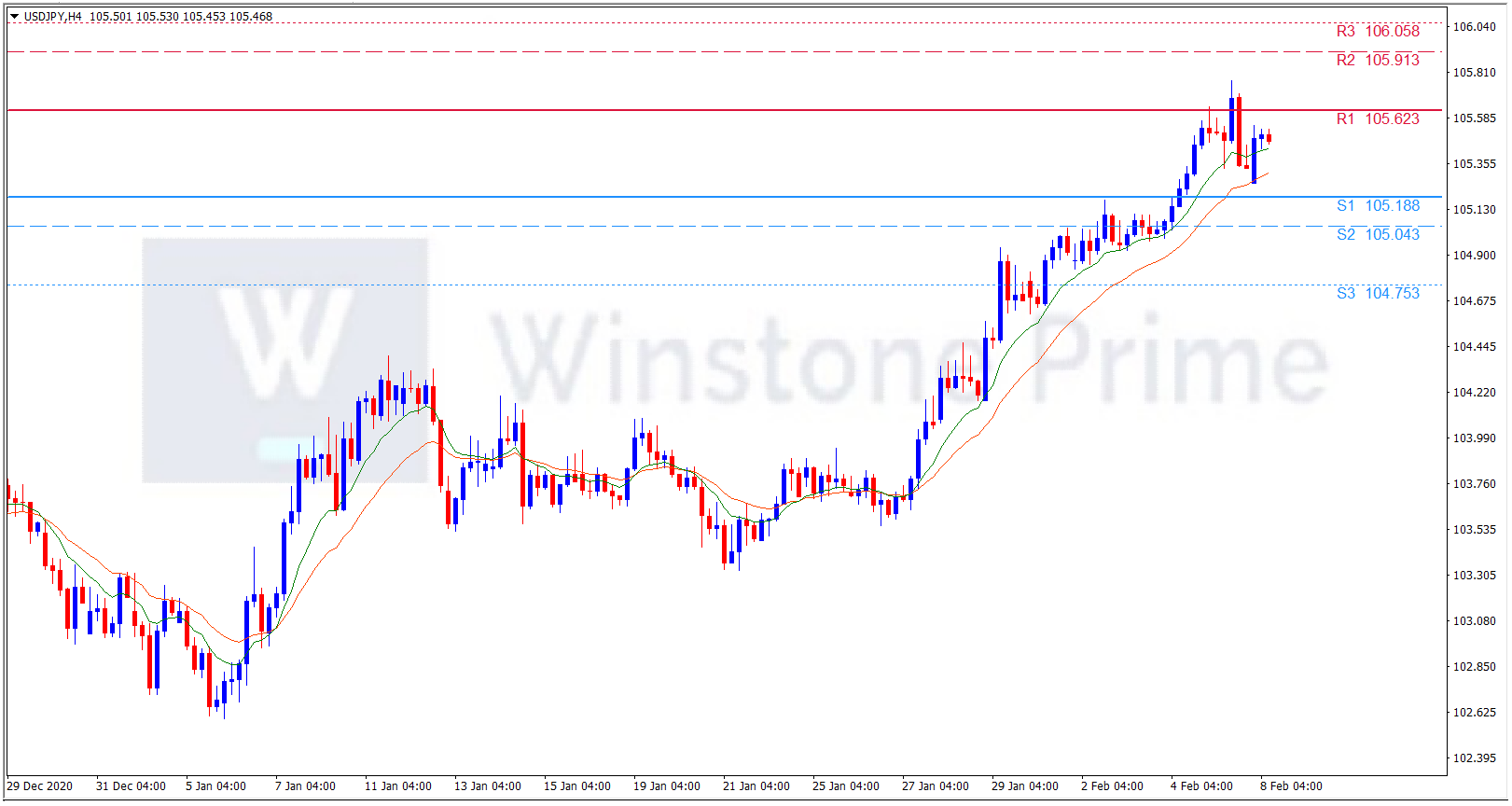
USD/JPY 4 Hour Chart:

Support: 105.19 (S1), 105.04 (S2), 104.75 (S3).

Resistance: 105.62 (R1), 105.91 (R2), 106.06 (R3).

Traders ignore upbeat Japanese current account and trade data, as the focus remains on the US stimulus developments and virus updates from Japan. We expect a mixed trend for USD/JPY.