Australia PM Morrison’s speech favors Aussie

With covid vaccinations likely to kick off at the end of the ongoing month, Australian Prime Minister Mr. Scott Morrison said Thursday that the government would buy another 10 million doses of Pfizer’s vaccine. He also said that the country now has access to 150 million doses of the vaccine. Its worth mentioning that AstraZeneca’s jabs will get injected as early as March in Australia. Among other vaccine updates, Novavax is expected to supply 6 million doses of Covid-19 vaccine candidates to Switzerland.

As a boost to the Aussie,  Australia’s trade surplus rose to a six-month high in December as exports of iron ore to China easily weathered diplomatic squalls between the two countries, while coal shipments found new buyers beyond the world’s second-largest economy. China’s reliance on steel-intensive infrastructure and construction to sustain economic growth means it has little choice but to keep importing Australian iron ore, even as prices for the mineral hit multi-year highs. Data from the Australian Bureau of Statistics out on Thursday showed goods exports to China jumped 21% in December to a six-month high of A$13.3 billion, with iron ore up sharply by both value and volume.

Elsewhere, Australian shares were set to snap a three-day winning streak on Thursday as miners and healthcare stocks eased, while investors awaited more risk-supportive economic outlook from the central bank. The Reserve Bank of Australia, which is slated to provide updated economic forecasts on Friday, earlier this week expanded its bond-buying programme and it also kept its cash rate near zero, even though the A$2 trillion economy has performed better than expected after largely controlling its COVID-19 outbreak.

On the other hand, Japanese shares snapped a three-session rally on Thursday, mainly led by declines in chip-related shares as investors booked profits, while electronics and media giant Sony jumped more than 9% on upbeat third-quarter earnings.

Meanwhile, in the US, the political environment has also made some progress in a recent vote whereby  ”the Democratic-controlled US House of Representatives approved a budget outline on Wednesday that would allow them to pass President Joe Biden’s proposed $1.9 trillion coronavirus aid plan without Republican support,” Reuters reported.

AUD/JPY 4 Hour Chart:
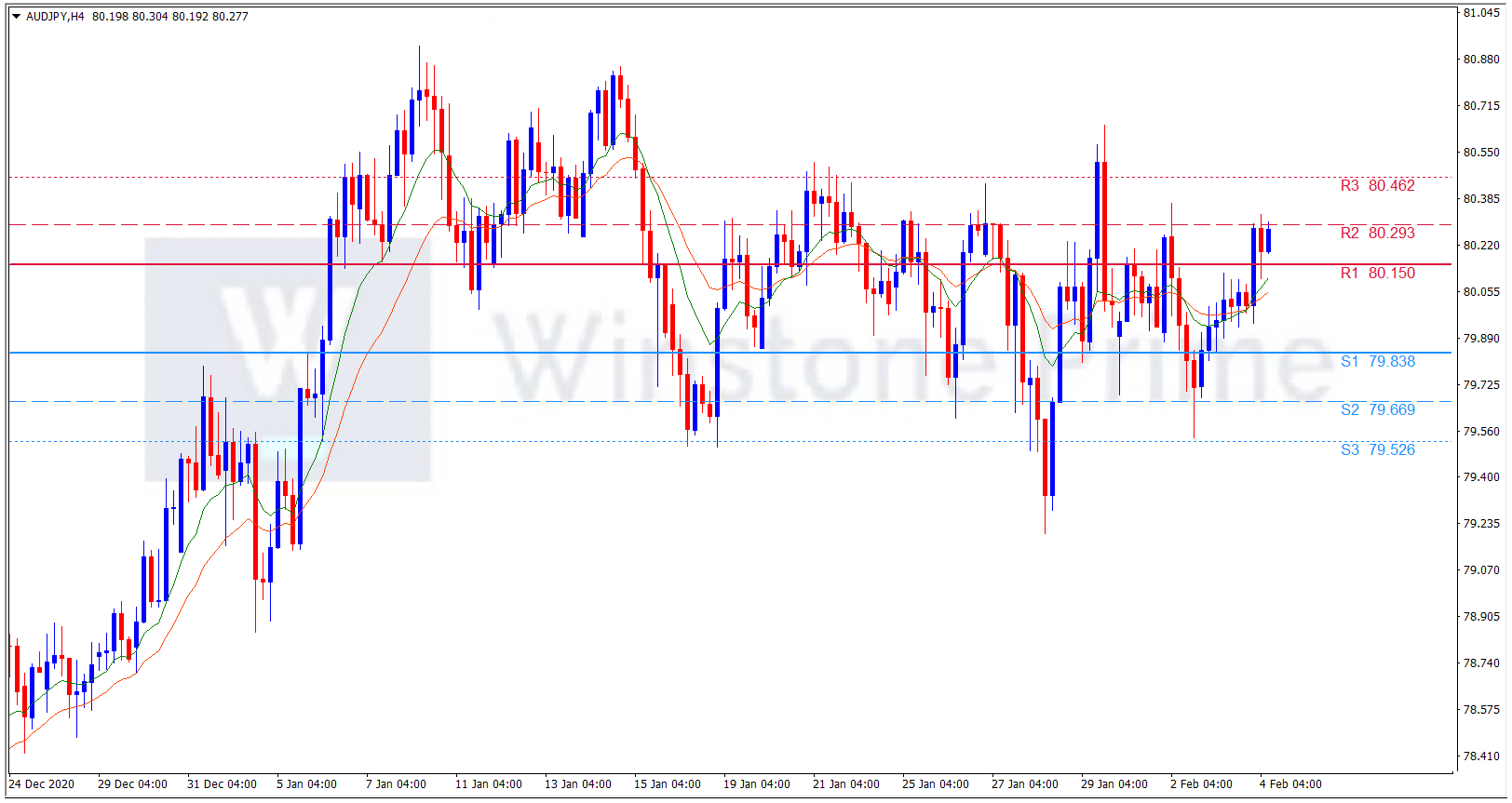
Support: 79.84 (S1), 79.67 (S2), 79.53 (S3).

Resistance: 80.15 (R1), 80.29 (R2), 80.46 (R3).

As all the factors contribute to strengthen Aussie against the yen, we expect a bullish trend for AUD/JPY.
US stimulus and vaccine development boost dollar

US Treasury Secretary Janet Yellen is expected to hold a meeting with the Securities Exchange Commission (SEC), the Federal Reserve (Fed), the New York Fed and the Commodity Futures Trading Commission this week, citing sources familiar with the matter.

Earlier on Wednesday, Yellen said that the Congressional Budget Office (CBO) forecast portrays a desperate need for aid package. It will be years before the US reaches full employment again based, she added.

Asian shares and U.S. stock futures rose on Wednesday as governments around the world looked poised to boost spending to help economies recover from the coronavirus and vaccine roll-out programmes accelerated.

Adding to it, Wall Street rallied on Tuesday on renewed hopes for U.S. President Joe Biden’ proposed $1.9 trillion COVID-19 aid bill as the Senate took certain steps to allow Democrats to pass Biden’s package without Republican support.

Elsewhere, the Biden administration said it would increase the weekly supply of shots nationwide and start shipping coronavirus vaccines directly to retail pharmacies in addition to ongoing deliveries to states. Sentiment was also bolstered by higher-than-expected earnings from tech giants Alphabet Inc GOOG.O and Amazon.com Inc AMZN.O, which overshadowed the retail trading frenzy that roiled markets last week.

The party for the Reddit-inspired trading frenzy that pushed GameStop’s stock up five-fold in five days last week appeared over as its shares plunged 60% in heavy trade to close at $90.00, less than one-fifth of an all-time peak on Friday.

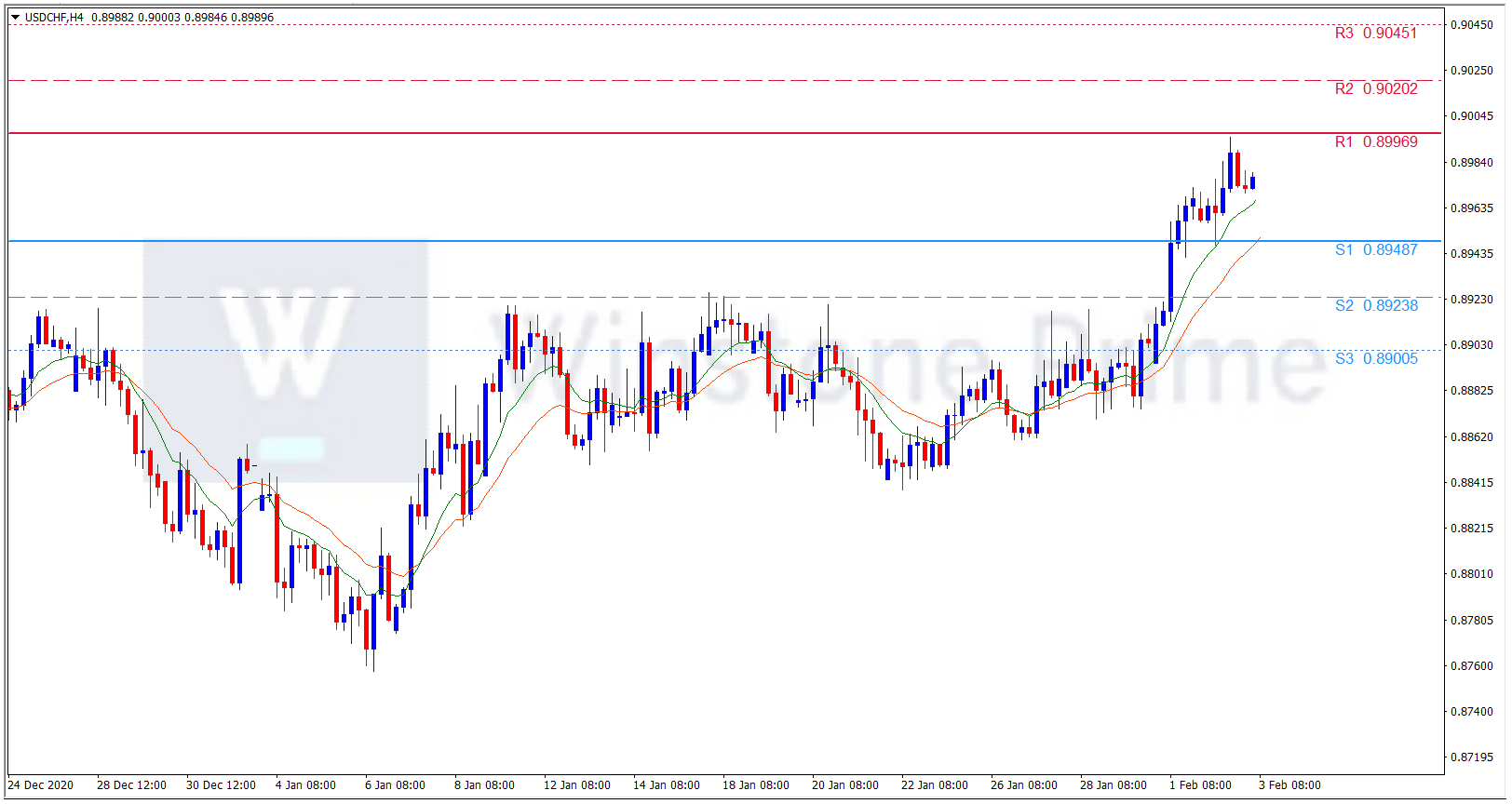
USD/CHF 4 Hour Chart:

Support: 0.8949 (S1), 0.8924 (S2), 0.8901 (S3).

Resistance: 0.8997 (R1), 0.9020 (R2), 0.9045 (R3).

Amidst all the catalysts favoring greenback against CHF, we expect a bullish trend for USD/CHF.

RBA’s move weakens Aussie

At its first monetary policy meeting of 2021 on February 2, the Reserve Bank of Australia (RBA) board members decided to maintain the official cash rate (OCR) at a record low of 0.10%, matching the market’s consensus. The RBA left its three-year bond yield target unchanged at 0.10%.

It has also decided to purchase an additional $100bn worth of government bonds as the additional monetary support is set to expire in April. The additional buying will be in the form of $5bn per week.

RBA Governor Philip Lowe said a return to normal economic measures are “still some way off”, with the central bank to continue its support for the foreseeable future.

“The current monetary policy settings are continuing to help the economy by lowering financing costs for borrowers, contributing to a lower exchange rate than otherwise, supporting the supply of credit needed for the recovery and supporting household and business balance sheets,” Dr Lowe said.

“The decision to extend the bond purchase program will ensure a continuation of this monetary support.” “The outlook for the global economy has improved over recent months due to the development of vaccines,” RBA Governor Philip Lowe said.

On the other hand, Earlier in the day beginning , market sentiment was disturbed initially as an increase in margin requirements for silver trading the Gamestop’s weakness stopped bulls from cheering Wall Street’s upbeat performance. However, US President Joe Biden’s “substantive and productive” stimulus discussions with Republicans renewed optimism. Also on the positive side could be China’s readiness to give a fresh start to the diplomatic relations with the US, as per Senior Chinese diplomat Yang Jiechi.

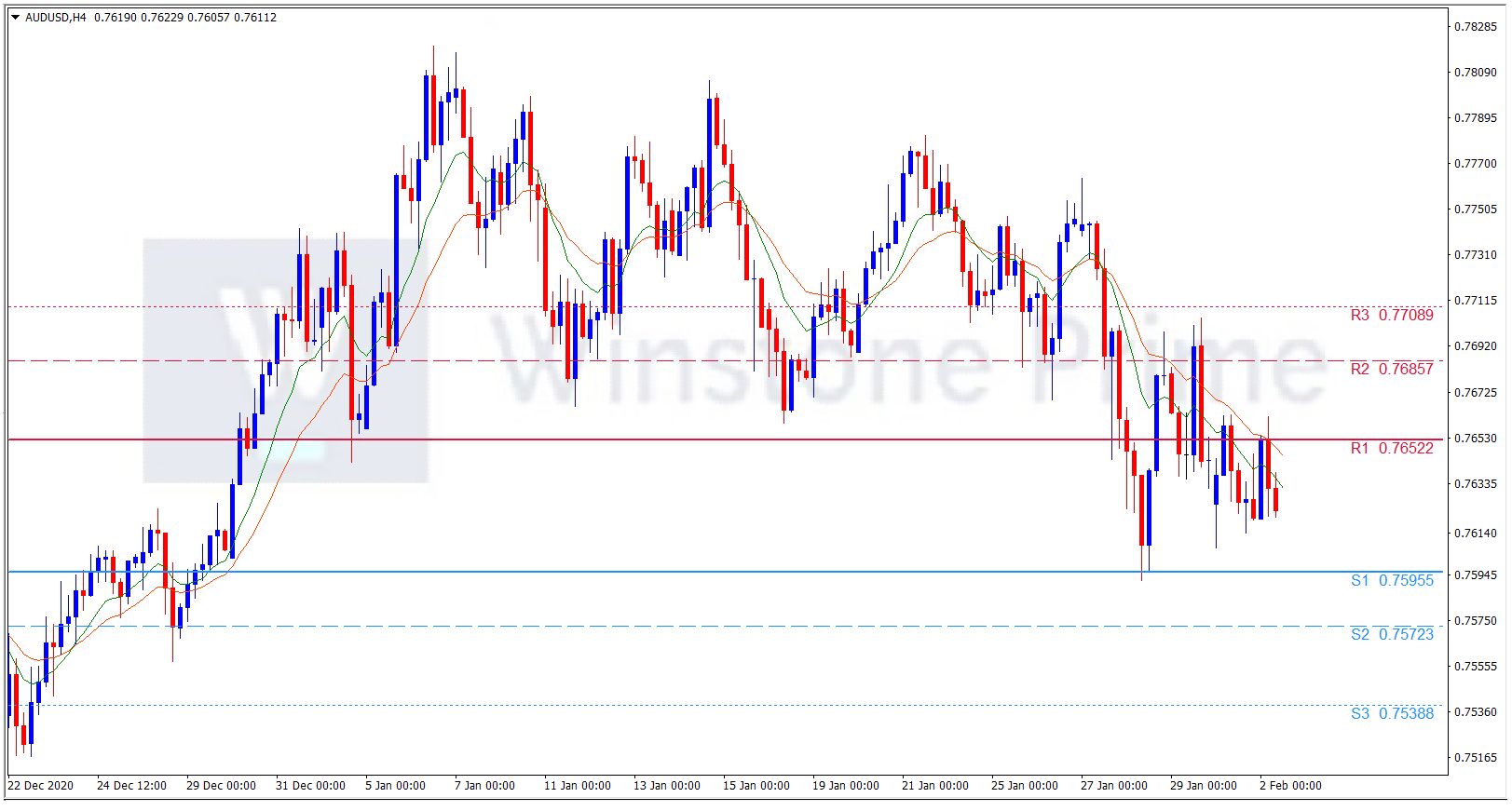
AUD/USD 4 Hour Chart:

Support: 0.7596 (S1), 0.7572 (S2), 0.7539 (S3).

Resistance: 0.7652 (R1), 0.7686 (R2), 0.7709 (R3).

Amidst all the catalysts favoring greenback against Aussie, we expect a bearish trend for AUD/USD.

Day Trading Tips for Beginners

The foreign exchange market (forex) has a low barrier to entry, which makes it one of the world’s most accessible day trading markets. If you have a computer, an internet connection, and a few hundred dollars, you should be able to start day trading. As with starting any career, there is a lot to learn when you’re a day trading beginner. Not only will you need to decide what to trade and how much capital you’ll need, but you’ll have to get the proper equipment and software, determine when to trade, and of course, how to manage your risk.

Here are some tips to steer you in the right direction as you start your journey.

Choosing a Day Trading Market

All markets offer profit potential. Therefore it often comes down to how much capital you need to get started. Don’t try to master all markets at once. This will divide your attention, and it may take longer to make money. Pick one market so that you can focus your learning. Once you learn to make money in one market, it is easier to adapt to learn other markets. So, be patient.

You may already have a market in mind, but here’s the background in a nutshell. It comes down to what you like, but also what you can afford.

  • The foreign exchange market, where you’re trading currencies such as the euro and U.S. dollar (EUR/USD), requires the least capital. You can get started with as little as $100, although starting with more is recommended.
  • Trading certain futures markets may only require $1,000 to get started. There is also a wide assortment of futures available to trade. These are often based on commodities or indexes such as crude oil, gold, or S&P 500 movements.
  • Day trading stocks requires at least $5,000, making this a more capital-intensive option.


Equipment and Software for Day Trading Beginners

You need a few basic tools to day trade:

Desktop, Laptop Or Mobile

Desktop, Laptop or Mobile is needed for trading. Android or IOS phone can be used if you prefer quick trading and you can go with desktop or laptop if you prefer to analyze the trading platform and trade.

Reliable, Quick Internet Connection

Day trading isn’t recommended with a sporadic internet connection. Recommendation for day trading internet speed is a minimum of 2mb download and 1 mb upload speed for day trading. Speeds vary across these types of services, so strive for at least a mid-range internet package.

The slowest speed offered by your internet provider may do the job, but if you have multiple web pages and applications running, then you may notice your trading platform isn’t updating as quickly as it should. If your internet goes down a lot, see if there is a more reliable provider.

A Trading Platform

Download several trading platforms and try them out. Since you are a beginner, you won’t have a well-developed trading style yet, so just try a few that your broker offers and see which you like best.

Keep in mind you may change your trading platform more than once within your career, or you may alter how it is set up to accommodate your trading progress. Meta trader 4 and Meta trader 5 are the best and most used trading platforms. MT4 and MT5 platform provides highly advanced technology along with the high level of security which makes it stable. MT5 is more advanced than MT5 hence it is recommended but if you like conservative trading style, you can go with MT4.

Supportive Broker

Your broker facilitates your trades, and in exchange charges you a commission or fee on your trades. Day traders want to focus on low-fee brokers since high commission costs can ruin the profitability of a day trading strategy.

That said, the lowest fee broker isn’t always best. You want a broker that will be there to provide support if you have an issue. A few cents extra on a commission is worth it if the company can save you hundreds or thousands of dollars when you have a computer meltdown and can’t get out of your trades.

That said, the lowest fee broker isn’t always best. You want a broker that will be there to provide support if you have an issue. A few cents extra on a commission is worth it if the company can save you hundreds or thousands of dollars when you have a computer meltdown and can’t get out of your trades.

Major banks, while they offer trading accounts, typically aren’t the best option for day traders. Fees are typically higher at major banks, and smaller brokers will typically offer more customizable fee and commission structures to day traders.

BEST TIME to TRADE

As a day trader, both as a beginner and a pro, your life is centered around consistency. One way to generate consistency is to trade during the same hours each day.

While some day traders trade for a whole regular session (6.30 pm to 1.00 am GST or example, for the U.S. stock market), most only trade for a portion of the day. Trading only two to three hours per day is quite common among day traders. Here are the hours you’ll want to focus on:

  • For stocks, the best time for day trading is the first one to two hours after the open, and the last hour before the close. You want to get good at trading between 6:30 pm and 8.30 pm GST because this is the most volatile time of the day, offering the biggest price moves and most profit potential. Some sizable moves also occur during the last hour of the day—12 a.m to 1 a.m. If you only want to trade for an hour or two, trade the morning session.
  • For day trading futures, around the open is a great time to day trade. Active futures see some trading activity around the clock, so good day trading opportunities typically start a bit earlier than in the stock market. Focus on trading between 6:30 pm and 8 pm. GST. Futures markets have official closes at different times, but the last hour of trading also typically offers sizable moves to capitalize on.
  • The forex market trades 24 hours a day during the week. The EUR/USD is the most popular day trading pair. This currency pair typically records greater trading volumes between 10 a.m and morning GST., when the London markets are open. And the hours of 4 p.m to 7 p.m. GST typically produce the biggest price moves because both the London and New York markets are open.
  • Cryptocurrency trading is a 24/7 market. So whether you’re buying Bitcoin or one of the other 2,500+ cryptocurrencies, prices fluctuate a lot. Most liquidity is around 8am when European markets open, and 5pm when European markets close.


Manage Your Day Trading Risk

Before you go any further, you need to know how to control risk. Day traders should control risk in two ways:

  • Trade risk 
  • Daily risk.

Trade Risk

Trade risk is how much you are willing to risk on each trade. Ideally, risk 1% or less of your capital on each trade. This is accomplished by picking an entry point and then setting a stop loss, which will get you out of the trade if it starts going too much against you.

The risk is also affected by how big of a position you take, so learn how to calculate the proper position size for stocks, forex, or futures. Factoring in your position size, your entry price, and your stop loss price, no single trade should expose you to more than a 1% loss in capital.6

Daily Risk

Just as you don’t want a single trade to cause a lot of damage to your account (hence the 1% rule), you also don’t want one day to ruin your week or month. Therefore, set a daily loss limit. One possibility is to set it at 3% of your capital. If you are risking 1% or less on each trade, you would need to lose three trades or more (with no winners) to lose 3%. With a sound strategy, that shouldn’t happen very often. Once you hit your daily cap, stop trading for the day.

Once you are consistently profitable, set your daily loss limit equal to your average winning day. For example, if you typically make $500 on winning days, then you are allowed to lose $500 on losing days. If you lose more than that, stop trading. The logic is that we want to keep daily losses small so that the loss can be easily recouped by a typical winning day.

From Demo to Live Trading

Most traders notice a deterioration in performance from when they switch from demo trading to live trading. Demo trading is a good practice ground for determining if a strategy is viable, but it can’t mimic the actual market precisely, nor does it create the emotional turmoil many traders face when they put real money on the line.

Therefore, if you notice that your trading isn’t going very well when you start to live (compared to the demo), know that this is natural.

As you become more comfortable trading real money, increase your position size up to the 1% threshold discussed above. Also, continually bring your focus back to what you have practiced and implement your strategies precisely. Focusing on precision and implementation will help dilute some of the strong emotions that may negatively affect your trading.