Better than expected CPI report favors Aussie

The already uptrend Aussie dollar extends its gains as the Australian Bureau of Statistics (ABS) reported better-than-expected fourth-quarter inflation figures. Australia’s Consumer Price Index (CPI) rose 0.9% quarter-on-quarter in the fourth quarter, leaving behind the estimate of a 0.7% rise but it is down from the preceding quarter’s 1.6% rise. In December, the ABS had warned of an uptick in inflation due to a jump in childcare costs. The CPI rose 0.9% in annualized terms versus expectations of 0.7%.

The Reserve Bank of Australia’s Trimmed Mean CPI rose 0.4% and 1.4% as expected in quarter-on-quarter and annualized terms, respectively.

Analysts at Westpac offer their afterthoughts on the Australian Q4 CPI beat ,The key notes were “The CPI is still being influenced by government taxes and subsidies which have been pushing and pulling on the data. However, outside of dwelling prices we found little to suggests more broad-based inflationary pressures.”

“The main surprise compared to our forecast was how the surge in housing demand lifting dwelling prices to swamp the benefit of the Home Builders Grants. In many capital cities developers were able to lift prices in excess of the value of the grants, even in Perth and Hobart were the Federal Grant ($25,000) was supplemented by state government grants ($20,000).“

On the other hand, The U.S. dollar was pressured by expectations the Federal Reserve would stick with its ultra-easy policy at a meeting later on Wednesday and play down the need for tightening anytime soon.

The Biden administration said Tuesday that it would purchase 100 million doses each of the vaccines made by Pfizer Inc and Moderna Inc, with making an increase of overall total doses to 600 million.

Meanwhile, the International Monetary Fund (IMF) revised the 2021 global economic growth forecast higher to 5.5% versus 5.2%.

AUD/USD 4 Hour Chart:
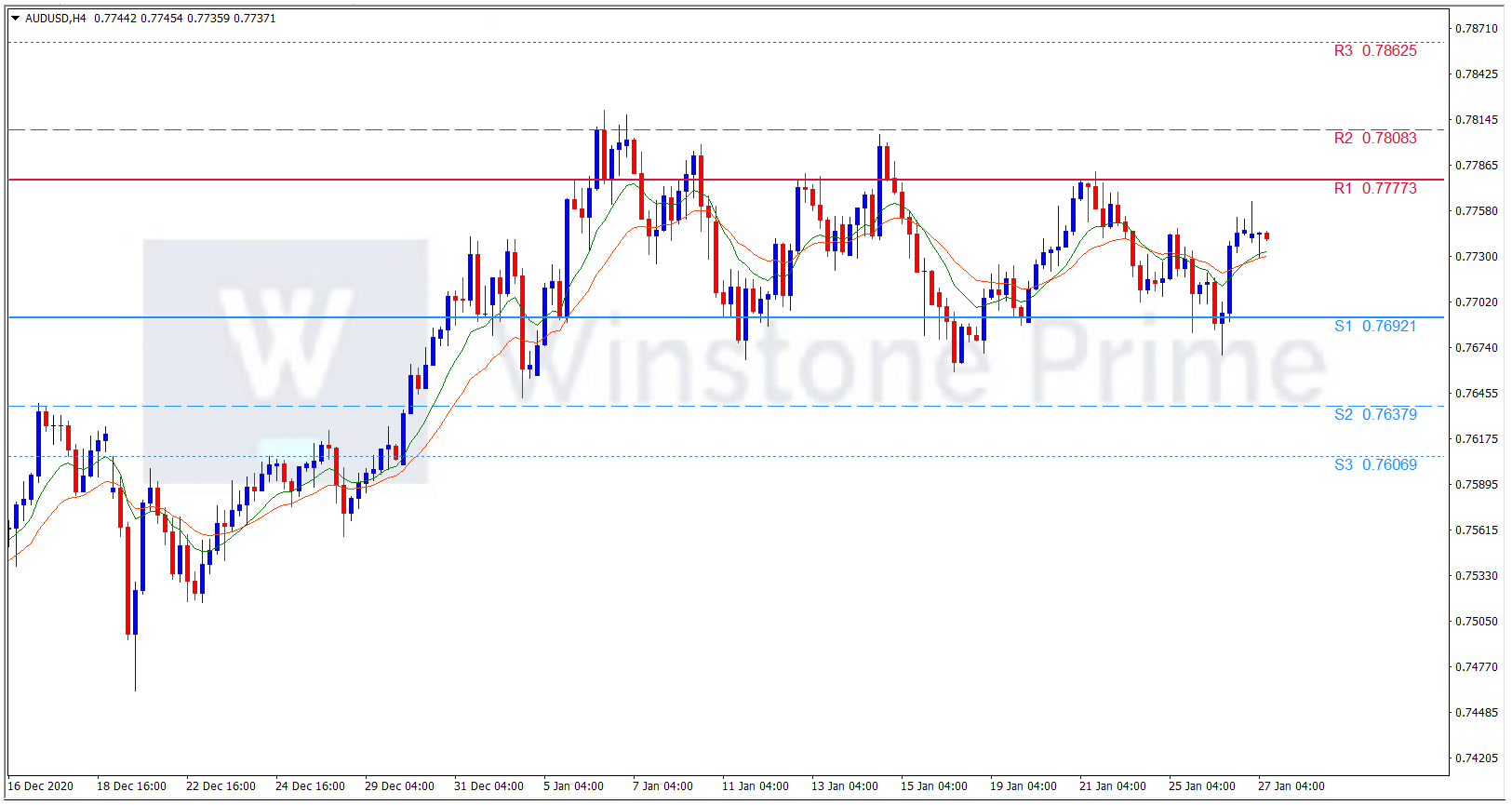
Support: 0.7692 (S1), 0.7638 (S2), 0.7607 (S3).

Resistance: 0.7777 (R1), 0.7808 (R2), 0.7863 (R3).

The Better than expected CPI report creates a optimism among the Aussie traders and we expect an bullish trend for AUD/USD.

Fear of new corona virus strain in Uk impacts pound

Sterling is under pressure amidst fears of new coronavirus strain in the UK and lockdown restrictions. Prime Minister Boris Johnson warned on Friday that the new UK COVID-19 variant might be associated with a higher level of mortality. Also, the British government has extended lockdown laws to give councils the power to close pubs, restaurants, shops, and public spaces until July 17.

Early by Tuesday, the UK’s Office for National Statistics (ONS) will release the December month Claimant Count figures together along with the Unemployment Rate in the three months to November at 07:00 AM GMT. The UK labor market report is expected to show that the average weekly earnings, including bonuses, in the three months to November, grew from the previous 2.7% to 2.9%, while ex-bonuses, the wages are seen improving from 2.8% to 3.1% during the mentioned period.

The number of people seeking jobless benefits, named as the Claimant Count Change jumped to 64.3K in November, expected +35K for December, whereas the ILO Unemployment Rate suggests a further improvement in the employment data from 4.9% to 5.1% during the three months ending in November.

On the other hand, US dollar seems to be stronger on Tuesday as rising coronavirus cases and doubts over the speed and size of U.S. stimulus encouraged the traders’ upward mood, while investors were also cautious ahead of the Federal Reserve’s policy review later in the week.

Markets have come a long way in the hope that COVID will go away and governments will spend a lot of money,”said Imre Speizer, a Westpac currency analyst. However, currency markets have entered a capture pattern as they wait to see if the Democrats’ big anti-virus package can wipe out Congress and whether the COVID-19 vaccine will actually start to turn the tide.

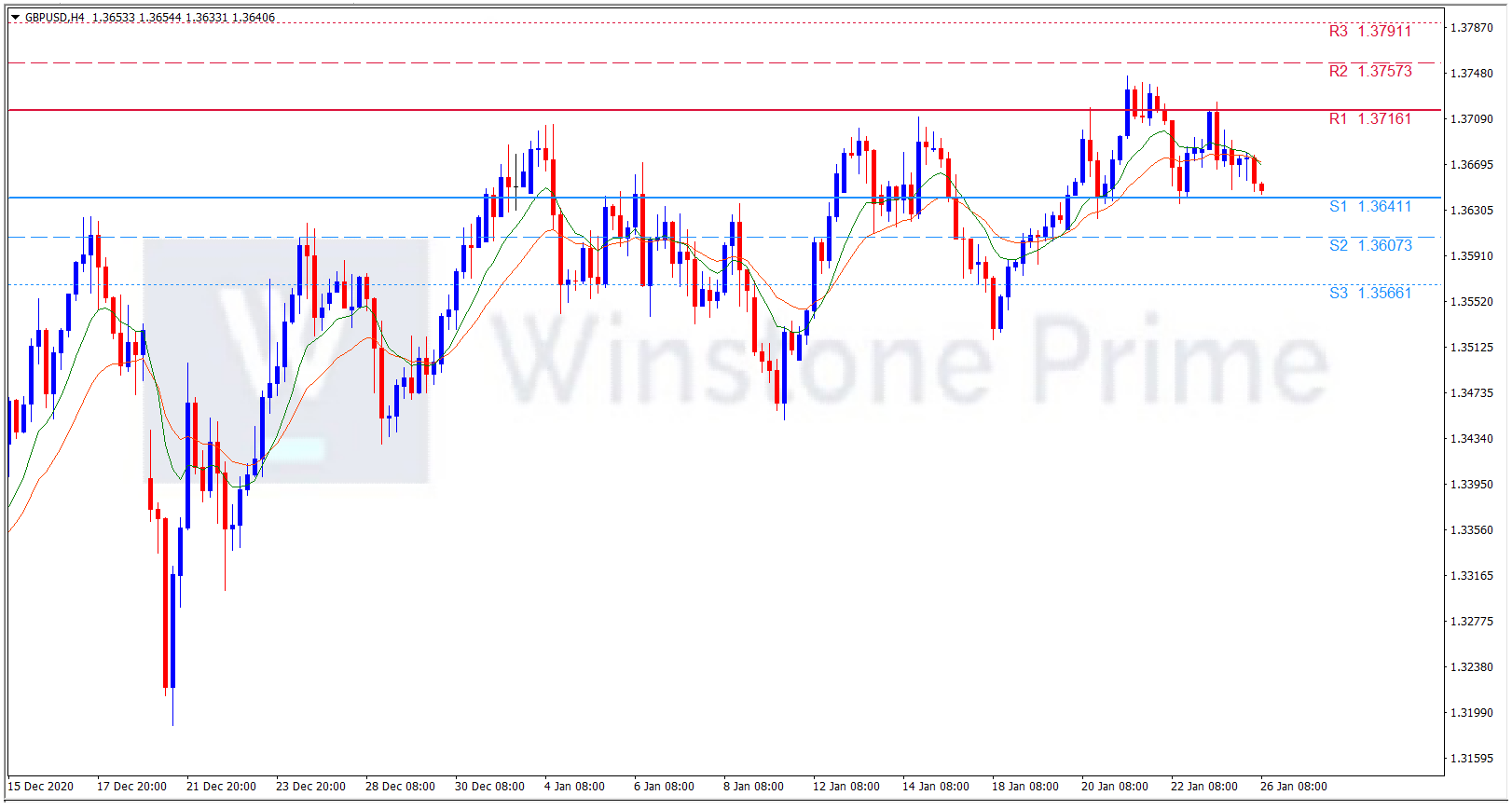
GBP/USD 4 Hour Chart:

Support: 1.3641 (S1), 1.3607 (S2), 1.3566 (S3).

Resistance: 1.3716 (R1), 1.3757 (R2), 1.3791 (R3).

In the prevailing atmosphere, where the fear of new coronavirus strain in the UK and lockdown restrictions make the sterling traders cautious, we expect a bearish trend for GBP/USD.

Dollar Index impacts the gold negatively

Yellow metal is seeing very little action on Monday, as the dollar index and US Treasury yields are consolidating. The dollar index, gold’s biggest nemesis, is currently side lined near 90.22, and the 10-year US Treasury yield is hovering near 1.09% for the seventh straight day.

Most of the analysts believe that the path of least resistance for the dollar is to the lower side, as markets expect massive US fiscal spending under Joe Biden’s Presidency. With that being the case, gold’s broader outlook looks bullish.

Elsewhere, President Joe Biden’s administration tried to head off Republican concerns that his $1.9 trillion pandemic relief proposal was too expensive on a Sunday call. Lachlan Shaw, National Australia Bank’s head of commodity research said that “We’re seeing bigger question marks over the passage of Biden’s stimulus package, Senate Republicans are starting to stand a bit more objectionable with particular parts of the package.”

“So it does raise the question about the speed and the timing of the package. (Although,) some of the issues of the vaccine delays in the U.S. are perhaps tilting the balance in odds of favour of that stimulus,” Shaw added.

Favoring the yellow metal, Demand for physical gold picked up last week as the approaching Chinese New Year encouraged buyers in China and Singapore. Speculators reduced their bullish positions in COMEX gold and silver contracts in the week to Jan. 19, data showed.

But the yellow metal might face some selling pressure in the short-run if coronavirus fears destabilize global equities, drawing bids for the weakened US dollar.

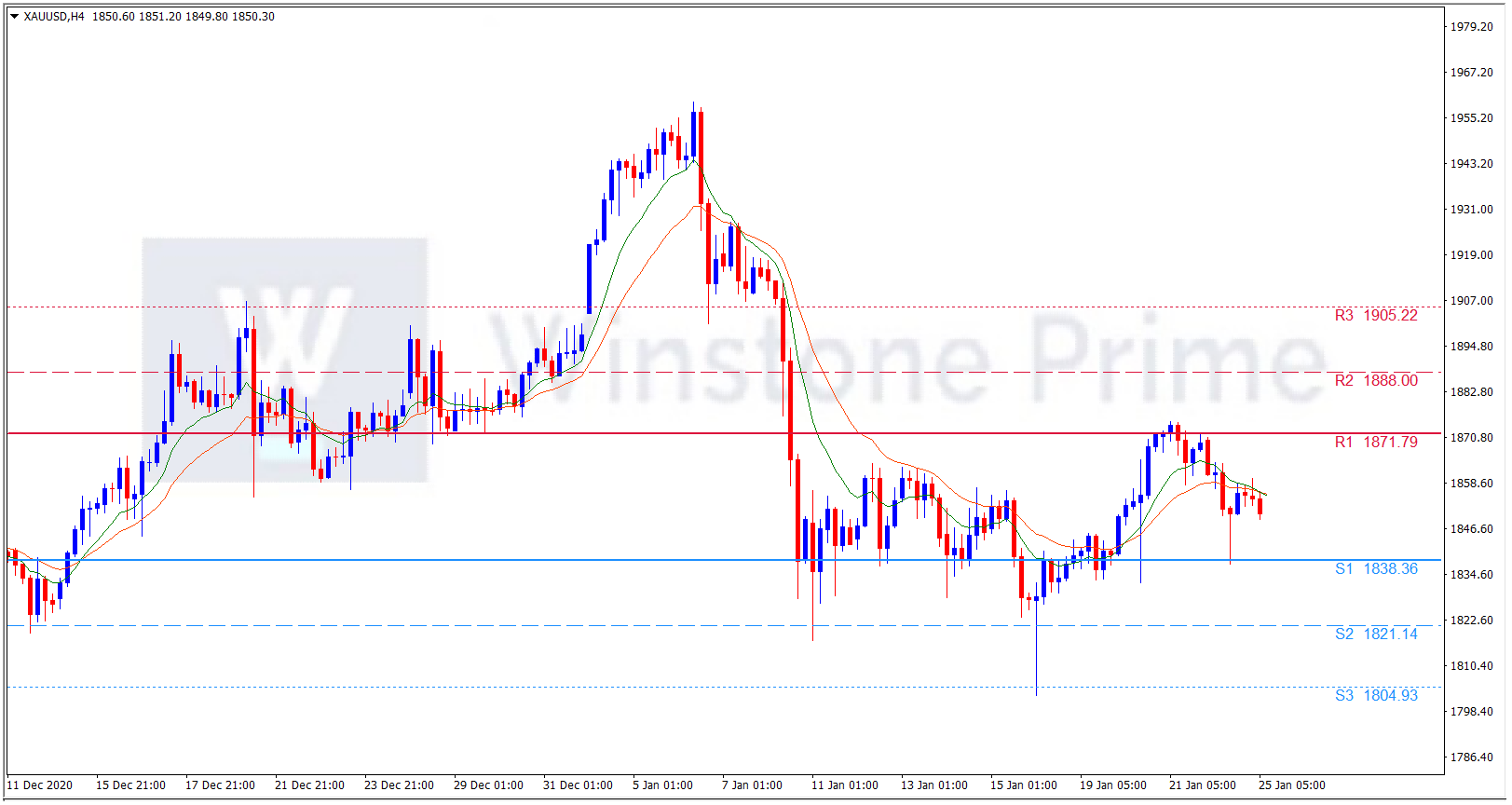
XAU/USD 4 Hour Chart:

Support: 1838.4 (S1), 1821.1 (S2), 1804.9 (S3).

Resistance: 1871.8 (R1), 1888.0 (R2), 1905.2 (R3).

Amidst the catalysts creating short term pressure on the yellow metal, we expect a short term bearish trend for XAU/USD.

XAU/USD Weekly Forecast (25th January 2021 – 29th January 2021)

Fundamental view:

Gold markets have gone back and forth during the course of the week, showing signs of volatility. Biden’s plan to introduce spending of $1.9 trillion, a figure that amounts to 9.1% of US 2020 GDP, appears to have been priced into gold prices and did not deliver a much-needed boost to the yellow metal. Treasury Secretary Janet Yellen, at her Senate confirmation hearing this week, also said the White House intended to go “big” on deficit spending to stimulate the economy, and that the benefits of recovery outweigh the costs.

Inflation expectations remain low, whilst US bond yields have risen sharply. This means that the real yield has risen in the USA, which tends to hurt gold prices.               

The major economic events deciding the movement of the pair in the next week are CB Consumer Confidence Index at Jan 26, Core Durable Goods Orders monthly report, EIA Crude Oil Stocks Change, Fed Interest Rate Decision at Jan 27, GDP quarterly report and Initial Jobless Claims at Jan 28 for US.

XAU/USD Weekly outlook:

Technical View:

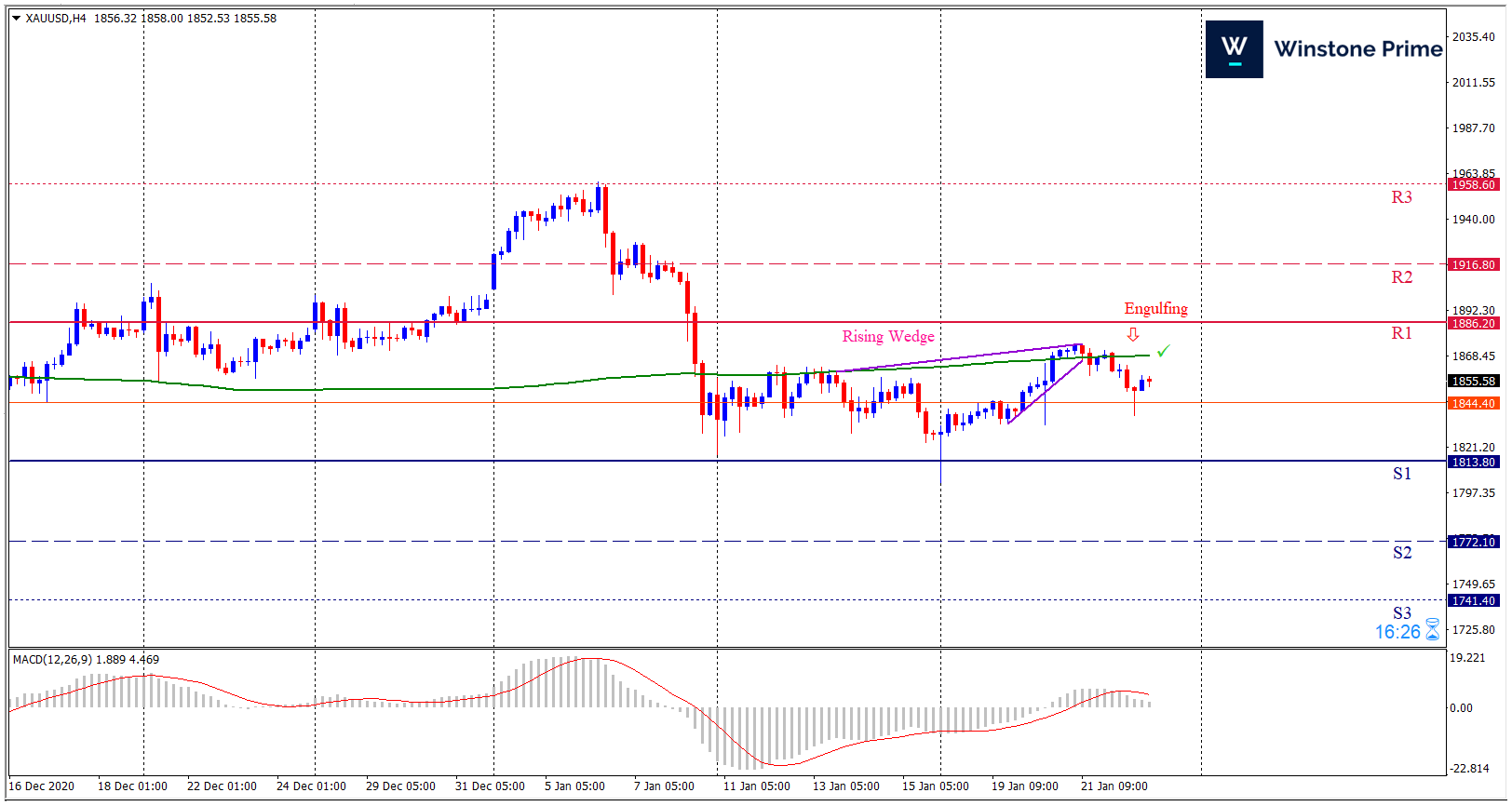
Last week’s high was 0.61% higher than the previous week. Maintaining high at 1875.1 and low at 1802.7 showed a movement of 724 pips.

In the upcoming week we expect XAU/USD to show a bearish trend.  The Instrument is trading below the 200 Simple Moving Average and the MACD trades to the downside. A solid breakout below 1813.8 may open a clean path towards 1772.1 and may take a way down to 1741.4. Should 1886.2 prove to be unreliable resistance, the XAUUSD may raise upwards 1916.8 and 1958.6 respectively. In H4 chart rising wedge breakout favors prospects of a bearish trend. Also to be noted bearish engulfing formation exerts the expectation of downtrend for the pair.

Preference
Sell:  1854.8 target at 1814.7 and stop loss at 1889.5


Alternate Scenario
Buy: 1889.5 target at 1926.3 and stop loss at 1854.8