EUR/USD Weekly Forecast (25th January 2021 – 29th January 2021)

Fundamental view:

The Euro has rallied significantly during the course of the week. A scarce macroeconomic calendar, uneventful central banks and corona virus-related concerns offset hopes that vaccine immunization will soon put an end to the pandemic and let economies return to the growth path. In the meantime, The US Federal Reserve is having a monetary policy meeting next Wednesday, the most relevant event of the week, although the central bank is expected to maintain its monetary policy unchanged. 

US TIC Net Long-Term Transactions on 20th January and Europe Trade Balance on 21st January created bearish trend whereas Europe CPI FOI excl. Tobacco yearly report on 18th January and Europe Trade Balance on 19th January created bullish trend for the pair.

The major economic events deciding the movement of the pair in the next week are ECB President Lagarde Speech at Jan 25, US CB Consumer Confidence Index at Jan 26, US Core Durable Goods Orders monthly report, Fed Interest Rate Decision at Jan 27, US GDP quarterly report, US Initial Jobless Claims at Jan 28, and Europe GDP quarterly report at Jan 29.

EUR/USD Weekly outlook:

Technical View:

Last week’s high was 0.27% lower than the previous week. Maintaining high at 1.2190 and low at 1.2054 showed a movement of 136 pips.

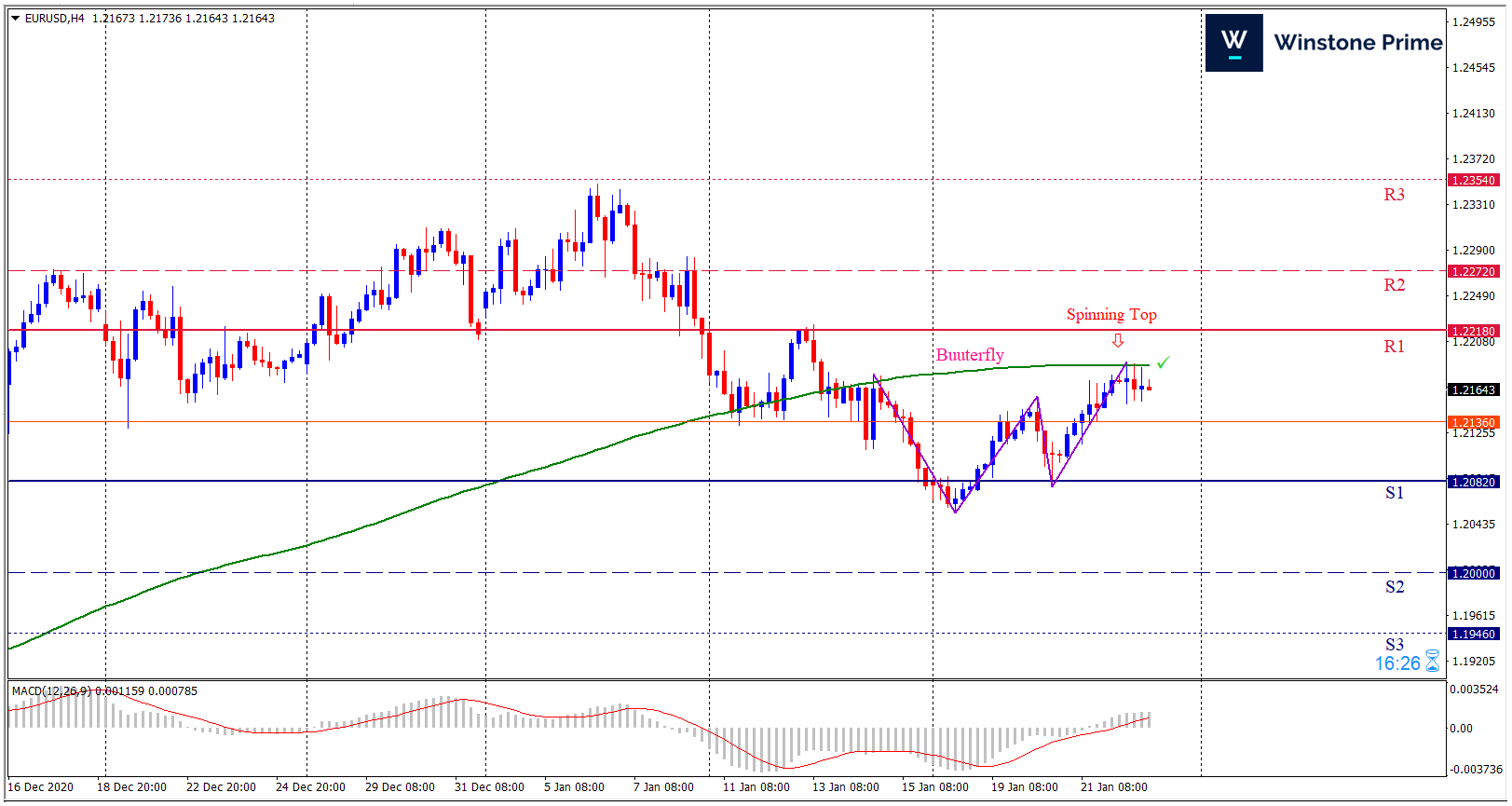
In the upcoming week we expect EUR/USD to show a bearish trend. The currency pair is trading below the 200 Simple Moving Average and the MACD trades to the downside. A solid breakout below 1.2082 may open a clean path towards 1.2000 and may take a way down to 1.1946. Should 1.2218 prove to be unreliable resistance, the EURUSD may raise upwards 1.2272 and 1.2354 respectively. Chart formation of a Bearish butterfly pattern in H4 chart sets prospects for a bearish trend. Spinning top formation in H4 chart escalates the expectation for a bearish trend.

Preference
Sell: 1.2175 target at 1.2039 and stop loss at 1.2222


Alternate Scenario
Buy:  1.2222 target at 1.2353 and stop loss at 1.2175

Postponing of data by RBNZ pressurizes NZD

New Zealand’s central bank said on Friday that it is going to postpone publication of most of its statistical data releases for a number of weeks while it is investigating a cyber attack that has led to a serious breach of its data systems. The breach was declared earlier this month and the Reserve Bank of New Zealand (RBNZ) said a file sharing service provided by California-based Accellion was illegally accessed.

The Bank said that Statistics on bank customer lending, credit card balances and spending, new mortgage commitments, bank liquidity, non-bank lending institutions, and retail interest rates would be delayed. “RBNZ will be postponing publication of most statistical releases. We will provide an updated release calendar when we can, but we expect delays of 3-4 weeks to most publications,” RBNZ said in an email

“It’s clear the data affected was shared by banks and other institutions,” said Dave Parry, Professor of Computer Science at Auckland University of Technology. “There is possibly a loss of trust among these institutions that their data will be secure, until it’s been proven that it will be secure.”

RBNZ had said earlier in the day that the data breach investigation had significantly progressed and it was able to tell stakeholders which of their files were downloaded illegally.

In the meantime, The Reserve Bank of New Zealand (RBNZ) released its Sectoral Factor Model Inflation gauge for the fourth quarter of 2020 after NZ Stats released the official consumer price index (CPI) early Friday. The gauge rose to 1.8% YoY in Q4. The inflation measures are closely watched by the RBNZ, which has a monetary policy goal of achieving 1% to 3% inflation.

On the other hand the dollar was headed for its worst week of the year on Friday, as investors cheered in the Joe Biden administration by buying riskier currencies and refreshed bets that a pandemic recovery could push the greenback lower still.

NZD/CHF 4 Hour Chart:

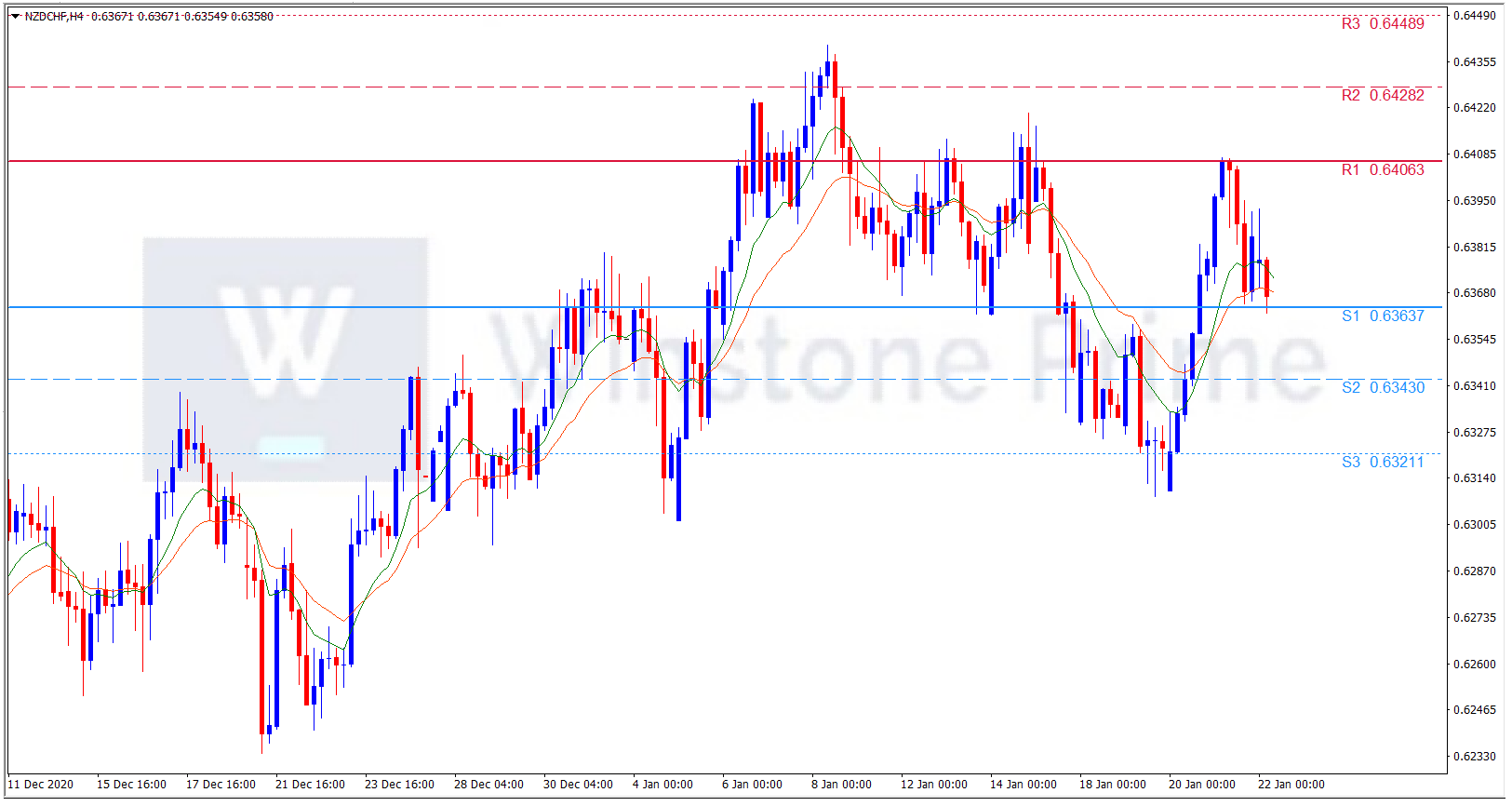
Support: 0.6364 (S1), 0.6343 (S2), 0.6321 (S3).

Resistance: 0.6406 (R1), 0.6428 (R2), 0.6449 (R3).

The delay in the publication of statistical data pressurizes NZD against CHF and we expect a bearish trend for NZD/CHF.

Employment report favors Aussie

December month employment statistics from the Australian Bureau of Statistics released 00:30 GMT on Thursday, it is the catalyst for the AUD/JPY pair traders. Australia boasted another solid rise in employment in December as strength in consumer spending and housing helped drive the jobless rate down to 6.6%, recovering most of the job losses suffered during the pandemic lockdown of 2020. The Australian Bureau of Statistics (ABS) on Thursday reported 50,000 net new jobs were created in December, on top of a 90,000 gain the month before.

Employment has now rebounded by 784,500 since May, leaving it 87,600 short of the level seen in March before much of the economy was shut down. The jobless rate was down from a July peak of 7.5% and beat forecasts of 6.7%, but still remains well above its pre-pandemic level of 5.2%. “Job vacancies have continued to rise suggesting the labour demand from businesses remains high, so we expect employment to continue to recover toward pre-virus levels,” said Ben Udy, Australia & New Zealand economist at Capital Economics.

On the other hand, The Bank of Japan kept monetary policy steady on Thursday and upgraded its economic forecast for next fiscal year, but warned of escalating risks to the outlook as new coronavirus emergency measures threatened to derail a fragile recovery.

BOJ Governor Haruhiko Kuroda said the board also discussed the bank’s review of its policy tools due in March, though dropped few hints on what the outcome could be. “Our review won’t focus just on addressing the side-effects of our policy. We need to make it more effective and agile,” Kuroda told a news conference.

In fresh quarterly projections, the BOJ upgraded next fiscal year’s growth forecast to a 3.9% expansion from a 3.6% gain seen three months ago based on hopes the government’s huge spending package will soften the blow from the pandemic.

AUD/JPY 4 Hour Chart:

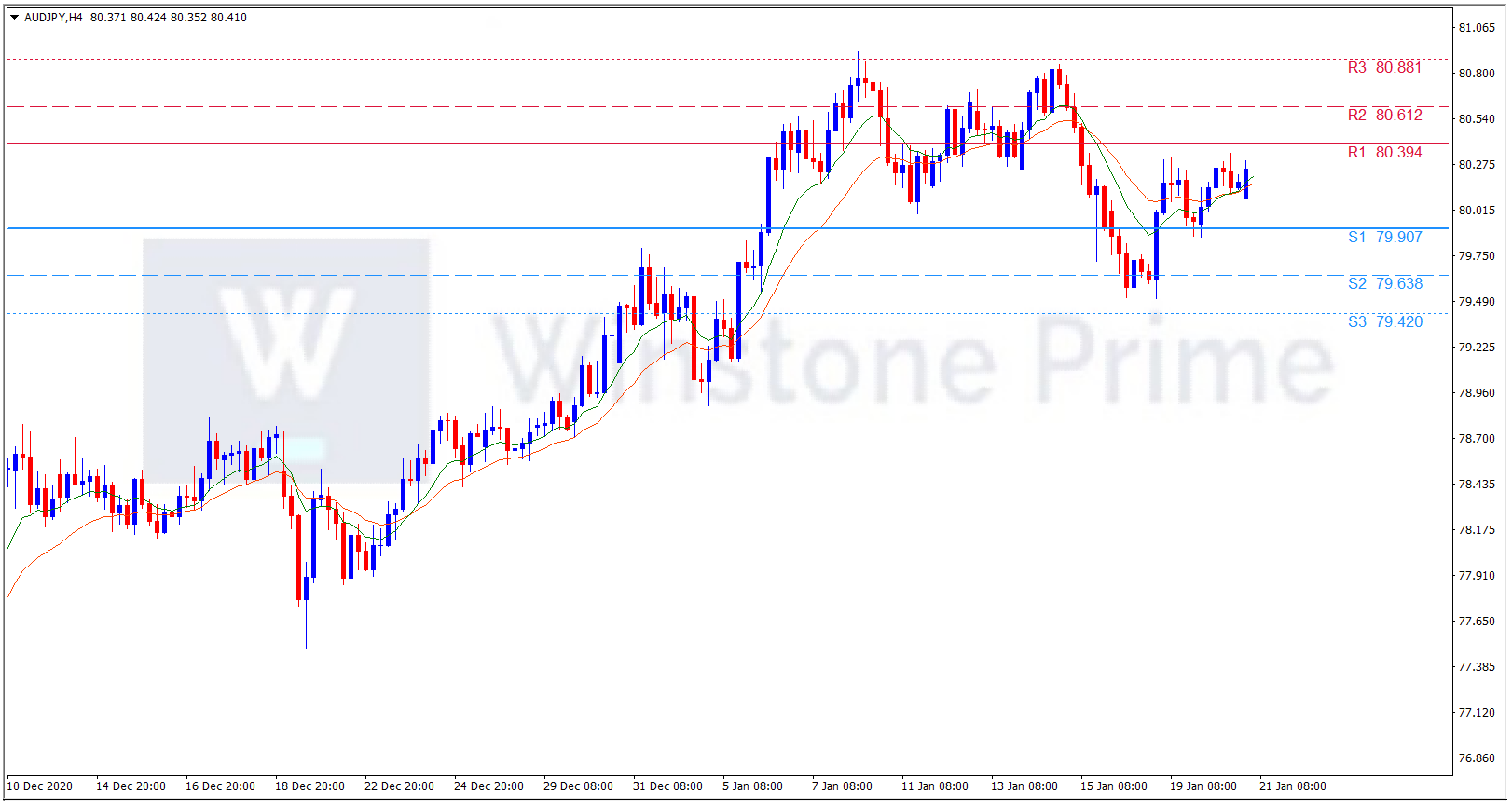
Support: 79.91 (S1), 79.64 (S2), 79.42 (S3).

Resistance: 80.39 (R1), 80.61 (R2), 80.88 (R3).

Amidst all catalyst favoring Aussie against yen, we expect a bullish trend for AUD/JPY.

Leverage trading and key things to keep in mind

Introduction

Leverage is the ability to use something small to control something big. Specific to foreign exchange (forex or FX) trading, it means you can have a small amount of capital in your account, controlling a larger amount in the market. With leverage, a little money can make a whole bunch if you are right, but leverage works two ways and losses can mount in a hurry when you are wrong. Stock traders will call this trading on margin. In forex trading, there is no interest charged on the margin used, and it doesn’t matter what kind of trader you are or what kind of credit you have. If you have an account and the broker offers margin, you can trade on it. The apparent advantage of using leverage is that you can make a considerable amount of money with only a limited amount of capital. The problem is that you can also lose a considerable amount of money trading with leverage. It all depends on how wisely you use it and how conservative your risk management is.

We summed up the useful information that will make your leverage trading effective and prevent you from making mistakes that may cost a fortune.

1. Importance Of Effective Leverage

Traders often want to ascertain the effective leverage of their trading account, along with the amount of leverage they still have available to be used in times of a potential trading opportunity. This can help manage overall trading risk and in staying below the maximum leverage limits imposed by a broker. It also helps to avoid margin calls or position closeouts, which brokers have to resort to in case of insufficient margin to support outstanding transactions.

The idea of optimizing the use of leverage is based on the goal of maximising growth of trading accounts, while not risking the total depletion of forex trading funds. Keeping an eye on effective leverage helps keep levels of trading risks visible and tolerable. Money management and risk management have been proven to be linked to each other. The Kelly criterion is an important example of this.

Kelly’s leverage optimization concept is based on the formula: L = (E-R)/ V

Here, L represents the optimal effective leverage that traders can aim for in their accounts. The term (E-R) shows the excess return of the trading strategy, where E is the rate of return and R is the risk-free interest rate. The term V is the expected statistical variance of the strategy’s excess return.

So, suppose the expected annual rate of return is 20% or 0.20, the risk-free rate of interest is 2% or 0.02, and the variance of the strategy’s excess return is 0.01, then the value of L would be:

L = (0.20-0.02)/ 0.01 = 18

This means that the trader should aim for an effective leverage ratio of 18:1. However, the Kelly criterion was designed for extremely high risk-taking traders, whereas most traders might feel comfortable with an optimal effective leverage of up to 10:1.

The forex market is popular among high volume market that commonly allows such significant leverage ratios. Equities and stocks generally won’t go above a leverage amount of 2:1. But this is because the forex market is actually far more stable than any other market; most currencies don’t fluctuate significantly the way that stocks or other forms of equity do. Thus, using leverage on the foreign exchange market is safer than using it on any other market. That being said, there are still some major concerns regarding leverage. Though these concerns don’t outweigh the benefits, they still need to be considered, especially by traders who are new to the market.

2. Low Leverage Allows trader’s to Survive

Lower leverage means risk is better controlled. In the simplest case, an unleveraged long stock position (no matter how volatile) cannot lose more than what you put in. Higher leverage on a less volatile asset may be calibrated so that your expected exposure to volatility is the same, but there is more room for unexpected volatility to wipe you out. Hence it is said that that low leverage allows traders to survive.  

3. Professional Traders and Leverage

Professional traders usually trade with very low leverage. Keeping your leverage lower protects your capital when you make trading mistakes and keeps your returns consistent. No matter what your style, remember that just because the leverage is, there does not mean you have to use it. In general, the less leverage you use, the better. It takes the experience to really know when to use leverage and when not to. 

4. Best Leverage Ratio

Forex traders need to adopt a maximum leverage depending on their risk-reward profile and trading goals. It also depends on the trader’s experience. It is best for beginners to start low. Three main factors need to be considered:

  • Starting with low levels of leverage.
  • Never risking more than 1% or 2% of the trading capital in each position.
  • Using risk management tools like stop-loss, take-profit and trailing stops to limit downside risk.


Trading styles can have a say too. For instance, scalpers and breakout traders tend to use higher leverage ratios, since they get in and out of trades quickly, multiple times a day. On the other hand, position traders might prefer low leverage.

It is good to start with a forex demo account to test the trading strategy and leverage mixes, without risking any money.

Assets can be traded through Leverage

Leverage is used not only in the Forex market. Traders can use leverage for different assets. For example, derivative investors apply for leverage to open larger trades. Also, you can trade CFD of oil, gold, and stocks via a broker. Here, you can also use leverage. Below you will see a list of the securities that are mostly traded with leverage:

  • Currencies. Of course, currencies are the most popular assets for leverage trading. Every reliable broker offers leverage for currency pairs.
  • CFD. CFDs are famous among traders because they provide an option to trade such attractive assets as gold, oil, and stocks that provide a significant reward.
  • Derivatives. Derivatives are also highly used by traders. Leverage allows them to operate large positions with small expenses or even without them.


Conclusion

Leverage is a progressive tool for traders to achieve good results. The obvious advantage of using leverage is that you can make a lot of money with only a limited amount of capital. However, it is impossible to choose the best leverage to use in Forex for both beginners and professional participants. This choice largely depends on the starting balance, trading strategy and the chosen risk management model.  However, one should always remember about the risks that high leverage carries.