The most powerful and effective aspect of forex trading is in general its Leverage. This gives you the flexibility to take significant positions in key currency pairs without adding too much capital, and maximizes the amount of any profit you make. However, Leverage can be risky. If you are wrong about a trade, it magnifies your losses. At excessively high levels, leverage exerts another effect. In addition to simple magnification of P&L, it begins to materially damage your odds of success on any particular trade.
Before enter into trade you should fully understand the impact of leverage, and the circumstances under which it can significantly damage the probability of a trade being profitable. And we also believe that allowing excessively high levels of leverage is not in the interests of our clients, our firm or our industry, and we have set our margin levels accordingly.
How does high leverage impact your trades?
This graph shows how excessively high leverage acts to distort the probability of your trade being successful. This distortion is the result of the way leverage interacts with transaction costs (spread and funding).
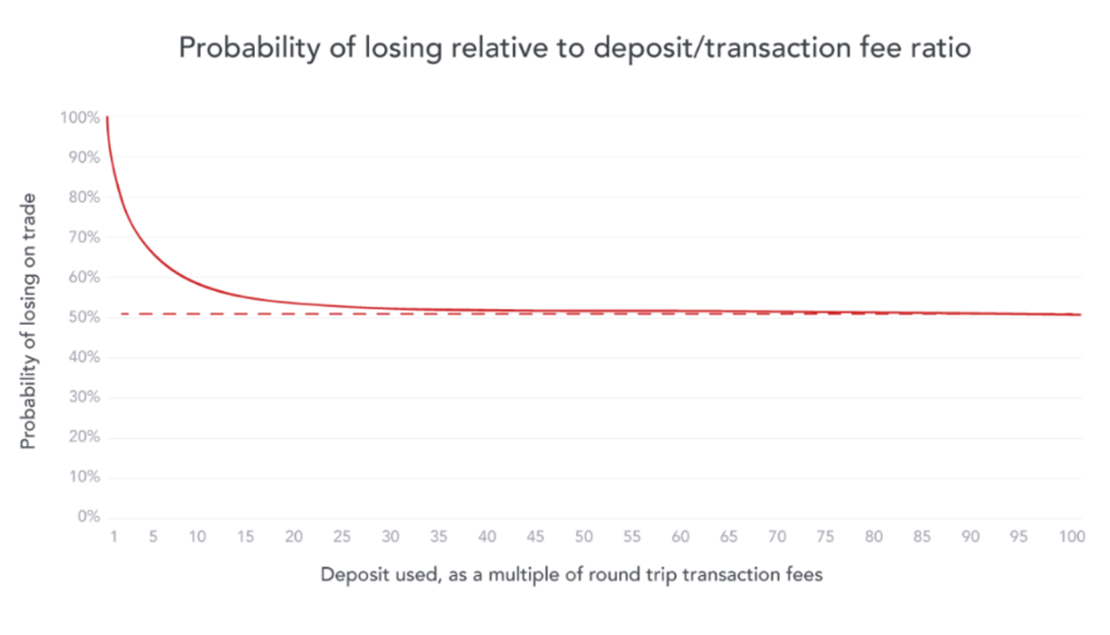
In the absence of transaction costs, the leverage you use has no impact on your probability of success. If you were to place trades randomly, without any particular insight or skill, and aim to take profits of the same size as your maximum stop-loss, you’d tend to win on 50% of trades and lose on 50% trades. This would be independent of your leverage used, and is represented by the dotted horizontal line on the chart. Transaction costs change this picture, representing a hurdle between you and a profitable trade. Another way of saying this is that costs shift the odds against you. At most levels of leverage this shift in odds is small.
However, when the leverage you use is so high that the margin supporting your trade is less than 10x to 20x your costs, your probability of losing begins to increase very rapidly. This is because costs eat away at the supporting margin, leading to a high probability of being closed out. This is easy to understand if you think about the most extreme case, where your supporting margin is exactly equal to your transaction costs on a trade. You’d place your trade, and the transaction costs would leave you with zero supporting margin for your position. This would lead to you being closed out immediately, with 100% probability, every single time – regardless of your trading strategy or how the market moves.
Now we want to take a harder look at “leverage” and show you how it regularly wipes out unsuspecting or overzealous traders. We’ve all seen or heard online forex brokers advertising how they offer 200:1 leverage or 400:1 leverage. We just want to be clear that what they are really talking about is the maximum leverage you can trade with. Remember this leverage ratio depends on the margin required by the broker. For example, if a 1% margin is required, you have 100:1 leverage. There is maximum leverage. And then there is your true leverage.
Examples of Using Excessive Leverage
Leverage can magnify your profits or losses by the same magnitude. Let’s look at it using an example. Consider two traders A and B who have the same trading capital of $10,000 in their trading accounts. Their accounts are with the same broker and have the same type of account. Consider the situation where both of them plan to short trade USD/JPY at 120. However, they use different leverage.

Trader A takes the 1:50 (50 times) leverage on this trade by shorting/selling US $500,000 worth of USD/JPY (50 x $10,000) based on his $10,000 trading capital. Because USD/JPY stands at 120, one pip of USD/JPY for one standard lot is worth approximately US $8.30, so one pip of USD/JPY for five standard lots is worth approximately US $41.50. If USD/JPY rises to 121, Trader A will lose 100 pips on this trade, which is equivalent to a loss of US $4,150. This single loss will wipe out 41.5% of his total trading capital.
Trader B is a conservative trader who decides to use (1:5) five times leverage on this trade by shorting/selling US $50,000 worth of USD/JPY (5 x $10,000) based on his $10,000 trading capital. That $50,000 worth of USD/JPY equals to just one-half of 1 standard lot. If USD/JPY rises to 121, Trader B will lose 100 pips on this trade, which is equivalent to a loss of $415. This single loss costs him just 4.15% of his total trading capital.
Using Leverage as a Tool

There is a relationship between leverage and its impact on your Forex trading account. The greater the amount of effective leverage used, the greater the swings (up and down) in your account equity. The smaller the amount of leverage used, the smaller the swings (up or down) in your account equity.
As tempting the ability to generate big profits without putting at stake too much of your hard-earned money may be, you should never forget that an excessively high degree of leverage could drain your entire starting capital in a blink of an eye. The following few safety precautions used by experienced traders may prove useful in diminishing the risks of leveraged Forex trading:
Use leverage adequate to your comfort level:
If you are a cautious or an inexperienced investor or trader, use a lower level of leverage that you feel comfortable with, perhaps 5:1 or 10:1, instead of trying to mimic the professional players choice of 50:1, 100:1 and even higher.
Limit your losses:

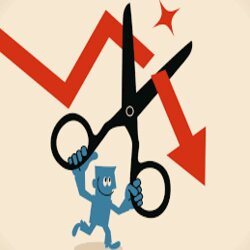
If you hope to achieve considerable profits somewhere in the future, you must first learn how to cut your losses in order to survive longer on the market and gather experience. Limit your losses to a manageable size to live to trade another day. That is achievable by following a sound money management system and using protective stops.
Use protective stops:
Stops are of great significance because a single distraction that draws you away from your computer can result in losing hundreds or thousands of dollars when you miss a sudden price reversal. Since the Forex market is decentralized and remains open around the clock, some market players leave their positions open and go to bed, only to wake up the next day and see their account balance wiped. Going away from the computer without incorporating a stop loss is a suicide for your account. Moreover, stops are used not only to limit losses, but also to protect profits (trailing stops).
Don’t make the situation even worse:
Don’t attempt to turn around a losing position by adding more money and averaging down on it. It defies logic to stick to a losing position and risk more and more of your trading capital, hoping for a miracle turnaround. Eventually that losing position will become so large, that your account won’t be able to contain it and you will be forced to exit the position at a huge loss which exceeds many times what you would have lost in the first time.
Even if the price action does eventually reverse at some point and you think you should have stuck to it, relax. Such decisions based solely on emotions and not on solid technical/fundamental analysis are one-time winners and will render you a losing trader in the long-term. It’s much better to exit the position, score a minor loss and offset that loss by entering some other, winning position, instead of wasting your time and money on losers.
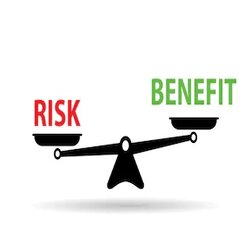
If you are following the above mentioned point you can easily avoid the losses from the excessive leverage. As rightly said “Leverage is a Double-Edged Sword”, Leverage greatly increases the risk of loss if a trader does not use money management rules. While the leverage has its benefits, there are also risks associated with its feature: it also increases the number of losses received from individual trades, just like it does with the pay-outs. So, it is important to understand both the benefits and risks of leverage.