Expectation of fiscal stimulus favors dollar

The yellow metal remains vulnerable to losses, as the US Treasury yields and the dollar continue to cheer the prospects of a bigger-than-expected fiscal stimulus plan, of about $2 trillion, likely to be announced by President-elect Joe Biden on Friday.

Political drama continues in white house. President Donald Trump was impeached for the second time in his term amid his role in the Capitol riots. Ten House Republicans voted with Democrats, but the Senate is unlikely to hold a trial before January 20, allowing Trump to conclude his term. Markets are focused on Biden’s plans rather than the political drama.

Jerome Powell, Chairman of the Federal Reserve, speaks later in the day and will likely give a message of stability regarding the Fed’s bond-buying scheme. His colleagues have been talking about the possibility of tapering the scheme, somewhat encouraging the dollar.  Gold traders will keep an eye on this speech.

The stalled US labor recovery has markets again looking to the initial claims early warning for evidence of the extent and duration of the slowdown. For the month until the next Nonfarm Payrolls on February 5 every claims report will be a good for the economy.

First time filings for unemployment benefits are expected to dip to 780,000 in the January 8 week from 787, 00 prior. Continuing Claims are were 5.072 million and the four-week moving average was 818,750 in the week of January 1.

XAU/USD 4 Hour Chart:
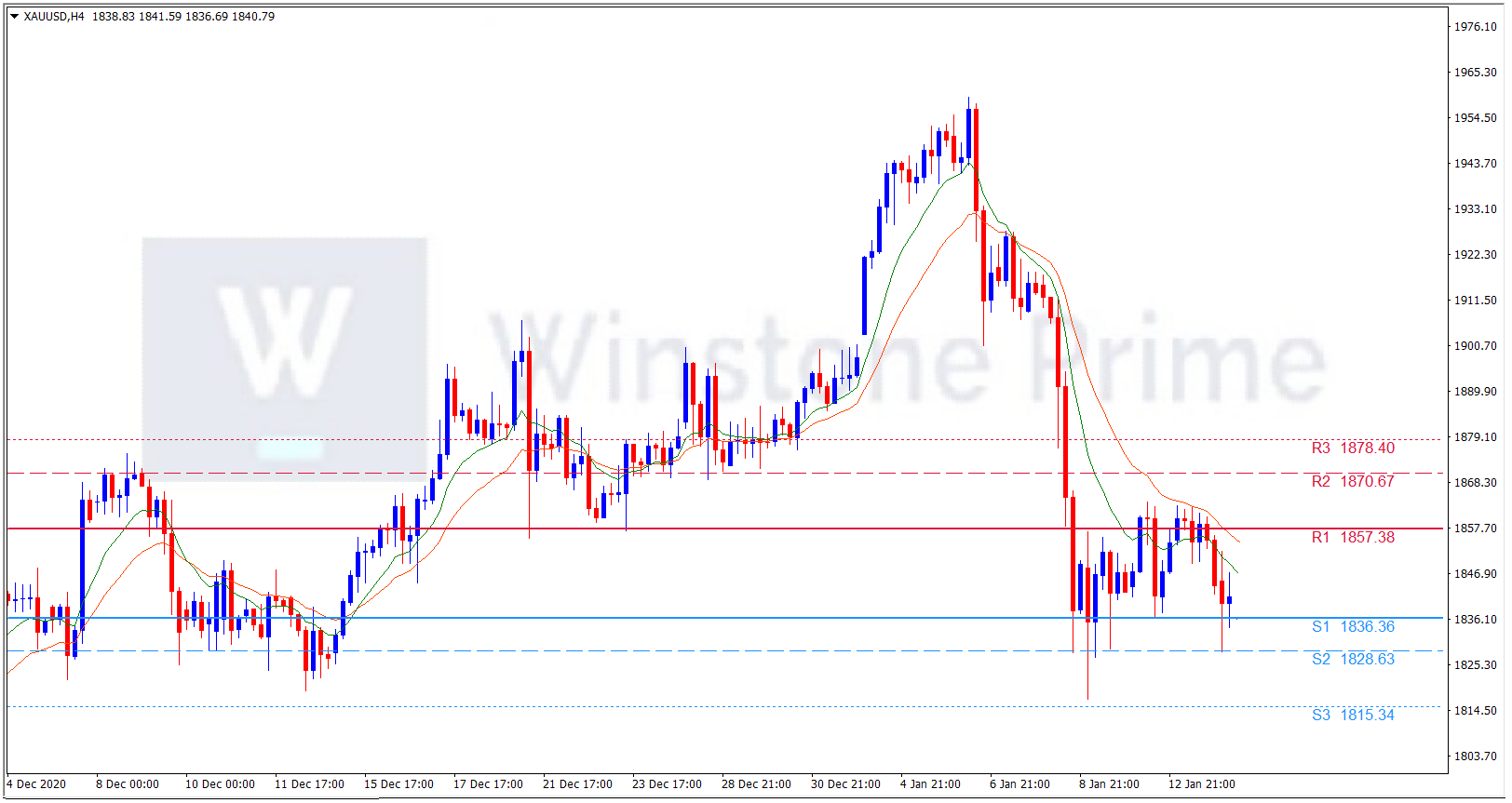
Support: 1836.4 (S1), 1828.6 (S2), 1815.3 (S3).

Resistance: 1857.4 (R1), 1870.7 (R2), 1878.4 (R3).

Amidst all the catalysts favoring greenback against the yellow metal, we expect a bearish trend for XAU/USD.


3 Best successful CFD trading strategies

CFDs are relatively new financial products that have become popular by investors over the last decade. When you trade CFDs, you do not own the underlying asset – you are only paying or collecting the difference between the opening price and the closing price. 

Once you have reached a point where you are comfortable with what CFDs are, how they work and the various options that present you as a trader, it is time to start looking further into the risky things that are a trading strategy. Ask any competent trader if he or she is using a consistent, repetitive strategy, and many times you can see the promise in the answer. Creating a strategy is central to a successful, sustainable investment is  nothing else is more labor intensive and time consuming or subject to speculation.

Why do you need CFD Trading Strategies?

A strategy for investing is like a blueprint for building a house – without those instructions, it is difficult to make sure you are constantly attacking the identity, and the pieces of the puzzle will come together instantly when the time comes. While strategies do not have to be very complicated, they are specially developed practices with a combination of knowledge and business theory and personal (and often bitter) business experience.

3 Best CFD Trading Strategies:

Most of the time, when you use CFDs, you use an intra-day, scalping or day trading strategy. This way, you do not have to pay any fees to keep your trading positions open overnight. These strategies require a lot of time, commitment and focus to try to follow the markets and surpass them. Intra-day and day trading strategies means you open and close a position in a single trading session.

One of the strategies that work well with CFDs is “scalping”. Thanks to the higher flexibility and low transaction costs of CFDs, scalping is ideal for trading the news. With this strategy, you take advantage of small and quick profits within a few minutes or even seconds.To be successful with news trading, it’s important that you follow a comprehensive economic and financial calendar, so then you will be aware of upcoming events or statistics that could affect the underlying asset you are trading. Winstone Prime Economic Calendar providing the most popular market news among traders.

How to trade the News?

With this strategy, you can either invest before a statistics’ release or just after the release. The aim of the 1st option is to try to understand and anticipate traders’ reactions to the upcoming release. This can be very risky, as it’s hard to know whether the release will be above, below or meet the market’s expectations, or even how the market will react to such news (sometimes, bad news on the market is in fact treated as good news, and vice versa).

The second way to trade the news is to go with the flow, knowing that prices can easily and rapidly change direction. It’s then very important to use strict money management rules when news trading. You shouldn’t invest without stop-loss and take-profit orders, so then you can manage your risk.

If you are trading currency pairs, it’s important to follow any statistics that are important for central banks, as they are the main market mover in the FX market. Any statistics about growth, employment, consumer/business confidence or inflation can influence the growth outlook of a country, which will, in turn, affect the demand for its currency. Of course, central banks decisions usually trigger the highest volatility on the market.

Pair trading belongs to market-neutral strategies and is usually used with CFDs on stocks. However, you can use it with 2 ETFs, currencies, commodities, etc. The main advantage is that pair trading can be used with high or low market volatility. The market’s direction is also not really important to this strategy.

To devise a pairs trading strategy, a trader will need the price data for the two markets, and then create a ratio (one market’s price divided by the other). When the ratio between the two moves outside its normal range then a trading opportunity is created.

To identify this, the trader can use Bollinger Bands, which are indicators that contain upper and lower bands that are two standard deviations from the ratio’s price. When the ratio hits the top or bottom Bollinger band then a trading opportunity is created.

How to trade it?

Pair trading allows you to take advantage of divergences between the 2 underlying assets. You first need to choose a strong and weak asset depending on the trend. You will then open a long position on the weaker asset – the one that is underperforming, while you will go short on the stronger asset.

Example:

Let’s pick 2 stocks within the French banking sector – if we see that 2 banks (Google and Facebook) suddenly aren’t following the same trend, then you know that the correlation is weakening. You can take advantage of this to make profits with a pair trading strategy. To take advantage of this divergence, short the company that is going up and go long on one company that is going down.

Usually, the overall direction of the market doesn’t affect the result, as you will be winning with one position and losing with the other one. The profit is based on the relative movement of the 2 stocks, not the market’s direction. Therefore, you will win on the difference between the 2 assets’ price, not the direction of these 2 assets.

Hedging is often compared to insurance. For instance, if you have a car insurance policy against accidents, and if something bad happens to your car, the negative consequences won’t are reduced. In finance, hedging is often used to reduce or completely negate risks from other investment vehicles. Hedge funds, big banks, and many other investment firms all use hedging to protect their investments.

Let’s say that you have a diversified portfolio with Coca-Cola, Bayer, BMW and BNP Paribas. You think that the French banking sector is weakening. You open a short position on BNP Paribas to hedge against a short-term decrease in BNP Paribas’ stock price.

Of course, you still have BNP Paribas in your investment portfolio, as you have a medium/long-term investment horizon. Another way to use hedging will be to hedge your whole portfolio with CFDs on an index rather than on a single stock. With our previous example, you could short the French index, the CAC40, or the French banking sector index.

Take Advantage Of Price Volatility:

Using CFDs to protect more traditional investments is a great way to take advantage of price volatility. This is especially true for blue chips. This strategy can also be used to prepare you for higher volatility or uncertainty. Many factors can affect the market in the short-term, which will affect the liquidity and the overall market conditions. Central banks decisions, company earnings being released, natural disasters and geopolitical uncertainty are among the most influential events.

Selling your shares in order to buy them back again later at a lower price could be costly with a normal broker. In comparison, CFDs are cheap and more flexible when market participants become less predictable. Of course, hedging isn’t adapted to all trading environments, so you should first take into consideration trading conditions.

When building your trading strategy, it’s important to first work on determining your trading profile. Think about your financial knowledge, your trading capital, your time horizon, your risk aversion, your financial goals, etc. Once you’ve answered all of these questions, you will be able to fine-tune your trading decision process. Based on that, you will be able to create a trading plan to follow.

Conclusion

While it’s up to you which (if any) you choose to implement, it is nevertheless important to bear in mind the value of experience, and to take advantage of the mistakes others have made before you to prevent losing your capital unnecessarily. Likewise, there is no substitute for experience in trading other than the knowledge of those who have gone before you, and there are invaluable lessons to be learned from spending time and energy studying the trade and the do’s and don’ts. One might think why it’s so important to have a trading strategy, think again. One has to follow the plan and stick to it. No matter if the markets go south or north, you have to be prepared for it and that’s where the strategy comes into play as you can weather the storm without paying much attention. You know your goal and you stick to it.

BOE Governor’s speech supports pound

On Wednesday, greenback suffered a loss against the pound supported by the Bank of England governor talking down the prospect of negative rates in the United Kingdom.

The key notes of the governor speech were “Negative rates are a controversial issue., There are a lot of issues with negative rates., No country has used negative rates in ‘retail’ end of the financial market., There are good reasons to think we’re in a world of low rates for a long period of time. Outlook for interest rates hinges on productivity growth.”

The dollar index fell by 0.41% on Tuesday, but there is a rise in the US bond yields on markets and economy and awaiting additional stimulus measures amid political turmoil in Washington.

President-elect Joe Biden is about to reveal details of his economic plan on Thursday. According to a CNBC report citing UBS Global Wealth Management, even a $500 billion fiscal package consisting of additional stimulus checks, extended unemployment benefits, and funding for healthcare and vaccine disbursement could boost economic growth in 2021.

There may be selling pressure if the expectation is not meet. In that case, the dollar, which has been treated as funding currency since the March crash.

Political tensions in Washington also poses a risk. Vice President Mike Pence said Tuesday in a letter to House Speaker Nancy Pelosi that he will not remove President Donald Trump from office. Pence’s comments came as the Democratic-held House planned to vote on a resolution calling on him and the Cabinet to invoke the 25th Amendment.

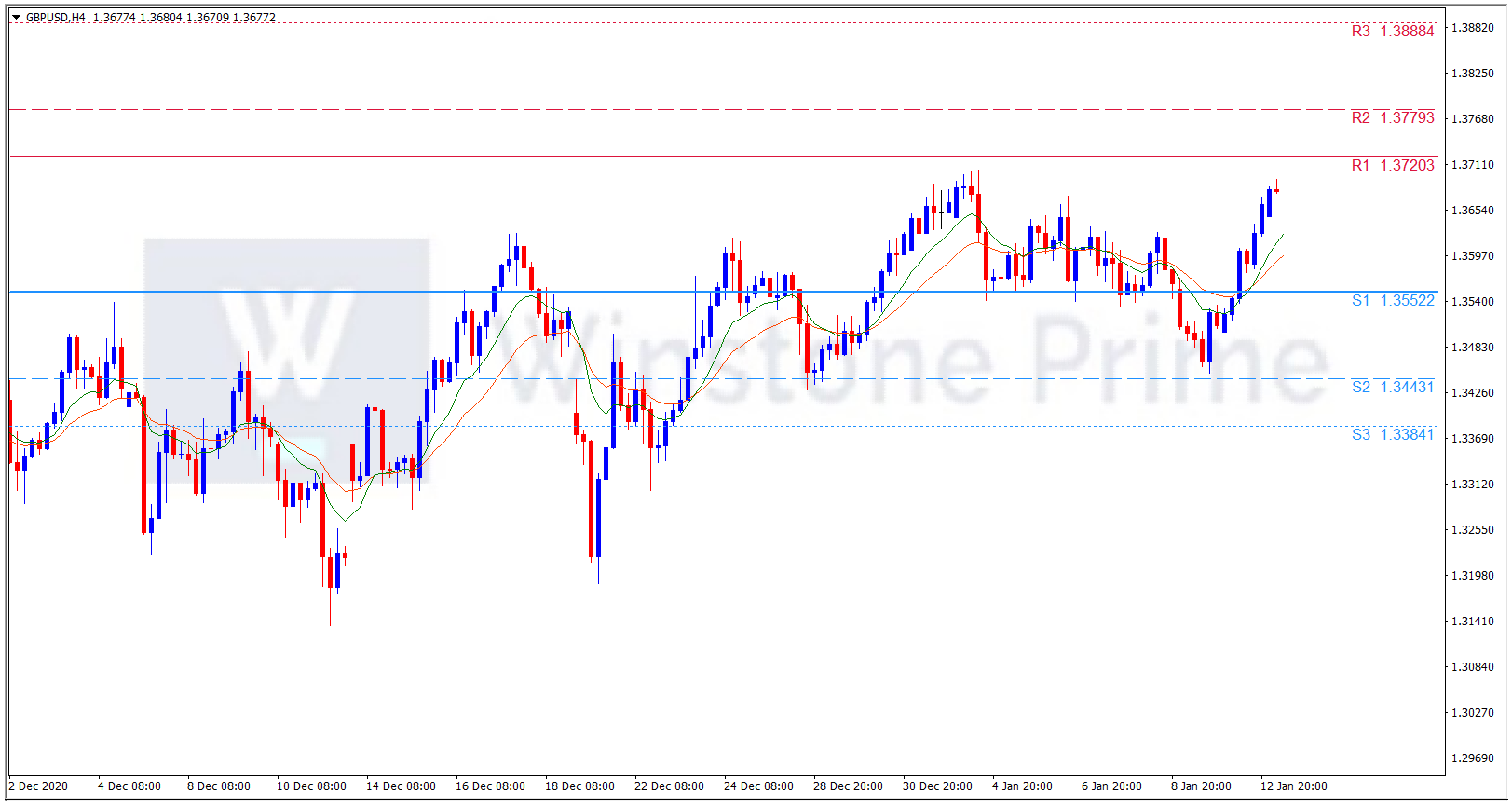
GBP/USD 4 Hour Chart:

Support: 1.3552 (S1), 1.3443 (S2), 1.3384 (S3).

Resistance: 1.3720 (R1), 1.3779 (R2), 1.3888 (R3).

Amidst all the catalysts still posing some pressure on the greenback, we expect a short term bullish trend for GBP/USD.

Covid -19 vaccination favors greenback

USD raises against Yen rises for the fifth consecutive day because of  the US dollar strength and recent mild gains of S&P 500 Futures . It should, however, be noted that the downbeat performance of Nikkei 225 probes the upside momentum.

Mixed data can create confusion in USD/JPY traders. Japan’s Current Account for November grew past- ¥1551 B forecast to ¥1878.4 B but Trade Balance – BOP Basis eased from ¥971.1 B to ¥616.1 B during the stated month.

The coronavirus and its variant is spreading at an alarming rate, now it is reported in Latin American nations also. The greenback continues to correct on the back of US yields. The pandemic’s toll in the United States is drawing attention.

The nation’s seven-day average of coronavirus-related deaths has broke the limit of 3,000 a day, reaching 3,249 on Sunday. Virus deaths surpassed 375,000 on Monday, according to a report. California has reported more than 3,300 virus deaths in the last week ended Sunday. No other state except New York has recorded more than that in a week.

On the positive side, as of Monday, around nine million people had received at least one dose of a Covid-19 vaccine, but it is far short of the federal goal of 20 million people or more by Dec. 31.

”The federal government said Friday that it had delivered more than 22.1 million vaccine doses to states, territories and federal agencies. The same day, President-elect Joseph R. Biden Jr. said he would release nearly all available doses of the vaccine to states as soon as he is inaugurated.”

On the other hand, virus conditions at Japan have worsened off-late even as the government has already announced a lockdown in Tokyo and three neigh boring areas. Recent updates from a news said, “Japan is set to expand a state of emergency declared over the coronavirus pandemic to Osaka, Kyoto and Hyogo prefectures, government and ruling party sources said Monday.

The Japanese government will provide JPY400,000 to small firms hit hard due to the coronavirus pandemic, Finance Minister Taro Aso said in a statement on Tuesday.

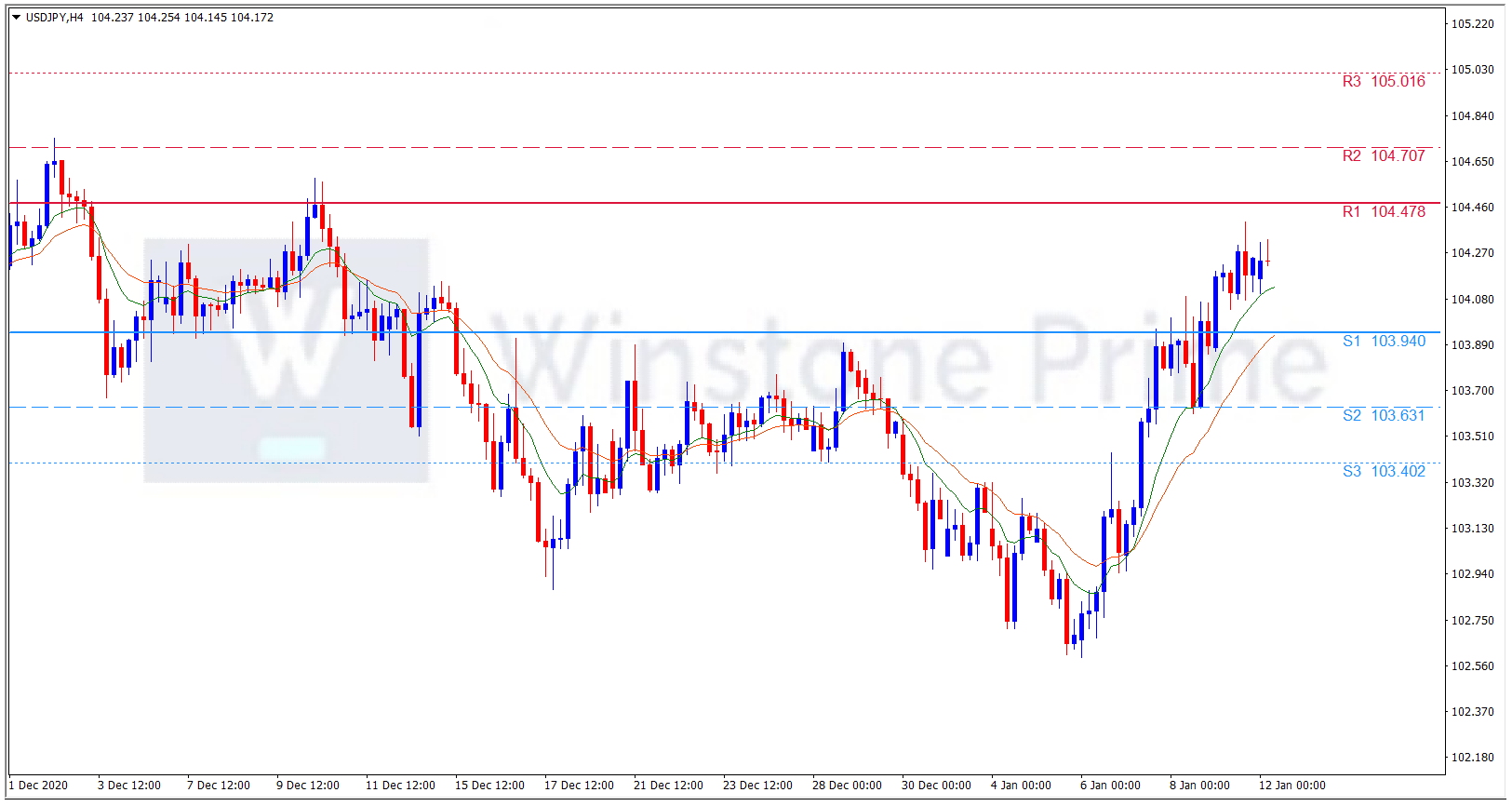
USD/JPY 4 Hour Chart:

Support: 103.94 (S1), 103.63 (S2), 103.40 (S3).

Resistance: 104.48 (R1), 104.71 (R2), 105.02 (R3).

The virus spread and lockdown in Japan has impacted yen negatively and we expect a bullish trend for USD/JPY.