AUD/USD Weekly Forecast (14th December 2020 – 18th December 2020)

Fundamental view:

Australian dollar has rallied significantly during the week. The United States is currently debating a stimulus package, which is normally bad for the US dollar and of course good for commodities which the Aussie dollar represents and this favored the Aussie in the last week.

In the past week, US Revised Nonfarm Productivity quarterly on 8th Dec and US JOLTS Job Openings on 9th Dec created bearish atmosphere for the pair whereas US Consumer Credit monthly report & Australia HPI quarterly report on 8th Dec and US Unemployment Claims on 10th Dec created bullish atmosphere for the pair.

The major economic events deciding the movement of the pair in the next week are RBA Meeting Minutes at Dec 15, US Retail Sales monthly report, US EIA Crude Oil Stocks Change, Fed Interest Rate Decision at Dec 16, Australia Employment Change, US Building Permits, and US Initial Jobless Claims at Dec 17.

AUD/USD Weekly outlook:
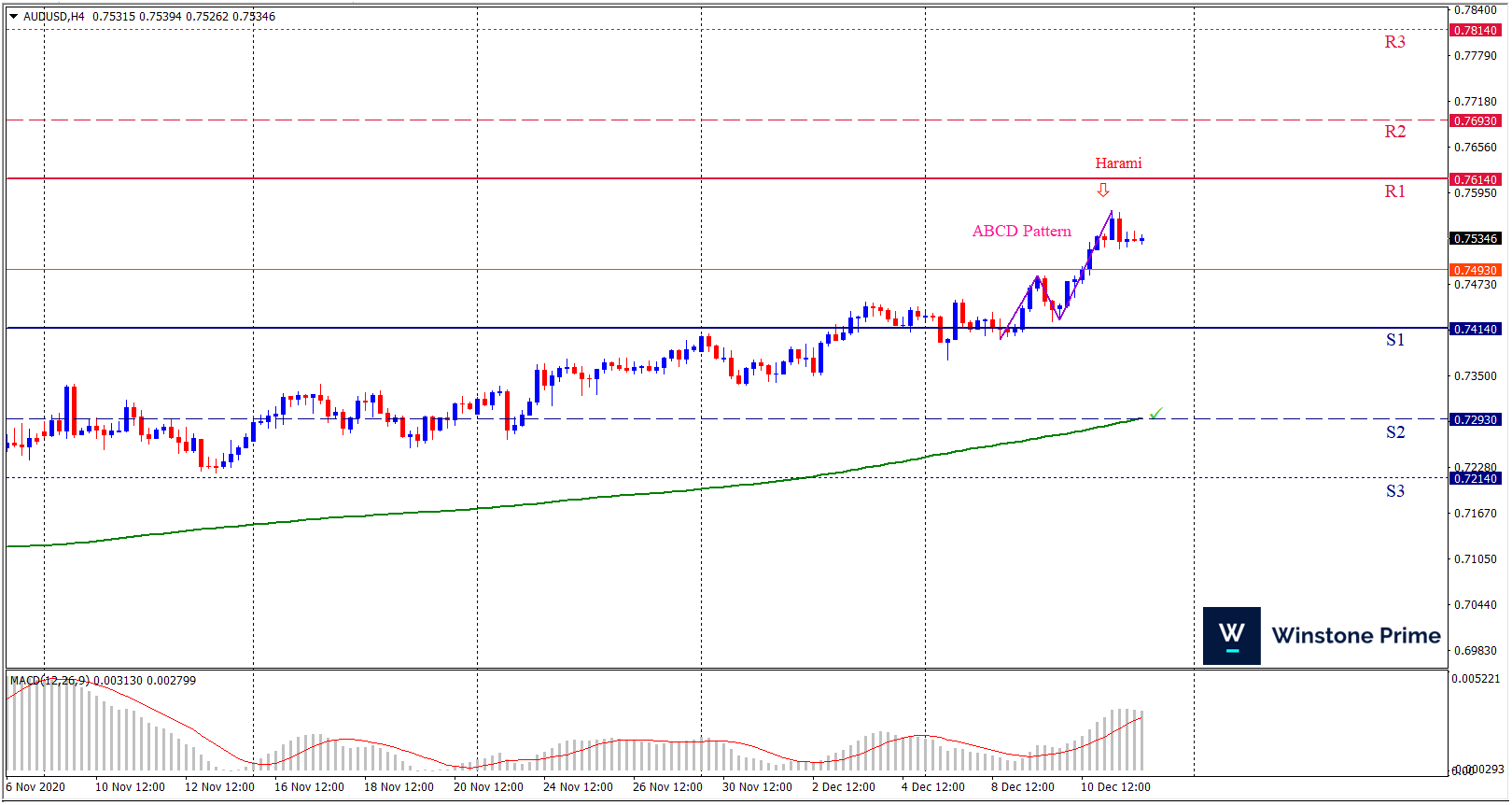
Technical View:

Last week’s high was 1.65% higher than the previous week. Maintaining high at 0.7572 and low at 0.7372 showed a movement of 200 pips.

In the upcoming week we expect AUD/USD to show a bearish trend.  The currency pair is trading above the 200 Simple Moving Average and the MACD trades to the downside. A solid breakout below 0.7414 may open a clean path towards 0.7293 and may take a way down to 0.7214. Should 0.7614 prove to be unreliable resistance, the AUDUSD may raise upwards 0.7693 and 0.7814 respectively. In H4 chart ABCD pattern breakout favors prospects of a bearish trend. Also to be noted bearish harami formation exerts the expectation of downtrend for the pair.

Preference
Sell: 0.7518 target at 0.7325 and stop loss at 0.7619


Alternate Scenario
Buy:  0.7619 target at 0.7813 and stop loss at 0.7518

Greenback gets weaker after release of jobless claim data

The Australian Dollar surged to the upside on Thursday, hitting a 2-1/2 year peak, on strong iron ore prices. The Aussie was also helped by a weaker U.S. Dollar, which fell in reaction to the release of weaker-than-expected jobless claims data, which increased the urgency for U.S. lawmakers to push through new fiscal stimulus before year-end.

Initial weekly jobless claims jumped to 853,000 last week, topping a Dow Jones estimate of 730,000. That marks the highest number of initial claims being filed since September and the first time since October that they topped 800,000.

The most actively traded contract for China’s benchmark iron ore futures, traded on Dalian Commodity Exchange, surge over 7.0% on early Friday to refresh the record high near $150.00. While the May contract rose to 981 Chinese yuan, other contracts ranging from December 2020 to March 2021 also jumped between 4.0% and 8.0% during the latest run-up. Thus

Although hopes of the coronavirus (COVID-19) vaccine and China’s successful recovery from the pandemic could be identified as helping the commodity prices, successive cuts in the 2021 output forecasts by major iron ore producer Vale also favored the prices. In this regard, Australia mining said, “This is propped up by a reduced supply estimate from Vale, which is likely to produce 300-305 million tones for this year, falling short of its previously downgraded 2020 target of over 310 million tones.” This favors the AUD.

On the other hand, The US inflation will likely trough in the next several months and rise above 2% in 2021, according to the bond king and Doubleline Capital’s CEO Jeffrey Gundlach. “The inflation may range from 2.25% to 2.4% in 2021, Gundlach said Tuesday on a webcast for his flagship Double Line Total Return Bond Fund, according to Bloomberg.

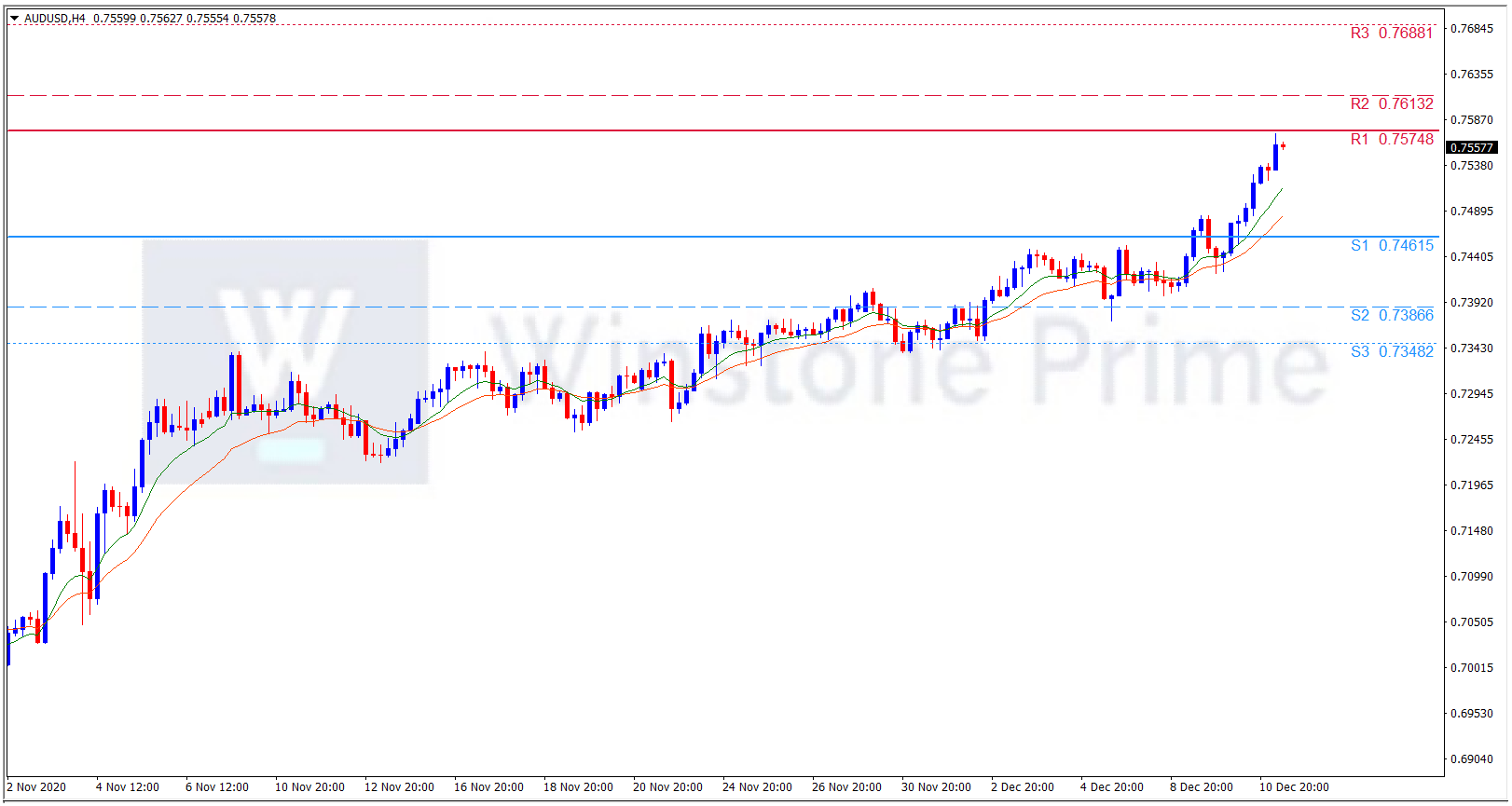
AUD/USD 4 Hour Chart:

Support: 0.7462 (S1), 0.7387 (S2), 0.7348 (S3).

Resistance: 0.7575 (R1), 0.7613 (R2), 0.7688 (R3).

All the catalysts favors Australian dollar against Dollar. We expect a bullish trend for AUD/USD.

Pound turns to be weaker after a dull meeting

The Pound became weaker today after the ‘boring’ meeting between Boris Johnson and Ursula von der Leyen in Brussels. The meeting ended without a deal as the two pressed their teams to reach an agreement. This shifts the next solid deadline to Sunday.

On the economic calendar, the key events today will be UK GDP and production data that will come out at 10:00 GMT+3. Economists expect the data to show that industrial and manufacturing production dropped by 6.5% and 8.4% in November as the number of new Covid cases continued to rise. The ONS will also release the October trade numbers.

There have been two reports of anaphylaxis and one report of a possible allergic reaction following  COVID19 immunization in the UK.

News wrote that ”Britain’s medicine regulator has advised that people with a history of significant allergic reactions do not get Pfizer-BioNTech’s vaccine after two people reported adverse effects, England’s National Health Service (NHS) said on Wednesday.”

“As is common with new vaccines the MHRA (regulator) have advised on a precautionary basis that people with a significant history of allergic reactions do not receive this vaccination,” Stephen Powis, national Medical Director for the NHS, said.

On the  other hand, according to a  poll of economists, the US economic growth is likely to slow over the coming quarters while reaching the pre-COVID-19 trajectory in a year’s time.“But in response to an additional question, nearly two-thirds of economists, or 43 of 69, said US GDP would reach pre-COVID-19 levels within a year. Twenty-one said within two years and five said two or more years.” “The wider poll showed GDP for Q3 is expected to remain unrevised at a record 33.1% when the final data is issued later this month, after contracting at an annualized 31.4% pace in Q2.”

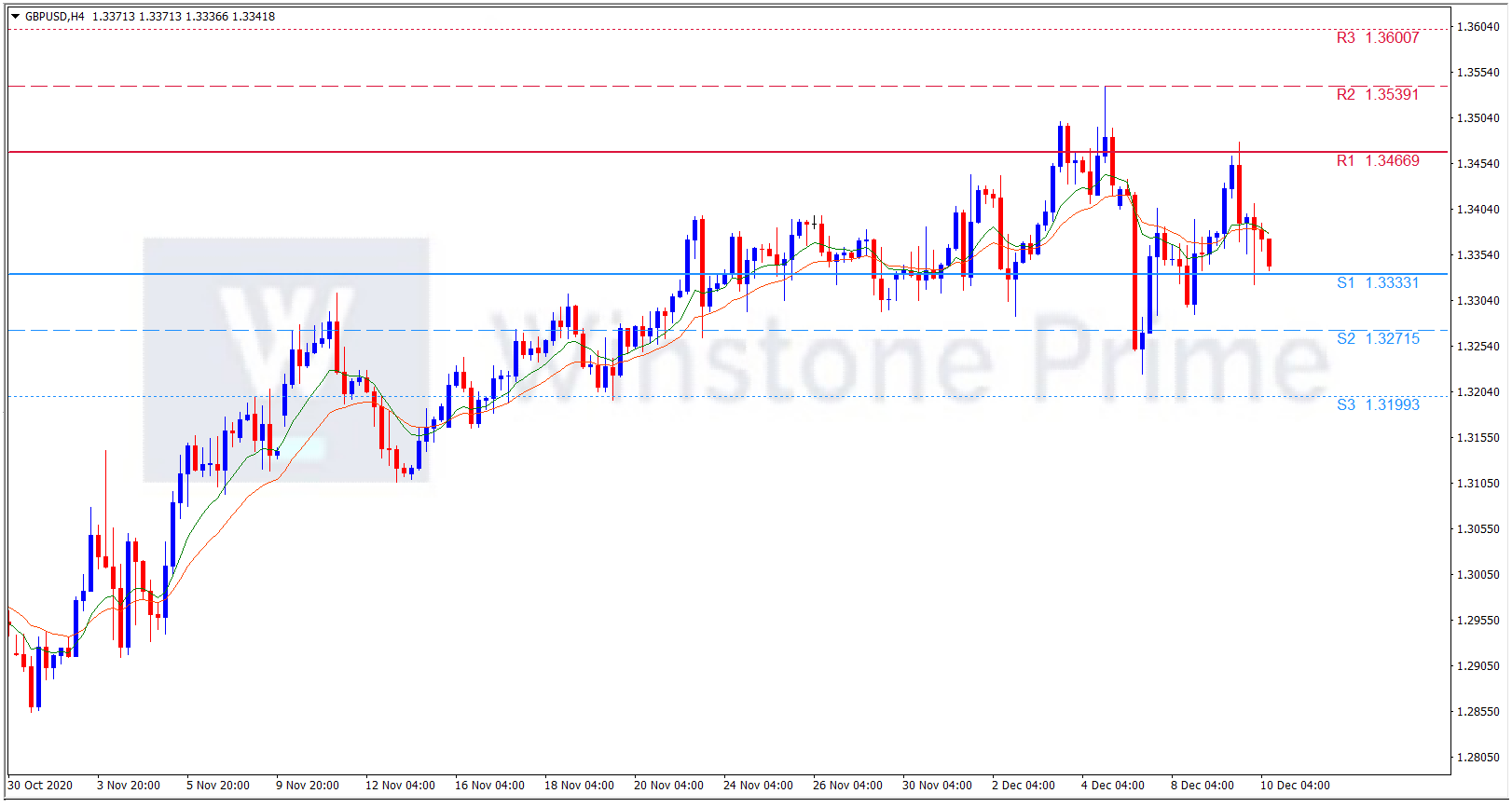
GBP/USD 4 Hour Chart:

Support: 1.3333 (S1), 1.3272 (S2), 1.3199 (S3).

Resistance: 1.3467 (R1), 1.3539 (R2), 1.3601 (R3).

Amidst all the catalysts pressurizing pound against greenback, we expect a bearish trend for GBP/USD.

Loonie seems gaining strength ahead of BOC monetary policy

The loonie pair declines for the first time in the week even as risk catalysts stay upbeat. The reason could be traced from the pair’s traders cautious sentiment ahead of the Bank of Canada (BOC) monetary policy meeting.

Global market sentiment remains cautiously optimistic as the US policymakers are finally inching closer to the much-awaited coronavirus (COVID-19) stimulus. While House Speaker Nancy Pelosi recently conveyed optimism relating to the talks, US Treasury Secretary Steve Mnuchin put forward a higher than the earlier proposal of $908 billion to $916 billion figure for the aid package.

The COVID-19 vaccine distribution in the UK and likely approval of Pfizer’s vaccine by the Canadian authorities this week also add to the risk-on mood. However, fears of a no-deal Brexit and the surge in the US virus infections and death toll to the record high probe the bulls.

The central bank of canada is expected to keep its benchmark interest rate on hold at a record low of 0.25% but could comment on the recent strength of the loonie. “They might talk it down a little bit, most likely through saying something that they will remain dovish for some time,” said Colin Cieszynski, chief market strategist at SIA Wealth Management.

“Now that we have got new lockdowns coming in some provinces … they might say we’re not going to cut any more of our asset purchases in the near term.” In October, the central bank reduced its bond-buying program to C$4 billion per week from C$5 billion.

On the other hand, oil prices remain downbeat for the third consecutive day even as the industry inventory data from the American Petroleum Institute (API) eased below 4.146M prior to 1.141M during the week ended on December 04. Oil is Canada’s key export and hence has a notable impact on the USD/CAD prices.

USD/CAD 4 Hour Chart:

Support: 1.2782 (S1), 1.2746 (S2), 1.2724 (S3).

Resistance: 1.2840 (R1), 1.2862 (R2), 1.2898 (R3).

Even though there are some favorable catalysts supporting greenback, Canadian dollar seems to be stronger ahead of the BOC monetary policy and we expect a bearish trend for USD/CAD.