USD/JPY Weekly Forecast (30th November 2020 – 4th December 2020)

Fundamental view:

The US dollar has rallied a bit during the week to reach towards the ¥105 level. However, the market has pulled back significantly from there, which shows a strong downtrend. The waning psychological impact of the pandemic is evident in the frequent market responses to US economic data and positive COVID-19 news. However, the barrier to a new scenario in the currency markets is the state of the pandemic in the United States. Until the number of diagnoses starts to decline and the series of new, albeit economically limited, closures abate, it will be difficult for traders to wholly abandon the safety-trade to the yen or countenance the US economy.

US Richmond Manufacturing Index & CB Consumer Confidence on 24th August and Japan BOJ Core CPI yearly report on 25th Aug created bearish trend whereas US Flash Manufacturing PMI & Flash Services PMI  on 23rd August and Japan SPPI on 25th August created a bullish trend for the pair.

The major economic events deciding the movement of the pair in the next week are Japan Unemployment Rate, OPEC Meetings at Nov 30, Japan Markit Manufacturing PMI, US ISM Manufacturing PMI, Fed Chair Powell Testimony at Dec 01, US ADP Nonfarm Employment Change at Dec 02, US ISM Non-Manufacturing PMI at Dec 03, and US Nonfarm Payrolls at Dec 04.

USD/JPY Weekly outlook:

Technical View:

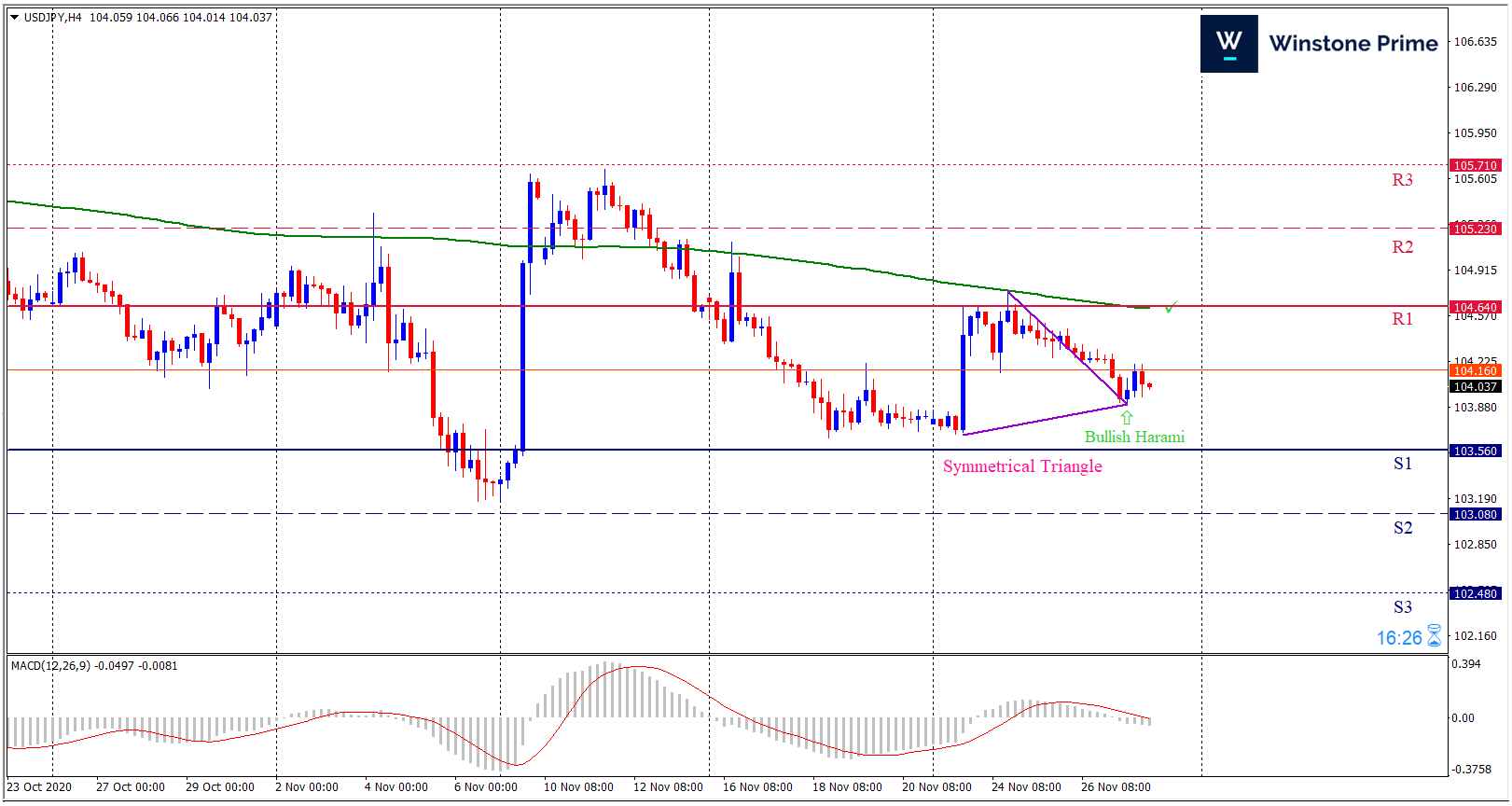
Last week’s high was 0.35% lower than the previous week. Maintaining high at 104.76 and low at 103.68 showed a movement of 108 pips

In the upcoming week we expect USD/JPY to show a bullish trend. The currency pair is trading below the 200 Simple Moving Average and the MACD trades to the upside. A solid breakout above 104.64 may open a clean path towards 105.23 and may take a way up to 105.71. Should 103.56 prove to be unreliable support, the USDJPY may sink downwards 103.08 and 102.48 respectively. In H4 chart, Formation of symmetrical triangle breakout indicates reversal of the trend creating prospects of a bullish trend Along with a bullish harami formation braces our expectation.

Preference
Buy: 103.98 target at 105.00 and stop loss at 103.51


Alternate Scenario
Sell:  103.51 target at 102.49 and stop loss at 103.98

BTC/USD Weekly Forecast (30th November 2020 – 4th December 2020)

Fundamental view:

Bitcoin fell in the last week but will show a positive trend in the coming week. Bitcoin seems to be getting a lot more attention from institutional investors than the retail sector. The quantitative easing policies being implemented worldwide to contain the impact of the pandemic could be one of the main reasons behind this development. It appears that some of the most prominent billionaires are using BTC as a hedging asset against inflation. Amongst these enterprise investors are the likes of Pual Tudor Jones, who compared buying Bitcoin to investing in tech stocks like Google and Apple in their early days. Mexican business magnate Ricardo Salinas Pliego also stated that 10% of his liquid portfolio is in BTC, confirming that the asset guards his wealth against erosion.

Despite the rising interest among big players, Bitcoin has yet to see the same spike in demand from retail investors. If this were to happen as it did back in late 2017, prices would likely shoot up towards new yearly highs and peak at $300,000, as explained by Citibank’s Managing Director, Tom Fitzpatrick. 

The major economic events deciding the movement of the pair in the next week are OPEC Meetings at Nov 30, ISM Manufacturing PMI, Fed Chair Powell Testimony at Dec 01, ADP Nonfarm Employment Change at Dec 02, ISM Non-Manufacturing PMI at Dec 03, and Nonfarm Payrolls at Dec 04 for US.

BTC/USD Weekly outlook:

Technical View:

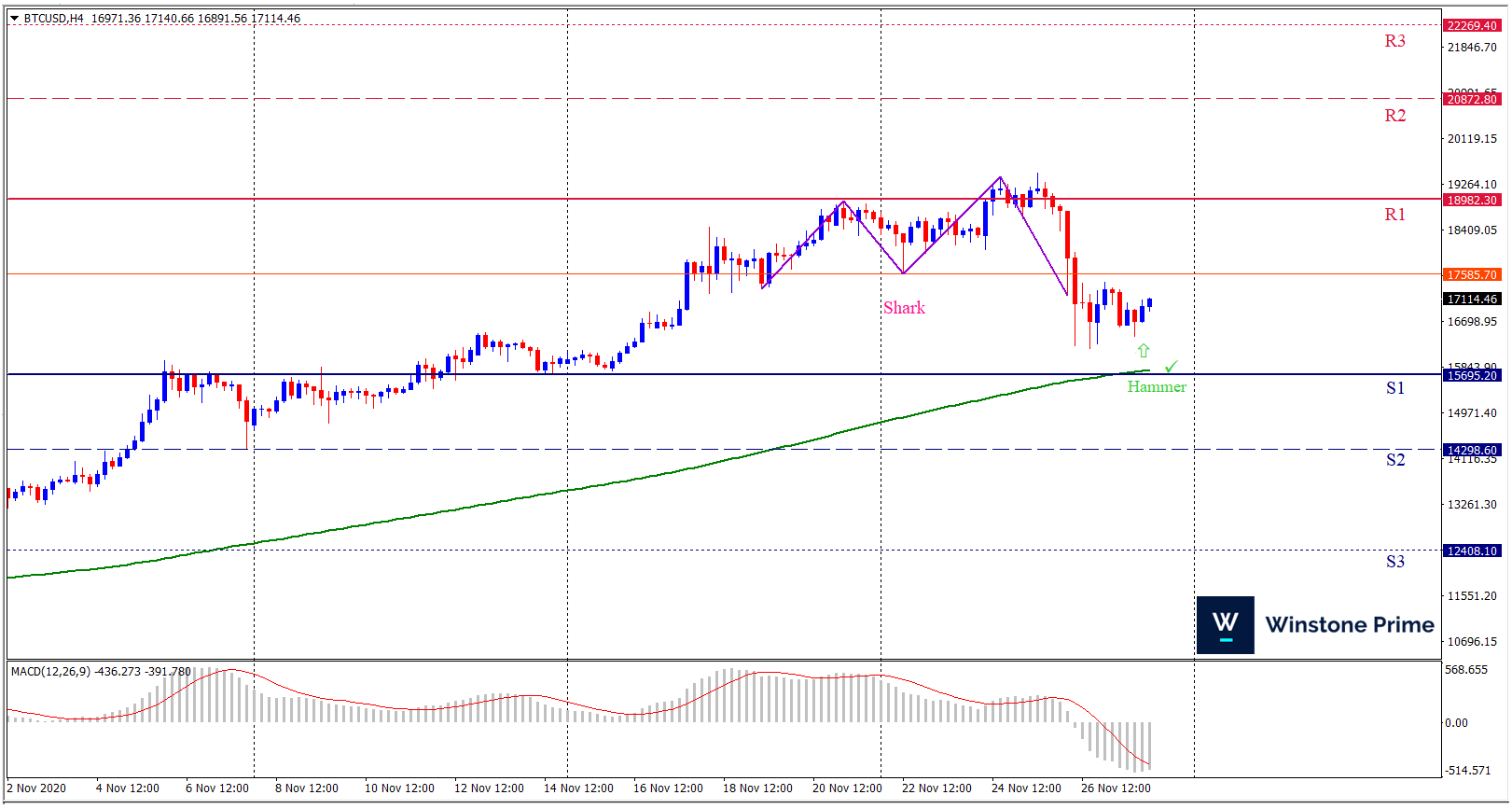
Last week’s high was 2.77% higher than the previous week. Maintaining high at 19476.2 and low at 16189.1 showed a movement of 3287 pips.

In the upcoming week we expect BTC/USD to show a bullish trend. The Instrument is trading above the 200 Simple Moving Average and the MACD trades to the upside. A solid breakout above 18982.3 may open a clean path towards 20872.8 and may take a way up to 22269.4. Should 15695.2 prove to be unreliable support, the BTCUSD may sink downwards 14298.6 and 12408.1 respectively. In H4 chart formation of a bullish shark pattern favors prospects of a bullish trend. Bullish hammer pattern constructs a bullish outlook for the pair in the upcoming week.

Preference
Buy: 16823.7 target at 18981.5 and stop loss at 15690.2


Alternate Scenario
Sell: 15690.2 target at 13275.8 and stop loss at 16823.7

Why the British Pound Is Stronger Than the U.S. Dollar

Great Britain Pound commonly referred to as the pound, but some people still refer to it as sterling. But regardless of what it may be called, the British pound sterling remains to be one of the strongest currencies throughout the world. It comes as a surprise to some especially those outside of Britain and those who don’t travel quite often but it actually makes a lot of sense for the pound to be so expensive and stronger than US Dollar.

Is the pound stronger than the dollar?

That’s always the question in the minds of new traders. The United States of America has the most robust economy but not the strongest currency in the world. According to an analysis of the Top Ten Strongest World Currencies, the US dollar (USD) ranks at No.9 and the British Pound (GBP) at No. 5. There are various reasons why the pound is being strong which is explained here.

What Determines the Currency Strength?

A country’s economic strength and the nominal value of a country’s currency are vital determinants, though not always the main drivers in its currency valuation. The relative value versus the nominal value is considered in determining the strength of the currency. How the value of currency changes over time relative to other currencies is more critical than its exchange rate. When money continually increases in value in comparison to another, it is considered a stronger currency. The best way to judge a currency’s strength is by observing its value in relation to other currencies over many years. Inflation, supply, demand, and other economic factors change a currency’s relative price, ultimately determining its strength.

Nominal Value vs. Relative Value

The nominal value of a currency is relatively arbitrary. What matters is how the value of that currency changes over time relative to other currencies. Historically, for over 20 years one U.S. dollar has been worth less than one British pound. As of July 31, 2020, the dollar is sitting around 1.32 to one pound. This is down from 1.68 in May 2014 and 1.40 in March 2018. This trend is indicative of deteriorating economic conditions in the United Kingdom, mainly from Brexit, combined with an improving U.S. economy.

It’s also worth considering that many more dollars are in circulation than pounds. As of July 2020, nearly 1.93 trillion U.S. dollars were in circulation. By contrast, the total pounds in circulation came to a mere 70.16 billion. To draw an analogy, the 2020 market capitalization of Berkshire Hathaway Inc. (BRK.A, BRK.B) was much lower than that of Microsoft Corp. (MSFT) despite the fact that Berkshire Hathaway’s share price is much higher. This is because there are many more outstanding Microsoft shares than Berkshire Hathaway shares.

Consequences of Brexit

On June 23, 2016, British citizens went to the polls and voted in favor of a referendum to leave the European Union (EU), of which the country had been a member since 1973.  The “Brexit,” or British exit, came about as a result of a populist movement that had grown weary of ceding control of laws and regulations to outside forces in Brussels and feared the effects of what it viewed as unchecked immigration. Economists, most of whom were confident that Britain would vote to remain in the EU, warned of economic consequences that would result from Brexit.

The vote in favor of Brexit shocked oddsmakers and roiled world markets. It also had an immediate and pronounced effect on the British pound, which declined in value by over 8% in the 24 hours following the vote. This is another example of relative value trumping nominal value. While the pound remained stronger than the dollar in nominal terms, investors still abandoned the currency, citing its precipitous decline in relative value.

Looking at the last five decades, it is evident that at least one ‘major event’ each decade affects the volatility of the GBP to USD rate. These significant events vary from natural disasters, financial or political crises, wars, and, most recently, COVID. In the 1990’s it was the Gulf War, in the early 2000s it was the Global Financial Crisis, in the early 2010s it was the Brexit referendum. The pound has been turbulent and volatile since the 2016 Brexit announcement. Near the end of 2016 the GBP/USD reached lows around 1.20. In 2018 there was a slight rebound, peaking at around 1.40 in April 2018.

And now, in the 2020s it is the Coronavirus pandemic, in March 2020, the currency pair reported some new lows around 1.16. The ongoing coronavirus pandemic has caused massive uncertainty of structural changes, and more needs to be done to tackle the increase of unemployment. The scarring of the outbreak was evident in the exchange rates of the two currencies. In March 2020, when the first wave of the Coronavirus occurred, pounds to dollars exchange rate took a 12% dive. The US Dollar was perceived to be safer at the time, causing investors to sell the GBP in its favor. This month it saw the USD hit its lowest in the last two years though it immediately did a rebound, erasing some of its recent losses. The non-farm payroll figures were not as expected, and traders saw the EUR/USD pair take a deep dive before it started regaining its position. The GBPUSD pair also strengthened.

Japan’s stimulus extension favors yen

Core consumer prices in Tokyo suffered their biggest annual drop in more than eight years, data showed on Friday, an indication the hit to consumption from the corona virus crisis continued to heap deflationary pressure on the economy. The data, which is considered a leading indicator of nationwide price trends, reinforces market expectations that inflation will remain distant from the Bank of Japan’s 2% target for the foreseeable future.

“Consumer prices will continue to hover on a weak note as any economic recovery will be moderate,” said Dai-ichi Life Research Institute, which expects nationwide core consumer prices to fall 0.5% in the fiscal year ending March 2021. The core consumer price index (CPI) for Japan’s capital, which includes oil products but excludes fresh food prices, fell 0.7% in November from a year earlier, government data showed, matching a median market forecast. It followed a 0.5% drop in October and marked the biggest annual drop since May 2012.

On the other hand, Japan’s ruling Liberal Democratic Party (LDP) is seen urging the government to expand and create new state-backed loan and loan guarantee schemes to support firms hit by the COVID-19 pandemic.

Japan’s LDP calls might be extended until march’s zero-interest loan scheme for covid-hit firms. Japan’s LDP calls on the government to take steps to promote electric vehicles, battery development.

Following the above proposal, the government said in a statement released on Friday, Japan will extend until February next year a subsidy scheme that compensates companies for retaining jobs while temporarily closing the business due to the corona virus pandemic.

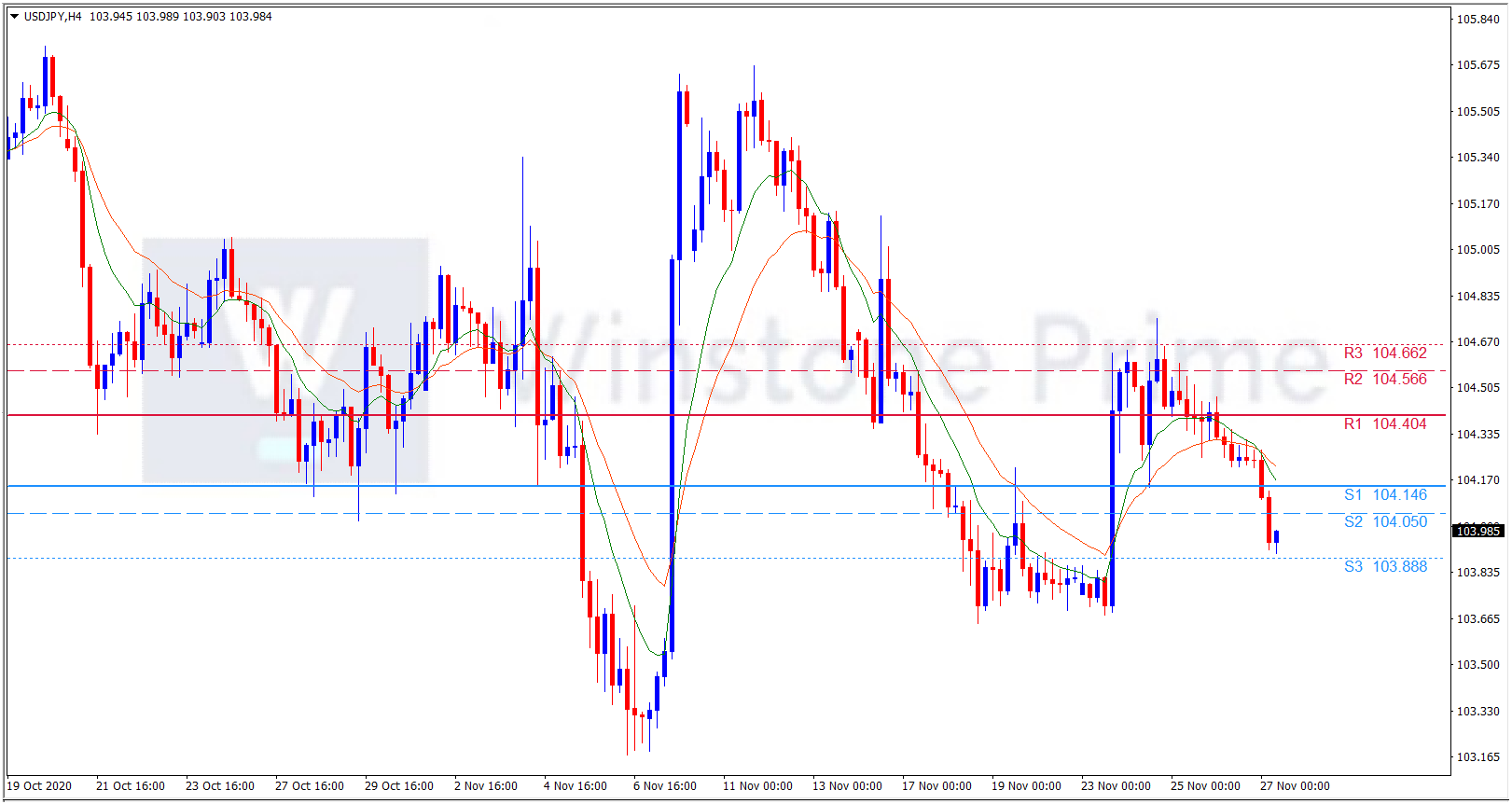
USD/JPY 4 Hour Chart:

Support: 104.15 (S1), 104.05 (S2), 103.89 (S3).

Resistance: 104.40 (R1), 104.57 (R2), 104.66 (R3).

Despite of the negative consumer price index, Yen is supported with corona virus relief stimulus and enjoys the broad-based USD weakness, we expect a bearish trend for USD/JPY.

.