US fiscal stimulus talk weakens greenback

EUR/USD has recovered sharply back into positive territory on the day. Triggering the abrupt recent injection of risk appetite into markets in recent trade was the news that US fiscal stimulus talks are back on; Democratic Minority Leader of the Senate Chuck Schumer said that Republican Senate Majority Mitch McConnell had agreed to resume negotiations on another Covid-19 aid package. Meanwhile, Senate and House leaders are reportedly scheduled to meet today to discuss stimulus.

Moving ahead, Thursday’s restart in US fiscal stimulus talks might have come at the perfect time for a market that was just showing signs of starting to really get worried about the worsening state of the Covid-19 pandemic. Of course, there is no guarantee that there will actually be a deal; the Democrats still want a big package ($2T plus), while the Republicans have maintained they want something smaller and more targeted ($500B). But with the election in the rear mirror, perhaps a compromise will be more palatable to both sides. Any progress towards a deal will of course continue to provide support for risk appetite and is likely to weigh further on USD, to the benefit of EUR/USD.

On the other hand, G-20 nations have deployed an unprecedented $11 trillion so far to accelerate an equitable and sustainable economic recovery from the corona virus crisis, according to a report released ahead of the G-20 leaders’ summit in Saudi Arabia this week. 

The European Union wants to increase its offshore wind capacity from 12 to 300 gigawatts (GW) by 2050, according to new plans laid out on Thursday. The “Offshore Renewable Energy Strategy” from the European Commission, the EU’s executive arm, will also aim for 40 GW of ocean energy such as tidal and wave power within the same time frame.

The greenback showed little reaction after the Labor Department reported that U.S. weekly jobless claims increased to a seasonally-adjusted 742,000 for the week ended Nov. 14. Economists polled by Reuters had forecast 707,000 applications for the latest week. It’s a relatively quiet day ahead on the economic calendar. German wholesale inflation and Eurozone consumer confidence figures are due out later today. Expect the consumer confidence figures for the Eurozone to have the greatest impact.

EUR/USD 4 Hour Chart:

Support: 1.1836 (S1), 1.1794 (S2), 1.1772 (S3).

Resistance: 1.1900 (R1), 1.1922 (R2), 1.1964 (R3).

Amidst all the catalysts favoring Euro against greenback, we expect a bullish trend for EUR/USD.

Lock-down measures in Australia impacts Aussie

Australian shares went down on Thursday, as a fresh cluster of COVID-19 cases sparked a lockdown in the state of South Australia while numbers in the United States also increased, denting recent optimism over promising vaccine trial results.

Most businesses in South Australia will close except for some food outlets, and people will be largely confined to their homes, as the state tries to avoid a more severe breakout like the one that all but shuttered neighboring Victoria for more than 100 days.

“The outbreak of COVID-19 in South Australia has unsurprisingly generated considerable concern given it happened so quickly and after a number of months without any locally acquired transmission,” analysts at ANZ wrote. He also said that “Google searches for “COVID testing” in South Australia have surged. The per capita level of searching is exceeding that of Victoria during its peak.”

Australian jobs surged past all expectations in October led by an easing of virus restrictions in the second-most populous state of Victoria, though the unemployment rate still ticked up to 7.0% as more people went out looking for work. Figures from the Australian Bureau of Statistics (ABS) on Thursday showed employment escalated by a solid 178,800 in October, after slipping in September. Economists were predicting a fall of 30,000 with the unemployment rate rising to 7.2%.

On the other hand, during the overnight trade, the risk sentiment weakened with investors selling the US stocks on fears of renewed corona virus lockdown restrictions.

Comments from the World Health Organization Director Michael Ryan that vaccines would be available in large numbers in four to six months forced investors to scale back the optimism and consider the possibility of a near-term economic slowdown. Further, the US House Speaker Nancy Pelosi’s rigid stand on the stimulus package worked against the equities.

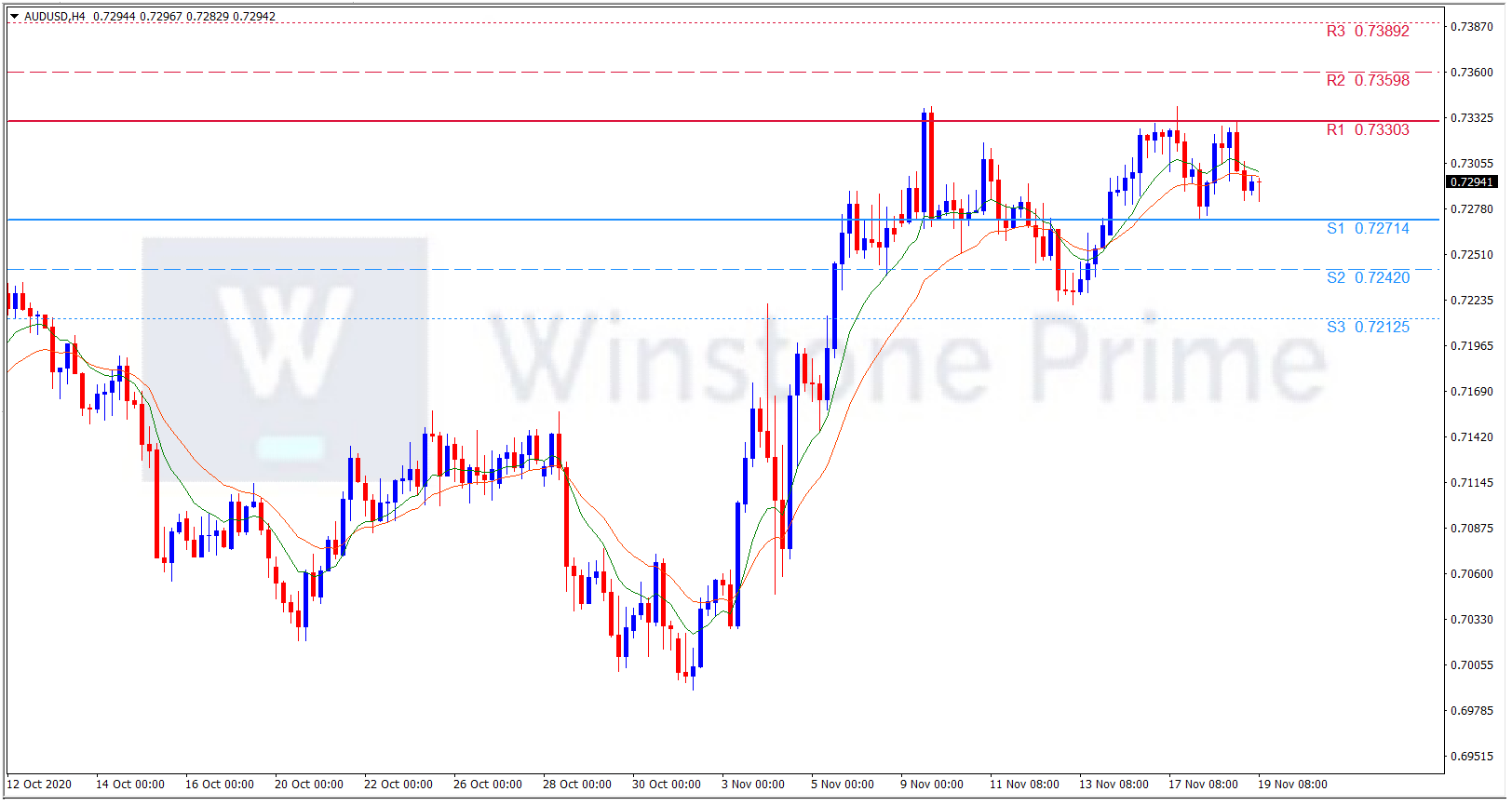
AUD/USD 4 Hour Chart:

Support: 0.7271 (S1), 0.7242 (S2), 0.7213 (S3).

Resistance: 0.7330 (R1), 0.7360 (R2), 0.7389 (R3).

The lock-down in Australia due to covid 19 spread and increasing unemployment rate pressurizes Aussie against greenback, we expect an bearish trend for AUD/USD.

BOJ’s Kuroda measures supports yen

USD/JPY prints 0.10% intraday losses while during the early Wednesday. In doing so, the yen pair drops the lowest since November 09 as the corona virus (COVID-19) firms up grip in Tokyo. It’s worth mentioning that the upbeat trade numbers and Japanese policymakers’ readiness to battle the pandemic also favor the sellers off-late.

Apart from US and European economies, Japan has also been facing negative impacts of the COVID-19 resurgence. Chief Cabinet Secretary Kato Katsunobu recently announced readiness to unveil the highest alert while citing “the recent nationwide surge in corona virus infections” as the reason behind the move. As per the latest covid update from the Kyodo News, Tokyo marked an increase of over 50 cases, from 34,888 to 34,931, as of 10:40 PM November 16, 2020 (Japan time).

It is “inappropriate to prematurely end the ultra-easy policy before the economy resumes sustainable recovery path, hits 2% inflation target,” the Bank of Japan (BOJ) Governor Haruhiko Kuroda said on Wednesday. And Japan’s Finance Minister (FinMin) Taro Aso offered subsidies as an option.

Japan’s Merchandise Trade Balance Total for October grew past ¥250 B forecast to ¥872.9 B. Details suggest that the Imports dropped below -9% forecast whereas the Exports recovered from -4.5% market consensus to -0.2% on YoY basis.

On the other hand, It’s worth mentioning that the uncertainty over the US stimulus package also weighs on the risks. Senate Majority Leader Mitch McConnell has stated that the Republicans have tried for weeks to pass another targeted rescue package. It would send hundreds of billions of dollars to schools, unemployment aid, another round of the job-saving PPP, and healthcare. Democrats repeatedly blocked it all. Let’s hope they let us make law soon.

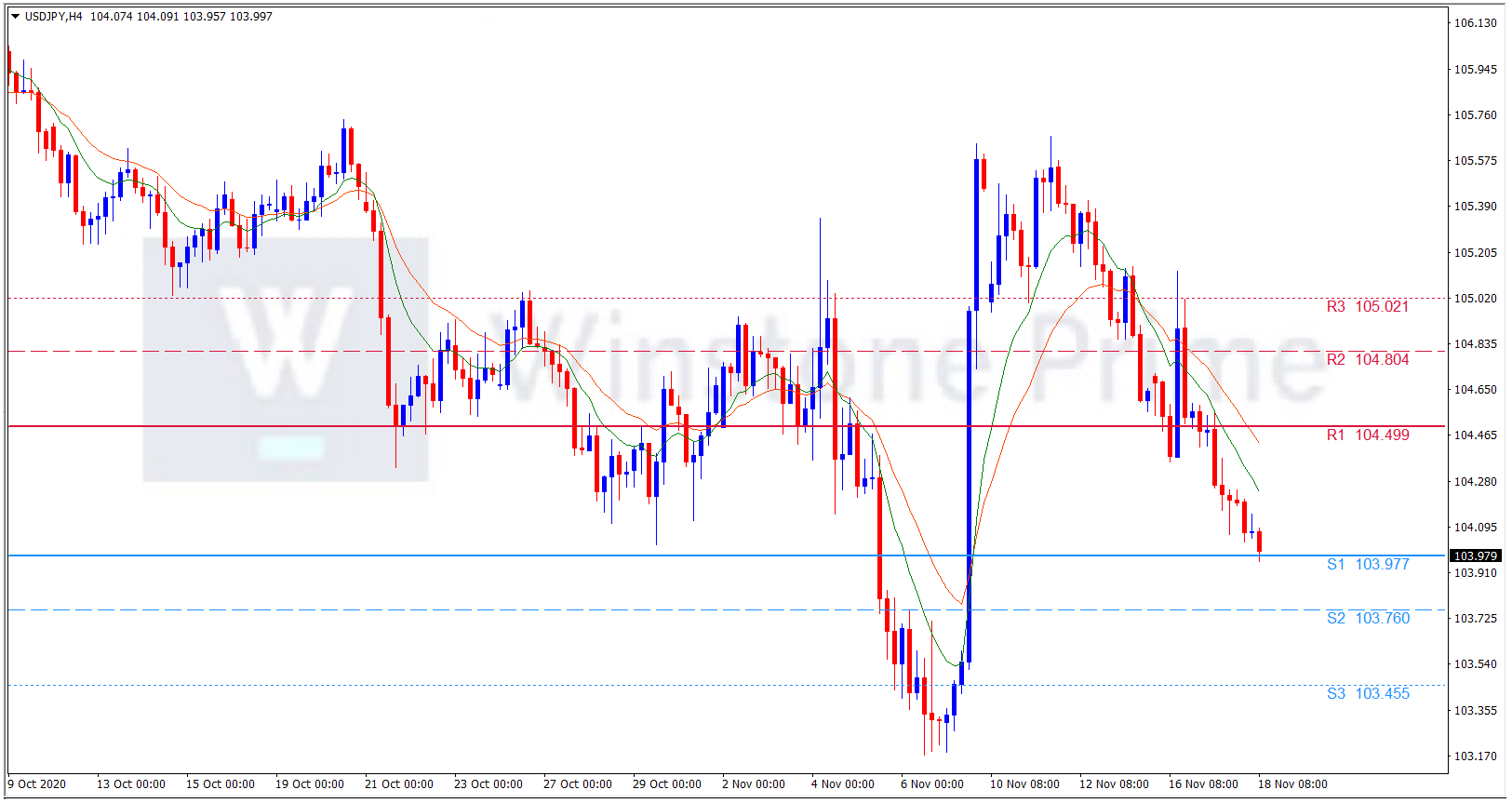
USD/JPY 4 Hour Chart:

Support: 103.98 (S1), 103.76 (S2), 103.46 (S3).

Resistance: 104.50 (R1), 104.80 (R2), 105.02 (R3).

Amidst all the catalysts strengthening Yen against dollar, we expect an bearish trend for USD/JPY.

RBA minutes favors Aussie

The Australian dollar climbed to a one-week high on Tuesday as investor sentiment was boosted by corona-virus vaccine hopes and RBA minutes release. Risk assets were buoyed overnight by news that Moderna’s MRNA.O COVID-19 vaccine recorded a 94.5% efficacy rate in preliminary numbers from a large late-stage clinical trial.

NAB analysts wrote in a note that “The Moderna news overnight is the second positive vaccine news following Pfizer/BioNTech results last week” Arguably, however, Moderna’s preliminary results are even better and provide a massive boost to the fight against the pandemic,” they added.

After Moderna’s vaccine trial update, Johnson & Johnson also mentioned beginning the late-stage testing of its two-dose vaccine.

Reserve Bank of Australia (RBA) released minutes of its Nov. 3 policy meeting in which it said it was ready to provide yet more policy stimulus if needed. The RBA had trimmed the cash rate to 0.1% and launched a A$100 billion quantitative easing (QE) programme over six months. This latest monetary policy meeting minutes suggest the policymaker’s readiness to offer further easy money while turning down any more immediate rate cuts and a clear ‘NO’ to the negative rates.

Not only the RBA minutes and COVID-19 vaccine but global market optimism concerning Brexit also favor the bulls. The Sun came out with the news suggesting that the UK’s Chief Brexit Negotiator David Frost indicates the Brexit trade deal between the European Union (EU) and Britain during the early next week.

Looking ahead, updates concerning the covid vaccine and the virus news can offer fresh direction to the AUD/USD traders before the speech from RBA Assistant Governor Guy Debelle. Following that, the US Retail Sales for October, expected 0.5% MoM versus 1.9% prior, will be important to note.

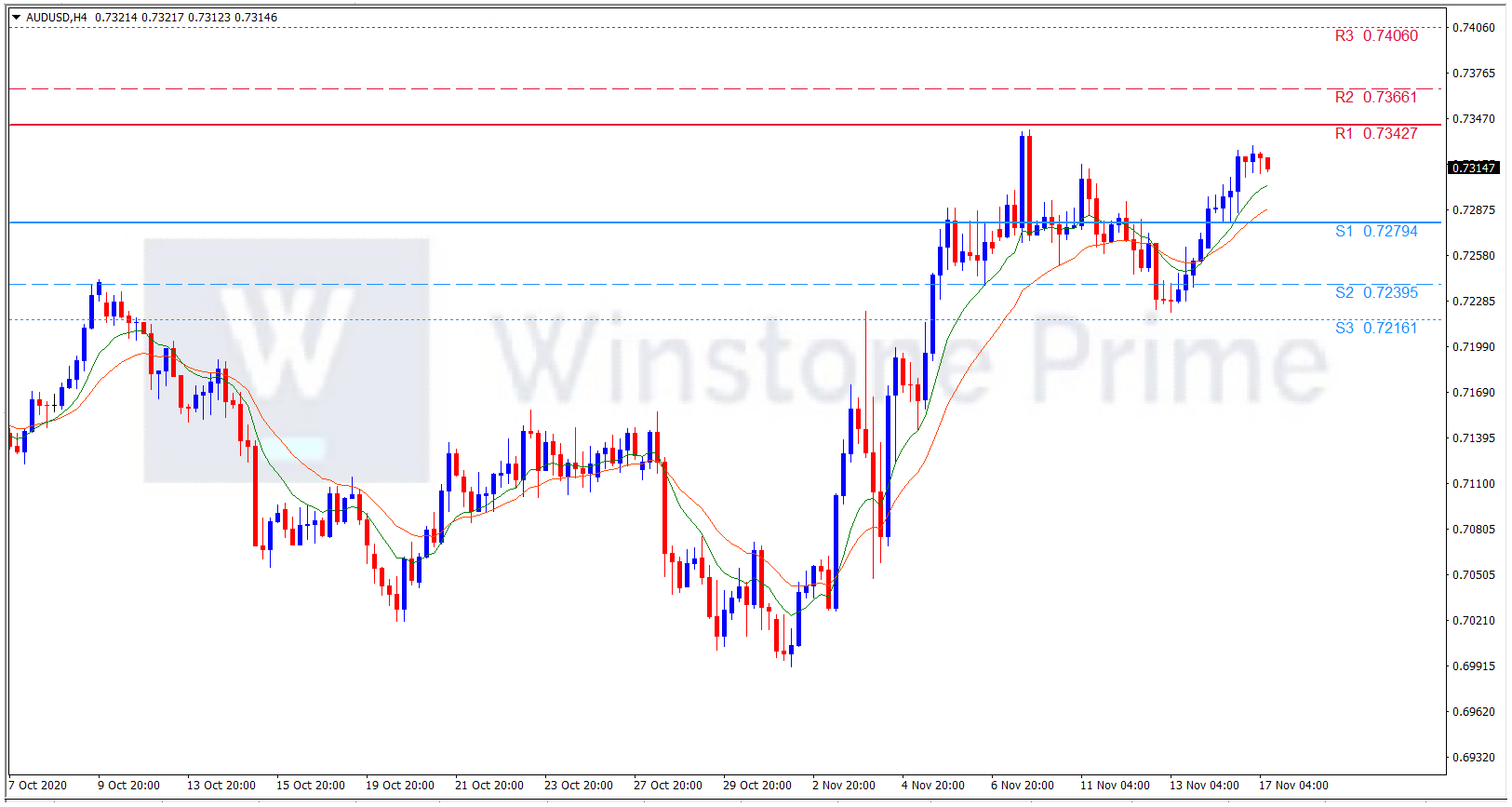
AUD/USD 4 Hour Chart:

Support: 0.7279 (S1), 0.7240 (S2), 0.7216 (S3).

Resistance: 0.7343 (R1), 0.7366 (R2), 0.7406 (R3).

The Covid 19 vaccine optimism and RBA minutes favors Aussie against greenback. We expect a bullish trend for AUD/USD.