Loonie pair pulls back ahead of BOC

  • Oil prices surged more than 10% as massive uncertainty sparked by Russia’s invasion of Ukraine.
  • Canadian dollar gains as economy seen growing in January after strong fourth quarter.
  • Market price in a 0.25% rate hike from Bank of Canada.


The Loonie pair pulls back from the bullish trend on Wednesday, The rationale behind this can be related to the  upbeat prices of Canada’s main export item WTI crude oil, upbeat economic data, as traders await the Bank of Canada’s (BOC) Interest Rate Decision.

WTI crude oil prices had crossed June 2014 peak, marked the previous day, and rallied to $109.30 on Wednesday. This move was due to massive uncertainty sparked by Russia’s invasion of Ukraine unnerved investors, leading stocks in Europe and on Wall Street to slide further.

As per Reuters, the oil cartel is likely to stick to its existing policy of increasing output by 400K barrels per day (BPD) each month in April during today’s meeting. The news quotes the reason as, “Russia’s invasion of Ukraine having not affected OPEC+ deal functioning so far.”

Whereas Tom Simons, a money market economist at Jefferies in New York said “If Russia controls more of Ukraine’s food and energy production capacity and those types of things, they may end up being more expensive for everyone around the world,” “The economic consequences of it may be more long-lasting.”

The Canadian economy mostly likely started 2022 on a strong footing, despite the impact of the Omicron variant of the coronavirus, and the fourth-quarter growth came in above expectations, official data showed on Tuesday.

Canada’s economy grew 6.7% in the last three months of 2021 on an annualized basis, beating analyst forecasts of -12.7%, while gross domestic product in January most likely rose 0.2% after stagnating in December, Statistics Canada data showed.

Moving ahead, the Bank of Canada’s (BOC) interest rate moves and forward guidance will be more important as the markets have already priced in a 0.25% rate hike, which is widely expected.

USD/CAD 4 Hour Chart:
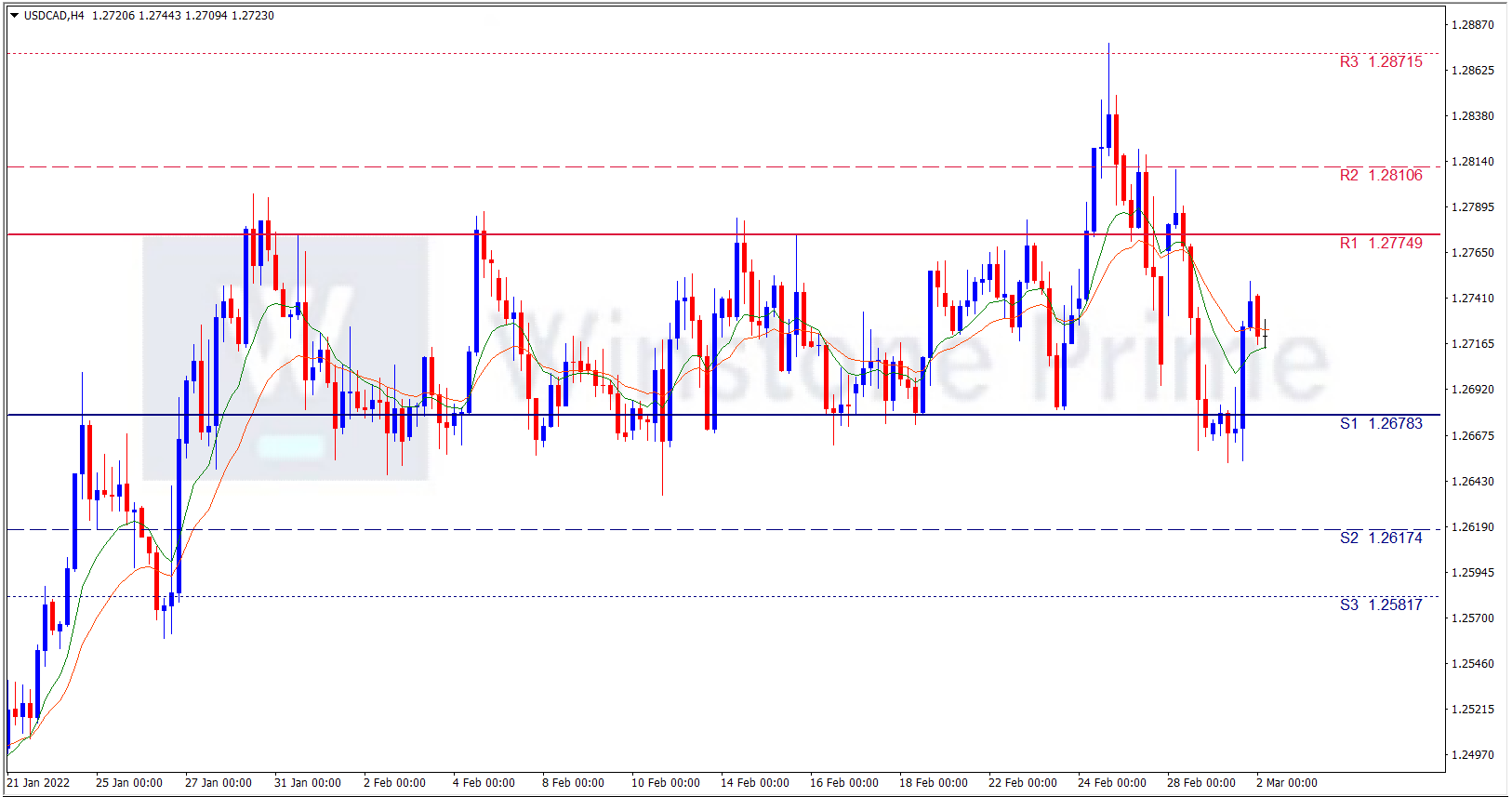
Support: 1.2678 (S1), 1.2617 (S2), 1.2582 (S3).

Resistance: 1.2775 (R1), 1.2811 (R2), 1.2872 (R3).

Moreover, headlines from Russia-Ukraine and Chair Jerome Powell’s bi-annual testimony, as well as the US ADP Employment Change for February, will also be important to watch for clear direction. In the meantime, we expect a mixed trend for USD/CAD.

Upbeat China’s PMI favors Aussie, Ukraine eyed

  • Australia, net energy exporter gains from higher commodity prices amidst Ukraine crisis.
  • Reserve Bank of Australia (RBA) keeps its monetary policy unchanged, with OCR at 0.10%.
  • Upbeat China’s PMI and Australia Upbeat retail sales data of January month favors Aussie, Ukraine development eyed.


The Australian dollar was resilient on Tuesday since strength in domestic economy and high commodity prices helped the Aussie against escalating geopolitical tensions.

Some of the demand was simply due to geography, with Australia and New Zealand distant to the troubles in Europe and little exposed to Russian trade. Australia as a net energy exporter is also set to gain from higher commodity prices, with liquefied natural gas and coal up sharply, while wheat, nickel, aluminium and iron ore were all firm.

The RBA matched wide market expectations of keeping the benchmark rate unchanged at 0.1%. Wrapping up its March policy meeting, the Reserve Bank of Australia (RBA) held rates at 0.1% and reiterated it was prepared to wait for a long-desired pick up in wages growth before acting to tighten policy.

“The Board is prepared to be patient as it monitors how the various factors affecting inflation in Australia evolve,” said RBA Governor Philip Lowe in a brief statement. “The war in Ukraine is a major new source of uncertainty.”

Lowe recently said it was plausible a first rate rise could come later this year if the economy continues to recover, while markets are pricing in a move as early as July.

Talking about data, On Monday, Australia retail sales for the month of January was upbeat at 1.  8% exceeded  the forecast of -0.3% and previous readout of -4.4%. Whereas Earlier in the day, Australia’s Current Account Balance for Q4 eased to 12.7B versus 26.56B forecasts and 23.9B prior. Further, Home Loans and Investment Lending For Homes flashed mixed numbers as the former eased to 1.0% whereas the latter rallied to 6.1% in January.

However, China’s upbeat data underpinned the AUD/USD bulls. China’s headline NBS Manufacturing PMI for February had rose to 50.2 versus 49.9 expected and 50.1 prior. Further, the Non-Manufacturing PMI crossed 51.1 previous readouts with 51.6 figures for the stated month.

On geopolitical front, Ukraine-Russia talks has ended without any update on Monday but have been kept on the table for discussion. However, Russia’s criticism of the Western sanctions and aggression of military invasion inside Kyiv suggests that the geopolitical risks have miles to go before easing, which may weigh on the market sentiment and test the AUD/USD bulls.

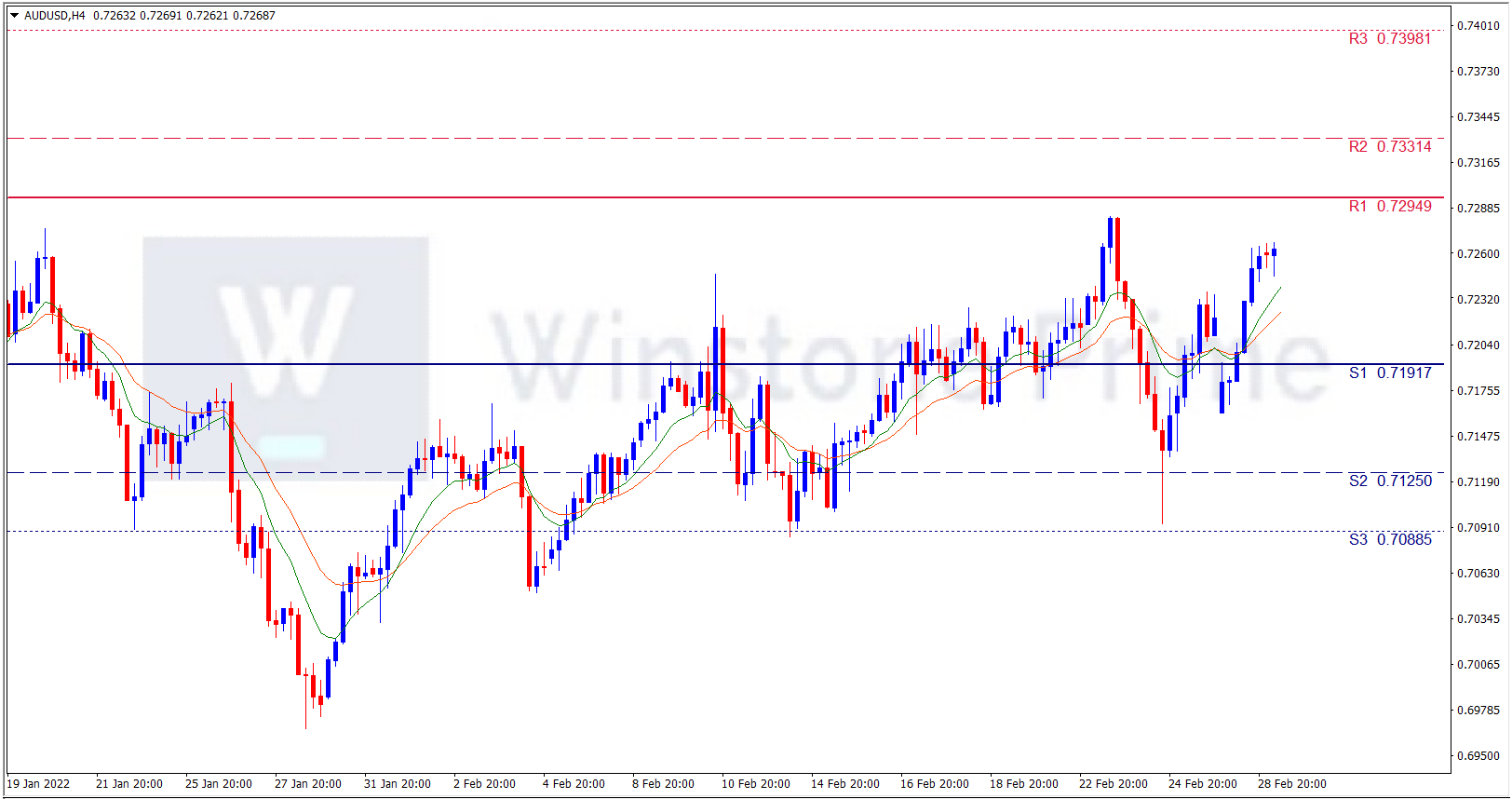
AUD/USD 4 Hour Chart:

Support: 0.7192 (S1), 0.7125 (S2), 0.7089 (S3).

Resistance: 0.7295 (R1), 0.7331 (R2), 0.7398 (R3).

Amidst all the catalysts favoring the Australian dollar against the American dollar, we expect a bullish trend for AUD/USD.

Euro dropped as Ukraine crisis intensifies

  • EUR/USD falls following headlines surrounding the Ukraine crisis.
  • More sanctions have been imposed on Russia for its invasion of Ukraine, along with Western leaders extending weaponry aid.
  • Geopolitical tension being the major catalyst, Euroland inflation data and second tier US data are also eyed.


Euro plummeted during starting day of the week amid escalating tensions between Russia and Ukraine.

The Russian advance into Ukraine has continued throughout the weekend. Russian military vehicles entered Ukraine’s second-largest city Kharkiv, with reports of fighting taking place and residents being warned to stay in shelters.

More sanctions have been imposed on Russia for its invasion of Ukraine. The U.S., Europe and Canada agreed on Saturday to remove key Russian banks from the interbank messaging system, SWIFT. The U.K. and EU have also closed their airspace to Russian aircraft.

US administration official cited that Belarus is preparing its military troops to send them to support the Russian military as soon as on Monday. Australian government announced on Monday that, they will provide lethal military equipment to Ukraine in response to Russian military activity last week.

The Canadian Foreign Affairs Minister Melanie Joly also made an announcement that their administration will provide an additional $25 million worth of defensive military equipment to Ukraine.

Along with Western leaders favoring Ukraine and providing weaponry aid to support them indirectly against Putin’s decision of destruction in Ukraine. Even other nations are supporting Ukraine, the overall picture of the war between Moscow and Kyiv is escalating further. This may advocate the situation of recession in Europe and the EU (European Union) will require resorting to cautioned fiscal policies. Also, this has weakened the euro against the greenback.

Whereas Russia’s Putin said he was giving the nuclear readiness order because “top officials in NATO’s leading countries have been making aggressive statements against our country,” according to a report from Russian state news operator TASS.

Along with the Ukraine crisis, Euroland inflation data will be key and markets look for upside risks in Germany & the euro area in general. Market will also keep an eye on US trade numbers for January and Chicago Purchasing Managers’ Index for February for short term direction.

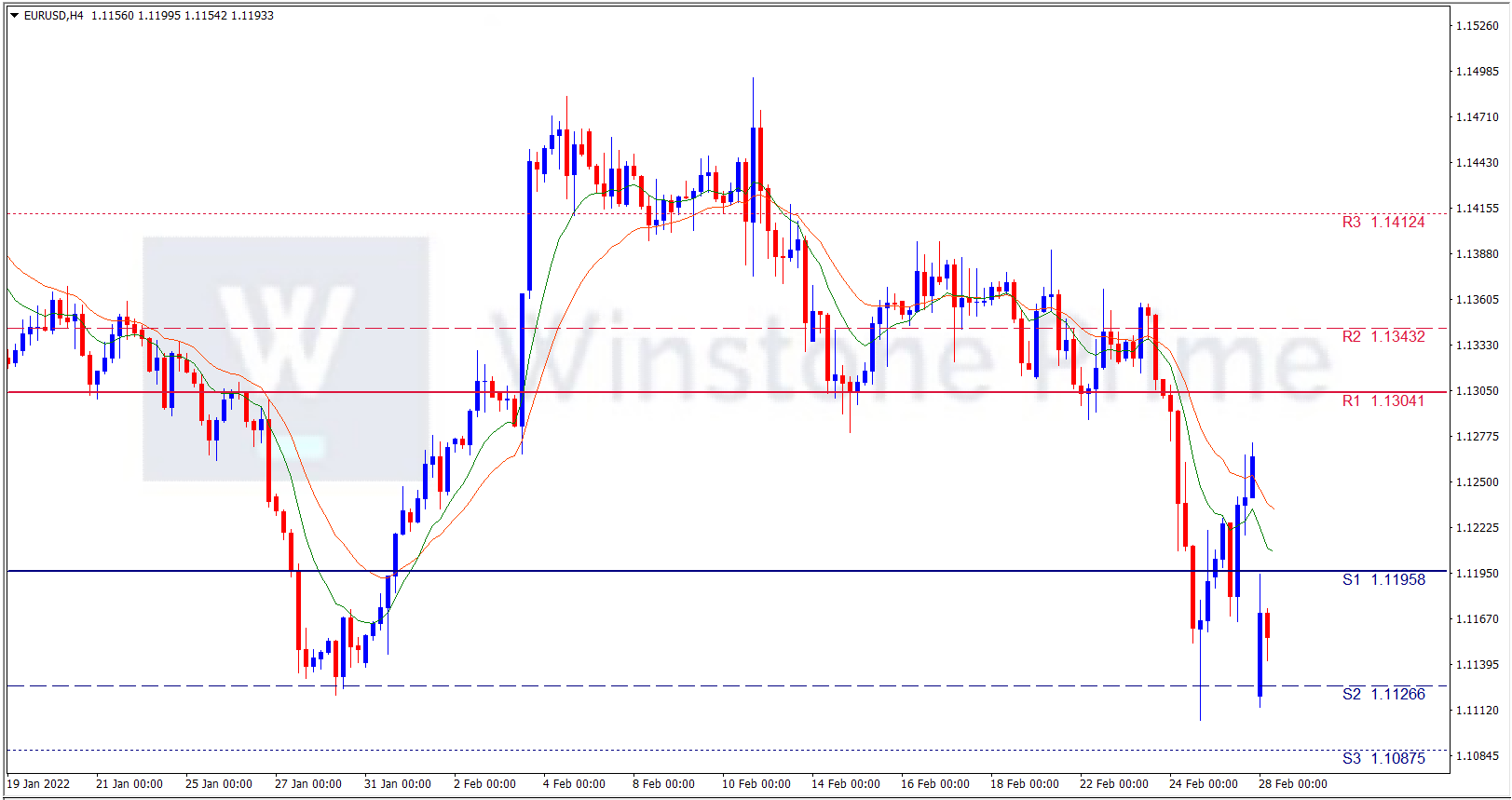
EUR/USD 4 Hour Chart:

Support: 1.1196 (S1), 1.1127 (S2), 1.1088 (S3).

Resistance: 1.1304 (R1), 1.1343 (R2), 1.1412 (R3).

Amidst the escalating tensions between Russia and Ukraine, we expect a bearish trend for EUR/USD.

BTC/USD Weekly Forecast (28th February 2022 – 4th March 2022)

Fundamental view:

Bitcoin traded back and forth against its counterpart US Dollar during the week and ended with a bullish candle. The Russia – Ukraine crisis headlines was the major catayst this week. And Russia’s invasion of Ukraine has perhaps dispelled a popular notion about bitcoin. It maybe it’s not the gold of the 21st century.

Bitcoin, the largest cryptocurrency by market capitalization, dropped as much as 9% to $34,584 Thursday after Russian President Vladimir invaded Ukraine overnight. The cryptocurrency moved in conjunction with tech stocks, which slumped, as opposed to gold, which jumped 3% to its highest in over a year.

Despite the current decline, Micro Strategy CEO Michael Saylor, a major crypto proponent, has held onto his belief that bitcoin remains a good bet amid geopolitical uncertainty. On Wednesday, he tweeted, “Nation state conflicts create uncertainty, constrain production, weaken currency, cripple trade, and undermine credit, making investments in debt & equity riskier and underscoring the benefit of converting treasury assets into pure digital energy. #Bitcoin.”

The major economic events deciding the movement of the pair in the next week are ISM Manufacturing PMI at Mar 01, ADP Nonfarm Employment Change, Fed Chair Powell Testimony, EIA Crude Oil Stocks Change at Mar 02, Initial Jobless Claims, ISM Non-Manufacturing PMI at Mar 03 and Nonfarm Payrolls at Mar 04 for US.

BTC/USD Weekly outlook:

Technical View:

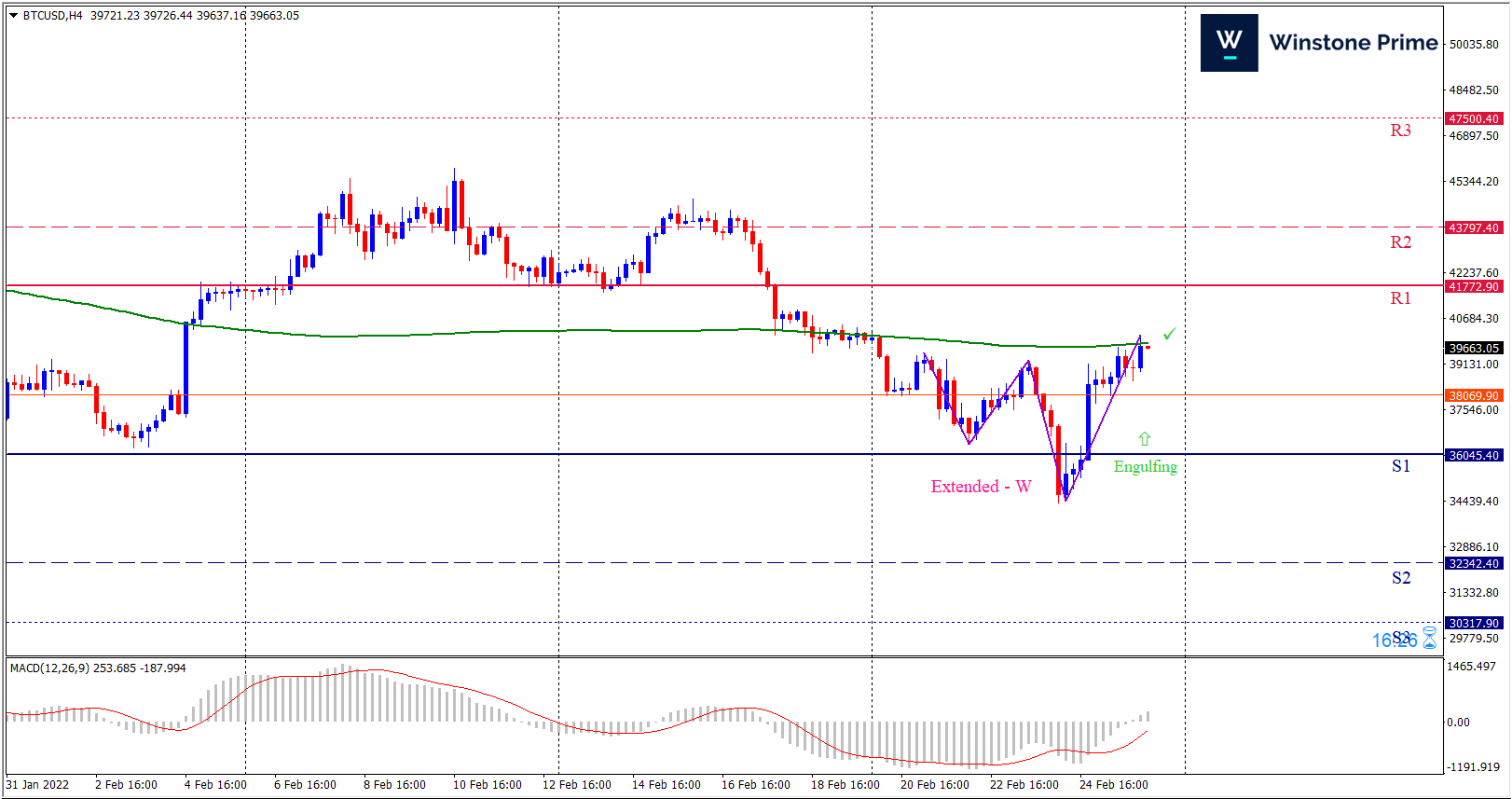
Last week’s high was 11.62% lower than the previous week. Maintaining high at 40094.5 and low at 34367.0 showed a movement of 5727 pips.

In the upcoming week we expect BTC/USD to show a bullish trend. The Instrument is trading above the 200 Simple Moving Average and the MACD trades to the upside. A solid breakout above 41772.9 may open a clean path towards 43797.4 and may take a way up to 47500.4. Should 36045.4 prove to be unreliable support, the BTCUSD may sink downwards 32342.4 and 30317.9 respectively. In H4 chart extended-w pattern breakout favors prospects of a bullish trend. Bullish engulfing pattern constructs a bullish outlook for the pair in the upcoming week.

Preference
Buy: 39381.6 target at 44856.7 and stop loss at 36040.7


Alternate Scenario
Sell: 36040.7 target at 30318.9 and stop loss at 39381.6