Second wave of Covid – 19 impacts Euro

EUR/USD is bearish, as the Eurozone’s second wave of corona virus is accelerating and threatening to slow down the already fragile economic recovery. France announced a daily record of new corona virus infections on Sunday, with the confirmed figure reaching 52,000. Italy announced a partial lockdown, which will remain in effect until Nov. 24. And Spain has approved a state of emergency and announced a national curfew from 11 p.m. to 6 a.m. to contain the virus.
These new restrictions, which is less severe than the ones seen in the second quarter, are likely to have a negative impact on the economy. The Eurozone is already facing deflationary pressures. The common currency bloc’s inflation fell deeper into the negative territory in September, raising pressure on the European Central Bank to ramp up stimulus.
According to a recent forecast, the central bank is likely to boost its pandemic bond-buying program by 400 billion euros ($470 billion) in December. However, with Eurozone nations reimposing economically-painful measures to control the second wave of the corona virus, markets may begin pricing a bigger boost in ECB’s stimulus.
The US election polls do still give Biden a commanding lead with just over a week to go in financial markets. However, there are plenty of activities and alternative themes to drive price action elsewhere.
The stimulus package has been a driver of risk appetite and a pro-dollar on a lack of progress at times, but investors could start to weather news that a US stimulus bill may not be forthcoming ahead of the election.
EUR/USD 4 Hour Chart:
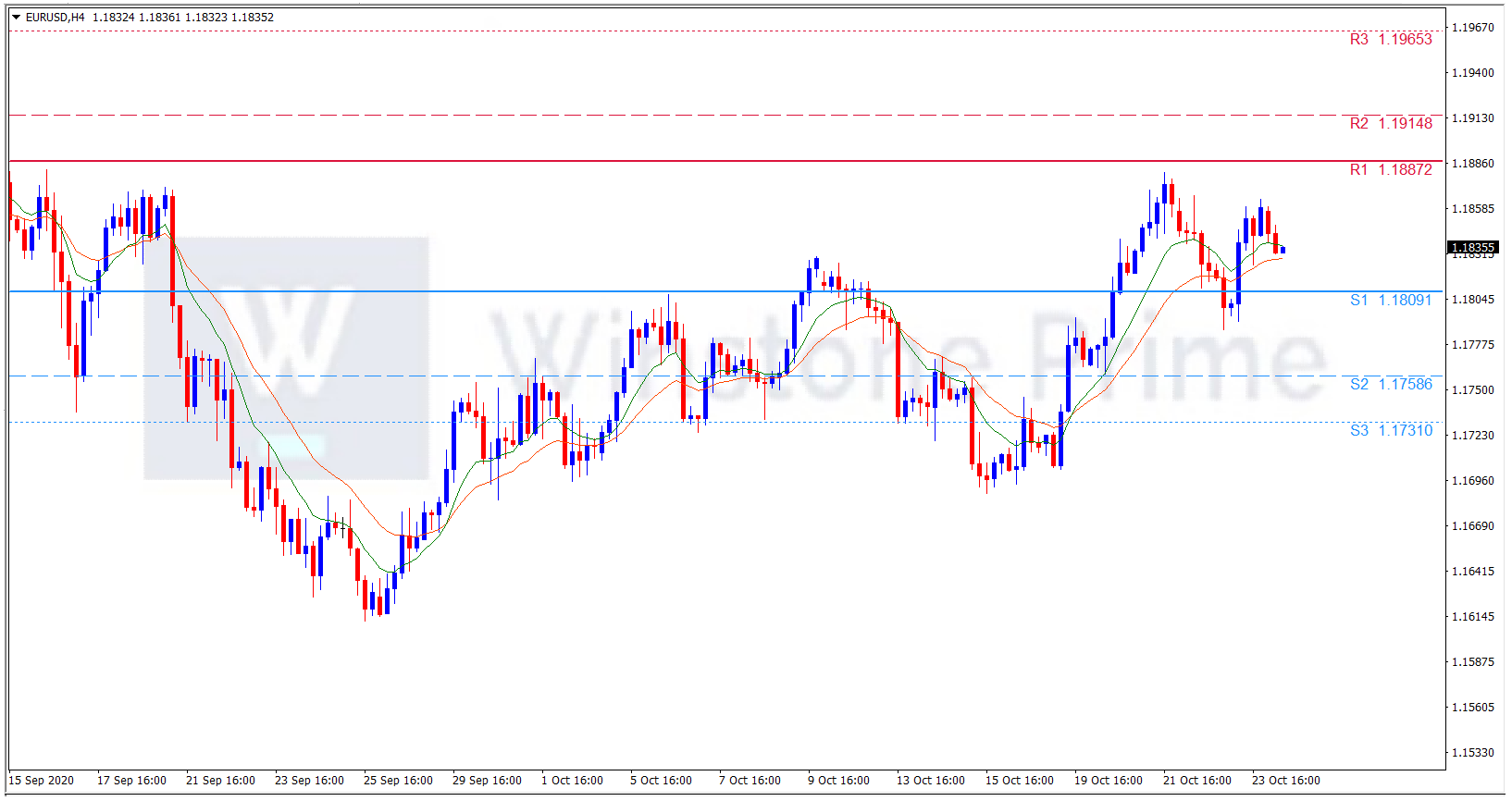
Support: 1.1809 (S1), 1.1759 (S2), 1.1731 (S3).
Resistance: 1.1887 (R1), 1.1915 (R2), 1.1965 (R3).
The second wave of corona virus impacts the Euro zone negatively and we expect a bearish trend for EUR/USD.
USD/JPY Weekly Forecast (26th October 2020 – 30th October 2020)

Fundamental view:
The pair managed first but later fell by Wednesday. The once and future US stimulus package is the market intervention of the month. As the Republicans and Democrats tried to wring as much electoral advantage from negotiations, hopeful statements for a deal from Democratic House Speaker Nancy Pelosi and President Donald Trump on Wednesday sent to a low. Japanese inflation dropped to its lowest annual level in three years falling to 0% in September from 0.2% in August. Core inflation rose from -0.1% to flat
Japan Trade Balance on 19th Oct and US Crude Oil Inventories on 21st Oct favored a bullish move for the pair whereas US Crude Oil Inventories on 20th Oct and Japan National Core CPI yearly report on 23rd Oct favored bearish trend for the pair.
The major economic events deciding the movement of the pair in the next week are US Core Durable Goods Orders monthly report, US CB Consumer Confidence Index at Oct 27, Japan Retail Sales monthly report Oct 28, BoJ Interest Rate Decision, US GDP quarterly report at Oct 29, and US Core PCE Price Index yearly report at Oct 30.
USD/JPY Weekly outlook:
Technical View:
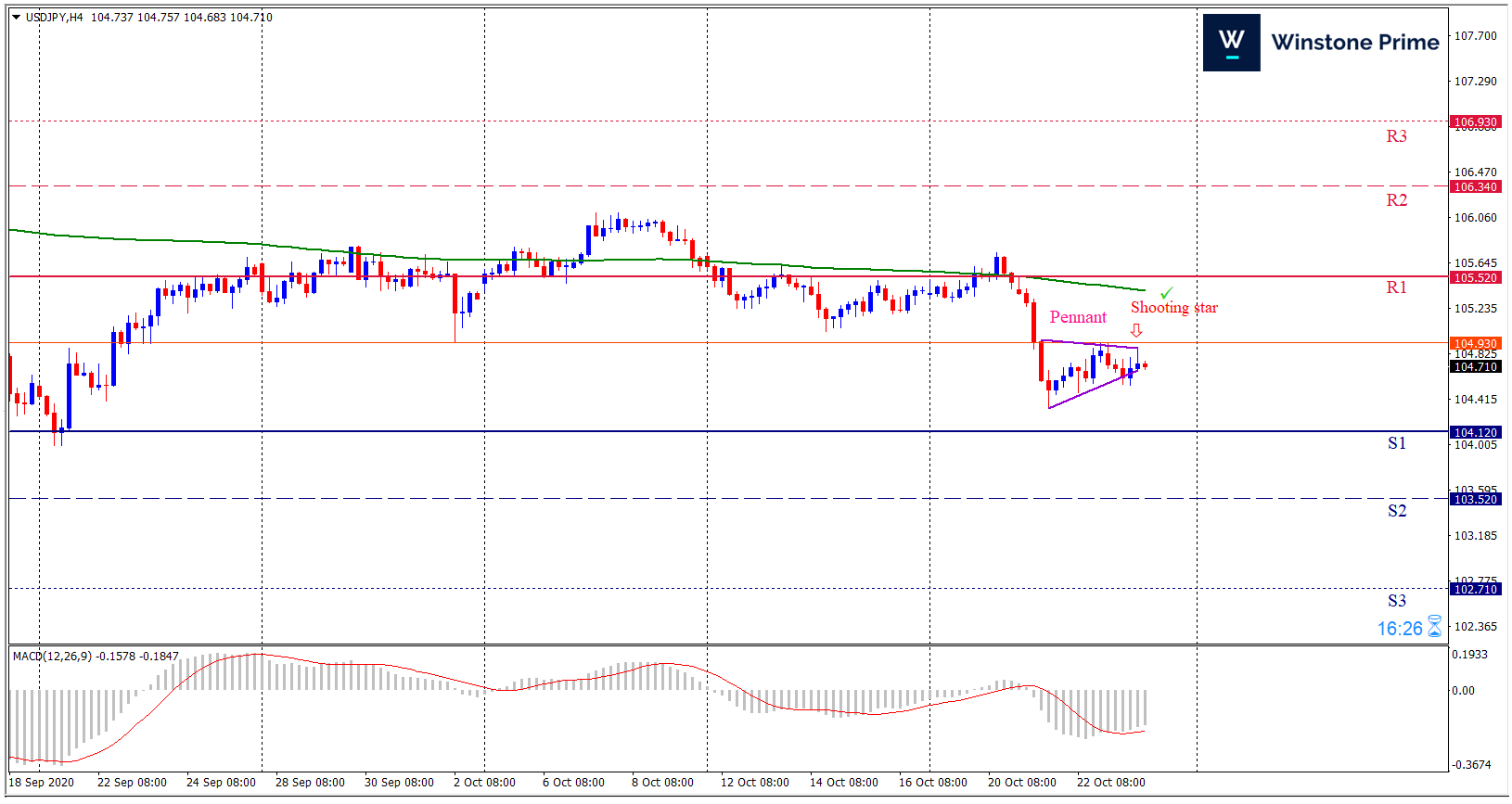
Last week’s high was 0.02% higher than the previous week. Maintaining high at 105.74 and low at 104.34 showed a movement of 140 pips.
In the upcoming week we expect USD/JPY to show a bearish trend. The currency pair is trading below the 200 Simple Moving Average and the MACD trades to the upside. A solid breakout below 104.12 may open a clean path towards 103.52 and may take a way down to 102.71. Should 105.52 prove to be unreliable resistance, the USDJPY may raise upwards 106.34 and 106.93 respectively. In H4 chart, the breakout of the pennant pattern to the downside favors our bearish expectation. Also to be noted shooting star formation exerts the expectation of downtrend for the pair.
| Preference |
| Sell: 104.91 target at 103.53 and stop loss at 105.57 |
| Alternate Scenario |
| Buy: 105.57 target at 106.92 and stop loss at 104.91 |
AUD/USD Weekly Forecast (26th October 2020 – 30th October 2020)

Fundamental view:
The Australian dollar has been back and forth during the course of the week, showing signs of confusion to say the least. The Australian dollar got hit by the Reserve Bank of Australia Minutes, as the document paved the way for a cash rate cut to a fresh record low of 0.1%. The strength of the local currency coupled with a local economic downturn after the latest Victoria’s lockdown, are among the reasons why policymakers decided to maintain a highly accommodative policy. The next RBA meeting will take place on November 3, coinciding with the US presidential election.
US NAHB Housing Market Index on19th Oct and US Crude Oil Inventories on 21st Oct created a bearish atmosphere for the pair whereas US Housing Starts on 20th Oct and US CB Leading Index monthly report on 22th Oct created a bullish atmosphere for the pair.
The major economic events deciding the movement of the pair in the next week are RBA Assistant Governor Bullock Speech, US Core Durable Goods Orders monthly report, US CB Consumer Confidence Index at Oct 27, Australia CPI quarterly report at Oct 28, US GDP quarterly report at Oct 29, and US Core PCE Price Index yearly report at Oct 30.
AUD/USD Weekly outlook:
Technical View:
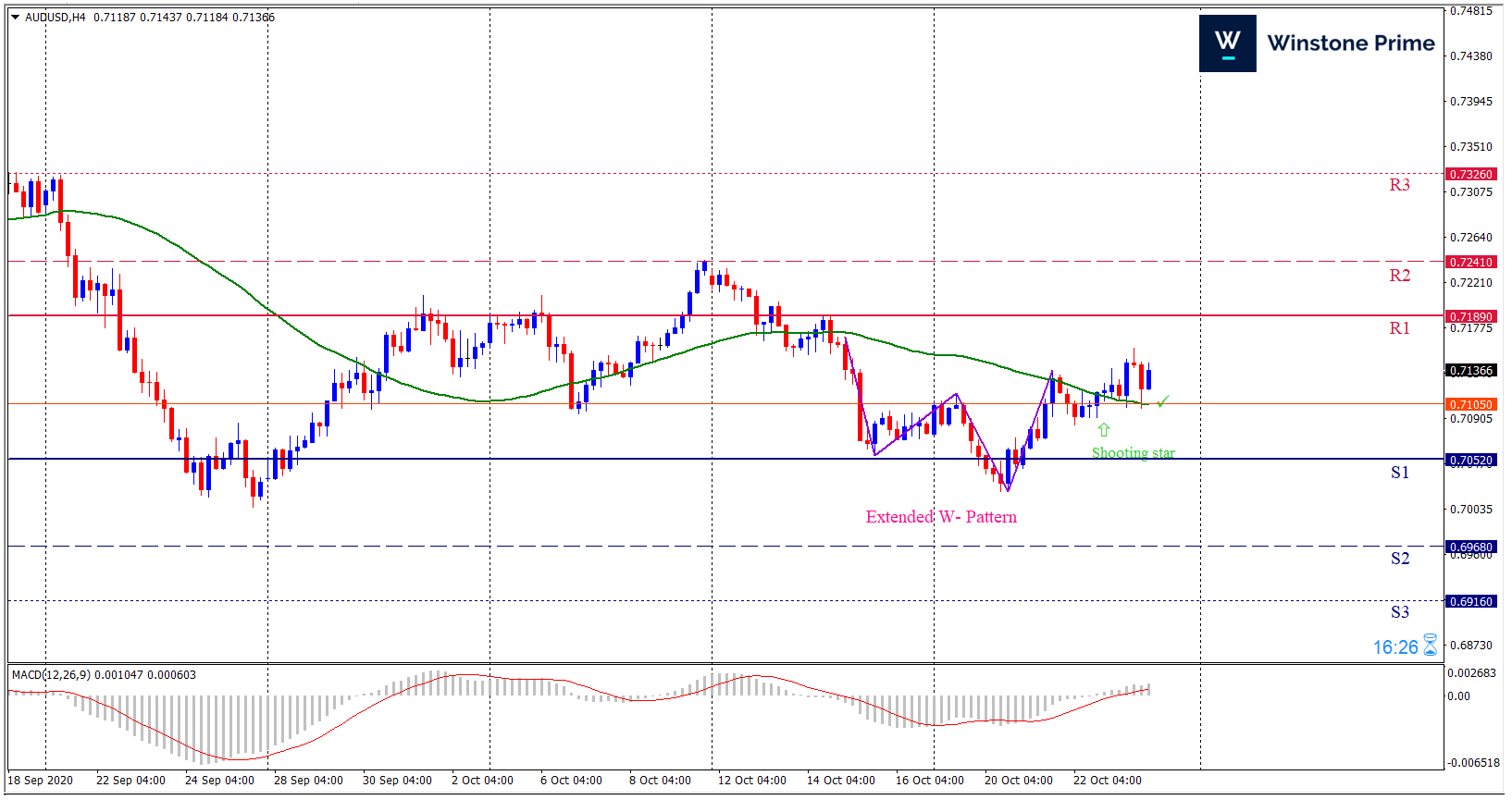
Last week’s high was 1.07% lower than the previous week. Maintaining high at 0.7158 and low at 0.7020 showed a movement of 138 pips.
In the upcoming week we expect AUD/USD to show a bullish trend. The currency pair is trading above the 50 Simple Moving Average and the MACD trades to the downside. A solid breakout above 0.7189 may open a clean path towards 0.7241 and may take a way up to 0.7326. Should 0.7052 prove to be unreliable support, the AUDUSD may sink downwards 0.6968 and 0.6916 respectively. In H4 chart extended W-pattern favors prospects of a bullish trend. Also to be noted shooting star formation exerts the expectation of uptrend for the pair.
| Preference |
| Buy: 0.7105 target at 0.7240 and stop loss at 0.7047 |
| Alternate Scenario |
| Sell: 0.7047 target at 0.6926 and stop loss at 0.7105 |