EUR/USD Weekly Forecast (28th February 2022 – 4th March 2022)

Fundamental view:

The Euro fell against US dollar and reached its lowest level since June 2020 on Thursday in this week and recovered just modestly ahead of the weekly close. The risk off market mood due to Russia invaded Ukraine, launching a massive military attack made the US dollar to soar. According to US intelligence, the main goal is to depose Ukrainian President Volodymyr Zelenskyy and impose a leader favorable to the Russian regime. Moscow’s military attack took over Chernobyl and reached the capital on Friday when Russia expressed willingness to send a delegation and discuss the possibility of Ukraine becoming neutral. This somewhat helped the Euro to recover on Friday. However, Ukrainian developments are the determinant factors for global markets.

Amidst the geopolitical tension taking the centre stage, market has temporarily taken the attention from the inflation woes. European Central Bank member of the governing council Klass Knot said he expects the ECB to raise rates in the last quarter of this year, adding that he supports winding down the asset purchasing program as quickly as possible. Meanwhile, US Federal Reserve member Raphael Bostic said that he is open to four or more rate hikes this year if inflation persists.

In this week, Eurozone Markit Services PMI on 21st February and US CB Consumer Confidence Index on 22nd February favored uptrend whereas GfK Consumer Climate on 23rd and US GDP quarterly report February favored downtrend for the pair.

The major economic events deciding the movement of the pair in the next week are US ISM Manufacturing PMI at Mar 01, US ADP Nonfarm Employment Change, Fed Chair Powell Testimony at Mar 02, Initial Jobless Claims, ECB Monetary Policy Meeting Accounts, US ISM Non-Manufacturing PMI at Mar 03 and Eurozone Retail Sales monthly report, US Nonfarm Payrolls at Mar 04.

EUR/USD Weekly outlook:
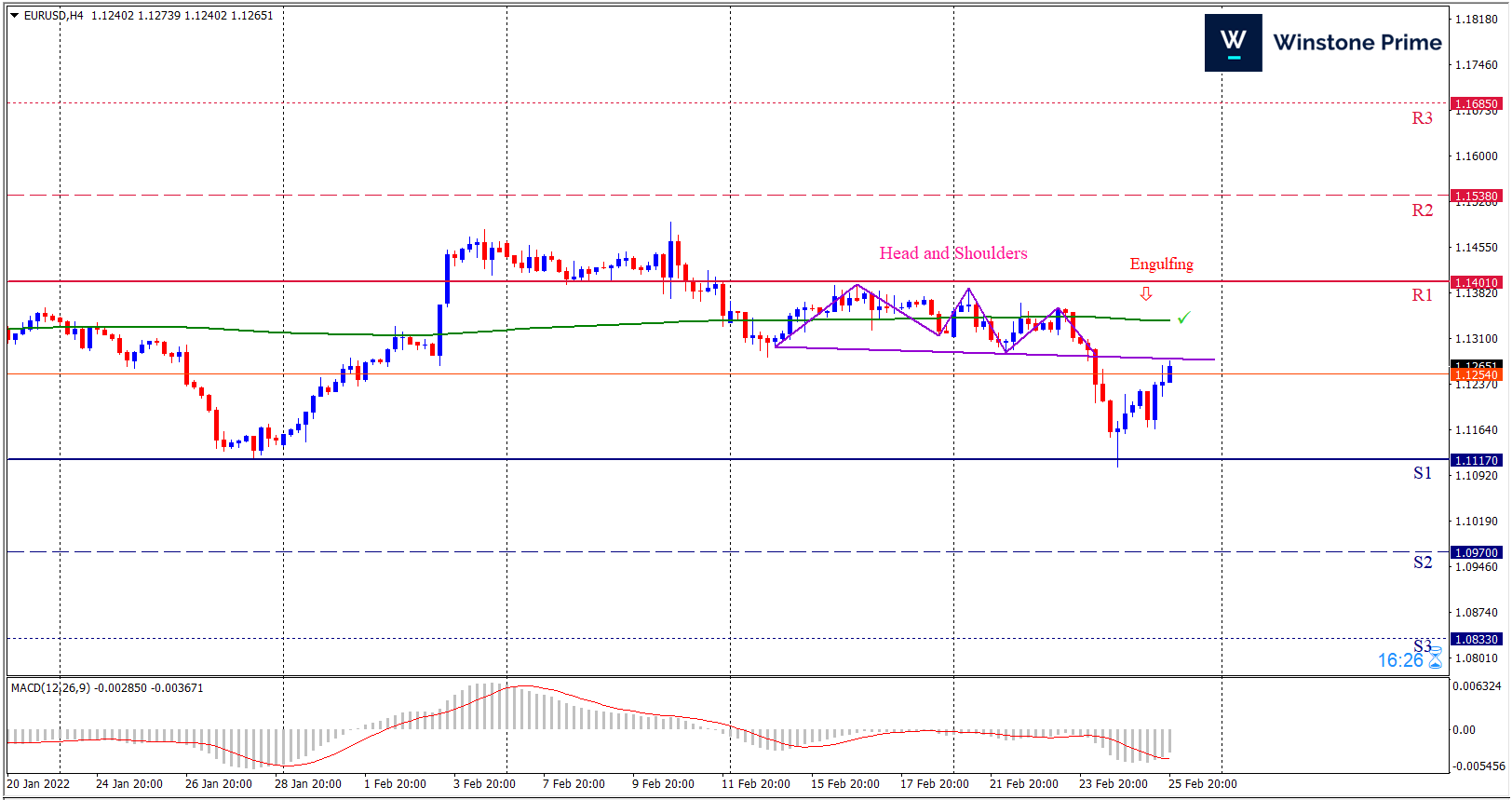
Technical View:

Last week’s high was 0.04% lower than the previous week. Maintaining high at 1.1390 and low at 1.1106 showed a movement of 284 pips.

In the upcoming week we expect EUR/USD to show a bearish trend. The currency pair is trading below the 200 Simple Moving Average and the MACD trades to the downside. Should 1.1117 proves to be unreliable support then the pair may fall further to 1.0970 and 1.0833 respectively whereas a solid breakout above 1.1401 will open a clear path upward to 1.1538 and then will further raise up to 1.1685. Chart formation of a head and shoulders pattern in H4 chart sets prospects for a bearish trend. Bearish engulfing formation in H4 chart escalates the expectation for a bearish trend.

Preference
Sell: 1.1251 target at 1.0979 and stop loss at 1.1406


Alternate Scenario
Buy: 1.1406 target at 1.1684 and stop loss at 1.1251

Upbeat data favors the USD/JPY bulls

  • Russia invasion on Ukraine triggered the traders to rusk towards the safe haven assets.
  • Upbeat US data and Hawkish comments from Fed favors the USD bulls.
  • Geopolitical developments will determine the next market move.


US dollar edges high against its counterpart Japanese Yen during Friday trading session. Traders flocked towards safety after Russia’s invasion which favored both the safe haven currencies. However, hawkish comments from Fed and upbeat US data seem to have added to the USD’s strength.

Russia launched its invasion by land, air and sea on Thursday following a declaration of war by Putin. An estimated 100,000 people fled as explosions and gunfire rocked major cities. Dozens have been reported killed.

Top European Union leaders said on Friday that President Vladimir Putin “must and will fail,” as they agreed new sanctions over his invasion of Ukraine, saying he was trying to bring the continent back to the age of empires and confrontations.

The bloc’s leaders agreed in principle at an emergency overnight summit to impose new economic sanctions, joining the United States and others in taking steps such as curbing Russia’s access to technologies. The EU will freeze Russian assets in the bloc and halt its banks’ access to European financial markets as part of what EU foreign policy chief Josep Borrell described as “the harshest package of sanctions we have ever implemented”.

On the same line,  Japan also seem to strengthen sanctions against Russia to include financial institutions and military equipment exports, Prime Minister Fumio Kishida said on Friday, following a similar move by Washington in retaliation after the invasion of Ukraine.

Amidst the Russia-Ukraine jitters favoring the safe haven , the upbeat US data favored the US bulls. US Q4 GDP of 7.0% exceeded the forecast and the previous readout of 6.9% and Firmer New Home Sales with a reading of 0.801M against the expectation of 0.776M and upbeat Chicago Fed National Activity also helped the USD bulls.

On the other hand, Tokyo Consumer Price Index (CPI) rose to 1.0% YoY versus 0.6% expected whereas Tokyo CPI ex Food, Energy dropped to -0.6% from -0.7% previous readings and -0.5% forecasts and -0.7% previous readout for February.

The Hawkish comment from Atlanta Fed President and FOMC member Raphael Bostic and Richmond Fed President, as well as an FOMC member, Thomas Barkin underpinned the bullish move of the US dollar Even though Cleveland Fed President Loretta Mester said that she doesn’t think raising interest rates by 50 bps in March is compelling.

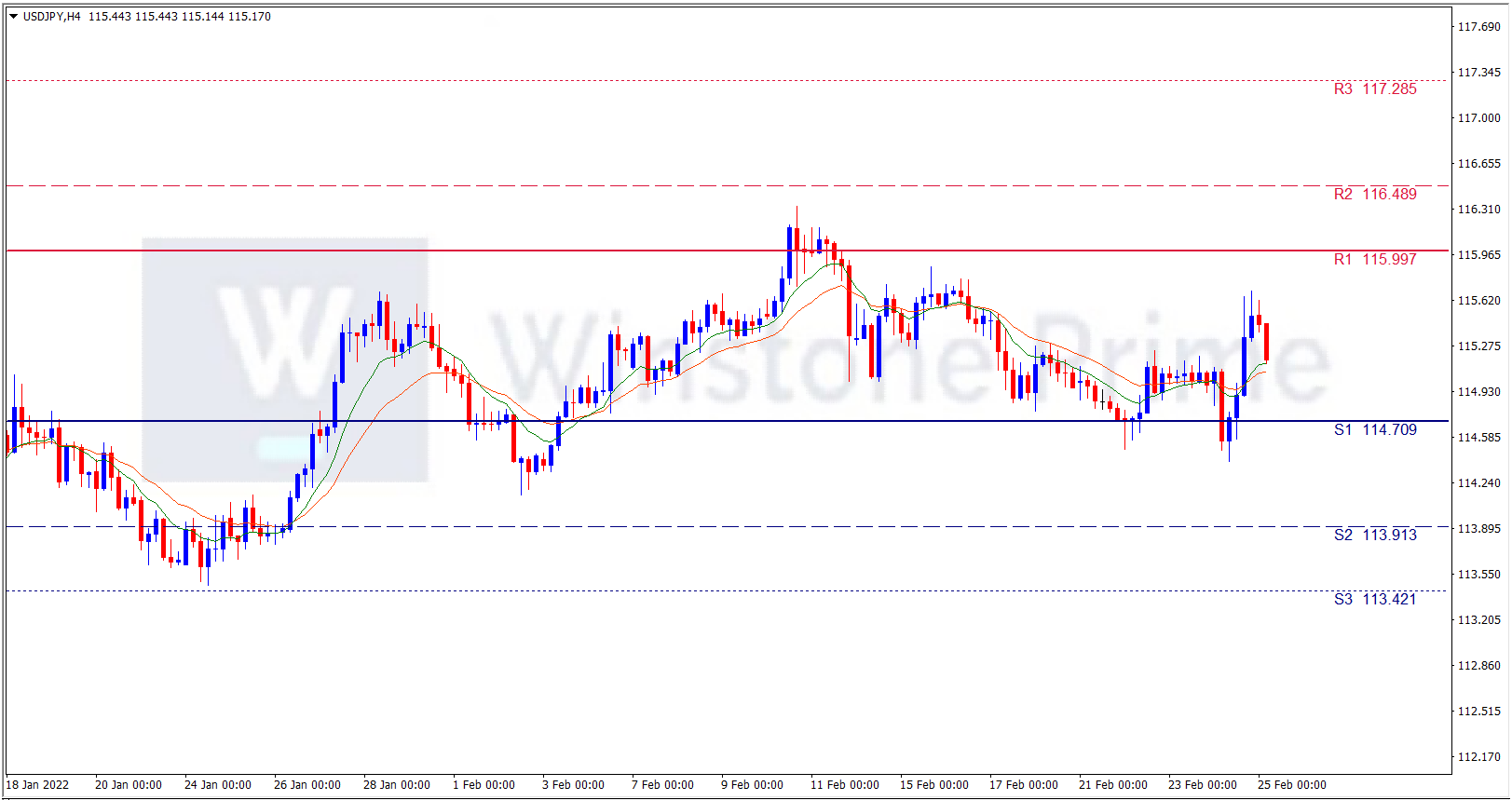
USD/JPY 4 Hour Chart:

Support: 114.71 (S1), 113.91 (S2), 113.42 (S3).

Resistance: 116.00 (R1), 116.49 (R2), 117.29 (R3).

The upbeat data and the hawkish comment from the Fed drives the US Bulls, However the geopolitical developments is the major catalyst in the financial market now. In the meantime, we expect a bullish trend for USD/JPY.

Gold prices jumped as Russia attacks Ukraine

  • The yellow metal rallies with investors flocking to safe havens.
  • Russian forces invaded Ukraine after Vladimir Putin authorized a special military operation.
  • Russia-Ukraine crisis walloped risk appetite, which in turn underpins the safe haven demand.


Gold rallied on Thursday reaching its highest level in more than a year since investors are crowding towards safe havens as Russian forces invaded Ukraine.

The Russian president Vladimir Putin has ordered military operations in Ukraine On Wednesday, demanding Kyiv forces to surrender. Military command centres Ukraine in Kyiv and Kharkiv have reportedly been attacked by missile strikes.

As Russia goes to war, Ukraine’s President Volodymyr Zelenskyy announces the imposition of martial law, which will cover the entire country. Zelenskyy noted: “Russia carried out missile strikes on our infrastructure and on our border guards.”

This update came after Ukrainian President Zelensky and his American counterpart Joe Biden spoke on the phone, earlier on. Meanwhile, various witnesses are tweeting of Hypersonic missiles being used to attack Kramatorsk while Ukraine’s 54th mechanized base just got shot.

Meanwhile, In a tweet, Ukrainian Foreign Minister Dmytro Kuleba said Russia has launched a full-scale invasion of Ukraine and is targeting cities with weapons strikes.

Elsewhere, Ukraine Foreign Minister Dmtryo Kuleba had requested an emergency meeting of the United Nations (UN) Security Council to reach a positive outcome against the ongoing tensions with Moscow. However, the Kremlin is supposed to strike Ukraine before the scheduling of the UN Security Council emergency meeting.

Having initially promised “further consequences” for Russia, due to Moscow’s military attack on Ukraine, US President Joe Biden tweeted, “Tomorrow, I will be meeting with the Leaders of the G7, and the United States and our Allies and partners will be imposing severe sanctions on Russia.”

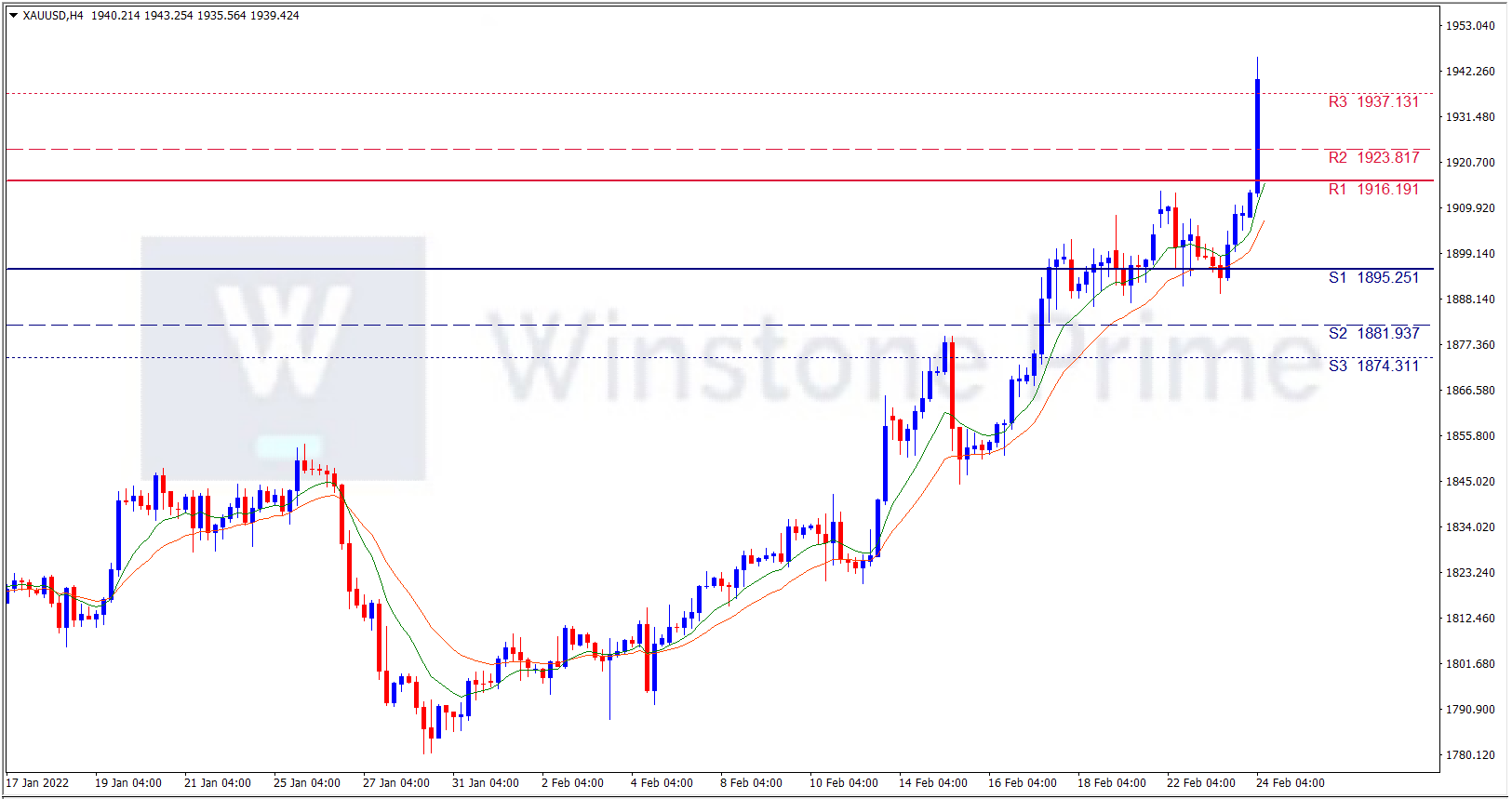
XAU/USD 4 Hour Chart:

Support: 1895.3 (S1), 1881.9 (S2), 1874.3 (S3).

Resistance: 1916.2 (R1), 1923.8 (R2), 1937.1 (R3).

Gold which is perceived as a safe store of value during uncertain times, has risen about 8% in February since headlines on developments in the Russia-Ukraine crisis walloped risk appetite. We expect a bullish trend for XAU/USD.

Gold is flat amid Ukraine Standoff

  • The yellow metal takes a U turn from the highest levels since June 2021 reached on the previous day.
  • Traders focus on Fed after the Russian- Ukraine risk started to fade.
  • The absence of Japanese traders also triggers the bearish trend of XAU/USD.


Gold is flat against the US dollar during Wednesday trading session since the safe haven demand offset by a rise in Treasury yields after the first wave of U.S. and European sanctions on Russia for sending troops into eastern Ukraine.

The markets cheers the prospects of diplomacy since there has been no further evidence that Russia has indeed infiltrated deeper into Ukraine territory.

However, A senior U.S. State Department official said “Actions the Joe Biden administration took on Tuesday and may take soon to punish Russia’s economy over its aggression in Ukraine are not intended to hit global energy markets.”

Meanwhile, The US Secretary of State Antony John Blinken announced that it doesn’t make sense for him to meet with Russia’s Lavrov anymore. He says he sent a letter today to him informing him of that.

Blinken says “Putin’s ‘disturbing’ speech yesterday and statements today showed to the world that he views Ukraine as a ‘subordinate’ of Russia” “now we know now that Putin’s plan all along has been to invade Ukraine” “Putin is blatantly breaking the laws and principles that have kept peace across Europe and in the world.”

The recent action of the gold can also be linked to the absence of Japanese traders, which indirectly affects US bond demand in Asia and restricts catalysts for gold.

St. Louis Fed President James Bullard has been among the most hawkish voices at the Federal Reserve in recent months, pushing for 100 basis points worth of rate hikes over the next three meetings.

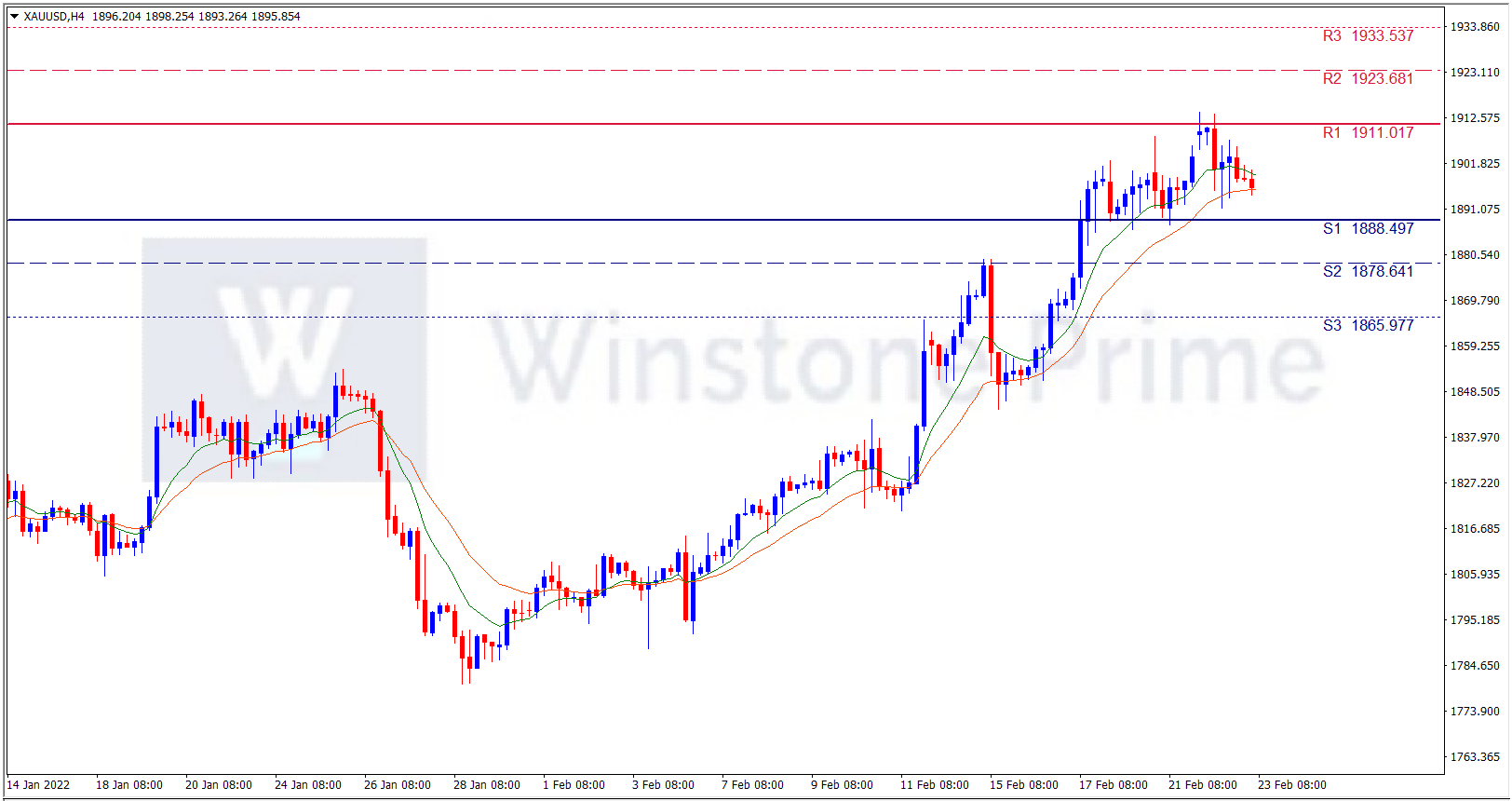
XAU/USD 4 Hour Chart:

Support: 1888.5 (S1), 1878.6 (S2), 1866.0 (S3).

Resistance: 1911.0 (R1), 1923.7 (R2), 1933.5 (R3).

Markets cheers the prospects of diplomacy amid Ukraine standoff thus shifting the traders attention from the safe haven gold. We expect a bearish trend for XAU/USD.