Interest decision by Central Banks
Central banks are endowed with the responsibility of controlling the interest rates. After evaluating the economic situation of a country, a central bank can issue a monetary policy to either hike or cut interest rates.
The monetary policy decisions are usually made by the members of the central banks, who vote to increase, decrease, or leave the rates unchanged.
Here is a table of some of the major central banks around the world.
Country
|
Central Bank
|
The United States
|
Federal Reserve (Fed)
|
The United Kingdom
|
Bank of England (BOE)
|
The European Union
|
European Central Bank (ECB)
|
Japan
|
Bank of Japan (BOJ)
|
Canada
|
Bank of Canada (BOC)
|
Australia
|
Reserve Bank of Australia (RBA)
|
New Zealand
|
Reserve Bank of New Zealand (RBNZ)
|
Switzerland
|
Swiss National Bank (SNB)
|
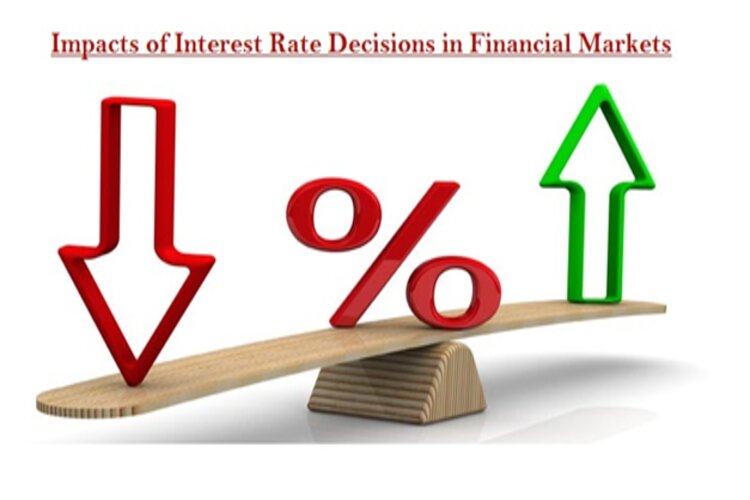
In the case of an interest rate cut, it’s exactly the other way round. With a cut in key interest rates, the central bank is pursuing a looser monetary policy. Market participants can get money more cheaply and invest it, which boosts the economy. Interest rate cuts are often associated with rising equity markets, although a decline suggests a weaker economy that needs to be helped with a rate cut. Central banks use their actions to steer financial markets and economies to make money more expensive by raising interest rates. One of the main mechanisms of action is the interest rate decision. With a rise in interest rates, the central bank is making investments more expensive, since loans can only be purchased at a higher price. An increase in interest rates thus indirectly signals a reduction in the economy, which under normal circumstances has a negative impact on the financial markets. How do Interest rate decision leads the Financial Market For example, if you were to trade the Japanese Yen, you should keep an eye on the interest rate decisions made by the BoJ to assist you in spotting profitable trading opportunities in the currency. When trading in the financial markets, you should stay updated with the economic reports and speeches from the above listed central banks.
What Happens When Interest Rates Rise?
When the Federal Reserve increases the discount rate, it does not directly impact the Financial market. The only direct impact is that borrowing money from the Federal Reserve is more expensive for banks. The impact is due to the fact that any increases in the discount rate have a ripple effect throughout the rest of the economy. Because it costs financial institutions more to borrow money, these same financial institutions often increase the rates they charge their customers to borrow money. So, individuals consumers are impacted through increases to their credit card and mortgage interest rates, especially if these loans carry a variable interest rate. When the interest rate for credit cards and mortgages increases, the amount of money that consumers can spend decreases.
Consumers still have to pay their bills. When those bills become more expensive, households are left with less disposable income. When consumers have less discretionary spending money, businesses’ revenues and profits decrease. Businesses are not just impacted indirectly. They are also impacted directly because they also borrow money from banks to run and expand their operations. When the banks make borrowing more expensive, companies may not borrow as much and will pay higher rates of interest on their loans. Less business spending can slow the growth of a company—it may curtail expansion plans or new ventures, or even induce cutbacks. There may be a decrease in earnings as well, which, for a public company, usually affects its stock price negatively.
Example of Interest Rate Hike
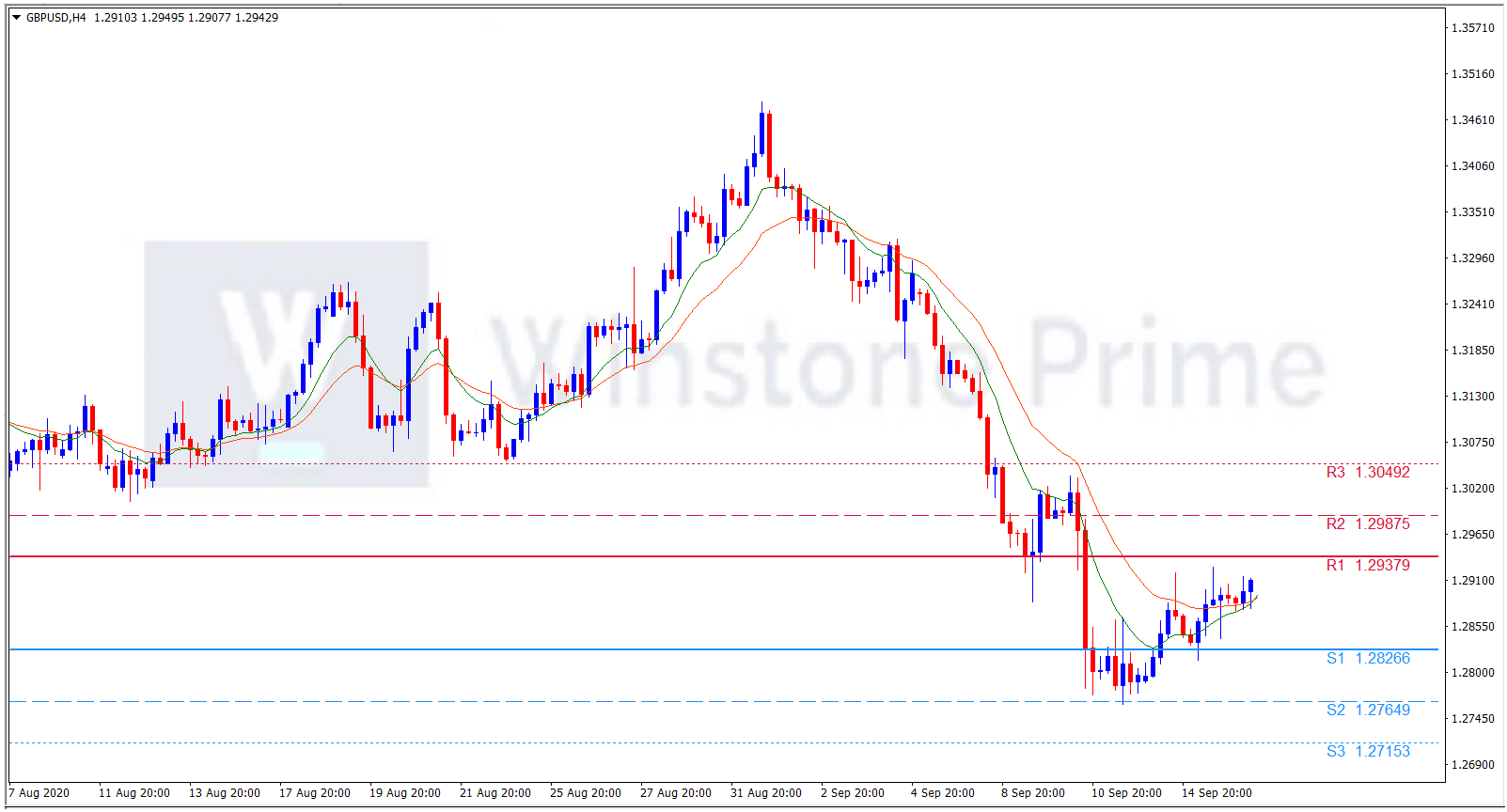
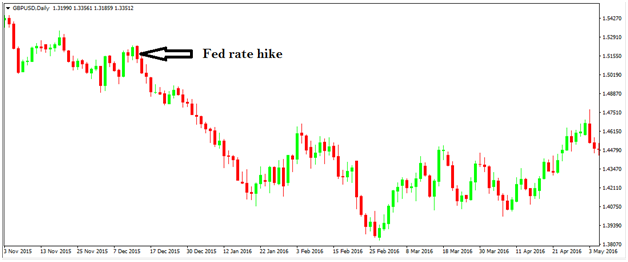
In December 2015, for the first time in ten years, the Fed increased rates from 0.25% to 0.50%. Before the Fed implemented the change, the GBP/USD was trending upwards. However, after the rate change was announced, the currency pair began dropping, implying that the U.S. dollar was becoming stronger. The pair lost about 1000 pips after two days and continued to trade lower in the next few days.
Here is a GBP/USD chart illustrating what happened.
What Happens When Interest Rates Fall?
When the economy is slowing, the Federal Reserve cuts the federal funds rate to stimulate financial activity. A decrease in interest rates by the Federal Reserve has the opposite effect of a rate hike. Investors and economists alike view lower interest rates as catalysts for growth—a benefit to personal and corporate borrowing. This, in turn, leads to greater profits and a robust economy. Consumers will spend more, with the lower interest rates making them feel that, perhaps, they can finally afford to buy that new house or send their kids to a private school. Businesses will enjoy the ability to finance operations, acquisitions, and expansions at a cheaper rate, thereby increasing their future earnings potential. This, in turn, leads to higher stock prices.
Particular winners of lower federal funds rates are dividend-paying sectors, such as utilities and real estate investment trusts (REITs). Additionally, large companies with stable cash flows and strong balance sheets benefit from cheaper debt financing.
Example of Interest Rate fall
Example 1
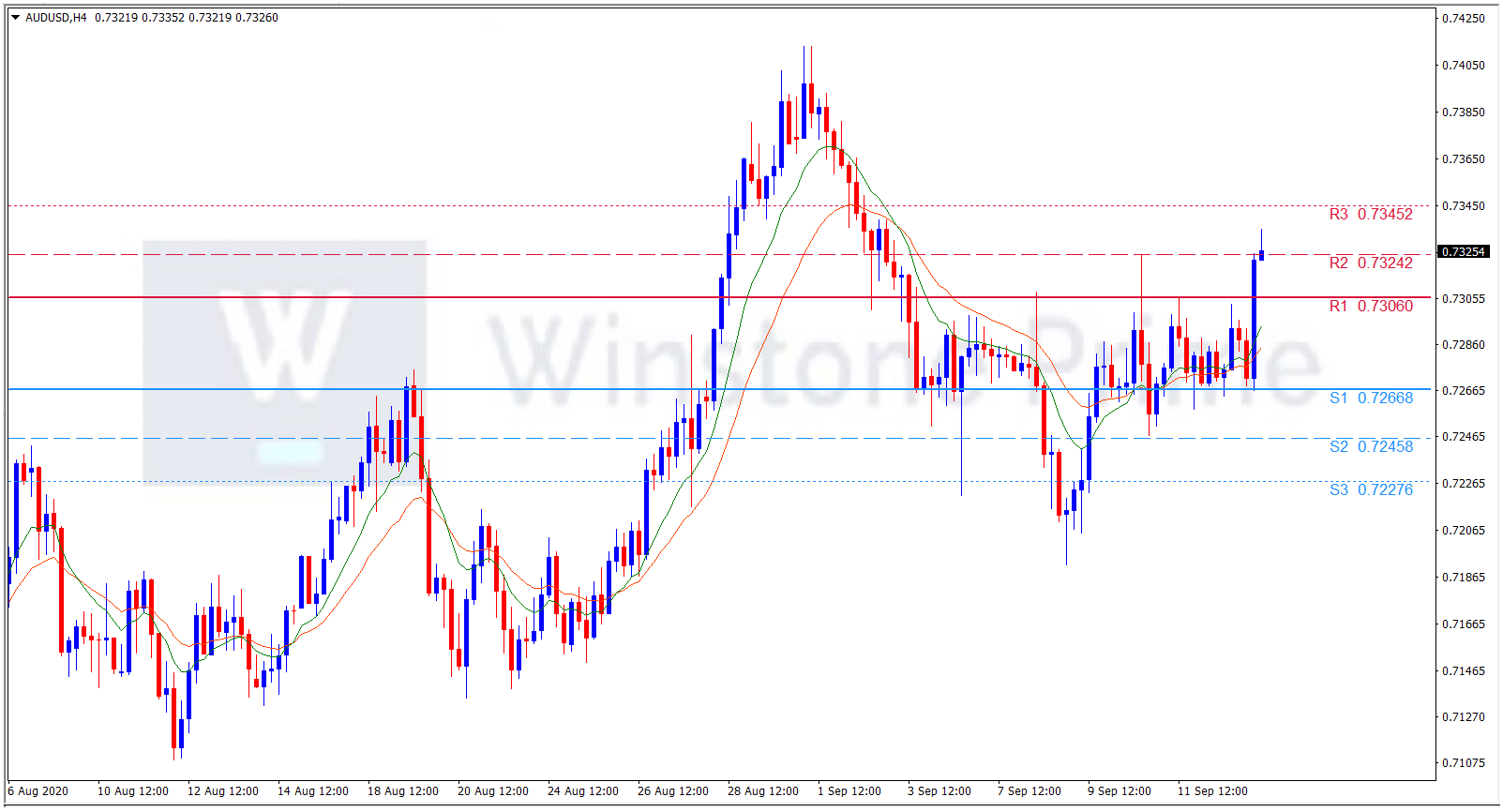
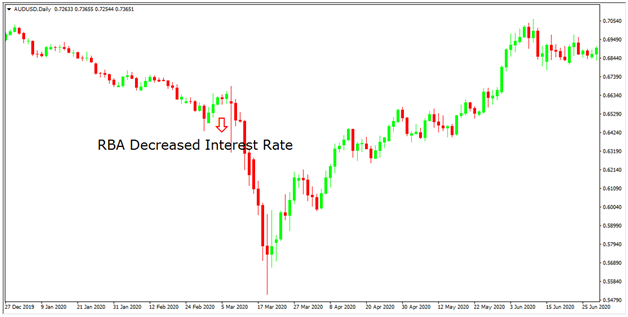
In March 3, 2020 the Reserve Bank Of Australia Board decided to lower the cash rate by 25 basis points to 0.50 per cent. The Board took this decision to support the economy as it responds to the global coronavirus outbreak. It is also depreciated and is at its lowest level for many years. The Board therefore judged that it was appropriate to ease monetary policy further to provide additional support to employment and economic activity. As a result, the currency lost value significantly from past months and over the next few days and weeks.
Here is an AUD/USD chart illustrating what happened.
Example 2
In March 2016, the ECB surprised the market by reducing the financing interest rates from 0.05% to 0.00%–hoping to stimulate the region’s economic growth. It also lowered the deposit rates from -0.20% to -0.30%.
 Initially, the EUR/USD reacted to this news by losing about 200 pips, which was the right direction. However, the currency pair reversed this move and closed the day around 400 pips higher. Why did this take place?
After the ECB reduced the interest rates and included additional programs to stimulate the region’s economy, traders concluded that the central bank was more interested in economic growth. Since this move was positive for the region in the long-term, traders swiftly repositioned their orders and started buying the euro currency.
Here is a EUR/USD chart showing what took place.
Why we have to look into these Interest Rate Decisions
The future prospects of Interest Rate Decision by central banks have a major impact on virtually all fnancial markets, so that equity, interest rate, currency and bond markets will show immediate reactions, which may be unavoidable, can be violent, as long as something unforeseeable is proclaimed. An interest rate decision can start a trend or lead to a necessary restructuring in a portfolio.
Conclusion
Rising or falling interest rates can also impact the psychology of investors . When the Federal Reserve announces a hike, both businesses and consumers will cut back on spending. This will cause earnings to fall and currency prices to drop, and the market may tumble in anticipation. On the other hand, when the Federal Reserve announces a cut, the assumption is consumers and businesses will increase spending and investment. This can cause market prices to rise.
However, as evidenced by the above examples, there are times when the opposite takes place. For example, instead of the price of a currency increasing after a rate hike, it falls. Of course, such events also allow the newstrading for advanced traders. Beginners, on the other hand, should avoid these market phases and close positions completely on the smaller timeframes to avoid the unnecessary risk.
Therefore, before placing trades based on the interest rates decisions, make a careful analysis of the implications of the released central bank statements.
Happy trading!