Slow ’employment progress and economic recovery’ pressurizes greenback

In an interview, on the sidelines of the Mines and Money Online Connect Global mining conference, the celebrated fund manager said that while he is no fan of the Federal Reserve, he sees that they are in an untenable position as they try to support the U.S. economy as it continues to feel the significant effects of the COVID-19 pandemic.

He added that “to promote growth, the U.S. central bank will continue to be forced to keep interest rates low and that will drive gold prices higher.” “Understand negative, real interest rates for what they are: they’re a war one on savers by spenders. And in a democracy, the winner of that war is foreshadowed given that the spenders are so much more numerous than savers. So from a political point of view, the Fed is doing the only thing that it can do,” he said. I don’t see what their way out is.”

Adding to it, U.S. job growth likely slowed further in August as financial assistance from the government ran out, threatening the economy’s recovery from the COVID-19 recession. The Labor Department’s closely watched employment report on Friday would come as companies from transportation to manufacturing industries announce layoffs or furloughs. It could add pressure on the White House and Congress to restart stalled negotiations for another fiscal package, and will likely become political ammunition for both Democrats and Republicans with just two months to go until the presidential election.

Lydia Boussour, a senior economist with Oxford Economics in New York, estimated that payroll gains in line with expectations would leave one out of two laid-off workers still unemployed, with an increased risk of a prolonged high unemployment spell.

“The fact that the employment is settling into a trend of slow, grinding improvement is a worrisome sign for the broader recovery,” said Boussour. “The combination of slow employment progress and poor health conditions along with the absence of fiscal aid risk jeopardizing the consumer spending rebound in the coming months.”

XAU/USD 4 Hour Chart:
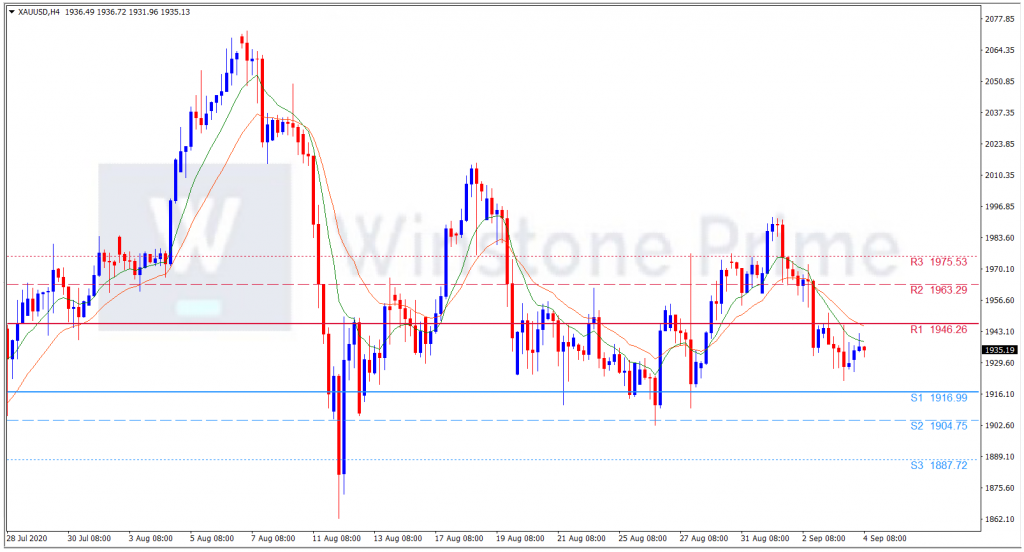
Support: 1917.0 (S1), 1904.8 (S2), 1887.7 (S3).

Resistance: 1946.3 (R1), 1963.3 (R2), 1975.5 (R3).

Amidst all the opinions coming against the greenback, the yellow metal bulls remain unnerved. But whether the upcoming US Non-farm payrolls data due to be published later on Friday at 12:30 GMT will add temporary strength to the greenback is yet to be seen. We expect a bullish trend for XAU/USD.

Euro weakens as European Central Bank worries on the inflation

Consumer prices in the 19-nation euro area are falling for the first time in four years, the consumer prices are projected to fall to -0.2% in August, down from 0.4% in July, and turning to negative for the first time in four years, the bloc’s statistic office announced Tuesday. A flash estimate of Euro stat showed the figure well below market expectations of a 0.2% rise.

Looking at the main components of euro area inflation, food, alcohol, and tobacco are expected to have the highest annual rate with 1.7% in August, compared to 2% in July. These followed by services with 0.7%, non-energy industrial goods -0.1%, and energy with -7.8%.

The European Central Bank had warned that inflation would weaken, but the negative reading will still sound the alarm for policymakers who have tried to soften the shock unleashed by the corona virus.

“This is a serious issue for the ECB,” said Nick Kounis, an economist at ABN Amro Bank NV. “We’re clearly seeing pretty aggressive disinflation, and there’s plenty more to come. Unemployment is on the way up, wage growth is coming down, and there’s going to be a lot of spare capacity in the economy for a long time to come.”

The risk for the ECB is that the price picture doesn’t improve. In a warning sign for what lies ahead, a separate release from IHS Markit showed that European factories lowered prices for a 14th straight month amid sluggish demand. They also cut jobs, and reduced inventories of raw materials and semi-manufactured stocks instead of ordering supplies. These catalysts makes the Euro to drop.

Whereas, White House Chief of Staff Mark Meadows stated that Senate Republicans were ready to take up their corona virus aid bill with $500 billion of additional aid. U.S. House Speaker Nancy Pelosi stated that Democrats and Republicans still had serious differences. While it remains to be seen whether the two sides will manage to reach a consensus, the return of the stimulus topic into the news flow provided additional support to the U.S. dollar.

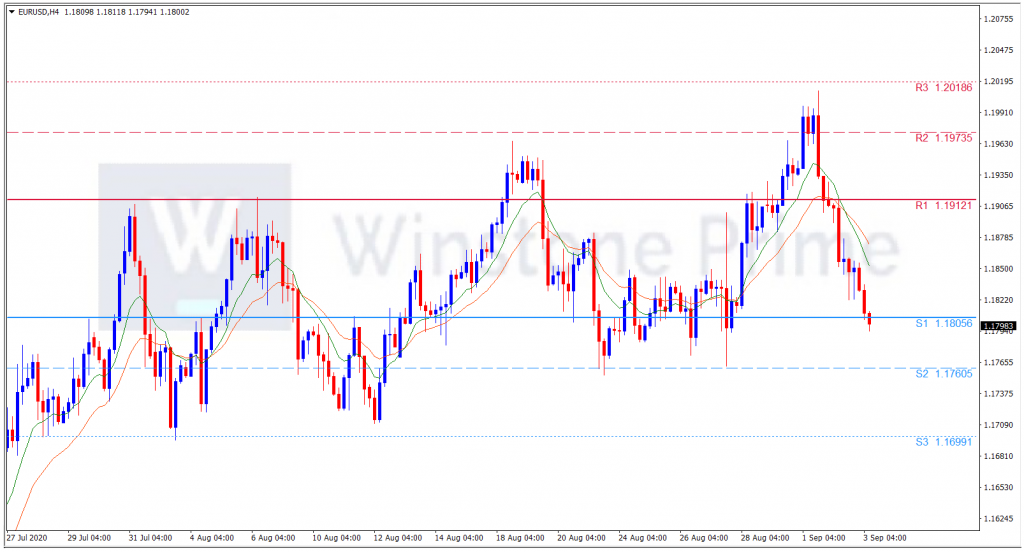
EUR/USD 4 Hour Chart:

Support: 1.1806 (S1), 1.1761 (S2), 1.1699 (S3).

Resistance: 1.1912 (R1), 1.1974 (R2), 1.2019 (R3).

Amidst all the catalysts depressing Euro against the greenback, we expect a bearish trend for EUR/USD.

Institute for Supply Management (ISM) release boosted greenback

The upbeat macroeconomic data releases from the US seem to be providing a boost to the greenback. August’s ISM manufacturing index has risen more than expected to stand at 56.0 well above the 50 break-even level which determines expansion/contraction in the sector. The consensus was looking for 54.8 versus July’s reading of 54.2.

In its closely-watched report, the Institute for Supply Management (ISM) revealed that the economic activity in the US manufacturing sector in August expanded at its strongest pace since January 2019. As for the components, production rose to 63.3 from 62.1 while the new orders component has surged to its highest level since 2004. This suggests good durability for the recovery process through the rest of the year. Employment remains in contraction territory though at 46.4 versus 44.3.

Tensions between India and China have flared with the nuclear-armed countries accusing each other of trying to seize territory across their disputed Himalayan border.

India’s Foreign Minister Subrahmanyam Jaishankar has said the latest border standoff is:

“The most serious situation after 1962. In fact, after 45 years, we have had military casualties on this border. The quantum of forces currently deployed by both sides at the LAC is also unprecedented,” Jaishankar told in an interview last week.

Traders might also have cheered hopes of the corona virus (COVID-19) vaccine as front-runner pharmaceutical companies, like AstraZeneca, start their final trials.

Analysts at JP Morgan say investors should prepare for rising odds of President Trump’s victory in the November elections. Betting odds, which earlier had Trump well behind challenger Joe Biden, are now nearly even, according to a report. Certainly, a lot can happen in the next 60 days to change the odds, but it is believed that momentum in favor of Trump will continue, while most investors are still positioned for a Biden win. Implications could be significant for the performance of factors, sectors, COVID-19 winners/losers, as well as ESG. Important drivers of the election in the coming weeks include developments on the Covid-19 pandemic, which looks like it might subside as the vote nears.

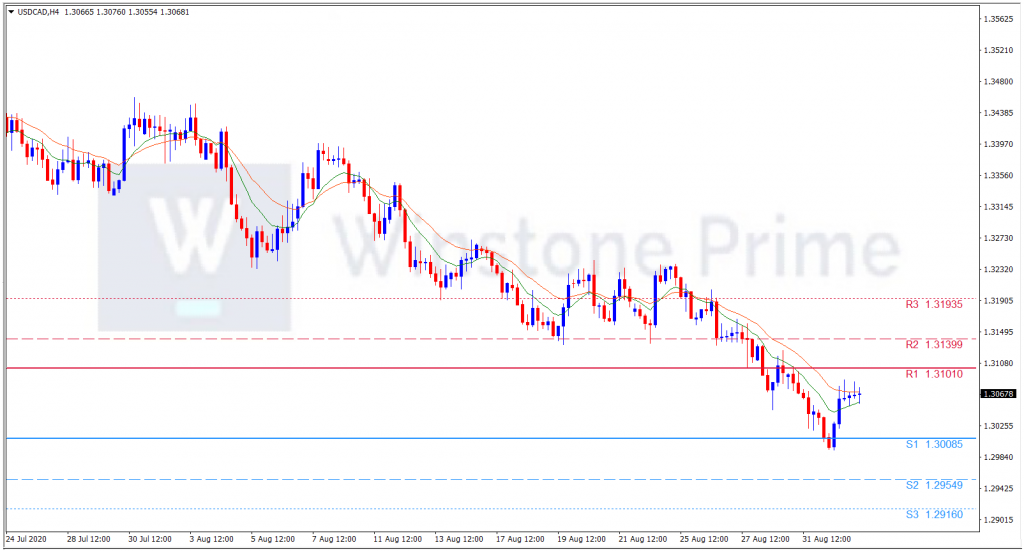
USD/CAD 4 Hour Chart:

Support: 1.3009 (S1), 1.2955 (S2), 1.2916 (S3).

Resistance: 1.3101 (R1), 1.3140 (R2), 1.3194 (R3).

ISM Manufacturing PMI gave instant strength to the dollar against many counterparts. We expect a bullish trend for USD/CAD.

Reserve Bank of Australia (RBA) interest rate supports Aussie

At its September monetary policy meeting this Tuesday, the Reserve Bank of Australia (RBA) board members kept the official cash rate (OCR) unchanged at a record low of 0.25%, as widely expected. “The board decided to maintain the targets for the cash rate and the yield on 3-year Australian government bonds of 25 basis points,” the statement read.

Banks will be able to draw upon this extra funding up until the end of June 2021.”This will help keep interest rates low for borrowers and support the provision of credit by providing (banks) greater confidence about continued access to low-cost funding,” RBA Governor Philip Lowe said in a post-meeting statement.

The RBA also hinted at further measures, while reiterating policy rates will remain low for a long time to come. He said, “The Board will maintain highly accommodative settings as long as is required and continues to consider how further monetary measures could support the recovery.”

Whereas The Caixin/Markit Manufacturing Purchasing Managers Index(PMI) rose to 53.1 last month from July’s 52.8, marking the sector’s fourth consecutive month of growth and the biggest rate of expansion since January 2011.

It was reported that  China’s factory activity expanded at the fastest clip in nearly a decade in August, bolstered by the first increase in new export orders this year as manufacturers ramped up production to meet rebounding demand, a private survey showed on Tuesday, This has favored the cyclical currency – Australian dollar.

Australia’s current account surplus in seasonally adjusted terms increased $8.7 billion to $17.7 billion in the June quarter 2020, driven mainly by increased goods and services surplus, according to the latest figures from the Australian Bureau of Statistics (ABS).

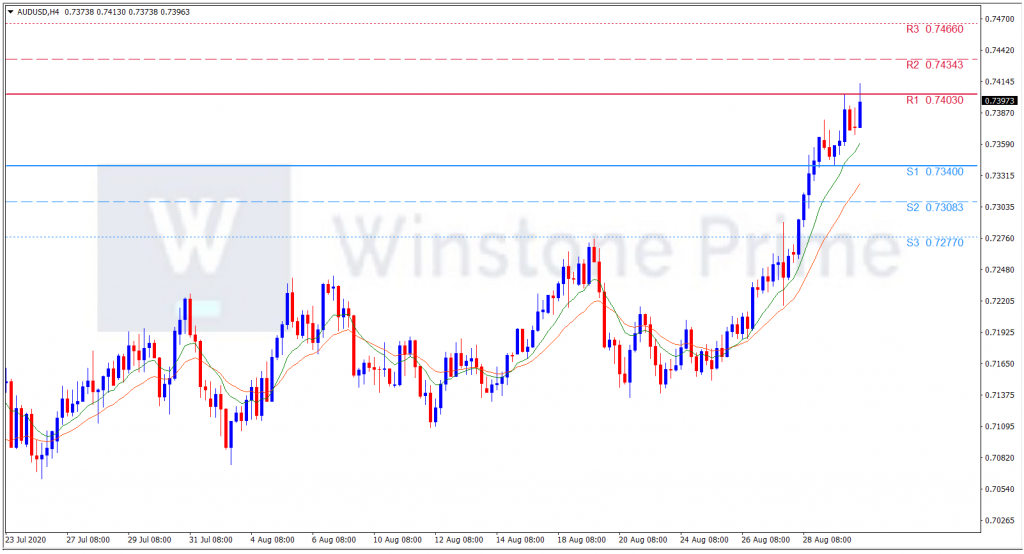
AUD/USD 4 Hour Chart:

Support:  0.73400 (S1), 0.7308 (S2), 0.7277 (S3).

Resistance: 0.7403 (R1), 0.7434 (R2), 0.7466 (R3).

Australian dollar has been benefiting from the cash rate and Australia’s current account surplus, which makes it stronger than USD. We expect a bullish trend for AUD/USD.