USDJPY – 1 Hour Trading Strategy

It is the best strategy for traders who do not prefer to trade in small time frames because it will give you 24 hrs opportunities to find a trade especially with the usd vs jpy chart.  Since the JPY is active after the main currency pairs slow down in trading volume.

Timeframes :  only on the hourly chart.

Currency Pairs : You can use only on trading USD/JPY

Trade only during the Asian trading session – 23.00 to 8.00 GMT

Trading Rules :

  • Wait until the first hour candlestick of the Asian Trading Session to close on the USD/JPY currency pair.
  • Place 2 separate pending orders – sell stop and buy stop order on both sides exactly at 2 pips from the low and high respectively.
  • Keep Stop loss at the distance from high to low of that 1-hour candlestick plus 2 pips.
  • When one pending order is activated, cancel the other one immediately.
  • Should aim for a target of 1.5 times.


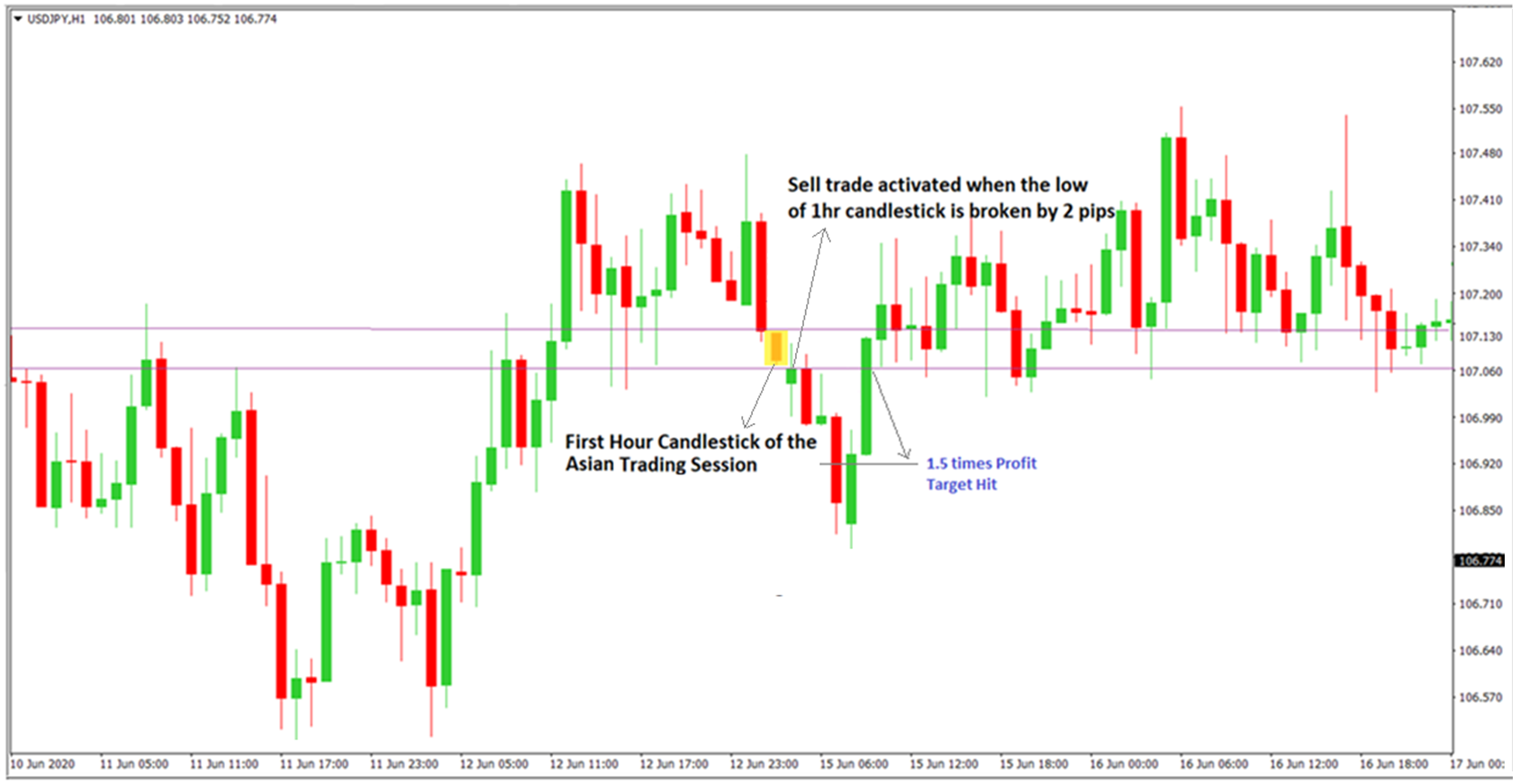
Short Entry :

Suppose your sell stop placed at 107.06 which is 2 pips lower than the low 107.08 gets hit, cancel the buy stop order, In this case, keep your stop loss at 107.15 which is 2 pips higher than the high of that 1-hour candlestick and set target at 1.5 times i.e. at 106.92.

Chart view :
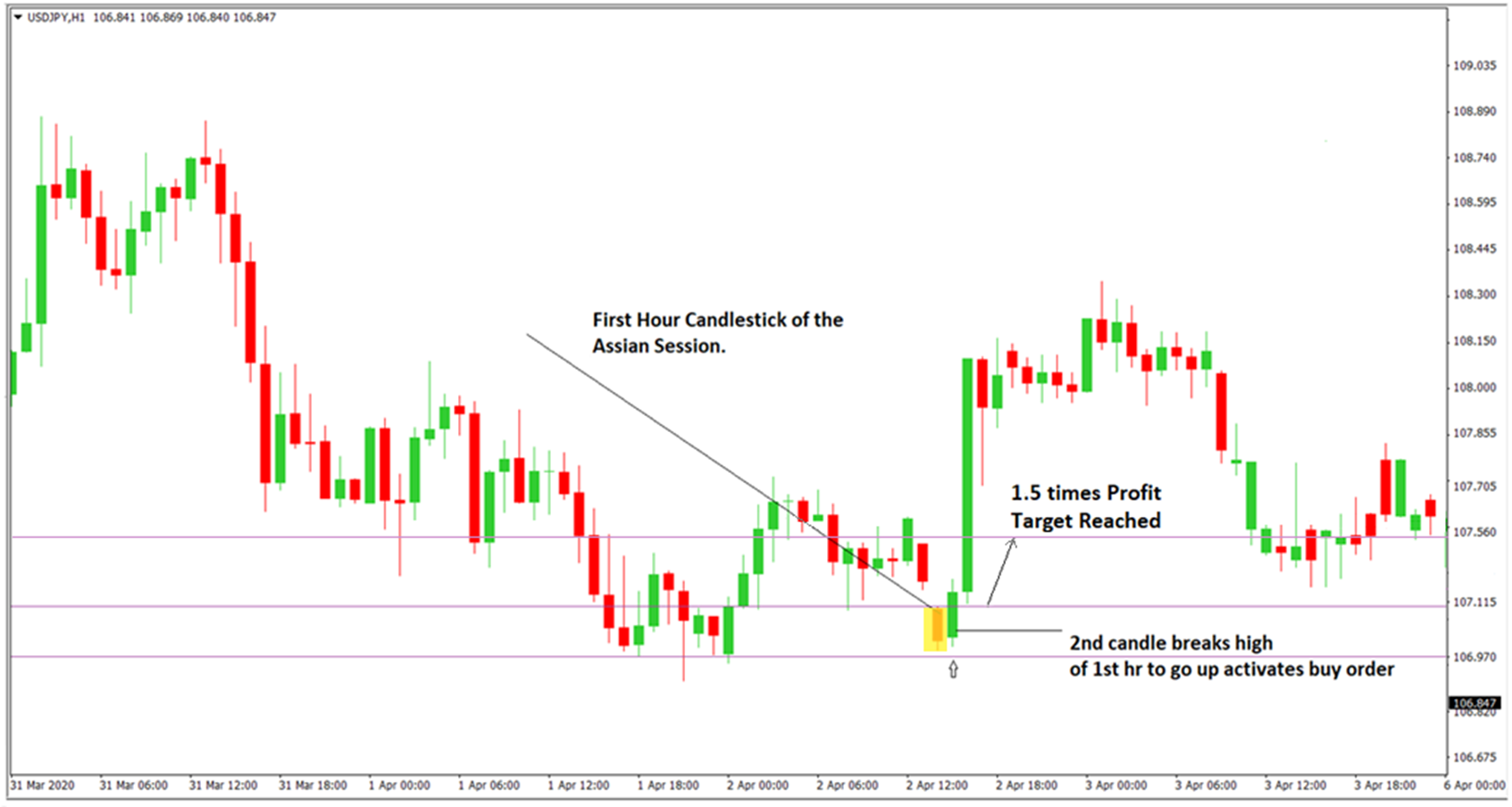
Long Entry :

Suppose your buy stop placed at 107.11 which is 2 pips higher than the high 107.09 gets hit, cancel the sell stop order, In this case, keep your stop loss at 106.97 which is 2 pips less than the low of that 1-hour candlestick and set target at 1.5 times i.e. at 107.32.                            

Chart view :
Pros :

  • Simple and easy to understand and follow.
  • Minimizes your trade as you can only trade once a day.
  • One time frame.
  • One currency pair.
  • Easy for the traders who work at day time.

Cons :

  • Asian trading session is sometimes a grind which can cause an almost instant trigger in and trigger out of the trade.
  • No strategies are 100% full proof.  Money management is vital with this strategy just like it is with any other.


The key is to be consistent with trading the 1-hour trading strategy and that also means to stick with trading USD/JPY as many of the other crosses simply range during the Asian session.
Japan’s Core CPI detriments Yen

Core consumer prices in Tokyo fell 0.3% in August from a year earlier, government data showed on Friday. The core consumer price index for Japan’s capital, which includes oil products but excludes fresh food prices, compared with economists’ median estimate for a 0.3% annual rise. Furthermore, the ex-Food and Energy CPI data lagged below 0.5% market consensus and 0.6% prior with -0.1% actual.

Fed Chair Powell announced a robust updating of the Fed’s monetary policy framework during his virtual speech at the Jackson Hole Symposium on August 27th, 2020. The Fed’s new approach could be viewed as a flexible form of average inflation targeting, allowing inflation to run moderately above or below the Fed’s 2% target for some time. This means that interest rates could be left lower for a longer period despite a rise in inflation. Regarding employment, the revised statement reflects the Fed’s view that a robust job market can be sustained without causing an outbreak of inflation and the maximum level of employment is a broad-based and inclusive goal.

The Federal Reserve has left the target range for its federal funds rate unchanged at 0-0.25 percent on July 29th, 2020 but opened the door for further monetary easing to support the world’s largest economy through the pandemic.

Adding to the upbeat mood are talks concerning the US corona virus (COVID-19) stimulus package. After a 25-minute phone call between the House Speaker Nancy Pelosi and White House chief of staff Mark Meadows, Pelosi issued a statement saying “this conversation made clear that the White House continues to disregard the needs of the American people as the corona virus crisis devastates lives and livelihoods.”She said the sides stood at a “tragic impasse” after the Trump administration again did not meet her demand to roughly double the price of its aid proposal to $2.2 trillion.

“Democrats are willing to resume negotiations once Republicans start to take this process seriously.  Lives, livelihoods, and the life of our democracy are at stake,” the California Democrat said in the statement.

On the other hand, news that Japan’s Prime Minister (PM) Shinzo Abe is planning to provide the virus vaccine for the entire nation offers additional strength to the market optimism.

USD/JPY 4 Hour Chart:

Support: 105.87 (S1), 105.19 (S2), 104.77 (S3).

Resistance: 106.97 (R1), 107.38 (R2), 108.06 (R3).

Looking forward, traders will keep eyes on the risk catalysts amid a lack of major data/events in Asia. However, the broad risk-on mood can keep the quote on the positive side unless wither any worrisome comments roll out of Wyoming or the US data mark heavy declines.

Australia’s Private Capital Expenditure encourages Aussie

A better-than-expected Aussie business spending data supports Aussie. While business spending, as represented by private capital expenditure (CAPEX), fell 5.9% in the second quarter, the actual reading was better than the forecasted drop of 8.4%. The third estimate for 3 for 2020-21 came in at $98,624 million – 12.6% lower than the third estimate for 2019-20. However, the third estimate is 8.9% higher than the second estimate of  2020-21.

Firms did scale back future spending plans, but again by not nearly as much as expected, thanks in part to the mining sector which is benefiting from strong Chinese demand.

Marcel Thieliant, an economist at Capital Economics said “The upshot is that the outlook for capital spending isn’t as gloomy as one would expect in the current environment.” The GDP data is due next week. He now estimated gross domestic product likely fell by around 4.5% in the June quarter, from the previous quarter, up from a previous forecast of 6.5%.

Investor confidence in Australian assets was underlined by details of the government’s huge A$21 billion ($15.20 billion)bond sale on Wednesday, which drew A$66 billion of bids. Some 46% of the record offer went to foreign investors, mostly in Asia ex-Japan, the U.S., and the UK. Fund managers bought almost 31% of the issue and hedge funds contributed to 20%.

Australian shares rose on Thursday, tracking Wall Street’s record-setting rally overnight, as sentiment was lifted by a fall in new COVID-19 cases in the country’s virus hot spot state. The southeastern state of Victoria recorded 23 deaths from the new coronavirus in the last 24 hours and 113 new cases, its lowest daily rise in nearly two months, due to strict lockdown measures.

The Investors are now keen towards the Jackson Hole Symposium, They await the Federal Reserve (Fed) Chair Jerome Powell’s speech, up for publishing at 14:00 GMT, to get the hints of September month policy meeting. The latest rumors suggest the Average Inflation Targeting (AIT), a measure favoring further easy money policy, is on the cards. Though, Talks over the growth stories can’t be ignored. It should also be noted that the US second quarter (Q2) GDP, expected -32.5% versus -32.9%, precedes the speech, and will be the key to watch as well.

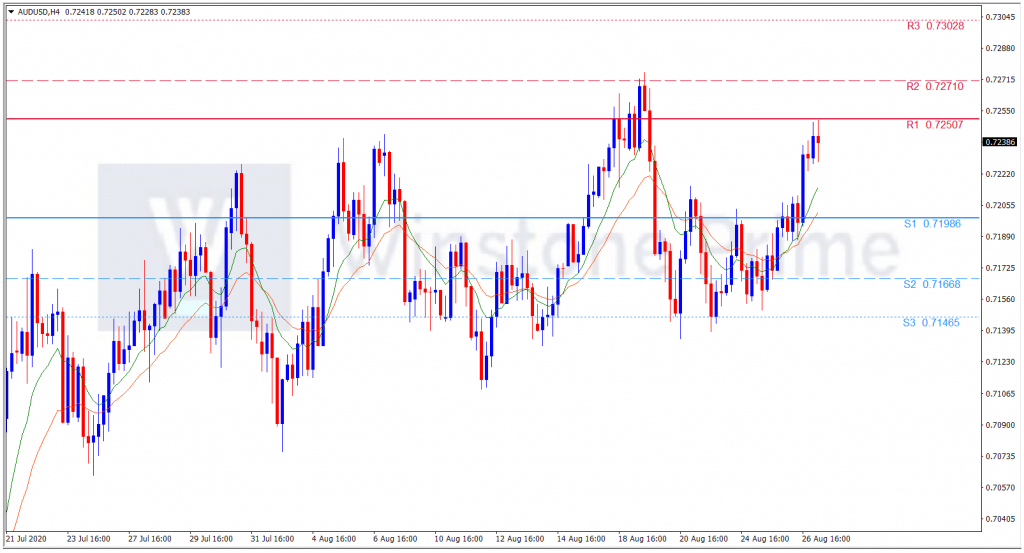
AUD/USD 4 Hour Chart:

Support: 0.7199 (S1), 0.7167 (S2), 0.7147 (S3).

Resistance: 0.7251 (R1), 0.7271 (R2), 0.7303 (R3).

In the prevailing condition, Aussie seems to be stronger than Dollar, whether Fed Chair Powell’s speech later today changes the trend is yet to be seen. As of now, we expect a bullish trend for AUD/USD.

BOJ Kiuchi’s pessimistic outlook impacts Yen

Former Bank of Japan (BOJ) policymaker Takahide Kiuchi said that Japan is likely to slip back into deflation over the coming three years due to the corona virus pandemic and its impact on the domestic consumption and labor market.

Takahide Kiuchi said that cutting interest rates further will hurt already weak regional lenders, which could face a build-up of bad loans as they boost lending to cash-strapped firms hit by COVID-19.

 Kiuchi, currently executive economist at Nomura Research Institute. Said “Japan will likely see more small and midsized firms go under as the pandemic’s pain deepens, which could boost credit costs for lenders through next year,”

“The pandemic has forced the BOJ to be more mindful of the risk of banking-sector problems, which means it can’t cut interest rates easily,” he told on Tuesday.

Kiuchi said Japan will need about five years for gross domestic product (GDP) to return to pre-pandemic levels.

During his five-year tenure at the BOJ until 2017, Kiuchi was a consistent dissenter to Kuroda’s radical stimulus measures on the view that excessive money printing could do more harm than good.

While BOJ Governor Haruhiko Kuroda has stressed his readiness to cut rates if needed, many analysts see that option is highly unlikely given the strain years of ultra-low rates have inflicted on commercial banks’ profits.

Japan suffered its biggest economic slump on record in the second quarter as the pandemic hit consumption and exports. Core consumer prices stood flat in July from a year earlier.

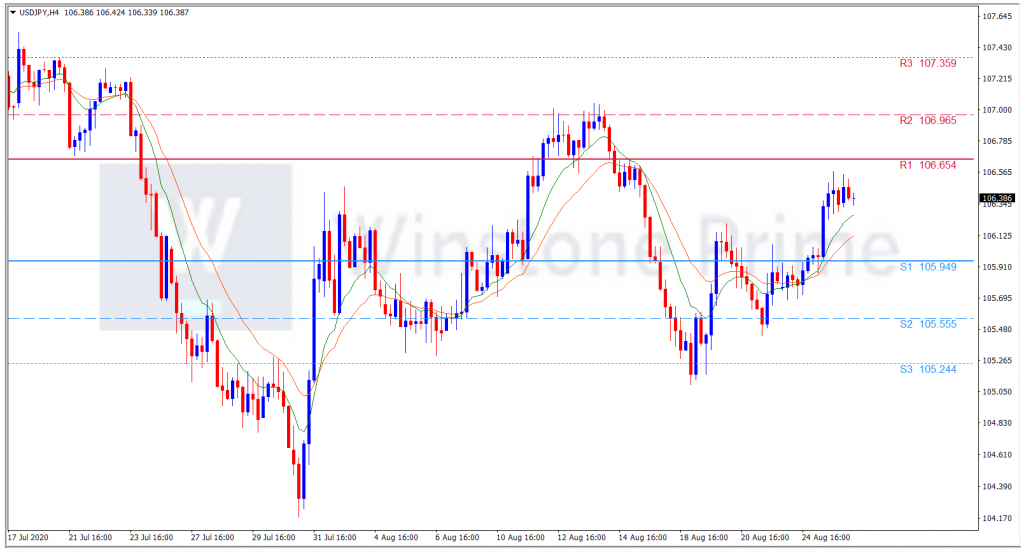
USD/JPY 4 Hour Chart:

Support: 105.95 (S1), 105.56 (S2), 105.24 (S3).

Resistance: 106.65 (R1), 106.97 (R2), 107.36 (R3).

Amidst all the catalysts creating unfavorable impact on Japan, Yen seems to struggle. We expect a bullish trend for USD/JPY.