Weakening dollar and trade optimism favors Euro

The dollar seems to struggle ahead of the Thursday speech from U.S. Federal Reserve Chair Jerome Powell. Fed Chair Powell on Thursday addresses a virtual Jackson Hole symposium with the theme “Navigating the Decade Ahead: Implications for monetary policy.” Investors expect he might address the bank’s strategy – especially its 2% inflation target, with speculation that could become an average rather than nominal aim.

“If we don’t get dovishness, I expect you might actually get rates rising and pop up higher in the U.S. dollar,” said Westpac FX analyst Imre Speizer.

“The dollar has had a massive fall since March,” he said. “I think what we’re seeing now is any excuse to buy it back as the punters who have been short all the way down get quite nervous and take the money off the table.”

Leon Cooperman said that The Federal Reserve has created a speculative bubble that has pushed debt levels beyond what the U.S. economy can support. He said “It took the U.S. 244 years to go from zero national debt to $21 trillion,” “We will probably end this year with $27 trillion. That’s a growth rate in debt far in excess of what the economy is growing at and I think that’s going to be a problem down the road.”

Trade optimism and positive news on the corona virus vaccine front has created optimism among the investors. Top US and Chinese officials on Monday agreed to take necessary steps to ensure the success of the US-China phase one trade deal.

In addition, It was reported that the Trump administration is considering providing “emergency use” approval of the experimental corona virus vaccine from AstraZeneca and Oxford University before the Presidential Elections, due in November this year.

EUR/USD 4 Hours Chart:
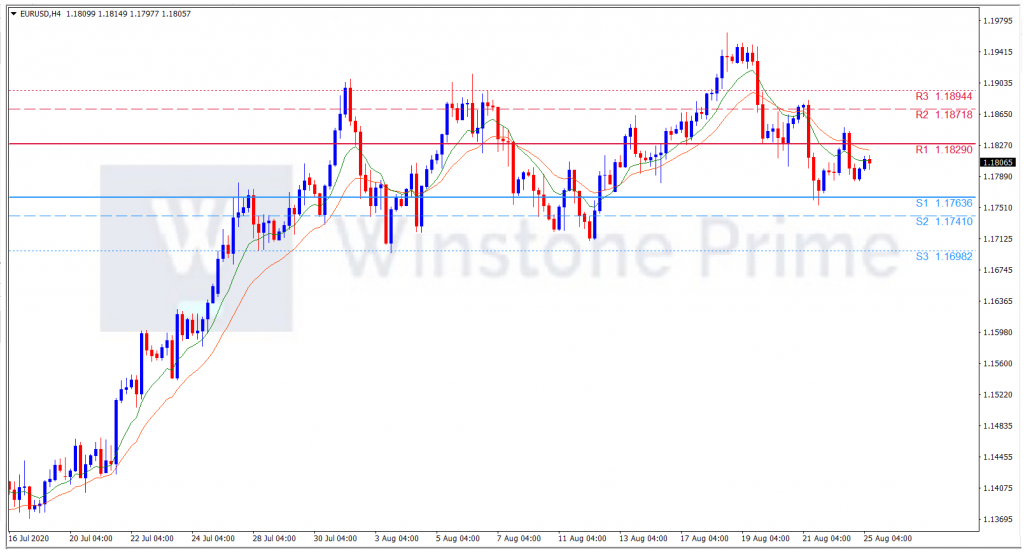
Support: 1.1764 (S1), 1.1741 (S2), 1.1698 (S3).

Resistance: 1.1829 (R1), 1.1872 (R2), 1.1894 (R3).

The improved risk appetite and the resulting weakness in the dollar has made the day for EUR/USD.  We expect a Bullish trend for the pair.

Core Retail Sales quarterly report pressurizes Kiwi

New Zealand Retail Sales Ex-Inflation for the second quarter (Q/Q, Q2) arrived at -14.6% vs expectations of -15.0% and prev -0.7%, putting sales 14.2 percent lower on the year.

Sales values drop to historic levels, Twelve of the 15 industries had lower sales in the June 2020 quarter compared with the June 2019 quarter. The result was heavily impacted by the Covid-19 lock-down of the economy in April. As the alert level was dialed back through the quarter, spending did pick up. However, that did not offset the loss of spending in April, or the loss of international tourists. The decline in spending was widespread but heavily centered on areas associated with hospitality and tourism. For instance, spending on accommodation and hospitality was down 40%. Spending on durable items like furnishings and apparel was down around 10% to 20%. The only category that held up was spending on groceries.

The corona virus (COVID-19)-led economic slowdown was also portrayed in the monthly New Zealand Credit Card Spending, down 5.8% in July, The Retail Sales ex-Autos grew 0.6% during the first quarter (Q1) of 2020 on a QoQ basis.

There are vulnerabilities masked by the weakness in the US dollar and at closer inspection, the NZD has actually been under-performing the dollar bloc ever since the last Monetary Policy Statement., (MPS). In fact, the kiwi has been the worst-performing G10 currency year to date. At the previous MPS on the 12th of August, the Reserve Bank of New Zealand’s message was extremely dovish.

The pandemic’s resurgence in the Pacific nation, coupled with the RBNZ’s recently dovish tone, downbeat data is likely to exert additional pressure on the NZD/USD prices. However, the market already knows that the negative outcome will arrive and hence the quote’s declines will be for a short time and may not push RBNZ towards any major decision-making.

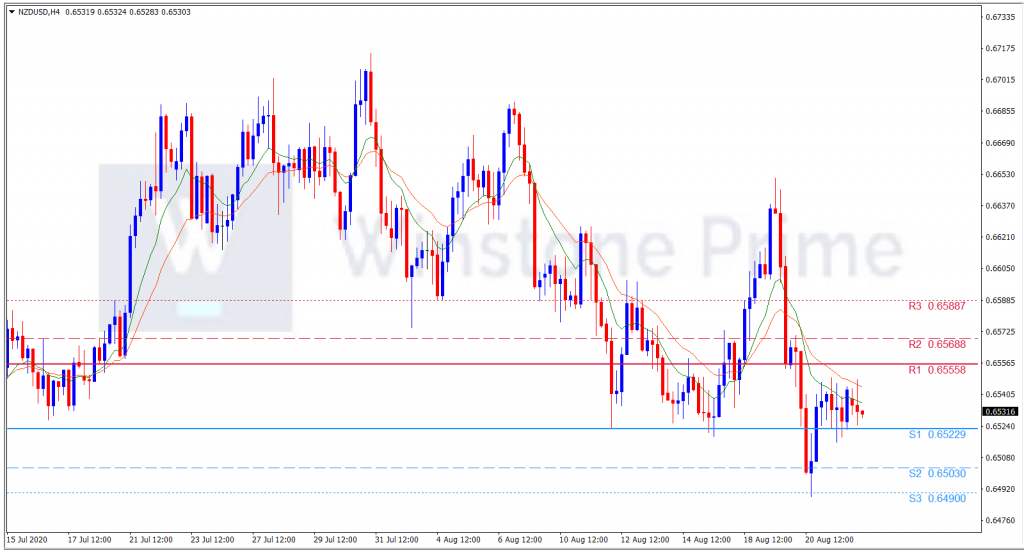
NZD/USD 4 Hour Chart:

Support: 0.6523 (S1), 0.6503 (S2), 0.6490 (S3).

Resistance: 0.6556 (R1), 0.6569 (R2), 0.6589 (R3).

Considering all the negative data for the bird. We expect a bearish trend for NZD/USD.

XAU/USD Weekly Forecast (24th August 2020 – 28th August 2020)

Fundamental view:

Gold fell in the last week as optimism among investors developed for the greenback as it started gaining strength. Improved productivity thanks to telework turns to be a bad news for gold

Looking ahead, it remains to be seen if Chairman Jerome Powell and Co. will reveal anything new at the Kansas City Fed’s Economic Symposium in Jackson Hole, Wyoming scheduled for August 27-28 as “members agreed that the Federal Reserve was committed to using its full range of tools to support the U.S. economy in this challenging time.” In turn, the Fed symposium may indicate more of the same for the September meeting, and current market conditions may keep the price of gold afloat as the crowding behavior in the Greenback looks poised to persist over the remainder of the month.          

The major economic events deciding the movement of the pair in the next week are CB Consumer Confidence at Aug 25, US Core Durable Goods Orders monthly report, Crude Oil Inventories at Aug 26, US Prelim GDP quarterly report, Fed Chair Powell Speaks at Aug 27 for US, Jackson Hole Symposium at Aug 27 & 28.

XAU/USD Weekly outlook:

Technical View:

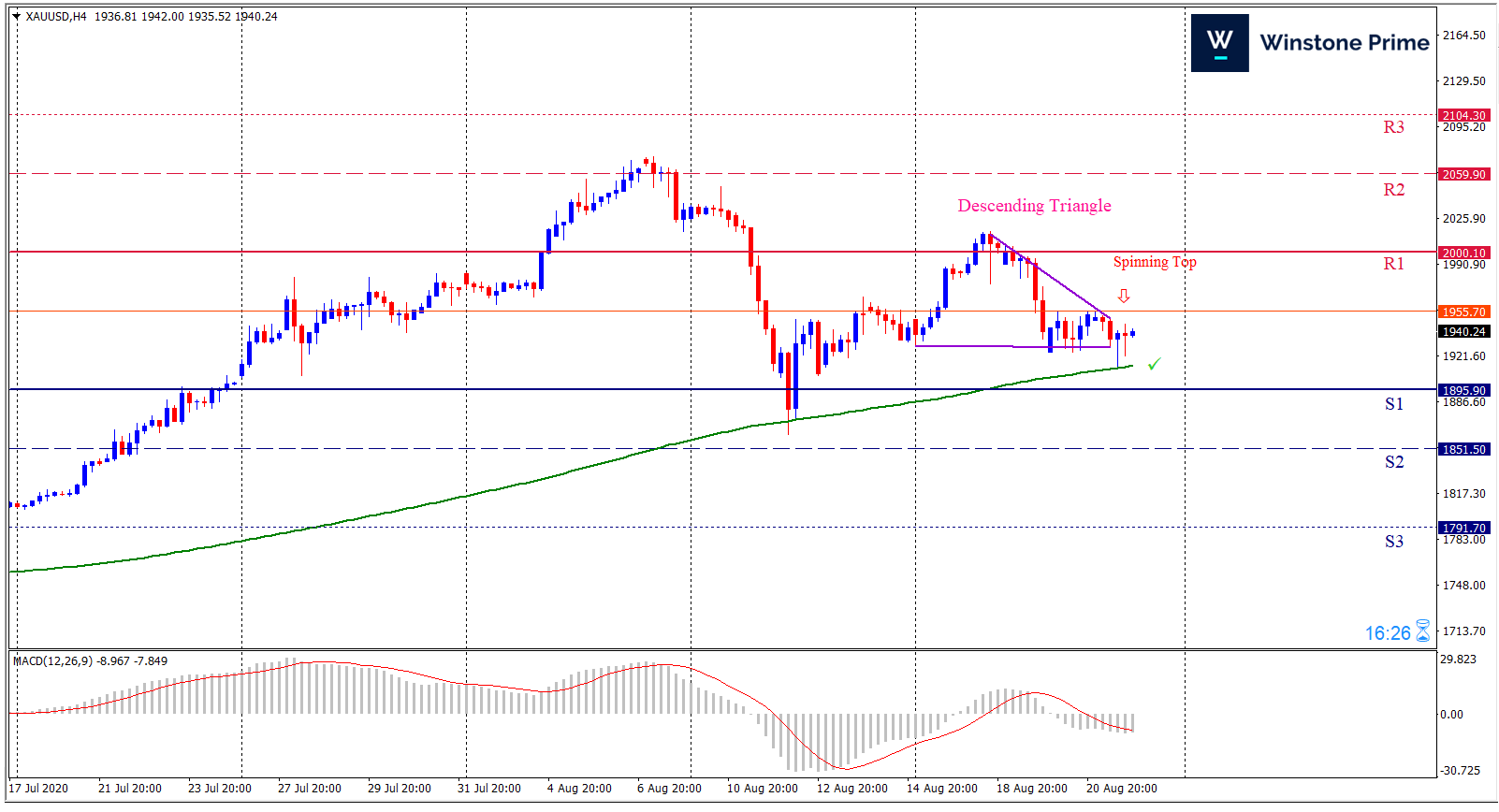
Last week’s high was 1.66% lower than the previous week. Maintaining high at 2015.6 and low at 1911.4 showed a movement of 1042 pips.

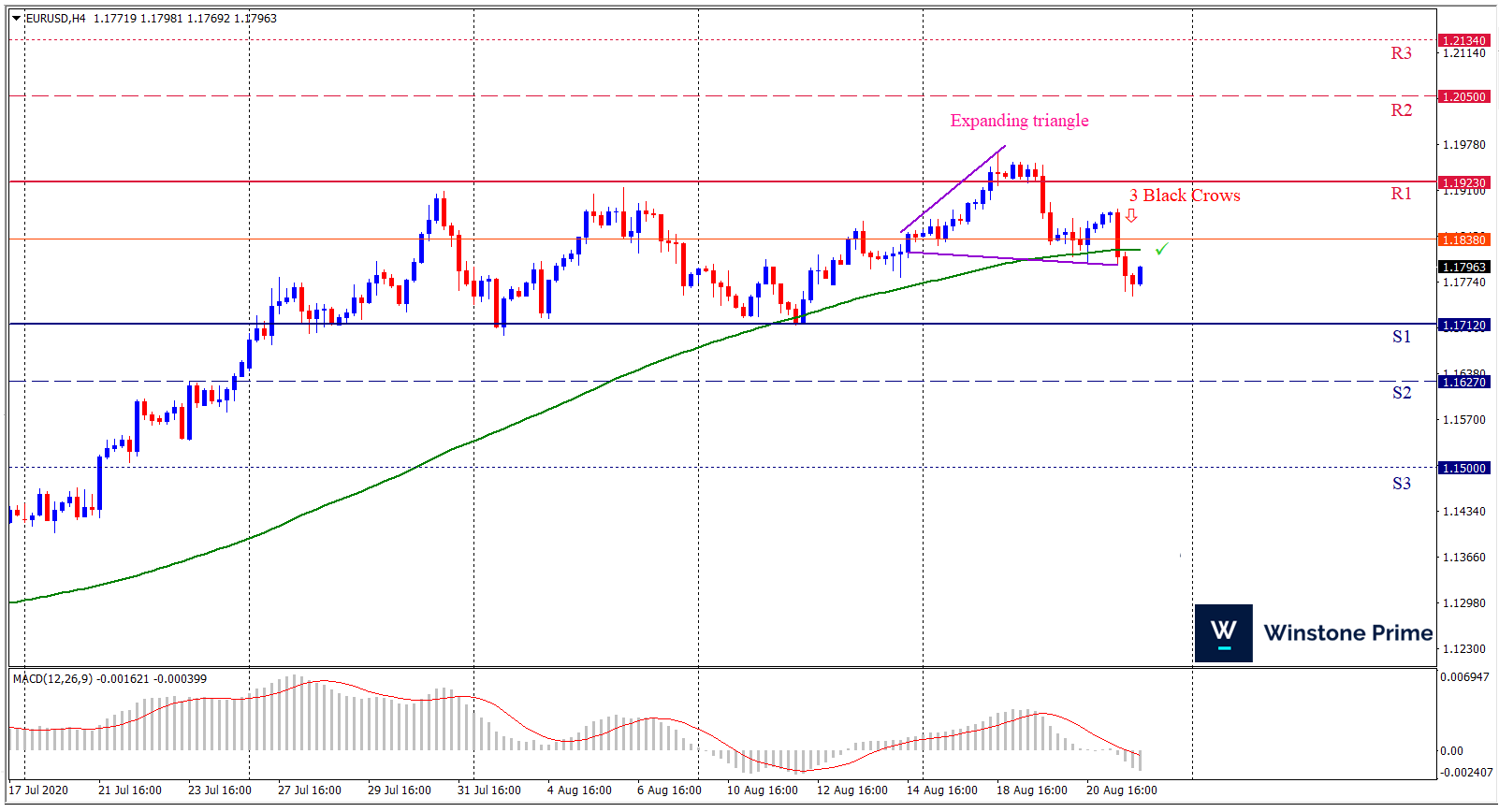
In the upcoming week we expect XAU/USD to show a bearish trend.  The Instrument is trading above the 200 Simple Moving Average and the MACD trades to the downside. A solid breakout below 1895.9 may open a clean path towards 1851.5 and may take a way down to 1791.7. Should 2000.1 prove to be unreliable resistance, the XAUUSD may raise upwards 2059.9 and 2104.3 respectively. In H4 chart Descending Triangle breakout favors prospects of a bearish trend. Also to be noted Spinning top formation exerts the expectation of downtrend for the pair.

Preference
Sell:  1951.2 target at 1882.4 and stop loss at 2005.9


Alternate Scenario
Buy: 2005.9 target at 2063.1 and stop loss at 1951.2

EUR/USD Weekly Forecast (24th August 2020 – 28th August 2020)

Fundamental view:

The Euro could not manage against the greenback last week and forecasted a bearish trend. US Empire State Manufacturing Index on 17th Aug and Europe Current Account, Final CPI yearly on 19th Aug favored uptrend for the pair whereas US NAHB Housing Market Index on 17th Aug, Europe German Flash Services PMI and US Flash Manufacturing PMI on 21st Aug favored downtrend for the pair.
 
The Pair has dropped last week as dollar gained strength. In the upcoming week we expect the greenback to gain strength and the pair to fall.

The major economic events deciding the movement of the pair in the next week are German Final GDP quarterly report, US CB Consumer Confidence at Aug 25, US Core Durable Goods Orders monthly report at Aug 26, US Prelim GDP quarterly report, Fed Chair Powell Speaks at Aug 27, German Import Prices monthly report, Jackson Hole Symposium at Aug 27 & 28.

EUR/USD Weekly outlook:

Technical View:

Last week’s high was 0.86% higher than the previous week. Maintaining high at 1.1965 and low at 1.1754 showed a movement of 211 pips.

In the upcoming week we expect EUR/USD to show a bearish trend. The currency pair is trading below the 200 Simple Moving Average and the MACD trades to the downside.  A solid breakout below 1.1712 may open a clean path towards 1.1617 and may take a way down to 1.1500. Should 1.1923 prove to be unreliable resistance, the EURUSD may raise upwards 1.2050 and 1.2134 respectively. Chart formation of an Expanding triangle pattern breakout in H4 chart sets prospects for a bearish trend. Three Black Crows formation in H4 chart escalates the expectation for a bearish trend.

Preference
Sell: 1.1805 target at 1.1629 and stop loss at 1.1956


Alternate Scenario
Buy:  1.1956 target at 1.2133 and stop loss at 1.1805