The delay in the aid package decision pressurizes Greenback

The US on Tuesday added 1302 death from COVID 19 in 24 hrs. The world’s largest economy added 53847 new cases of the virus. The US has now recorded 4,765,170 total cases with 156,668 deaths making it far the worst-hit country in the world.

The US Congress seems unable to find common ground on the next aid package, a headline that affected the market’s mood. Both sides Democrats and Republicans said they agreed to a series of concessions but also acknowledged they still had a number of differences that they were attempting to work through, though neither would lay out specific policy items.

“They made some concessions, which we appreciated. We made some concessions, which they appreciated. We’re still far away on a lot of the important issues,” Schumer told reporters after the meeting. “The fundamental disagreement is the scope and depth of the problem and its solution.”

At the same time speculation that stalemate over fiscal policy in Washington could leave the Federal Reserve with more to do, has hastened a steady decline in U.S. yields – undermining the dollar more broadly.

“U.S. economic outperformance, relative to the euro zone and Japan, is no longer guaranteed given the damage from the COVID-19 pandemic,” said Tai Hui, J.P. Morgan Asset Management’s chief strategist in Asia.

“Dollar interest rates are also converging to other developed economies’ interest rates, which means that the dollar is less appealing,” he said, adding it is difficult to see the Fed easing policy ahead of its global peers.

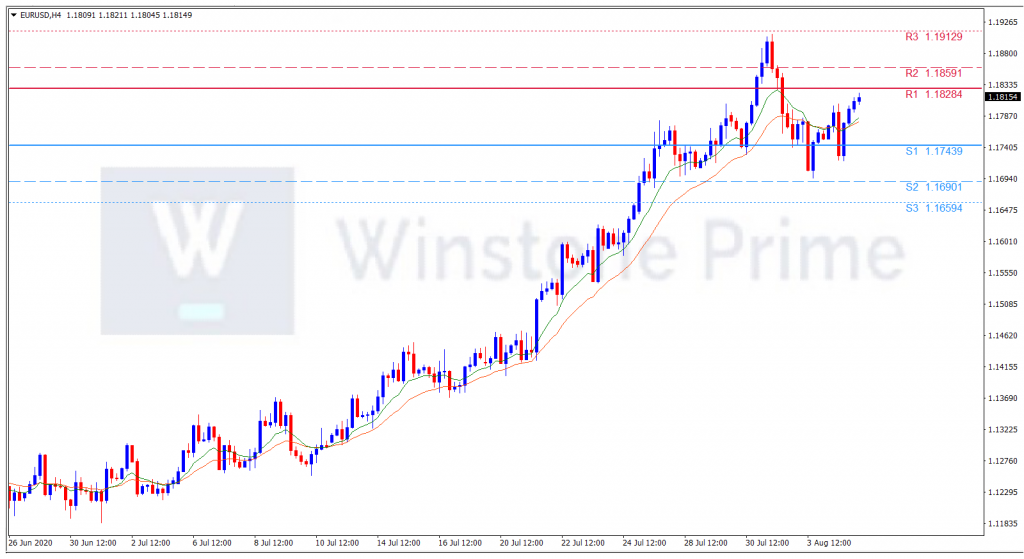
EUR/USD 4 Hour Chart:

Support: 1.1744 (S1), 1.1690 (S2), 1.1659 (S3).

Resistance: 1.1828 (R1), 1.1859 (R2), 1.1913 (R3).

Amid all the negative sentiments for the Dollar, we expect a bullish trend for EUR/USD.

RBA’s monetary policy braces Aussie

The Reserve Bank of Australia’s (RBA) monetary policy decision was out at 04:30 GMT on Tuesday while the recent pessimism concerning the coronavirus (COVID-19) outbreak in Victoria was prevailing in the market.

 The RBA left its currency monetary policy adjustment unchanged for the third straight August, maintaining a record low of 0.25% of the official cash ratio (OCR), widely expected.  “The Board decided to maintain the current policy framework, including targets for the monetary ratio and the yield of 25 basis points on 3-year Australian Government bonds,” the report said. “The Board decided to maintain the current policy framework. Targets for cash rates and yields of 3-year Australian Government bonds of 25 points,” the report said.

Australia’s Outbound shipments or exports rose 3% in June following May’s 4% contraction. In addition, consumer spending, as represented by seasonally adjusted retail sales rose 2.7% month-on-month in June, beating the preliminary forecast of 2.4%. Trade surplus rose to AUD 8,202 million from AUD 8,025 million.Imports rose 1% following May’s 6% contraction.

TD Securities, on the other hand, expect no major surprises from the event: “RBA Board Meeting should have the target cash rate remaining at 0.25%. The Minutes of the July meeting and the Governor’s speech released on 21st July indicated the door is shut to further policy easing, the Minutes concluding there is “no need to adjust the package of policy measures in Australia in the current environment”. Otherwise, on Tuesday the market will look to get a flavor of the Bank’s latest set of forecasts for GDP, CPI, and unemployment that will be published on Friday”

The traders are cautious amid the latest recovery in the US dollar and strict lockdown conditions in Victoria. The pandemic distracts the growth outlook in both economies.

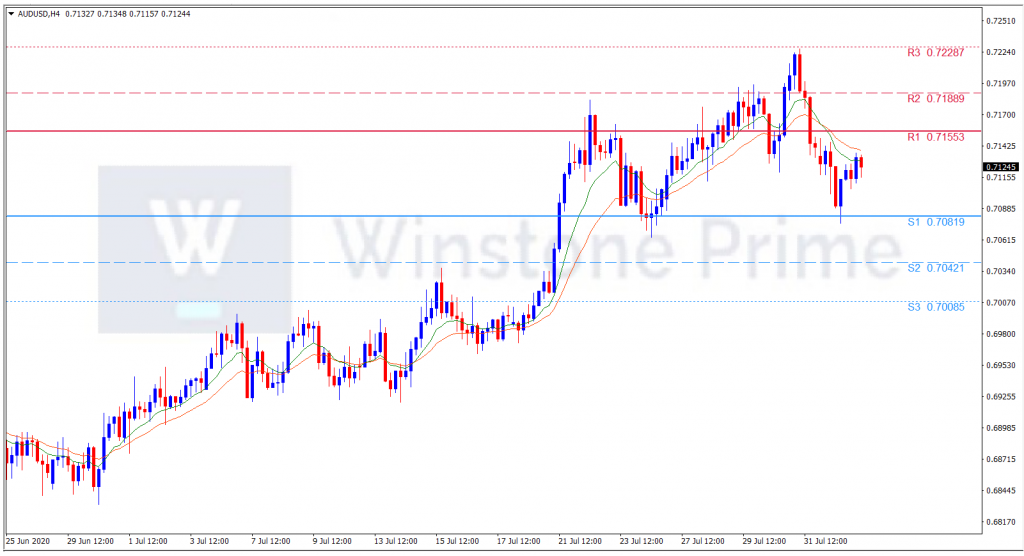
AUD/USD 4 Hour Chart:

Support: 0.7082 (S1), 0.7042 (S2), 0.7009 (S3).

Resistance: 0.7155 (R1), 0.7189 (R2), 0.7229 (R3).

The recent data have been price-positive for Aussie but witnessing future weakness in the Aussie, due to the virus, can’t be ruled out. We expect a short term bullish trend for AUD/USD.

Manufacturing PMI data and Q1 GDP data impacts Yen

The manufacturing sector in Japan employs more than 10 million people, equivalent to about 8% of the country’s total population. It is responsible for more than 10% of the total GDP. Its manufactured products like Toyotas and Hondas are used around the world.

According to Markit and au Jibun bank, the manufacturing sector made a good progress in July as the country continued to reopen. The headline manufacturing PMI rose to 45.2 in July, up from 40.1 in the previous month. A PMI reading of below 50 usually shows that a sector is in contraction. Still, the number was far higher than the 11-year low of 38.4 seen in April.

The data showed that manufacturing volumes dropped at the slowest pace in five months. Similarly, new orders fell to the smallest degree since February. Tim Moore of Markit said: “Looking at output trends by market group, consumer goods fared better than the rest of the manufacturing sector. Production of consumer goods was close to stabilisation in July, despite a headwind from weaker orders from abroad.”

Increasing case numbers of COVID 19 in Japan’s largest cities threaten jobs and home consumer spending. Prime Minister Shinzo Abe is already facing a budget deficit after pledging about $ 2 trillion in stimulus, but this recovery could force his administration to spend more. The government said last week that it did not see the opportunity to balance the budget before the end of March 2030.

According to the Q1 GDP data. The numbers showed that the economy shrank by 2.2% in the first quarter compared to the first three months of 2019. This data came two weeks before the first preliminary second-quarter GDP data. Analysts believed that the economy shrank by about 20% in the second quarter which will be the worst slowdown since 1955. This puts pressure on the Yen.

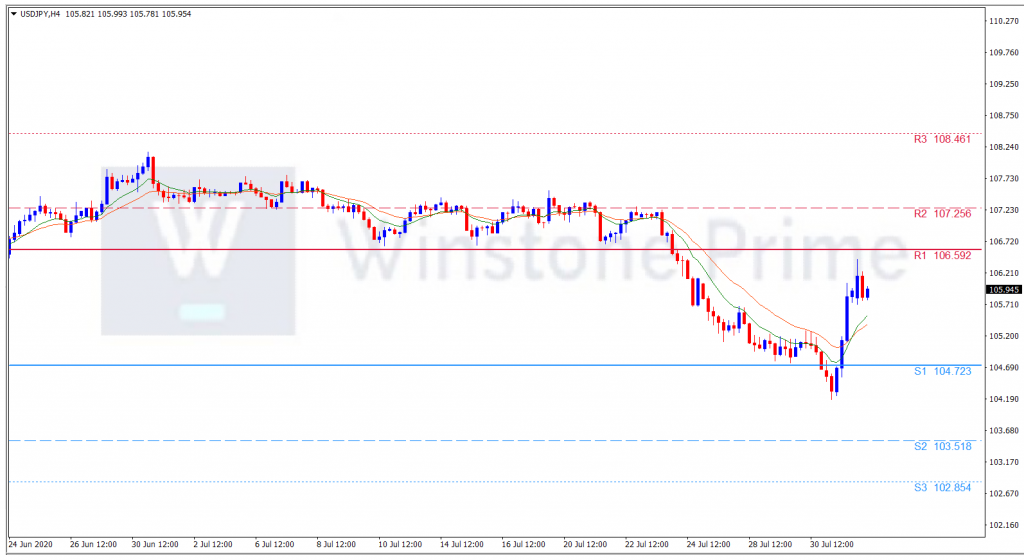
USD/JPY 4 Hour Chart:

Support: 104.72 (S1), 103.52 (S2), 102.85 (S3).

Resistance: 106.59 (R1), 107.26 (R2), 108.46 (R3).

The strong manufacturing PMI data from Japan made USD/JPY pair to slightly decline but the pair also reacted to relatively strong Q1 GDP data from Japan. We expect a bullish trend for the pair.

Cryptocurrencies trading – Complete guide 2020

Cryptocurrency is a type of ”digital asset” or ”digital currency” generated by various encryption techniques. Cryptocurrencies are not regulated or managed by any financial authorities, or bank, in the same way as traditional currencies are. It is mostly self-regulated and users within associated networks providing the verification that enables transactions to occur. The digital coin is designed to be transferred between people in virtual transactions.

Blockchain – The Technology Behind Cryptocurrencies

Bitcoin was originally proposed as an electronic payment system based on cryptographic proof. The cryptographic proof came from the emerging technology of the blockchain — a kind list of digital signatures that provide computational evidence describing the entire transaction history of each Bitcoin. This public chain of ownership allows peer-to-peer transactions, without any need to entrust a third-party with the task of processing the payment.

Cryptocurrencies can be bought and sold via exchanges and stored in ‘Block Chain Wallets’. When a user wants to send cryptocurrency units to another user, they send it to that user’s digital wallet. The transaction isn’t considered final until it has been verified and added to the blockchain through a process called mining. This is also how new cryptocurrency tokens are usually created. Every time someone pays via e-coin, his payment is recorded on a digital ledger called the blockchain.

A list of transaction records, called blocks, which are linked to each other and encrypted. The blockchain is continuously growing and is completely open to anyone.

Each block in the blockchain contains:

♦ The details of the sender, receiver and amount of e-coins.

♦ A hash, which serves as a unique fingerprint.

♦ A hash of the previous block in the chain.

When a new block is created, it is sent to all the users in the network. Each user then verifies the block and it is added to the blockchain.

Popular Cryptocurrencies in Trading

The success of Bitcoin has led to a huge rise in digital currencies in recent years. There are now hundreds of cryptocurrencies available to trade on. The following are the Major cryptocurrencies available for trading.

♦ Bitcoin

♦ Ethereum

♦ Litecoin

♦ Dash

Bitcoin – The Digital Gold

cyprto3

Bitcoin is the eldest child in the cryptocurrency family. Dating back to 2009, this makes it substantially older and more established than its nearest cryptocurrency rival in terms of capitalization. Because it is the most mature cryptocurrency, it shouldn’t come as much of a surprise that it generates the most headlines.

Throughout the years, those headlines were plentiful, on account of Bitcoin’s remarkable growth in value. One way to profit from an increase in value is to purchase Bitcoin and store it in a wallet, with the aim to sell it at a higher price in the future

Valuations in early 2018 pulled back substantially from the highs seen at the end of 2017, and this correction has been accompanied by some wild swings in price. While many traders will see this volatility as an opportunity, it is important to trade with caution during such times. The choice, of course, is yours. Bitcoin can be easily predicted using technical analysis figures, making your trading more profitable. Bitcoin is the most profitable instrument for trading in USD.

Bitcoin’s ISO code is XBT, but most trading venues list pairs using BTC ticker.

Ethereum – Invest in the Future

cyprto4

Ethereum blockchain was launched by Vitalik Buterin in 2015. Ethereum  is a decentralised, where Bitcoin is a currency pure and simple, Ethereum is a whole lot more. It takes the technology at the heart of Bitcoin. Ethereum offers substantially faster transaction times compared to Bitcoin, owing to its shorter block time – which is the mean amount of time for the network to generate another block within the

blockchain. This also means lower transaction fees compared with Bitcoin.

Ethereum has quickly grown in popularity and is currently the second-largest cryptocurrency by market capitalization ($17 billion at the time of writing).

The Ether currency does not have its own ISO code, but a common trading symbol for it is ETH.

Litecoin – Crypto Silver

cypro5

Litecoin was first issued in 2011 and is quite similar to Bitcoin. If Bitcoin can be defined as the ‘gold’ of today’s cryptocurrencies, this makes Litecoin the ‘silver’. Litecoin provides secure and fast transactions inside the blockchain, with the ability to purchase goods on the internet.

The Litecoin price now greatly depends on Bitcoin. That makes it possible to use the Pairs trading strategy with Bitcoin as the main currency to successfully forecast Litecoin changes.

Litecoin’s trading ticker is LTC.

Dash OR Alt Coin

cypto6

Dash is a cryptocurrency network built as a decentralized autonomous organization. Originally launched in 2014 as XCoin by Evan Duffield, it became known as Dash in 2015. It uses Bitcoin-like code at its core but adds other features. The most important of them is PrivateSend, which enables anonymous transactions. Like Bitcoin, Dash is designed to have limited supply (deflationary model).

Unlike most cryptocurrencies, the trading symbol for Dash uses four letters: DASH.

Ripple

cypro7

Ripple is quite different from conventional cryptocurrencies. It is a payment protocol built on top of a distributed ledger. Ripple was launched in 2012 by the Ripple company. Even though the protocol is open-source, ripples (the currency used in the Ripple network) have all been premined by the developer company and cannot be mined by the network participants. However, it is not very important if you only plan trading ripples speculatively.

The common symbol for ripple units on exchanges and brokers is XRP.

Trading on Crypto Exchanges

The easiest way for many people to obtain some cryptocurrency units is via many exchanges. Convenientlly, the same exchanges offer speculative trading opportunities to their customers. Not only can traders transact by exchanging one currency (crypto or fiat) for another, they can also engage in leveraged trading using a margin account.

Margin Trading

Leveraged trading on exchanges is funded by margin lending provided by other exchange participants (margin investors). Traders borrow funds for each trade they make at a varying interest rate and pay it for as long as the position remains open. The entire process is performed by the trading platform in an automatic mode.

Trading via Forex Brokers

Forex brokers had been quick to realize that they could be offering cryptocurrency pairs alongside the normal fiat currency pairs. They normally offer crypto trading in form of CFDs (contracts for difference), where each trade is effectively a bet as no exchange between assets is actually performed. In theory, this allows brokers to offer a higher leverage and lower commission, but in practice, due to low competition, these parameters remain quite close to their exchange counterparts.

The list of trader’s expenditures when trading cryptocurrency CFDs is similar to that of an exchange trader: You probably already have an account at some FX broker, so you do not need to open an exchange account to trade cryptocurrencies. Trading infrastructure (MetaTrader platform, for example) is usually more sophisticated than on exchanges; it is also more familiar if you are an experienced Forex trader.

Trading big amounts is easier – your deals do not affect the underlying market.

Trading Futures

Since December 2017, Bitcoin futures contracts are available for trading. This allows traditional financial traders to participate in the cryptocurrency market. The advantages of trading Bitcoin via futures are the following:

♦ Regulated environment with nearly zero counterparty or execution risk.

♦ No risk of hacking.

♦ Low cost of opening and holding positions.

♦ Open to US traders.

Why Trade Cryptocurrency Pairs at All?

A common question asked by many new to speculative cryptocurrency trading is “Isn’t it better to buy and hold?” It is an important question, which does not have an obvious answer.
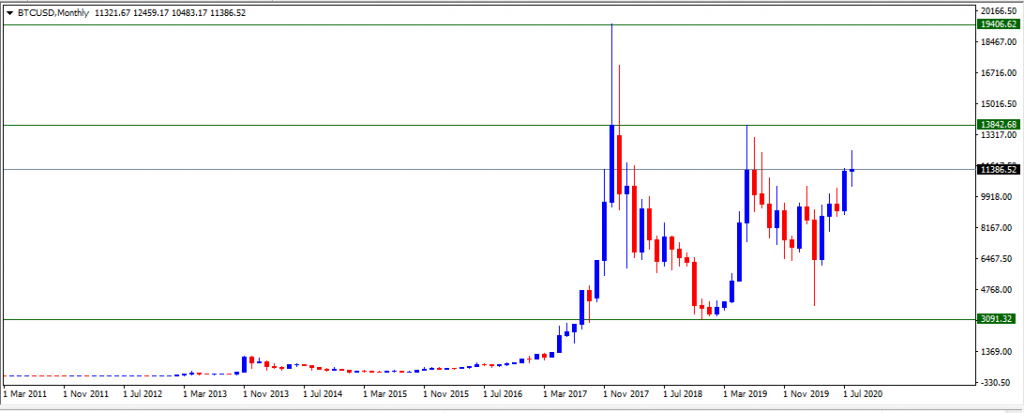
On the one hand, if you look at the long-term charts of the cryptocurrencies discussed above, you can see that they all have significantly appreciated against the US dollar in just a few years. The return on investment is thousands percent. Clearly, had you simply invested in Bitcoin in 2013, or earlier you would be well rewarded by now.

On the other hand, all cryptocurrencies go through boom-and-bust cycles with significant corrections that may last for years. Margin trading enables monetization of such movements by shorting cryptocurrencies. At the same time, riding the rallies on leverage should allow higher gains than simply buying and holding the same cryptocurrency.

Trading cryptocurrencies don’t require any specialist knowledge, and in fact, it’s not all that different to trading in Forex, commodities or many other markets. Despite its unusual nature, crypto still rises and falls like any other market, and is still subject to predictable external factors in a way that gives you the opportunity to make substantial profits. You needn’t rely on guesswork to predict which cryptocurrencies are worth in investing.

Why Trade Crypto CFDs With Winstone prime?

♦Uncompromised Safety –With regulatory authorities and segregated accounts, your money is protected at all times.

♦ Many Cryptos to Choose From –Trade on the wide variety of cryptos available on our trading platforms.

♦ No Hidden Fees – We offer zero commissions and no bank fees on transactions!

♦Crypto Never Goes to Sleep – Winstone Prime is one of the few brokers offer around-the-clock service and support many languages.

♦ Generous Leverage – Increase your initial capital with generous leverage and get far more exposure to trade than your account balance.

♦ Limit Your Risk –You can preset profit and loss levels by using stop losses or take profit limits when you trade. Determine the maximum amount you are prepared to risk when speculating on the price, or set a price at which you want to take profits. Future orders like Buy Stops and Buy Limits are also available.

♦ Trade Cryptos Against Fiat Currencies – Unlike many exchanges out there, who are restricting their clients to trade only Crypto to Crypto, our clients can trade Cryptos against Fiat currencies (USD, EUR, JPY etc.), as well.