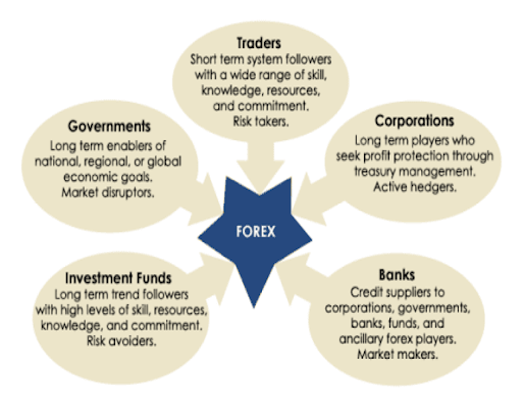
The trading parties may be Financial Institutions, Multi-national corporations, Banks, Central banks, Hedge funds, Money changers, Insurance companies, Speculators or Individual traders.
The trading parties may be Financial Institutions, Multi-national corporations, Banks, Central banks, Hedge funds, Money changers, Insurance companies, Speculators or Individual traders.
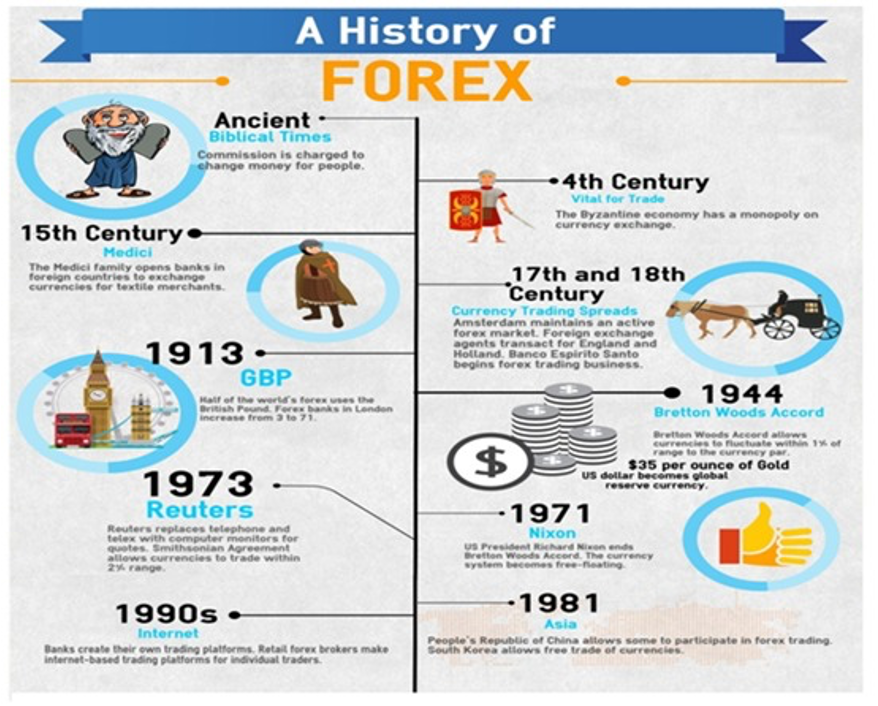
FOREX HISTORY
The Bretton Woods System (1944-1973), came after the great instability of World War II. England and other European countries were left in ruins, after the war ended, while the US’s economy was left relatively stable and strong.
The USD became the prominent currency after WWII, mainly because of the war. The Dollar also became the new global reserve currency, and remained so throughout the rest of the Forex history. This was agreed upon in the Bretton Woods conference, when all of the other foreign currencies were pegged to the USD, and a new international financial network was formed.
In 1971, the Smithsonian Agreement was signed by ten of the major financial powers, but it’s attempt to improve stability to the current Forex history failed.
Free Floating exchange rates came into use when the Bretton Woods agreement ended. This occurred after this international financial system was in operation for three decades in the Forex history.
During 1973, the UK, facing financial problems, floated it’s currency. Other currencies began to lose value, and this led the European economies to also float their currencies.
1994 saw the first online currency trading introduced to Forex history. This had a large impact on the development of the Euro currency, and introduced a new major contender to the control of the USD in the Forex history. By 2002 the Euro became the official currency for 12 European nations, and in the past few years more nations have joined this agreement. The modern online forex history offered new options for the online trader, such as the use of margin account to leverage investments, and this is all thanks to the contribution of the internet to the forex history.
Forex is the marketplace for trading all the world’s currencies and is the largest financial market in the world. It’s a decentralized market place that facilitates the buying and selling of different currencies in an agreed price. The vast majority of currency conversion is undertaken with the aim of earning a profit. The amount of currency converted every day can make price movements of some currencies extremely volatile. This volatility make forex so attractive to traders: It is estimated that, on average, $7 trillion is traded each day in the world Forex Markets.
Fundamental view:
In the last week, Japan National Core CPI at 20th July, US President Trump Speech at 21st July created a bullish move for the pair whereas US Unemployment Claims at 23rd July and US Flash Manufacturing PMI at 24th July, US New Home Sales report at 24th July created a bearish trend for the pair.
The upward swing of covid 19 curve in US suppressed dollar against Yen thus last week USD/JPY reflected a bearish trend.
The major economic events deciding the movement of the pair in the next week are Bank of Japan Core CPI yearly report at Jul 27, US CB Consumer Confidence at Jul 28, FOMC Press Conference at Jul 29, US Advance GDP quarterly report, Unemployment Claims at Jul 30, US Revised UoM Consumer Sentiment at Jul 31.
USD/JPY Weekly outlook:
Technical View:
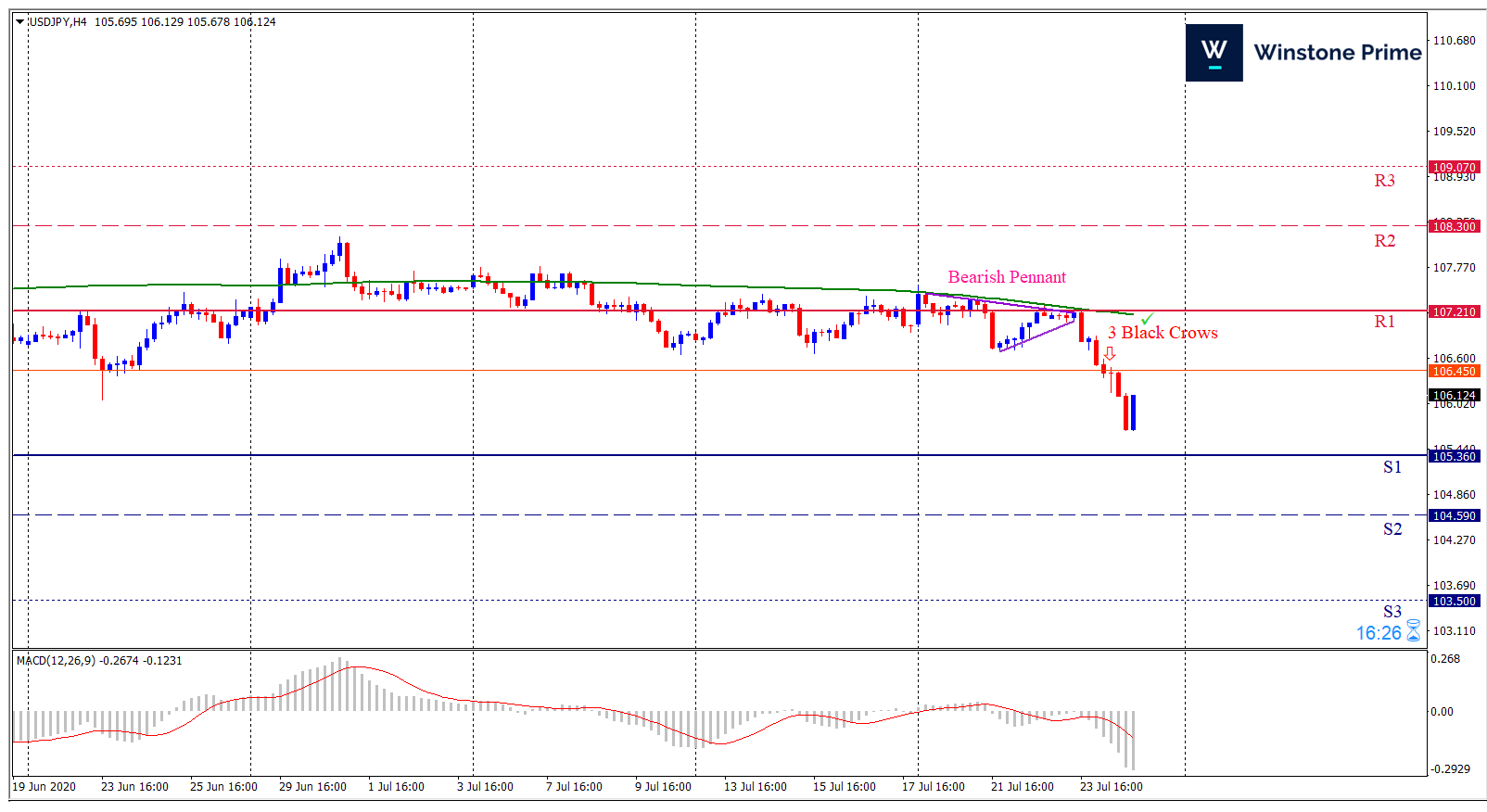
Last week’s high was 0.10% higher than the previous week. Maintaining high at 107.53 and low at 105.68 showed a movement of 186 pips.
In the upcoming week we expect USD/JPY to show a bearish trend. The currency pair is trading below the 200 Simple Moving Average and the MACD trades to the Downside. A solid breakout below 105.36 may open a clean path towards 104.59 and may take a way down to 103.50. Should 107.21 prove to be unreliable resistance, the USDJPY may raise upwards 108.30 and 109.07 respectively. In H4 chart, Formation of Bearish Pennant indicates reversal of the trend creating prospects of a bearish trend Along with a 3 black crow’s formation braces our expectation.
| Preference |
| Sell: 105.93 target at 104.22 and stop loss at 107.29 |
| Alternate Scenario |
| Buy: 107.29 target at 109.01 and stop loss at 105.93 |