Second wave of virus fear impacts loonie

Canadian provinces and territories have been gradually reopening. As of today, Canada reported  109000  total cases of COVID 19. Canada’s federal government will give the 13 provinces and territories more than C$19 billion ($14 billion) to help pay for the costs of restarting the economy after several months of COVID-19 pandemic lock-downs, the prime minister said on Thursday.

The cash is meant to cover the extraordinary costs for the coming 6 to 8 months. Prime Minister Justin Trudeau said in a news conference, and will take care of “the kinds of things that actually really matter to Canadians,” including preparing for a possible “second wave” of contagion. The things included are contact tracing, providing protective equipment to workers, helping struggling municipalities pay operating costs, aiding local transit operators, “safe spaces” for daycare, and improving long-term care for the elderly.

Deputy Prime Minister Chrystia Freeland said that ‘The money will also allow the government to provide up to 10 days of sick leave for those who do not already have it”.”COVID-19 isn’t just a health crisis, it’s an economic crisis, too,” Trudeau said. “Because until we find a vaccine, the daily threat of COVID-19 will not disappear.”

Cases of COVID 19 cases are rising continuously across the world which creates a fear of second wave of the virus. In the hunt for a vaccine against COVID-19, encouraging news emerged about two candidates on Wednesday. The New England Journal of Medicine published an interim analysis describing an immune response generated in participants of phase I clinical trials for a vaccine developed by US-based biotech company Moderna. Meanwhile, ITV reported that there could be positive news, possibly by Thursday, on initial trials of another vaccine from the University of Oxford.

“The dollar looks like a good safe haven now because of worries about a return to corona virus lock-downs,” said Minori Uchida, head of global market research at MUFG Bank.

USD/CAD 4 Hour Chart:
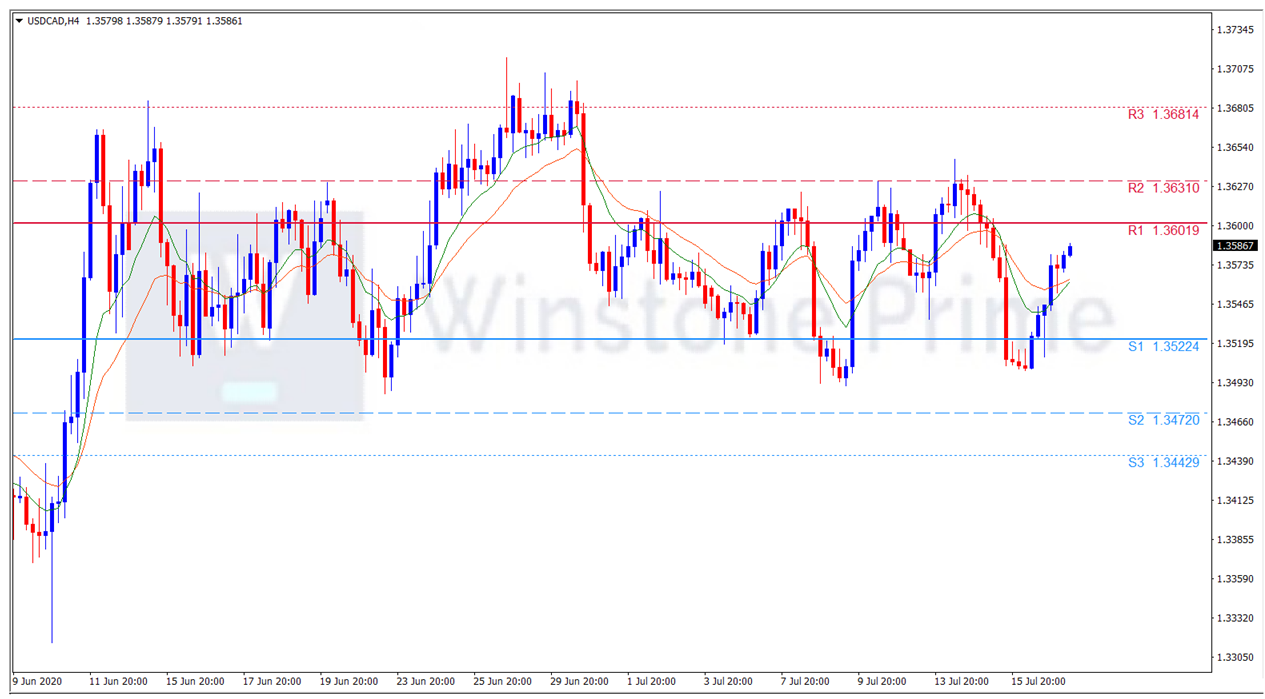
Support: 1.3522 (S1), 1.3472 (S2), 13443 (S3).

Resistance: 1.3602 (R1), 1.3631 (R2), 1.3681 (R3).

Canada’s federal government is taking all the necessary steps for economic recovery in the country but the fear of second wave of corona virus has made the Investors to concentrate on the safe-haven asset – USD for the time being, we expect a bullish trend for USD/CAD.

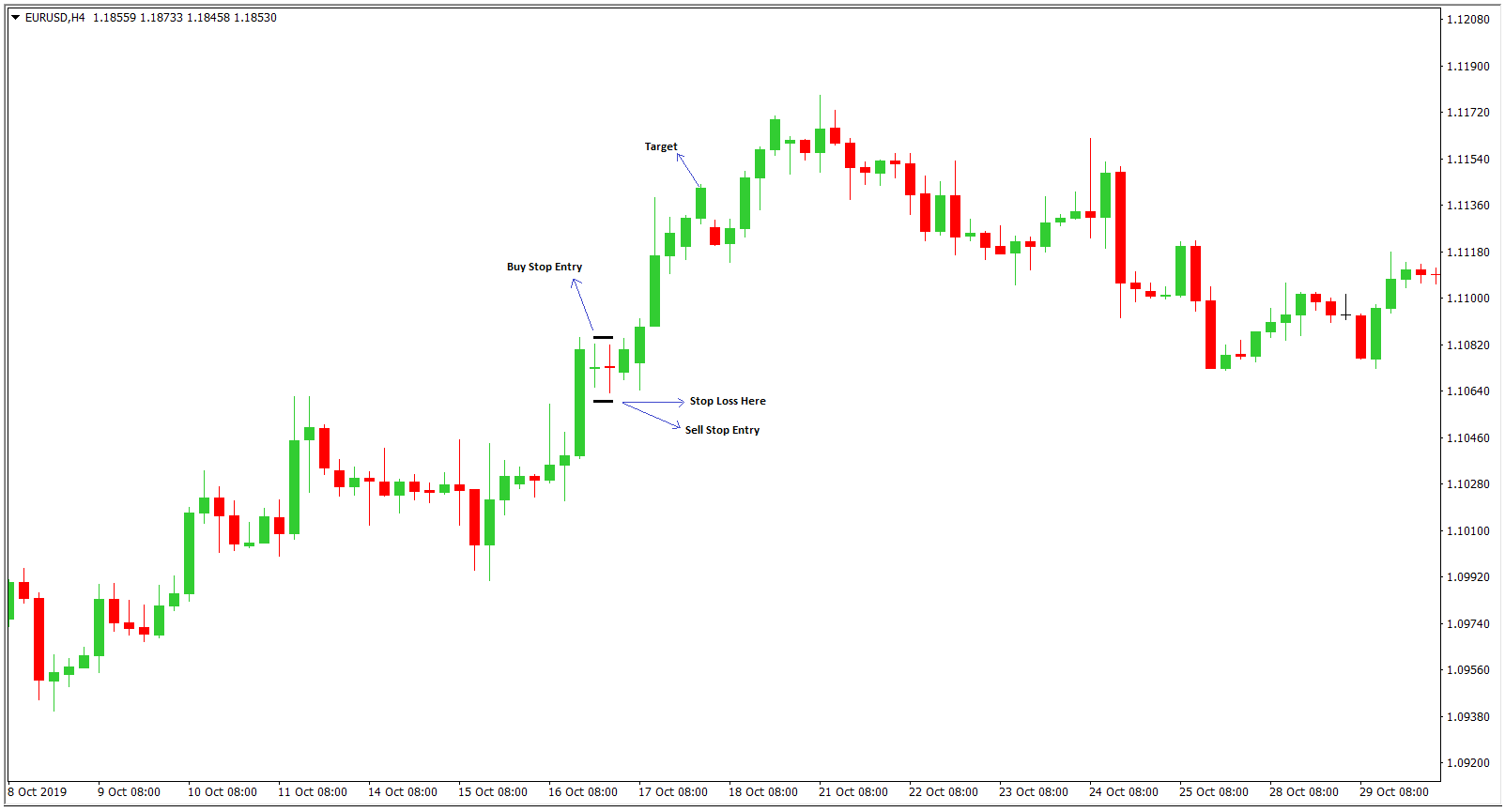
2 Doji Candlesticks Breakout Strategy

2 Doji Candlesticks Breakout Strategy can be used when 2 doji candlesticks are noticed. There is no need to care about whether the market is going to go up or down because whichever way it goes, we want to catch that breakout so what you do is place pending buy stop and sell stop orders on both sides to capture that breakout.

Timeframes : 4hr and daily

Instruments : You can use this strategy for any Instruments.

Candlestick Pattern : Doji

Trading Rules :

1. Wait until 2 consecutive doji candlesticks are noted on the charts

2. Next thing to do is mark the high and low of the doji borders

3. Place 2 separate pending orders- sell stop and buy stop order on both sides exactly at 2 – 3 pips from the low and high respectively.

4. Keep Stop loss at the distance from high to low of that 2 doji plus 2 pips. For buy orders place stop loss at 2 pips lower than the low and for sell orders at 2 pips higher than the high

5. For-profit target, use previous swing high for buy order and swing low for sell order or can target three times what you risk.

Pros :

  • Simple price action strategy.
  • Potential for explosive price moves that can help you get hundreds of pips.
  • The risk to reward is great when a trade goes as expected.


Cons :

  • Very rare to happen so you may need to watch a lot of Instruments to make sure you catch this trading setup happening.

Unemployment Rate pressurizes Aussie

As per Official data released on early Thursday, Australia’s unemployment rate rose to 7.4% in June to hit the highest level in two decades whereas Market consensus favors Employment Change to recover to +112.5K from -227.7K. The effective rate factors in people working zero hours and those who have dropped out of the labor force as per senior government figures, is more likely to be 13.3%.

However, Prime Minister Scott Morrison thinks the real situation in the labor market is worse than what official data shows.

“The effective rate of unemployment is likely to be far higher than illustrated in these numbers and the treasurer and I and the employment minister, have not been shy about pointing to that fact,” Mr. Morrison told reporters in Canberra on Thursday.

Australia’s consumer confidence index fell to -6.1% in July which was published by Westpac, almost entirely reversing the 6.1% rise seen in June. Confidence seems to fall among investors in response to the rise in the number of corona virus cases in Australia

Moderna and US President Donald Trump, Oxford Scientists, and US health official Fauci also suggest that the vaccine for the deadly virus will be out soon. Also to be noted that President Trump on Tuesday signed a bipartisan bill into law, sanctioning Chinese officials who undermine the rights to free speech and assembly in Hong Kong. AUD may come under more pressure if the Sino-US tension continues.

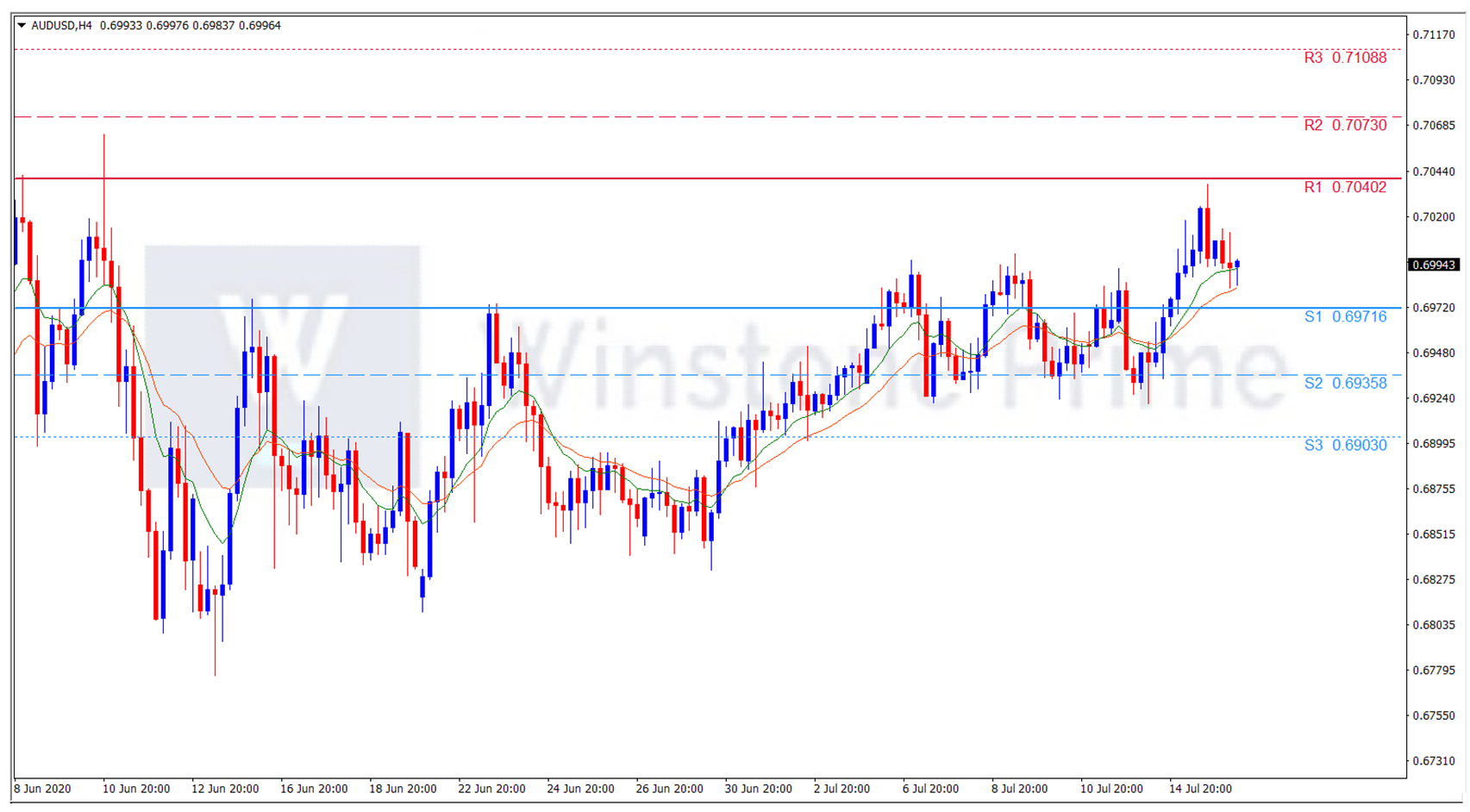
AUD/USD 4 Hour Chart:

Support: 0.6972 (S1), 0.6936 (S2), 0.6903 (S3).
Resistance: 0.7040 (R1), 0.7073 (R2), 0.7109 (R3).

Amid all the catalysts putting pressure on Aussie, we expect a bearish trend for AUD/USD.

BOJ Kuroda’s speech strengthens yen

As per the BOJ Outlook of economic activity and prices in July 2020, Japan’s economy is likely to improve gradually from the second half of this year with economic activity resuming, but the pace is expected to be moderate as the impact of the novel corona virus (COVID-19) remains worldwide. Thereafter, as the impact subsides globally, the economy is projected to keep improving further with overseas economies returning to a steady growth path.

The outlook for economic activity and prices provided in this Outlook Report is extremely unclear, since it could change depending on the consequences of COVID-19 and the magnitude of their impact on domestic and overseas economies. With regard to the risk balance, risks to both economic activity and prices are skewed to the downside, mainly due to the impact of COVID-19.

Further comments are coming in from the Bank of Japan (BOJ) Governor Haruhiko Kuroda, in his scheduled press conference after the monetary policy decision announced.

The speech of Mr. Kuroda “Will strive to support financial market stability, corporate financing for time being.” “Various measures are available for further easing including interest rate cuts.” “Hong Kong is a very important market for financial markets.” “Number of corporate bankruptcies is very low now.” “The second wave of corona virus infections is not occurring in advanced economies apart from the US.” “Consumption of goods and output has hit bottom.” “Japan’s CAPEX remains firm.” has added some positive sentiment in the market.

Further comments came from the Bank of Japan (BOJ) Governor Haruhiko Kuroda, in his scheduled press conference after the monetary policy decision announced on Wednesday.

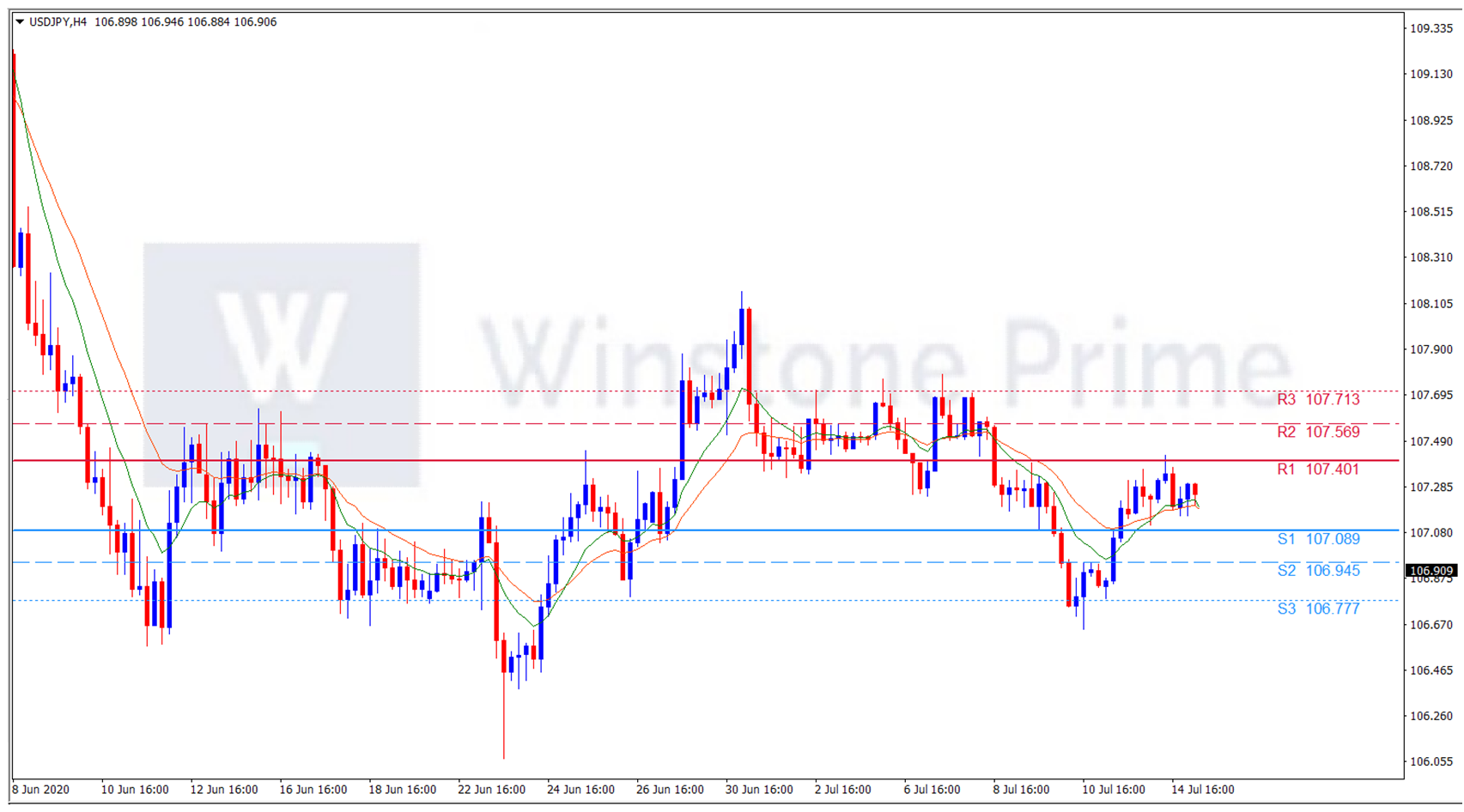
USD/JPY 4 Hour chart:

Support: 107.09 (S1), 106.95 (S2), 106.89 (S3).

Resistance: 107.40 (R1), 107.57 (R2), 107.71 (R3).

Even though BOJ’s Outlook of economic activity and prices July 2020 is not supportive to yen but optimistic speech of BOJ Kuroda supports yen. We expect bearish trend for USDJPY.