Reckoning of Brexit and Chancellor Sunak’s budget strengthens Pound

The EU’s chief negotiator met the UK’s David Frost yesterday. After months of digital discussions, the pair finally met a few weeks ago to discuss Britain’s exit from the bloc face-to-face. For further Brexit talks. Also, the pair is where to go for dinner yesterday night. And the next awaited update is Chancellor Sunak’s fiscal budget.

Chancellor Sunak’s budget will be delivered after Prime Minister’s Questions in parliament on Wednesday, where he’s expected to announce a package of measures for the economic recovery after restaurants and pubs reopened at the weekend following the relaxation of restrictions on other businesses last month.  One measure to support young people includes a £2billion investment in thousands of six-month work placements for 16 to 24-year-olds. Mr. Sunak admitted that youngsters will be hit hardest by the downturn because they work in sectors hammered by the pandemic.

The Brexit negotiations will continue through the week and although progress is yet to be officially acknowledged, there have been indicators to show something in the pipeline. British Prime Minister (PM) Boris Johnson is ready to accept the Australia-style trade deal, in a call with the German leader Angela Merkel. However, the bloc remains sturdy on its demands for “level-playing field”, fisheries and jurisdiction boundaries. This adds to the expectations of what is about to happen.

Corona virus cases in UK also started to decline as compared to the previous months. China recently has criticized the British ban on Huawei but it did not affect the market sentiment giving no positive response. On the other hand, the US increased standards for Chinese diplomats’ visas. It is also thinking to undermine the Hong Kong dollar peg in a move to punish Beijing.

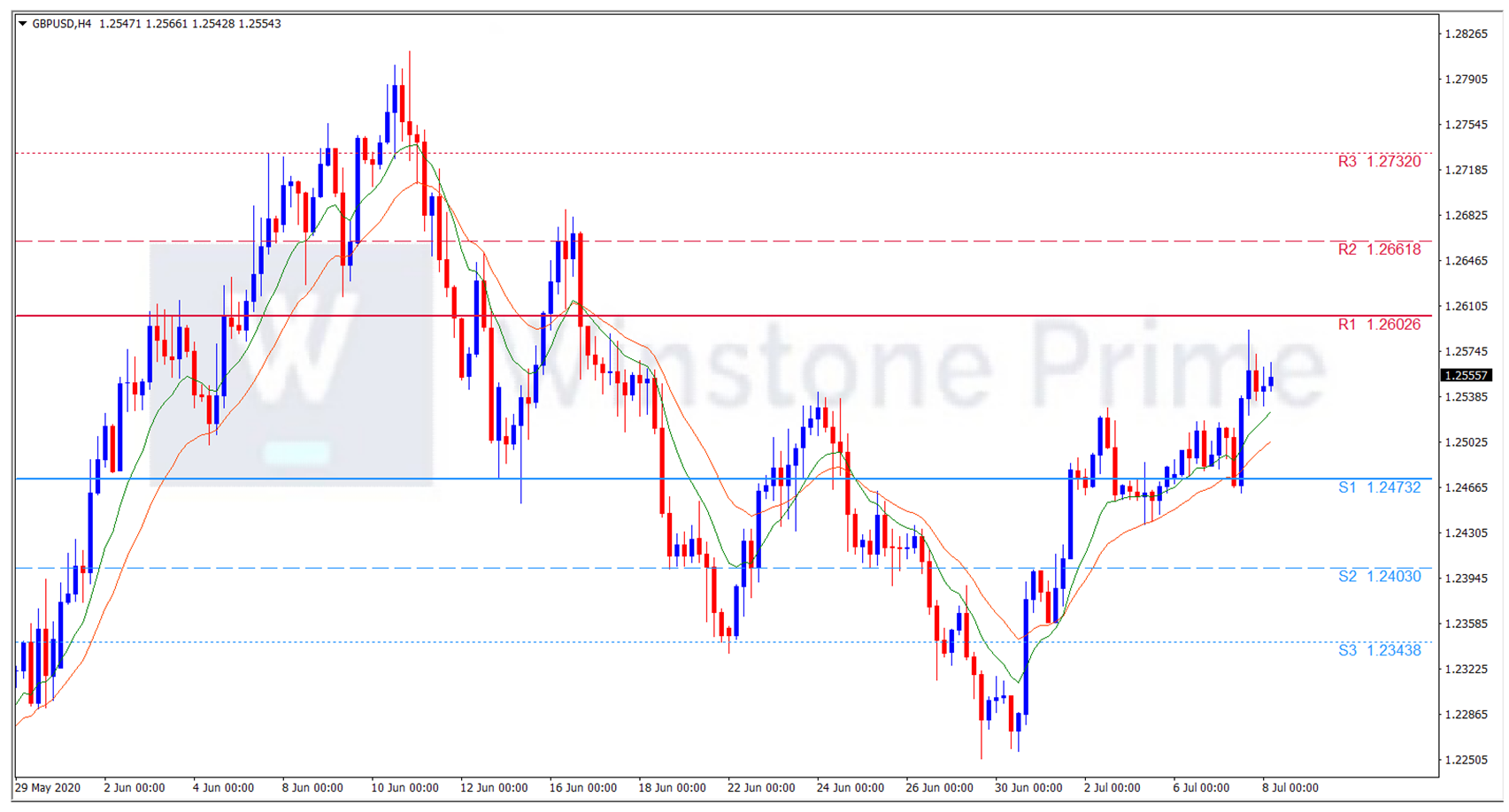
GBP/USD 4 Hour Chart:

Support: 1.2473 (S1), 1.2403 (S2), 1.2344 (S3).

Resistance: 1.2603 (R1), 1.2662 (R2), 1.2732 (R3).

In this risk-prone market, Brexit and Chancellor Sunak’s fiscal updates expectation creates hopes for sterling among the investors. We expect a bullish trend for Cable (GBP/USD).

Trading on Safe haven assets in Crisis time

What are Safe Haven Assets and How do you trade them?

Capital is hard to acquire and easy to lose, and safe haven assets provide a shelter for such capital at times when other riskier assets are prone to sharp price falls or devaluation. Safe haven assets may rise in value in these circumstances, but in general, investors don’t seek gains when they move money into these instruments. Rather they seek to preserve their capital and protect it from loss, as much as is practically possible.

Safe Haven is an investment that is expected to retain or increase value during market instability. Safe havens are sought by investors to control their exposure to losses in the event of Market Instability. However, what appears to be a safe investment in one lower market may be a disastrous investment in another lower market.  There are times, such as during an economic recession, when the downturn of the market is prolonged. When the market enters such turbulent times the value of most investments falls steeply. During these times, investors look to buy certain assets that are uncorrelated or negatively correlated to the general market. These types of assets are also known as “safe haven assets”.

Diversify Your Financial Portfolio

That age-old aphorism, ‘Never put all your eggs in one basket’ certainly holds true. Investments are finicky things mate, much like a bunch of eggs. If you pick the right batch and nurture them from inception through their growth phase, you will likely enjoy ‘plump and feathery-cushioned’ returns. However, if you have invested everything in one asset category like shares, and markets sour, that basket of investments will leave you with nothing but eggs on your face. By including asset categories with investment returns that move up and down under different market conditions within a portfolio, an investor can protect against significant losses. By investing in more than one asset category, you’ll reduce the risk that you’ll lose money and your portfolio’s overall investment returns will have a smoother ride. If one asset category’s investment return falls, you’ll be in a position to counteract your losses in that asset category with better investment returns in another asset category. It is better to diversify a financial portfolio with a variety of safe haven assets such as Gold, Platinum, and Silver in addition to a careful mix of Shares, Bonds, Forex, Bitcoin and other fixed-interest-bearing investments.

Safe-haven assets will typically show most, or all of the following characteristics:

High Liquidity – With significant trading volumes, you can enter and exit positions at the price you want without experiencing slippage. An example of a highly-liquid safe-haven currency pair is GBP/JPY. When signs of fundamental disruption arise, such as a Western recession, a common move is to go short GBP/JPY – and being able to enter the position at the original price will potentially mean higher profits as the price falls further.

Limited Supply – If an asset’s supply outpaces its demand, its value will likely erode. Markets such as gold, which have a scarcity of supply, are likely to have value residing in that scarcity, and potentially higher value still when demand increases. See more on the forces of supply and demand.

Varied Utility – Does the asset have enough uses, for example in industrial applications, for it to have substantial demand? Copper, for instance, has a wide range of uses in infrastructure and agriculture in particular, and demand often increases when emerging markets ramp up development.

Enduring Demand – A true safe haven will be expected to retain demand in the future, so there should be confidence in an asset’s future utility. For example, while some commodities such as silver may have many industrial applications now, they may be replaced by other commodities for those applications in the future.

Permanence – An asset capable of deteriorating in quality may see lower demand in future as its utility declines.

Safe Haven Assets

Assets that fit into our broader definition of safe havens include the following: Let’s take a look at these assets in more detail.
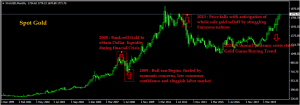
The most noteworthy safe-haven commodity is gold, which has historically shown a reliable negative correlation with stocks. This highly-coveted physical asset is in high demand, exists independent of monetary policy decisions, and has a tight supply. The value of gold is driven by demand. When demand is high, the value of gold goes up. When demand is low, the value of gold goes down. Demand for gold has been increasing after Corona virus economic crisis of 2020 and traders are worried about the damage that could be done to the U.S. economy if states and cities reinstate or intensify their lockdown orders.  Gold is negatively correlated to the U.S. dollar, a strong dollar makes bullion more expensive to buy and hold and therefore pushes gold prices lower and vice versa. At times when the USD is trading lower, investors tend to pile gold.

You can see that gold has climbed all the way back up to where it was trading in the aftermath of the 2008 Financial Crisis. And also in 2009 investors flocked to gold following the financial crisis, prompting a three-year bull run taking the price to $1,900 in August 2011 and the precious metal topped out at $1,923.70 per ounce. In fact, the price of gold is $1500 per ounce when the Corona 2020 world crisis starts and now Gold is trading just below $1800 per ounce.

Overall, XAU/USD is enjoying an uptrend that may continue. There is still a long way to go to reach a peak near $2,000 recorded in 2011, leaving substantial room to rise within the chartered territory. Gold continues enjoying an uptrend even in the Corona virus Scare.  While the metal saw a torrid run in the two years to follow, a prolonged bear market beyond that was never sustained, reinforcing its safe-haven status.

The chart below gives a picture of the main price moves since the turn of the century.

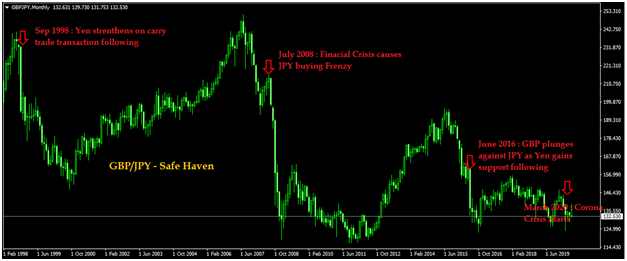
JPY is recognized as one of the most reliable safe-haven currencies due to its trade surplus and status as net creditor to the world, its demand in currency carry trade transactions, and the self-fulfilling prophecy caused by these factors as well as its historic stability. The devastating earthquake, tsunami, and nuclear disaster in Fukushima in 2011 resulted in a rush to the yen – despite the catastrophe for the island nation. While its status has eroded since then, the currency benefited from tensions around North Korea and, more recently, Iran. It remains in demand also with the corona virus.

The chart below demonstrates three instances where the allure of JPY as a safe haven can be seen in risk-off markets over three decades. A number of factors are responsible for creating the dynamic in which investors flock to the Japanese yen during periods of global risk aversion.

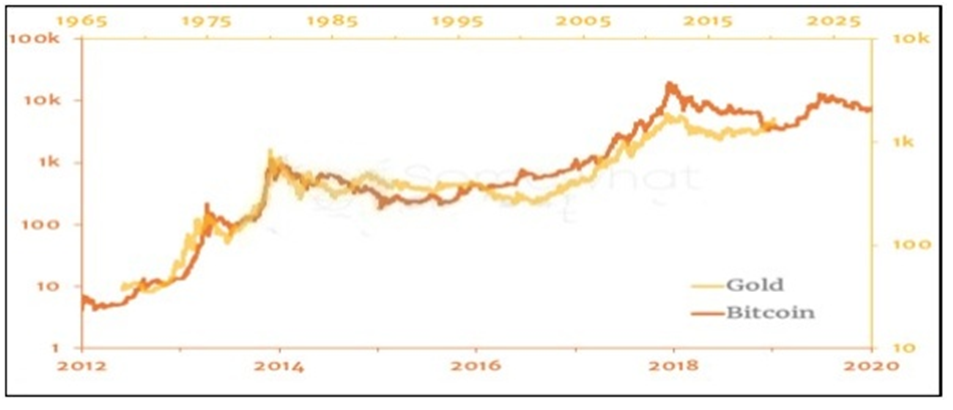
While we look at the shape of Bitcoin’s overall price trajectory since 2012, and compare it to gold’s price trajectory (Gold became “freely traded” in April 1968) Bitcoin has reached the peak level with in 10 years.  Bitcoin shows big moves in the past years. Bitcoin is a safe haven asset, just like gold. Bitcoin can be easily predicted using technical analysis figures, making your trading more profitable. as its price is determined by so many other factors that are unrelated to the global mood. Hacks of exchanges, regulation, movements from altcoins to the BTC, hash rate, whale activity, and many other crypto-related factors are all in the mix.

Bitcoin still hasn’t lost nearly as much as it did when the bubble of its $20,000 peak burst at the end of 2017, shedding an even more jaw-dropping two-thirds in value.  Additionally, after the panic drop of early March 2020, Bitcoin’s price has stabilized in the $6,000–$7,000 range for the month of March 2020 at the time of World Crisis and as of now it has reached $9,500.

Examples of other safe havens include defensive stocks, such as utility, healthcare, biotechnology, and consumer goods companies. These stocks tend to withstand recession because regardless of the state of the market, consumers are still going to purchase food, health products, and basic home supplies. There is a another safe haven currency Swiss Franc. The Swiss franc’s recent scrapping of its cap versus the euro may make it easier to flee to in times of volatility. Bonds can still be strong diversifiers (given our long-term outlook for modest growth, low inflation and still low rates) but many no longer offer protection and a coupon. Infrastructure has safe haven characteristics similar to those of real estate and a promising outlook given the demand for green projects.

SAFE-HAVEN ASSETS: KEY TAKEAWAYS

1. Keep a close eye on the fundamentals:  Fundamental factors such as employment statistics and business confidence can predict market downturns and economic prosperity alike. Accordingly, following as many fundamental factors as possible will give you a good measure of when to move into – and out of – safe havens.

2. Consider technical indicators: Indicators such as the Relative Strength Index will reveal when an asset moves into overbought/oversold territory. Combined with fundamental factors, this can give a clearer picture of when to enter or exit trades.

3. Historical price action matters: Bear in mind there will be times when a safe-haven asset may not behave as expected. For example, now gold in 2020 might have been expected to soar as the financial crisis hit – but instead, it remains gains in the World Crisis of Corona the reason behind in this Deman of Gold and trader’s fears of other investments.

Are These Assets Truly Safe?

Investors may have more choices for constructing resilient portfolios than they think. However, effectively embedding safe haven assets is likely to require as much attention to building portfolio ballast as to optimizing returns. The solutions may be surprising and the most appropriate trade-offs will vary across investors. Investors become more and more concerned about finding a safe place to park their money; it’s up to you to decide whether or not these types of assets are right for you. Remember, investments can go down as well as up in trading, you need to ensure you understand the risks involved before investing.

RBA Rate Statement impacts Aussie

Reserve Bank of Australia today announced an interest rate. At its meeting, RBA made no changes to its monetary policy settings once again, with the official cash rate (OCR) maintained a record low of 0.25%, as expected. The Bank has not purchased government bonds for some time. Until date with total purchases of around $50 billion, The Bank is ready to scale-up its bond purchases again and will take all the necessary steps to ensure bond markets remain functional and to achieve the yield target for 3-year AGS.

The steps taken by the Bank help in supporting the liquidity in the Australian financial system. Authorized deposit-taking institutions are continuing to draw on the Term Funding Facility, with total drawings to date of around $15 billion. The Board remains committed to so all the necessary steps to support jobs, incomes and businesses and to make sure that Australia is well placed for the recovery.

It is a tough time for the  Australian economy and is experiencing the biggest contraction since the 1930s. Since March, an unprecedented 800,000 people have lost their jobs, with many others retaining their job only because of government and other support programs. But the employment conditions gets stabilized recently and the downturn has been less severe than earlier expected.

Australian job advertisements jumped a record 42 percent in June as much of the economy re-opened from coronavirus lockdowns, but remained sharply lower from a year earlier.“After an initial bounce, we expect the recovery will be a lot slower. There have been a number of recent large-scale lay-offs announced across a wide range of sectors, including travel, retail, media, consulting, and education,” said ANZ senior economist Catherine Birch.

AUD/USD 4 Hour Chart:

Support: 0.6940 (S1), 0.6909 (S2), 0.6885 (S3).

Resistance: 0.6996 (R1), 0.7019 (R2), 0.7051 (R3).

All these recent updates portrays the signs of a gradual improvement in Australia but the nature and speed of the economic recovery remains highly uncertain which sets a mixed trend for AUD/USD.

Economic recovery in Canada boost loonie

Donald Trump invited India, Russia, Australia, and South Korea to the G-7 meeting. Canadian Prime Minister Justin Trudeau said on Monday that Russia will not be included in the upcoming meeting of Group of Seven nations (G-7),  after knowing that the US President Donald Trump revealed that he has plans to invite Russia. The Trump administration and Mexican diplomats signaled talks on the United States-Mexico-Canada Agreement (USMCA) but seems that Canada will not turn up for the talks. The news increases doubts on the much-championed trade deal by US President Donald Trump, creating plays negative for the Republican leaders’ Presidential election.

Canadian Finance Minister Bill Morneau will deliver a “fiscal snapshot” on Wednesday that will outline the current balance sheet and may give an idea of the money the government is setting aside for the future. As the economy recovers, some fiscal support measures, which are expected to boost the budget deficit sharply, could be relaxed and will be replaced by incentives meant to get people back to work and measures to boost economic growth, economists said.

Craig Wright, chief economist at Royal Bank of Canada said that “The only solution to these large deficits is growth, so we need a transition to a pro-growth agenda,”. The IMF expects Canada’s economy to contract by 8.4% this year. Ottawa is already rolling out more than C$150 billion in direct economic aid, including payments to workers impacted by COVID-19. “We have to make sure that government spending is calibrated to the economy of the future rather than the economy of the past,” Wright said. All these updates show the economic recovery in Canada.

US continues to record high cases of COVID-19 figures with situations in Texas and Florida getting worse on each passing day. The updates not only stops the economic restart plans but also shows the Trump administration’s failure to tame the pandemic. Even so, President Trump tweeted to signal the increase in testing as the reason behind the surge in the virus figures.

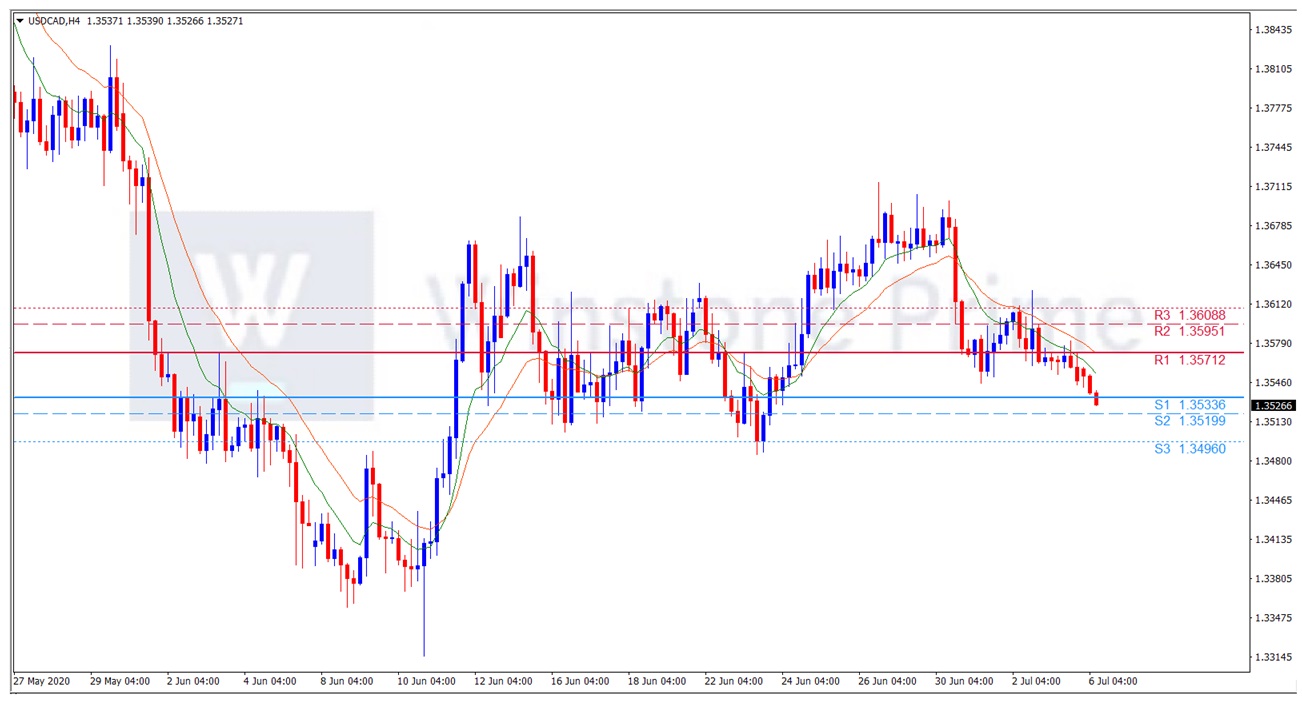
USD/CAD 4 Hours Chart:

Support: 1.3534 (S1), 1.3520 (S2), 1.3496 (S3).

Resistance: 1.3571 (R1), 1.3595 (R2), 1.3609 (R3).

All these catalysts create optimism among investors for loonie and pessimism for dollar we expect a bearish trend for the USD/CAD.