Support and Resistance Trading Strategy

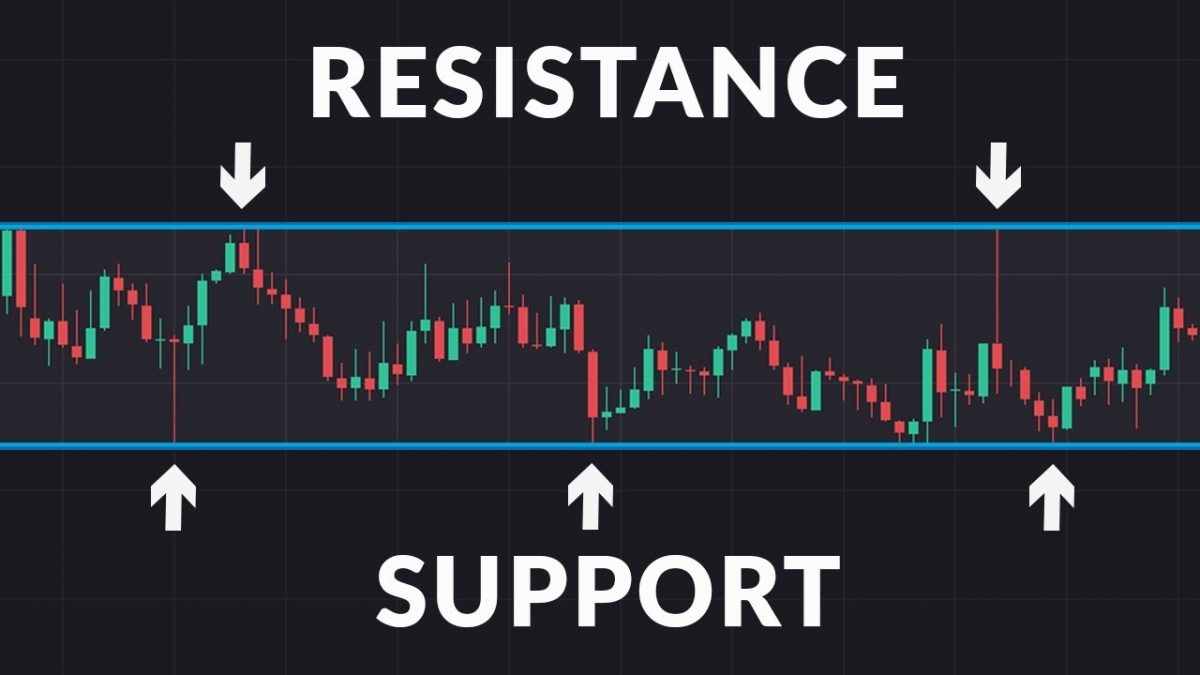
Horizontal support and resistance forex trading strategy is based on solid trading fundamentals of support and resistance hence it is one of the most popular strategies among traders.

This trading strategy works as :

  • where price has moved up, reverse on hitting the resistance level
  • or price has moved down, bounce back on hitting the support level.


These are the very basic ideas of support and resistance.

To find support and resistance levels, the following steps will help :

  • Look at the chart.
  • Look for a series of low points where price does not fall below this any further, you got your support level.
  • Look for a series of high points where price does not rise above this any further, you got your resistance level.
  • The more price bounces off this support & resistance levels, the stronger these levels become.
  • So next time price comes this level, expect it to bounce again like it did before.


Instrument : You can use this strategy for any currency pairs.

Timeframes :  For 15 minutes and above.

Long Entry :

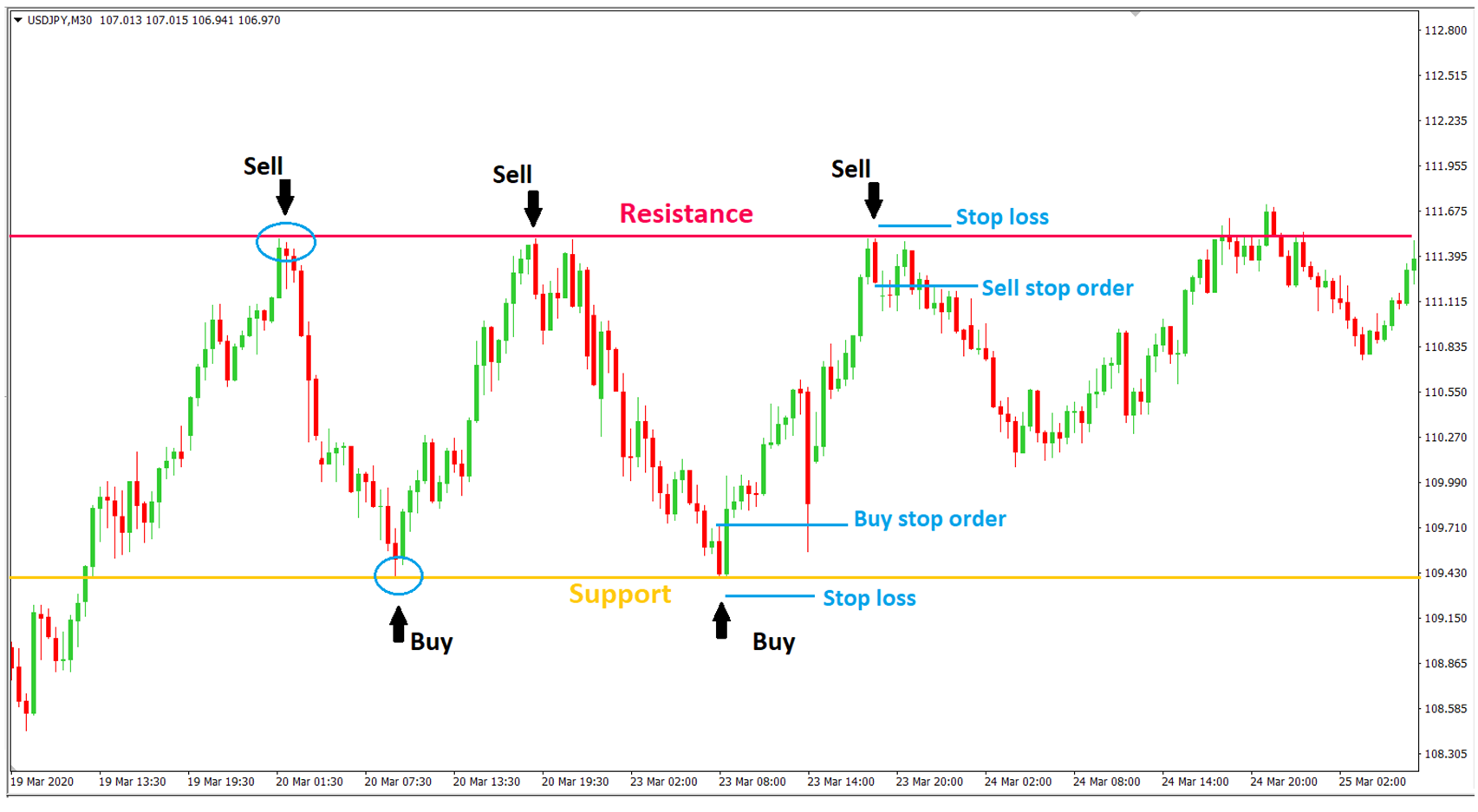
  • One you identify the support level, draw a horizontal support line and wait for the price to fall back to that support line.
  • Choose any of the options to trade.


(a) When price falls back and touches the support line, wait for the that candlesticks to close and place a buy stop order 2-5 pips above that high of the candlestick that touches the support line or

(b) Place a buy limit order so when price reaches it, it activates it and you are in a trade or

(c) You can buy immediately at market price when price touches that level.

  • Place your stops 10-30 pips below the support line for buy limit or at market orders, Depending on the time frame set the stop loss, the larger the time frame larger stop loss.
  • Take profit target levels should aim for the resistance levels below. Set Take profit below the resistance levels so there is a greater chance of your profit target to get hit.


Short Entry : 

  • One you identify the resistance level, draw a horizontal resistance line and wait for the price to rise up back to that line.
  • Choose any of the options to trade.


(a) When price rises back up and touches the resistance line, wait for the that candlesticks to close and place a sell stop order 2-5 pips below that low of the candlestick that touches the resistance line or

(b) Place a sell limit order so when price reaches it, it activates it and you are in a trade or

(c) You can sell immediately at market price when price touches that level.

  • Place your stops 5-30 pips above the resistance line for sell limit or at market orders, Depending on the time frame set the stop loss, the larger the time frame larger stop loss.
  • Take profit target levels should aim for the support levels below. Set Take profit below the support levels so there is a greater chance of your profit target being hit.
Trade Management :

  • Prefer to close half of your position when price travels to halfway point between the support and resistance levels.
  • As your trade moves in favor move stop loss and trail stop your profitable trades to lock in profit.
  • The best way as to trail stop is to move behind those swing highs or lows and place your stops just a few pips behind so there is less chance of you getting stopped out prematurely.


Pros :

  • It is quite predictable on what price does around support and resistance.
  • Will enhance your trade entry due to the use of price action trading especially the use of reversal candlesticks.
  • Great risk rewarding ratio.
  • Chance of getting stopped out prematurely. Becomes less as stop-loss is tight and placed at ideal locations-behind support and resistance level.

Cons :

  • Nothing is 100% correct, the price can break the levels and not obey them.
  • Sometimes, there may be false break or spike only to obey it later.

ECB Monetary Policy Meeting and German Import Prices impacts Euro

Account of the monetary policy meeting of the Governing Council of the European Central Bank released yesterday was of meeting held in Frankfurt aim main on Wednesday and Thursday, 3-4 June 2020. In this meeting, Ms.Schnabel reviewed the financial market developments and arrived at 3 key conclusions. First, the ECB’s monetary policy measures, together with the Franco-German recovery fund proposal which was subsequently broadly taken up in the package proposed by the European Commission and the drop in corona virus (COVID-19) infection numbers and further large fiscal stimulus measures taken has created a positive sentiment.

Second, the broad-based decline in risk factor on the back of these developments had offset the tightening impact of a deterioration in macroeconomic fundamentals. Third, and as a result of, the latest easing of financial conditions in the euro area in part hinged on the contribution of fiscal and monetary policy to mitigating reduces risks across markets and jurisdictions.

Mr. Lane reviewed the global environment and recent economic and monetary developments in the European area. The external environment was characterized by a  downturn in global activity and trade, which implied a decreasing foreign demand. in the European area. The data suggested that the economy has fallen into an unprecedented recession in the first half of the year. In short, Mr. Lane observed that the incoming information confirmed that the euro area economy was experiencing an unprecedented contraction. Survey data and real-time indicators for economic activity had shown some positive signs as the containment measures were gradually eased.

In the German import prices monthly report, As reported by the Federal Statistical Office (Destatis), the index of import prices decreased by 7.0% in May 2020 compared with the corresponding month of the preceding year. In April 2020 and in March 2020 the annual rates of change were -7.4% and -5.5%, respectively. From April 2020 to May 2020 the index rose by 0.3%.

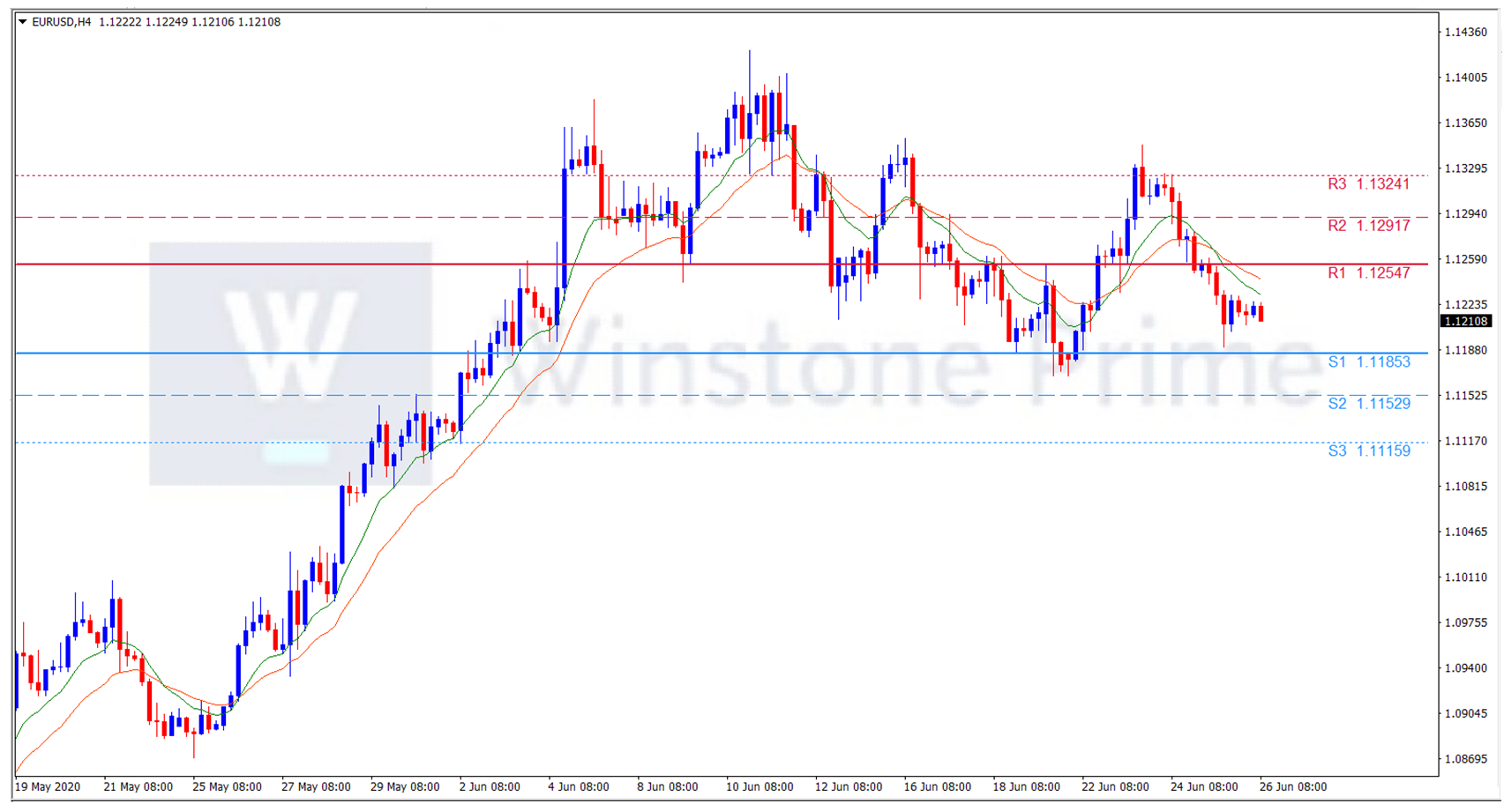
EUR/USD 4 Hour Chart:

Support: 1.1185 (S1), 1.1153 (S2), 1.1116 (S3).

Resistance: 1.1255 (R1), 1.1292 (R2), 1.1324 (R3).

While ECB Monetary Policy Meeting Accounts creates a favorable environment for the Euro economy a certain degree nevertheless German Import Prices monthly report puts pressure on EUR. We expect a short term bearish trend for the pair for a while.

Strengthening US economy favors greenback

In June, White House leaders announced “Operation Warp Speed,” which gives more tax dollars and technical support to companies developing five experimental COVID-19 vaccines to be fast-tracked through testing and then mass production after the development of the vaccine. But there is a lot of speculation that whether the vaccine will be affordable. The Trump administration is helping the nation’s economy to get better and corona virus cases are surging in more than half of the states, while there’s been little action in Congress on the one thing that actually could get things back to normal, ensuring an affordable COVID-19 vaccine that could curtail the spread of the diseases. Vaccination against corona virus creates a hope which favors the US market.

Speaking at Bloomberg event on Thursday, Goldman Sachs Chief Executive Officer (CEO) David Solomon said that he still sees a V-shaped recovery for the US economy this year.“Uncertainty still persists, as the secondary shocks could endanger recovery and seeing a sharp V to start with, but it’s very open-ended as to what kind of economic friction we’re going to see as we get through the end of the year and into 2021.”

President Trump on Tuesday rallied a crowd of largely maskless student supporters in Phoenix. Roughly 3,000 young attendees were expected to attend Tuesday’s event in Arizona.“We are going to be stronger than ever before, and it’s going to be soon,” Trump said of the corona virus, touting his “swift and early action” to ban travel from China at the beginning of February in order to prevent the spread of the disease.

Japanese data released at the beginning of the day was mixed since the May Corporate Service Price Index came in at 0.8% YoY, below the 1.1% expected, while the April Coincident Index was downwardly revised to 80.1 from 81.5. The Leading Economic Index for the same month, however, was revised to 77.7 from 76.2. All industry monthly report is 6.4% which is high compared to previous month 3.4%.

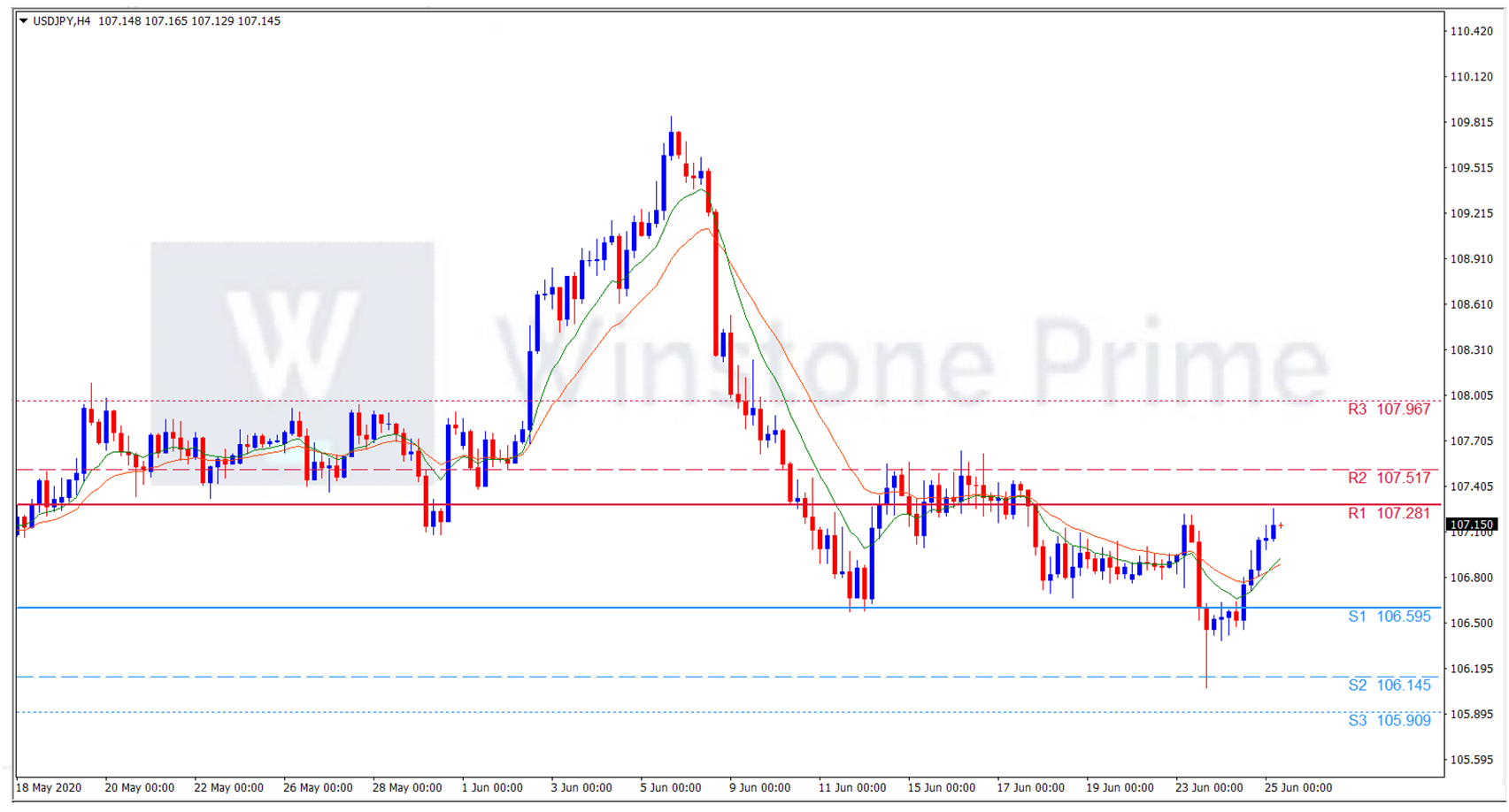
USD/JPY 4 Hours Chat:

Support: 106.60 (S1), 106.15 (S2), 105.91 (S3).

Resistance: 107.28 (R1), 107.52 (R2), 107.97 (R3).

Amidst many catalysts supporting the US economy, there remains a fear of the second wave of the virus. All Industries Activity monthly report of Japan did not impact the market. With the increasing strength of the dollar, we expect a bullish trend for USD/JPY.

UK’s PMI data and BoE Gov Bailey strengthens Sterling

UK June PMI data indicated a vastly improved overall picture across the UK private sector, with the downturn in total business activity continuing to steady after the record rate of decline seen at the height of the lockdown during April. Another drop-in service sector activity contrasted with a return to production growth among manufacturing companies in June.

 CIPS Flash UK Composite Output Index – which is based on approximately 85% of usual monthly replies – rose to 47.6 in June, from 30.0 in May. The latest reading was below the 50.0 no-change threshold, but signaled the slowest pace of decline since the start of the downturn in March.

On Monday, Bank of England Governor Andrew Bailey said that its time for the central bank to sell government bonds back to the market before it raises interest rates significantly, which can represent a reversal of long-standing BoE policy. Any bond sales are some way off, as just last week the BoE increased its bond-purchase target by 100 billion pounds to 745 billion pounds to support the economy through the unexpected flop caused by COVID-19.

Bailey also said this level of central bank asset purchases, known as quantitative easing (QE), “shouldn’t always be taken for granted” and emphasized the central bank’s independence from government.

“When the time comes to withdraw monetary stimulus, in my opinion, it may be better to consider adjusting the level of reserves first without waiting to raise interest rates on a sustained basis,” he wrote in an article.

This news impacted the market immediately, showing how Britain’s recovery from the massive economic shock of corona virus will be the main driver of BoE policy.

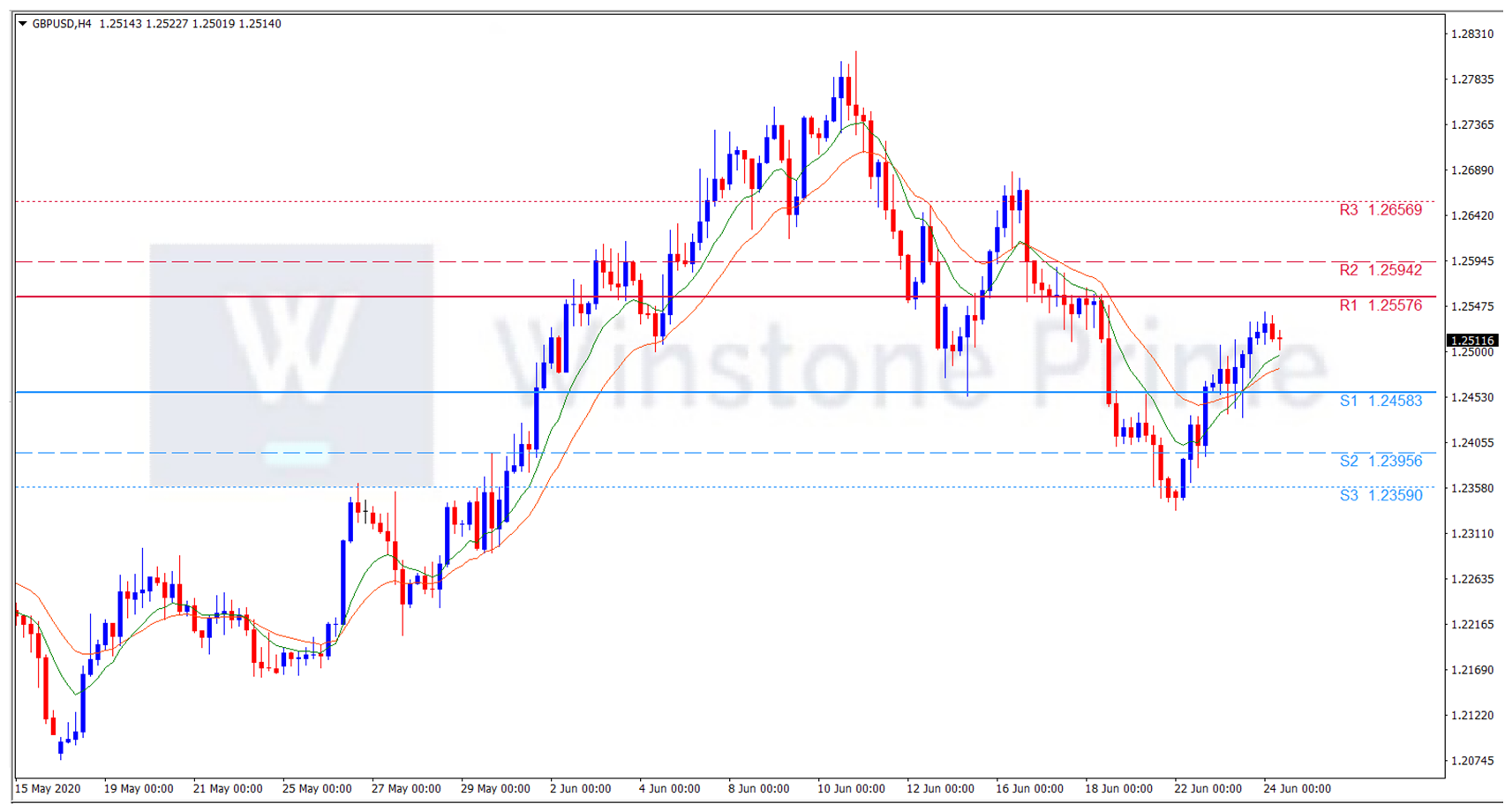
GBP/USD 4 Hours Chart:

Support: 1.2458 (S1), 1.2396 (S2), 1.2359 (S3).

Resistance: 1.2558 (R1), 1.2594 (R2), 1.2657 (R3).

UK’s PMI data and Bailey’s speech drives a positive sentiment in the market henceforth we expect a bullish trend for GBP/USD.