
US Unemployment data fails to predict gold trend

The recent US unemployment report was not as expected. Jobless claims numbers suggest the reopening story isn’t having as much of a positive impact on the labor market as hoped. It reinforces the case for more fiscal support to keep the economy on the recovery path. The unemployment claims was more than the forecast which suggests that it is a long way for the recovery.

“The restarting of the economy is going to be slow, it’s going to be uneven and initial jobless claims today reflect that,” said by Kristina Hooper, chief global market strategist at Invesco.

Cleveland Federal Reserve Bank President Loretta Mester said it could take a year or two for the U.S. economy to return to pre-pandemic levels, with the gross domestic product declining by 6% in 2020 and the unemployment rate still around 9% by year’s end.

Fears over the rise of the corona virus continue in Asia, With Beijing’s new infections rising has created a  fear of the second wave of corona – virus.

Escalation of tensions between North Korea and South Korea when the North Korean’s attacked the communications office the two shared in the southern territory. Adding to this China and India became involved in a dispute at the border they share and 20 Indian soldiers were killed.

XAU/USD 4 Hours Chart:
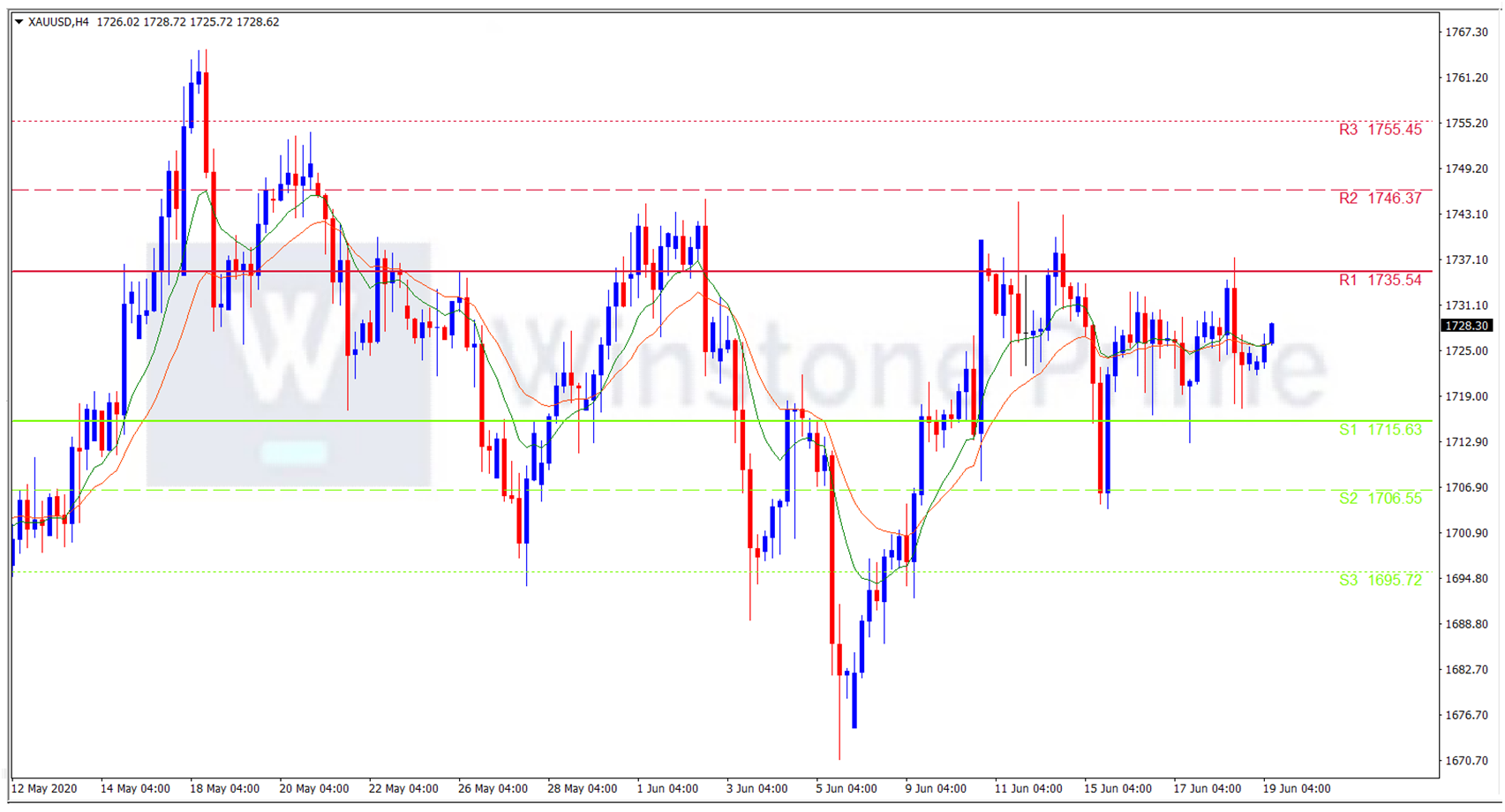
Support: 1715.6 (S1), 1706.6 (S2), 1695.7 (S3).

Resistance: 1735.5 (R1), 1746.4 (R2), 1755.5 (R3).

Gold reflects a short term bullish trend but the direction cannot be predicted due to the prevailing market tensions. Fed Powell speech later today is expected to give a direction for XAU/USD.

Unemployment rate puts Aussie under pressure

Australian unemployment surged in May and a huge chunk of jobs were lost as ongoing restrictions to prevent the spread of the corona virus kept large parts of the economy shuttered. The seasonally adjustments estimates are “Employment decreased 227,700 to 12,154,100 people, Full-time employment decreased 89,100 to 8,540,000 people and part-time employment decreased 138,600 to 3,614,100 people, Unemployment increased 85,700 to 927,600 people, Unemployment rate increased 0.7 pts to 7.1%, Underemployment rate decreased 0.7 pts to 13.1%, Underutilisation rate increased less than 0.1 pts to 20.2%, Participation rate decreased by 0.7 pts to 62.9%, Monthly hours worked in all jobs decreased 12.1 million hours to 1,604.7 million hours.”

Reserve Bank of Australia highlights the potential for the economic downturns to be “shallower than earlier expected” as lockdown restrictions are relaxed and the economy started restructuring. The main question now is how many workers will be kept employed when the government subsidy keeping workers tied to firms expires in September.

“Households that were already receiving welfare payments had received additional payments, and the Job Keeper program and increased Jobseeker payments had supported incomes for others,” the RBA said in minutes of its June policy which was released by Tuesday.

“The Board determined that it would not increase the cash rate target until progress is made towards full employment and it is confident that inflation will be sustainably within the target band,” RBA’s meeting minutes showed.

In US, Employers hired a record of 2.5 million workers in May as businesses reopened after shuttering in mid-March to slow the spread of COVID-19 which boosted the US market. Along with that, the Retail Sales data and Powell optimistic approach strengthens the safe haven assest.

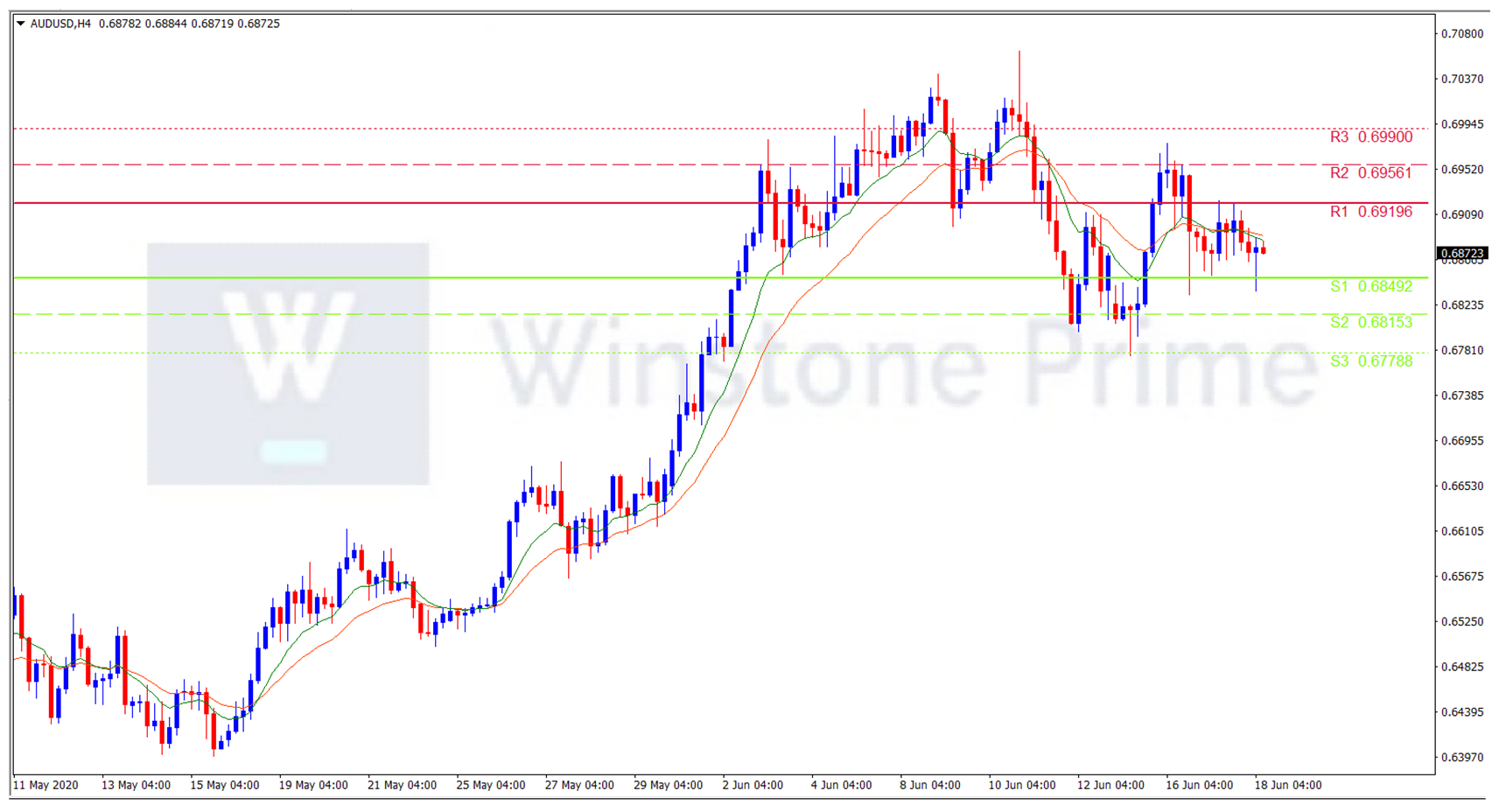
AUD/USD 4 Hours Chart:

Support: 0.6849 (S1), 0.6815 (S2), 0.6779 (S3)
Resistance: 0.6920 (R1), 0.6956 (R2), 0.6990 (R3).

Even though RBA’s minutes were positive but Australian unemployment surge did not give confidence among the Aussie traders. We expect a Bearish trend for the pair.

Retail Sales Data and Fed Powell Hopes strengthens the safe – haven assest

As per the Retail sales report, American shoppers in May showed a record 17.7% monthly gain in retail spending after devastating declines in the previous months due to the corona virus lockdowns. The recovery was only partially made up for the losses till now as spending were down about 6% year-on-year. And some sectors, such as clothing stores have seen far steeper declines. But the rebound of retail sales data was much more than expectation which boosted hopes of a V-shaped recovery.

Last month, US employers also added a surprise 2.5 million jobs and the unemployment rate fell to 13.3%. Capital Economics said it now expects the US economy to contract at an annual rate of 30% in the three months to July, compared to its previous more than 40% estimate.

President Donald Trump tweeting that it “looks like a BIG DAY FOR THE STOCK MARKET AND JOBS!” supported the safe haven assest.

Powell again emphasised policy will remain ultra-loose with the potential that they could have to do more to ensure the recovery continues. Chairman Powell’s semi-annual monetary policy testimony to the Senate reinforces the view that while the Fed is encouraged about the recent data flow as the economy re-opens, we are a long way from “normality” and that won’t arrive there is the confidence we have overcome Covid-19.

In this regard he again placed great emphasis on inequality, pointing out that “those least able to withstand the downturn have been affected most” with minorities, women, and low-income households disproportionately carrying the burden of the economic hardship.

Federal Reserve also gave hope with saying that it will use full range of tools to support the economy and to help assure that the recovery from this difficult period will be as robust as possible.

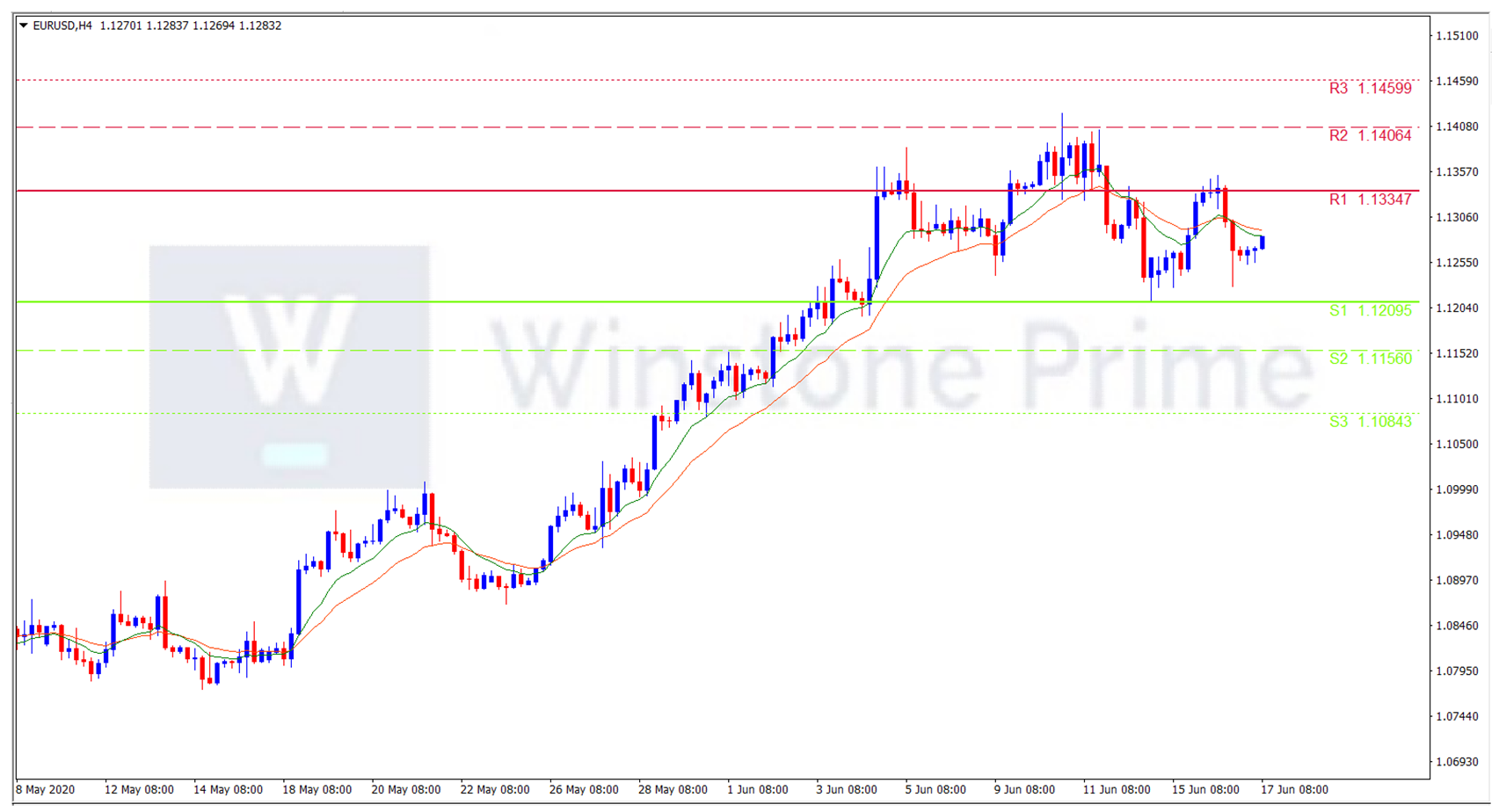
EUR/USD 4 Hours Chart:

Support: 1.1210 (S1), 1.1156 (S2), 1.1084 (S3).

Resistance: 1.1335 (R1), 1.1406 (R2), 1.1460 (R3).

Amid the prevailing hopes of recovery and Retail Sales data and Federal Powell boosting the strength of USD, we expect a bearish trend for EUR/USD.

UK’s Claimant count and unemployment report favors cable

The UK’s official jobless rate remained the same as that of last month – 3.9% in April, while the claimant count change showed a dramatically higher than expected increase last month. The unemployment rate remained at 3.9% which is better than 4.5% forecast.

The Claimant Count Change came in at 528.9K as against 370K expected and the previous month’s reading was also revised higher to 1032.7K

A possible no-deal Brexit favored GBP especially after the UK and the European Union agreed to intensify post-Brexit talks. It has to be noted that Mr. Johnson insisted he believes the UK has a very nice opportunity of securing a trade deal with the EU by the end of the year,  He said “provided we really focus now and get on and do it” which boosted the strength of GBP.

The Federal bank announced on Monday that it will begin buying individual corporate bonds 85 days after unveiling the purchase policy and after credit market pressure alleviates to a certain extent. The program also known as Secondary Market Corporate Credit Facility will take in up to $250 billion in corporate bonds.

According to columnists, we could be witnessing the crest of a second wave of corona virus in the U.S. in Texas, Arizona, Florida, and California. Fatigue Will Be the Carrier of the Second Corona virus Wave. The biggest risk for a second wave of corona virus infections is that people get tired of doing the right thing. ‘Past pandemics show that second waves can be painful. This news puts pressure on the safe-haven currency.

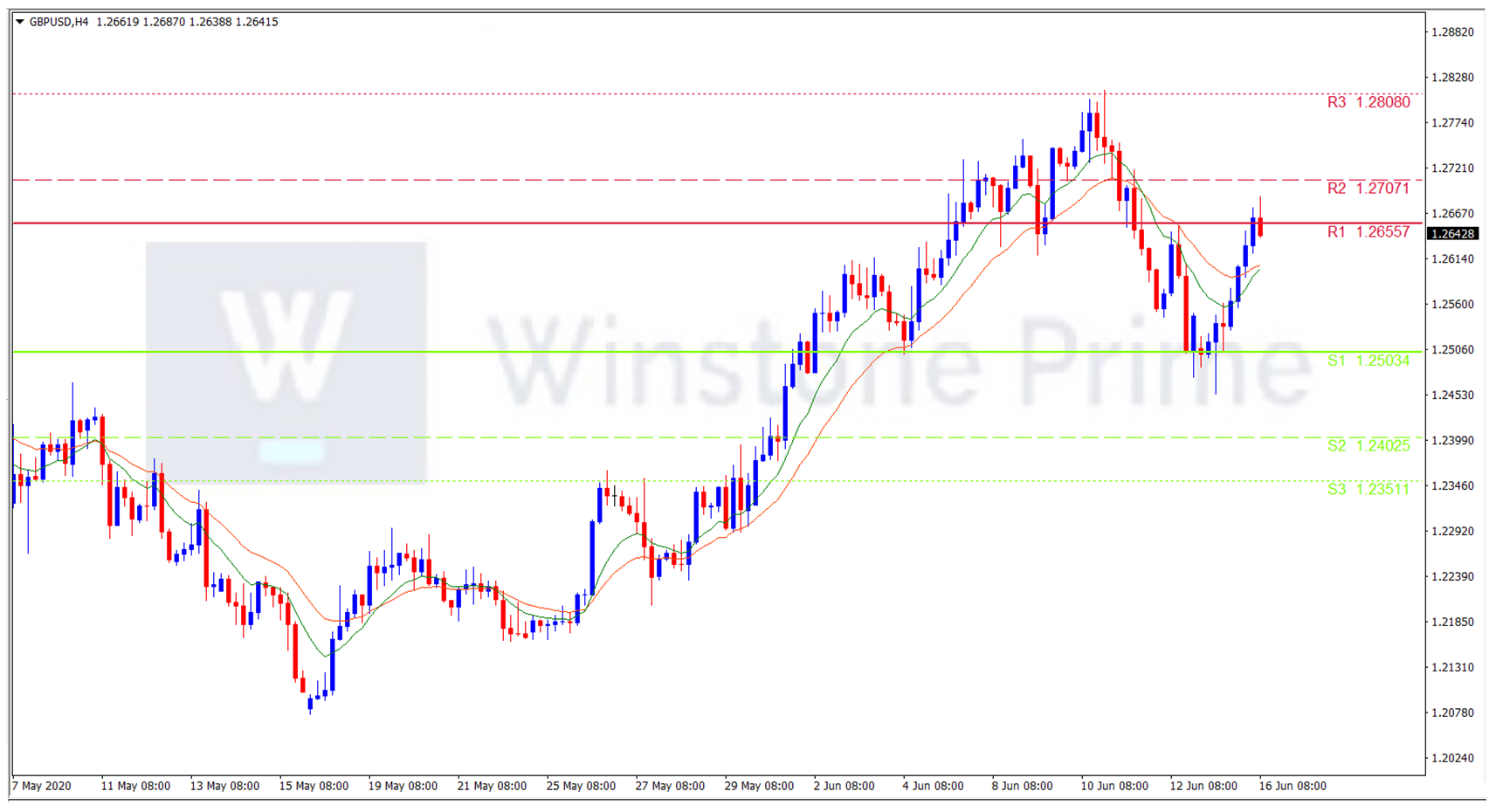
GBP/USD 4 Hours Chart:

Support: 1.2503 (S1), 1.2403 (S2), 1.2351 (S3).

Resistance: 1.2656 (R1), 1.2707 (R2), 1.2808 (R3).

Economic recovery in UK and Claimant count & unemployment report creates optimism for GBP whereas a risk of the second wave of virus in US creates pessimism for USD. Henceforth we expect a bullish trend for GBP/USD.