
The FOMC statement restructures USD

The FOMC statement release supports the US economy. The Federal Reserve’s target is to use its full range of tools to support the U.S. economy in this exigent time thus promoting its employment and price stability goals. The Committee will continuously monitor the implications of incoming information for the economic outlook, which includes the information related to public health, global developments, and inflation pressures, and will use its tools and act to support the economy.

The Federal Reserve displayed the numbers in the meeting forecasting that the US economy would contract to 6.5% this year and unemployment would be 9.3% in December. The interest rate will not be raised until the end of 2022 and inflation will not meet the 2% target.

Federal Reserve will increase its holdings of Treasury securities and agency residential and commercial mortgage-backed securities at least at the current pace to sustain smooth market functioning, thereby fostering effective transmission of monetary policy to broader financial conditions.

The readiness of the Federal Reserve to offer large-scale overnight and term repurchase agreement operations favors the us economy. Also, The Committee will closely monitor developments and is prepared to adjust its plans as appropriate.

USD/CAD 4 Hours Chart:Support: 1.3338 (S1), 1.3265 (S2), 1.3215 (S3).
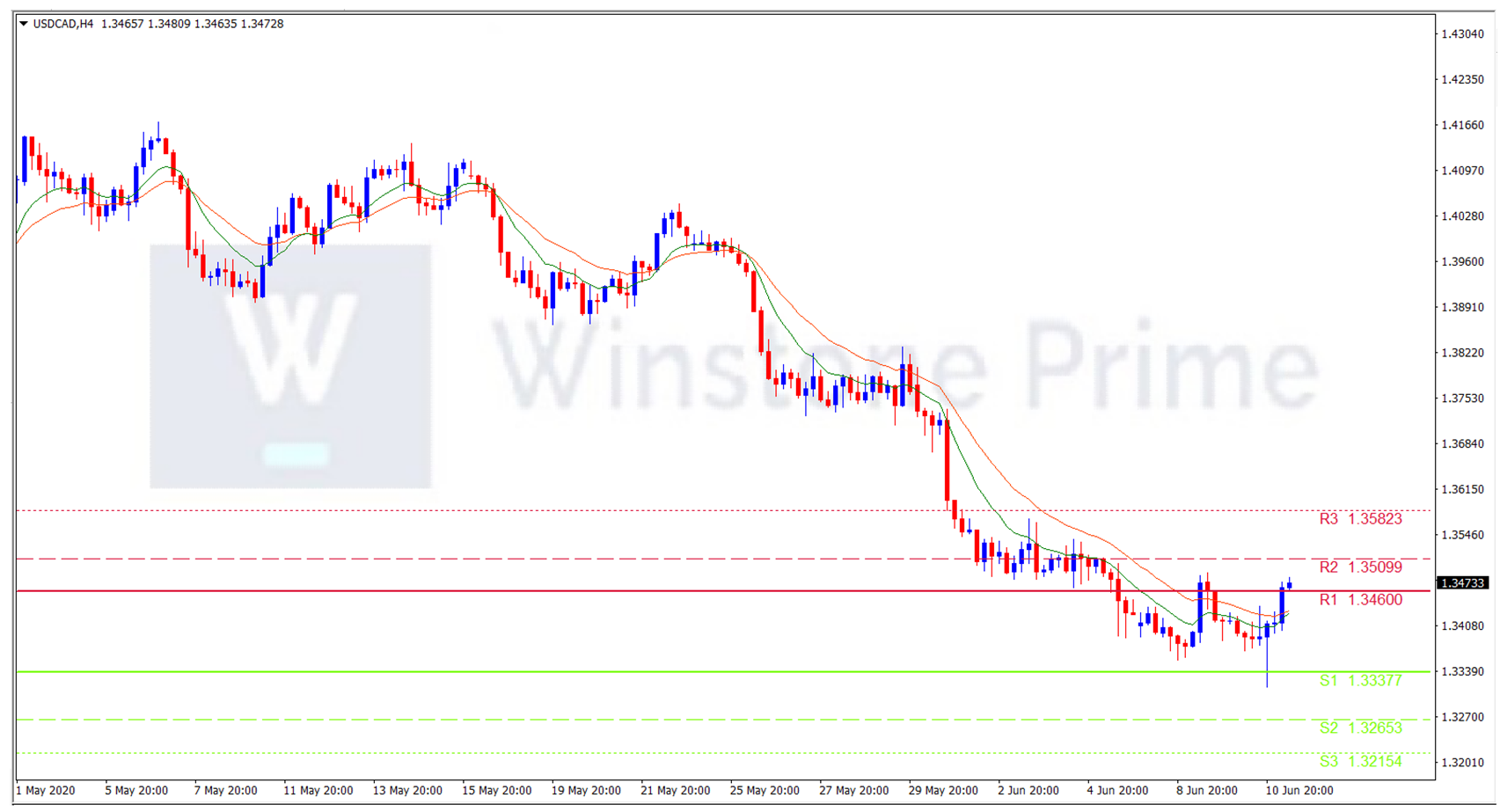
Resistance: 1.3460 (R1), 1.3510 (R2), 1.3582 (R3).

All these catalysts have lead to the bullish trend for USD/CAD. Contributing to the strength of the quote may be the weakness in Canada’s main export item of oil.
Uk Business Secretary’s speech assures Investors ahead of FOMC report

Business Secretary Alok Sharma’s speech on Wednesday was optimist. He stated that the number of infections has reduced and the R rate is under control. Lockdown easing was highlighted with allowing car showrooms and outdoor markets to open by June 1, retail outlets to operate from June 15th by following COVID-secure guidelines.

Alok Sharma speech ” I am leading 5 new ‘recovery roundtables’ bringing together businesses, business representative groups, and leading academics.” and ” We will work, shoulder to shoulder, with our businesses as we get ready for our economic fight back.” boosted confidence among the investors.

UK Prime Minister Boris Johnson is expected to announce a few more ways to ease the impact of the pandemic on economic activity. In addition to updates on how the economy will reopen, markets will listen to what Tory leaders say about China and Brexit.

“Boris Johnson’s government is drawing up a strategy to reduce the UK’s reliance on China for key imported goods.” “Those working on the project, which is overseen by foreign secretary Dominic Raab, stressed it was primarily about strengthening the country’s trade links in the wake of corona virus but would also lead to the production of some critical goods being brought back to the UK after the pandemic exposed the UK’s reliance on imports,” FT reported. But its impact on GBP’s strength is negligible.

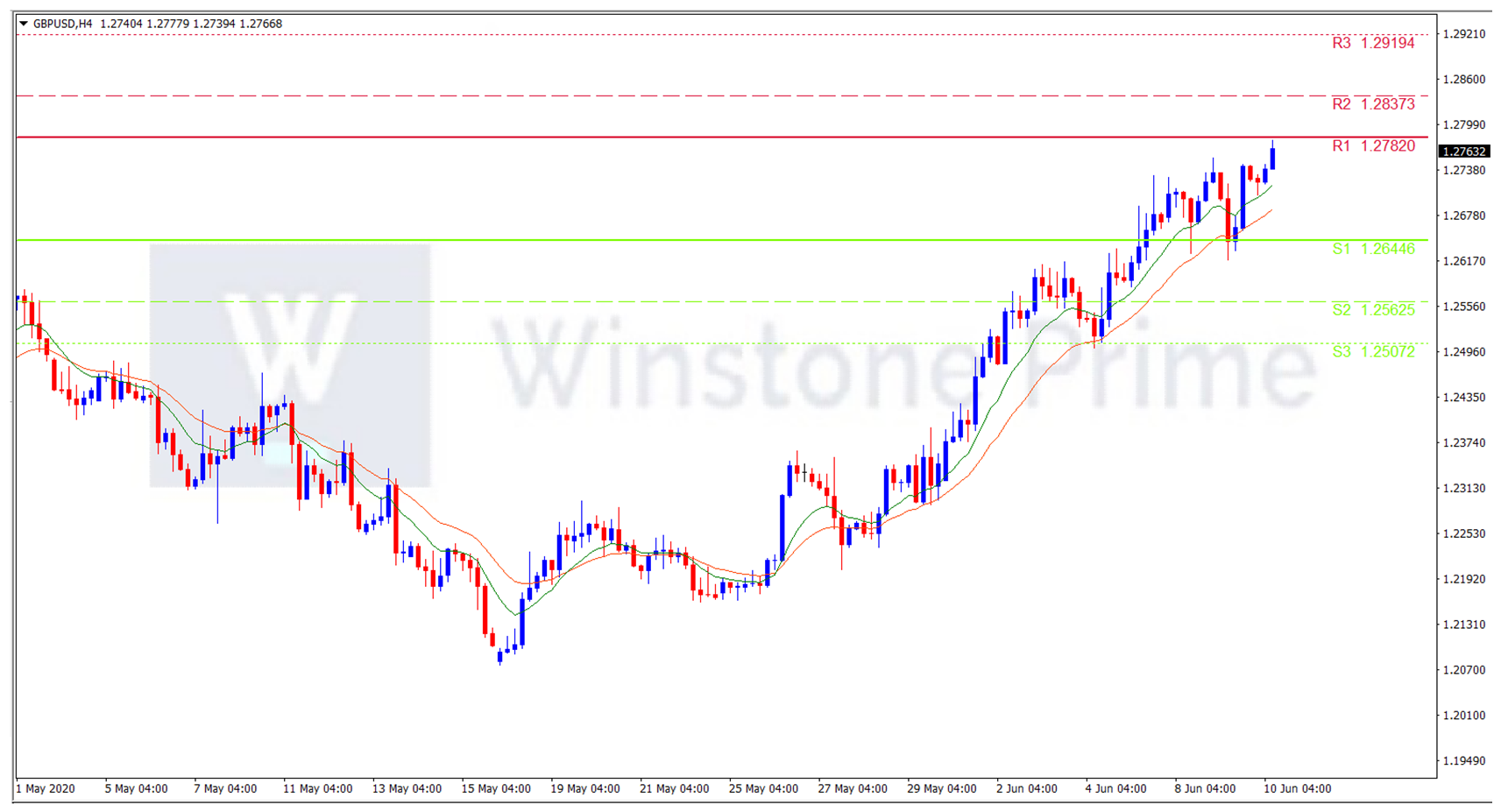
 GBPUSD 4 Hour Chart:

Support:  1.2645 (S1), 1.2563 (S2), 1.2507 (S3).
Resistance: 1.2782 (R1), 1.2837 (R2), 1.2919 (R3).

Amid all these catalysts we expect a bullish trend for GBP/USD As the Federal Reserve has a meeting today, Next mover setter for the market would depend on Jerome Powell and his report.

Aussie trades low despite Business improvement as per NAB’s data

The improvement in the Business Confidence and Business Conditions in May highlighted by the National Australia Bank’s survey released at 01:30 GMT did not impact AUD/USD positively.

National Australia Bank’s index of business confidence rose to -20 in May 2020 from -46 in April and compared to market consensus -32. The latest reading remained below the long-run average, with the figure last seen around the 1990s recession. Business conditions improved but remained negative (-24 vs -34 in April), also improvement in sales (-18 vs -31), profits (-19 vs -35) and employment (-31 vs -34) were noted. Manufacturing, construction, and retail saw rises between 11-16 points, while finance, business & property, and transport & utilities saw fewer gains. The services sectors remained weaker than the other industries. Meantime, capacity utilization rose, but remains historically low.

Restless relationship between close trade partners China and Australia has a major impact in Aussie. China accused Australia of endorsing racial discrimination against Asians. In a speech to Australian Broadcasting Corp (ABC) radio on Monday, the Trade Minister of the country Simon Birmingham said that it is very disappointing that China is not acting to its weeks-long pleas to ease tensions between the two trading partners. Birmingham said: “Unfortunately, our requests for a discussion have so far been met negatively. That’s disappointing.”

Tension between the two counties developed when Australia called for an international inquiry against China, concerning the origin of the corona virus. As a response to Australia, China suspended beef imports from four of Australia’s largest meat processors and imposed hefty tariffs on imports of barley.

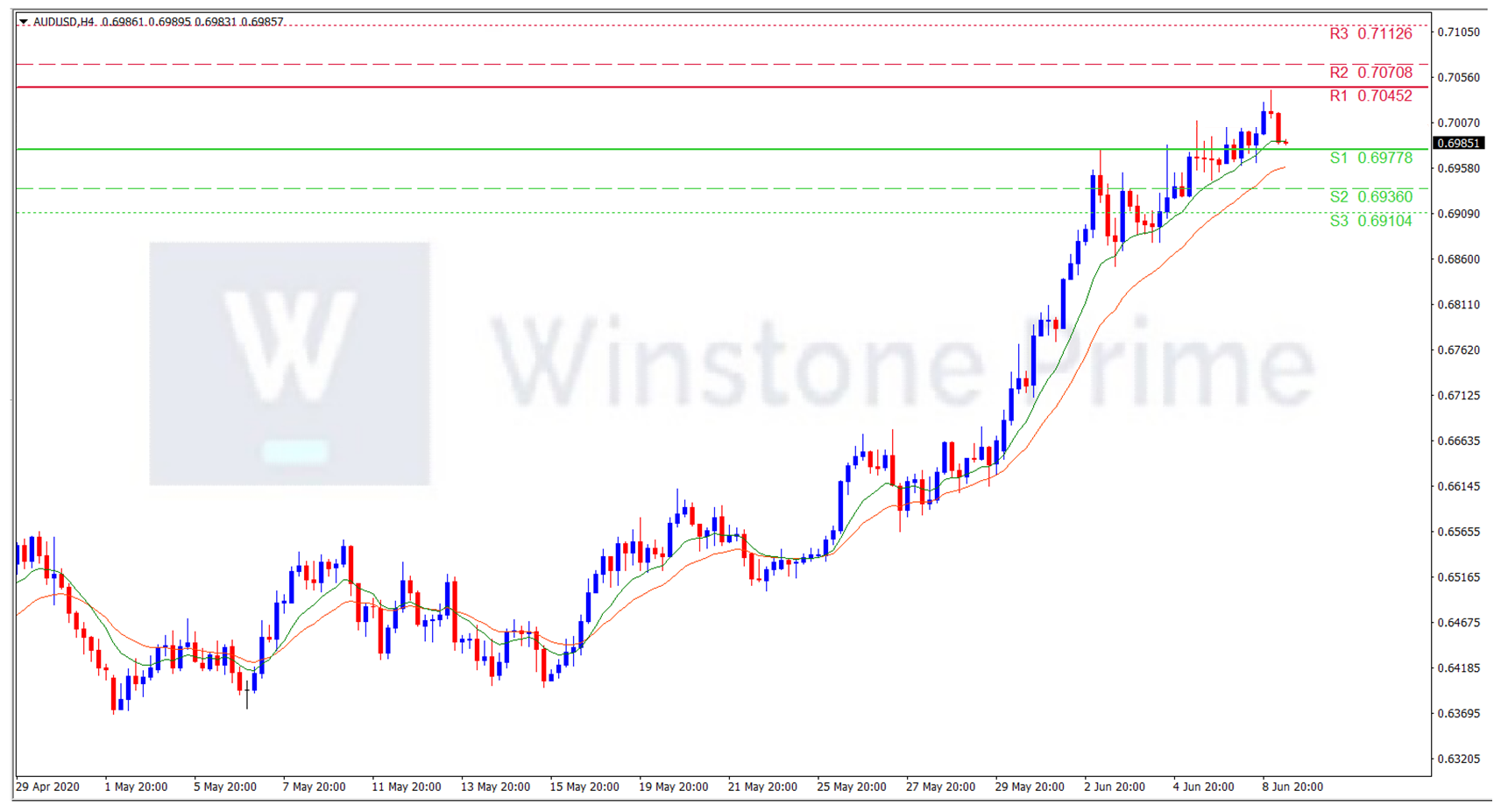
AUD/USD 4 Hour Chat:

Support: 0.6978 (S1), 0.6936 (S2), 0.6910 (S3).

Resistance: 0.7045 (R1), 0.7071 (R2), 0.7113 (R3).

The Business improvement highlighted in the National Australia Bank’s index did not create a favorable situation for AUD amid Australia China tension. We expect a bearish trend for the pair.

Unemployment report of US and German Industrial production report push EUR/USD

The unemployment rate of the US fell to 13.3%, down from 14.7% in April, as businesses started hiring again.

Firms in the food, construction, and health care sectors started again to take staff. In total, employers added 2.5 million jobs, with the education and retail sectors also recruiting. It came as US states started rolling back some of the tough measures put in place to control the spread of the corona virus. As businesses start reopening, firms are beginning to rehire their employees.

Economist Justin Wolfers, a professor at the University of Michigan, tweeted: “It’s hard to escape the conclusion that the economy bottomed in early/mid-May,” he said. “We’re in a massive and deep hole, and it’ll take a while to climb out, but at least the hole isn’t getting any deeper.”  “Really Big Jobs Report. Great going President Trump (kidding but true)!” he wrote. President Donald Trump, who has maintained the economic rebound will be swift, immediately took to Twitter to celebrate the numbers and claim credit.

The production in Germany has a drastic decrease again in April 2020 because of the pandemic and lockdown, after a  decrease already observed in March. In April 2020, production in the industry fell to by 17.9% on the previous month on a price, seasonally and calendar-adjusted basis according to provisional data of the Federal Statistical Office. The calendar-adjusted year-on-year decrease was as much as 25.3%. This is the largest decline since the beginning of the time series in January 1991.

Later for the day, European Central Bank (ECB) President Christine Lagarde (November 2019 – October 2027) is to speak. Her speech will affect the value of the Euro. Traders will keep an eye on her speech to get updates regarding future monetary policy and interest rate shifts. Her comments may determine a short-term positive or negative trend.

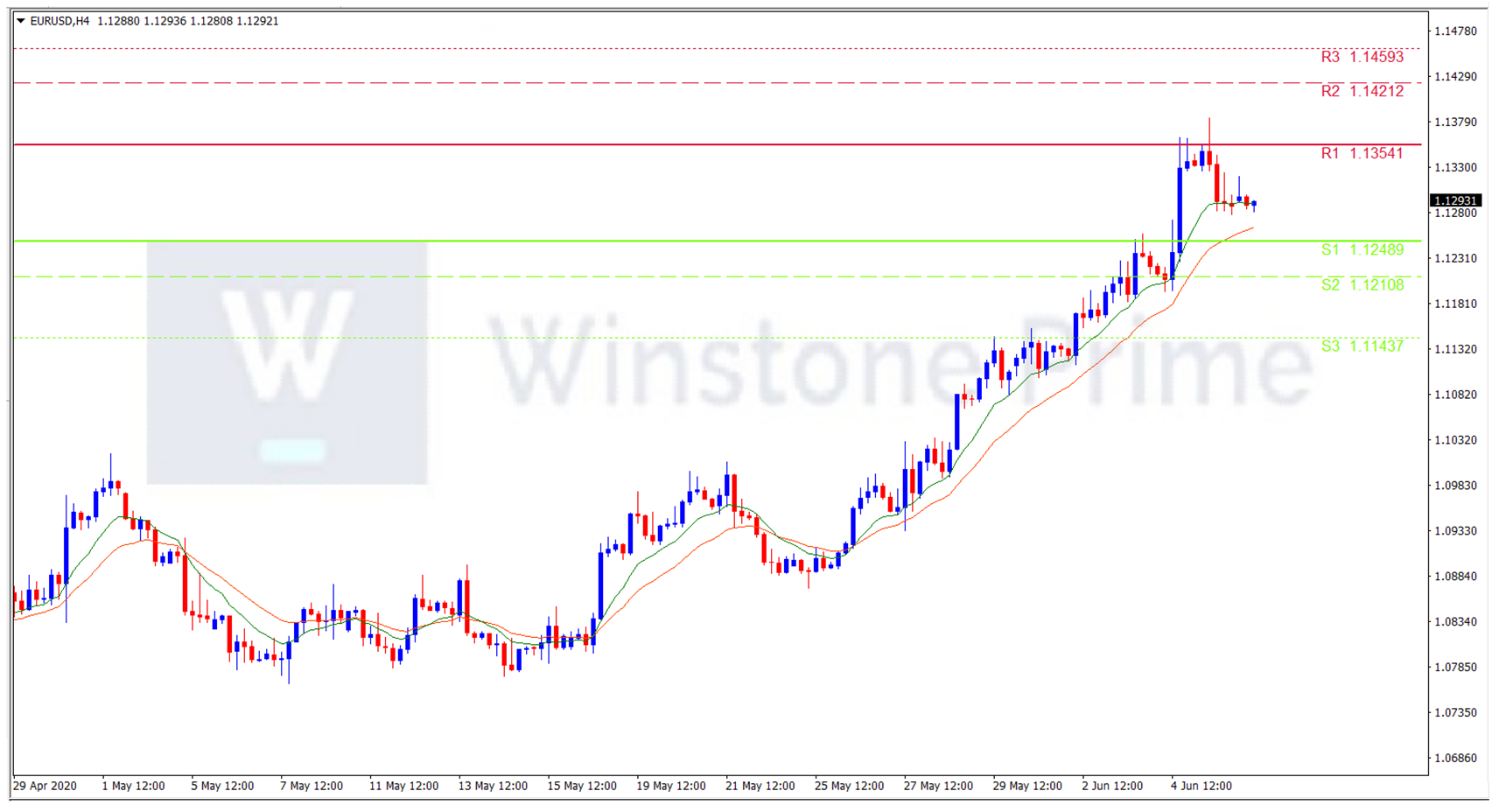
EUR/USD 4 Hour Chart:

Support: 1.1249 (S1), 1.1211 (S2), 1.1144 (S3).

Resistance: 1.1354 (R1), 1.1421 (R2), 1.1459 (R3).

Based on the unemployment rate of US and German Industrial Report we are expecting a Bearish trend for EUR/USD. Whether the upcoming news ‘European Central Bank (ECB) President Christine Lagarde speaks’ makes a difference in the trend is yet to see.