HongKong controversial law effects on Gold

Secretary of State Mike Pompeo made an announcement on Wednesday that the State Department no longer considered Hong Kong to have significant autonomy under Chinese rule, a move that indicated the Trump administration was likely to end some or all of the United States government’s special trade and economic relations with the territory in southern China. Chinese parliament passed the controversial Hong Kong security law. Also warned US  for the consequences if it continues the interference. 

It should be noted that even Us is accusing China for the spread of the virus and not warning the globe regarding the virus beforehand. Federal Reserve Chairman Jerome Powell did not suggest pushing official interest rates below zero in a video conference with former Fed Vice-Chair Alan Blinder. Global Analysts suggest the need for more monetary stimulus for increasing the positive sentiments in the market.

Jobless claims came down for the first time since the after the outbreak of coronavirus, and figures released on Friday showed personal income rising and spending falling as consumers were forced into involuntary savings by lockdowns.

“This is the basis for believing that spending will rebound strongly as lockdowns are eased, but it will also make it easier for Republicans in the Senate to keep pushing back on the idea of further stimulus, for a while at least,” said Pantheon Macroeconomics chief economist Ian Shepherdson.

 XAU/USD 4 Hour chart:
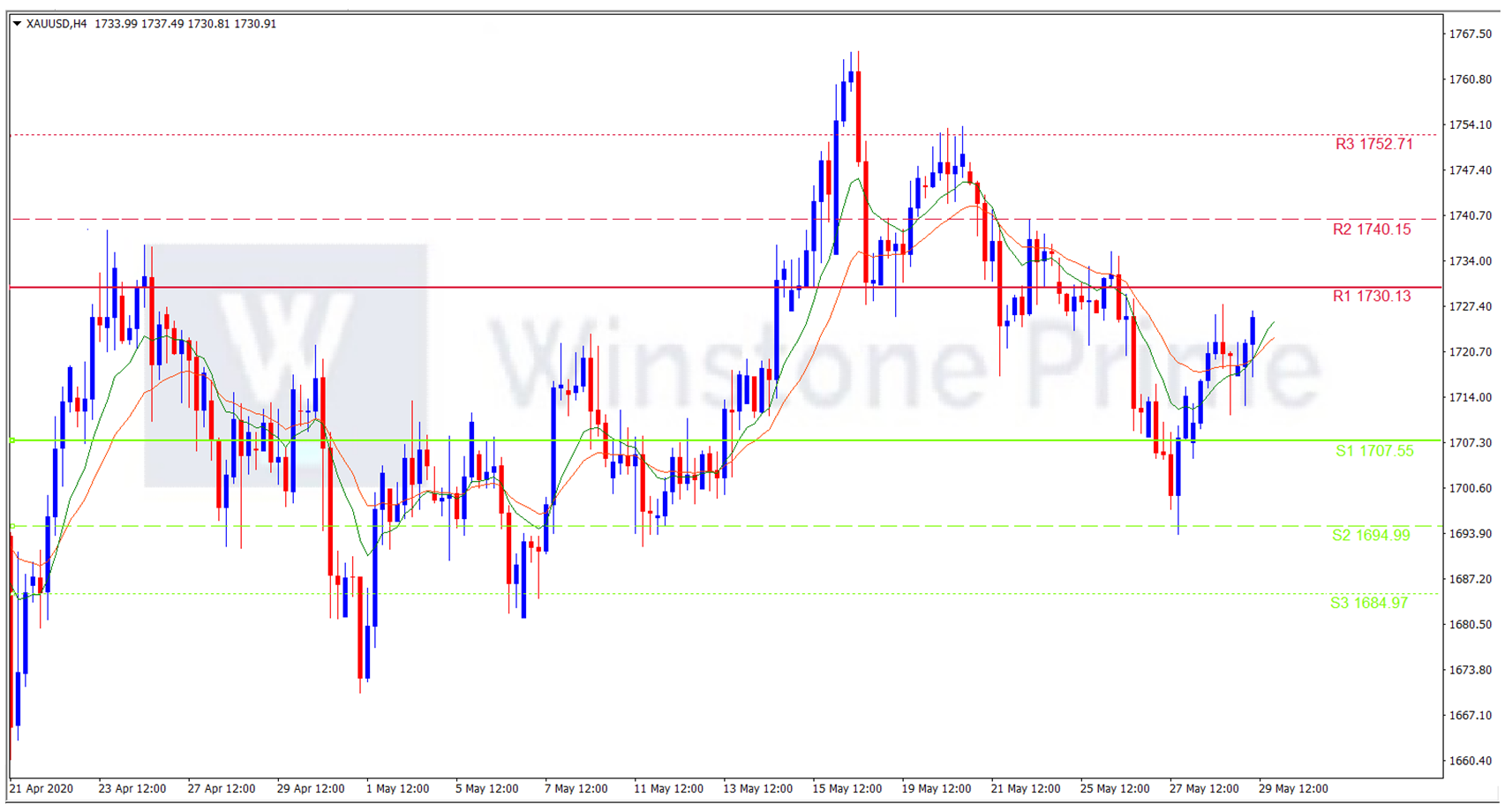
Support: 1707.6(S1), 1695(S2), 1685(S3).

Resistance: 1730.1(R1), 1740.2(R2), 1752.7(R3).

The Economic recovery hopes and US-China tension has created an uptrend for XAU/USD.
RBA Governor Lowe optimist speech favors Aussie

“RBA will maintain its expansionary settings until progress is being made towards full employment and we are confident that inflation will be sustainably within the 2–3 percent target band.” was said by RBA Governer Philp Lowe to the senate committee. His speech was optimistic that made Aussie to gain strength against USD.

He added that close coordination between monetary and fiscal policy has been there, and RBA processed the many billions of dollars in government assistance every segment from Household to Business. As per his words, the mid-March package worked as expected and is helping to create a bridge for recovery.

A bill levying sanctions to the Chinese diplomats involved in the Xinjiang case was passed by the US White House on Wednesday. Apart from this, China is also under one more threat as US Secretary of State Mike Pompeo announced on Wednesday that Hong Kong is no longer autonomous from China.

Amid hopes of economic restart and vaccine development for the virus has created positive sentiments for Aussie. Apart from this positive tone, US dollar weakness also plays a role in fueling the quote.

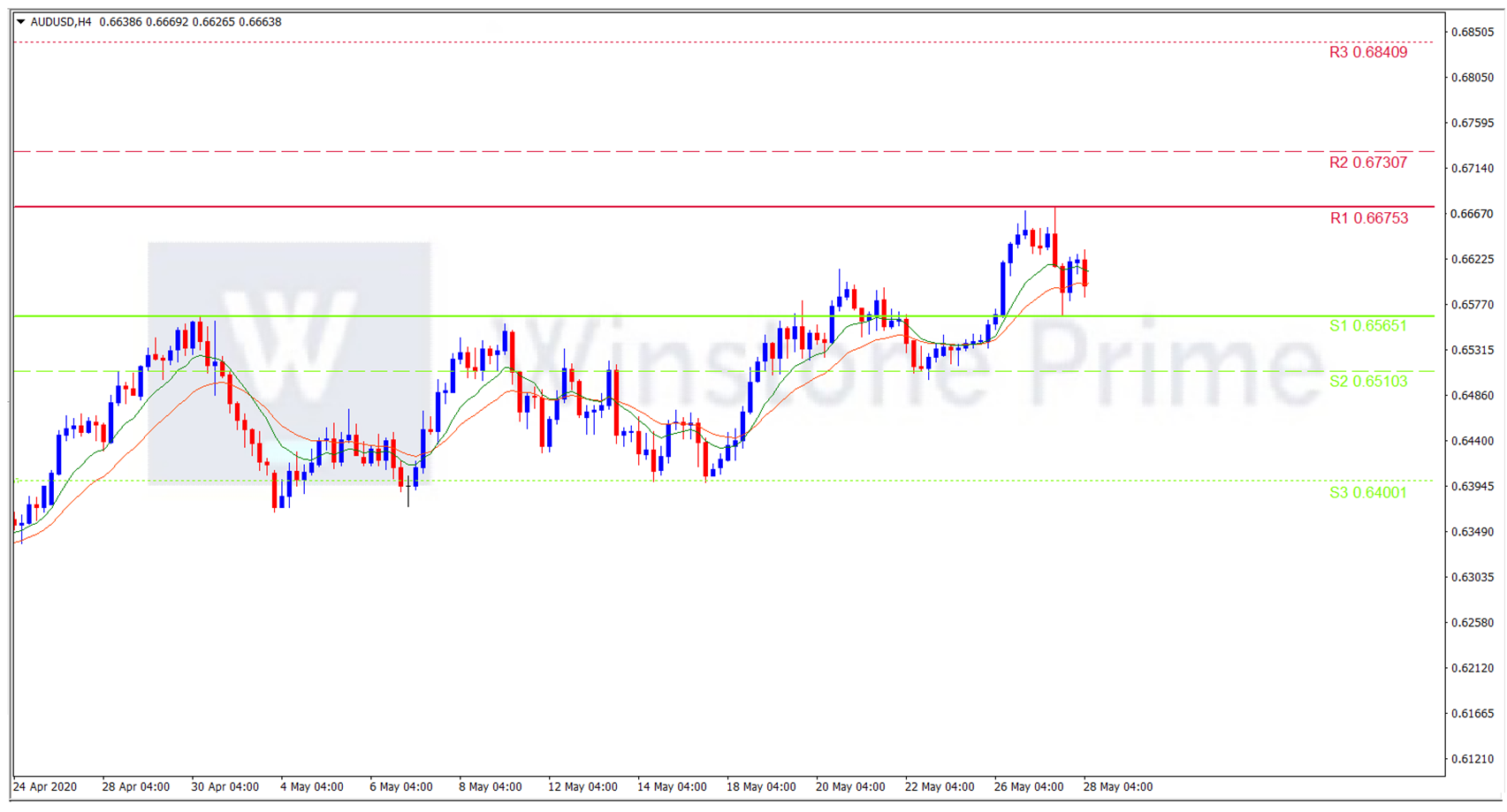
 AUD/USD 4 Hours chart:

Support:  0.6565(S1), 0.6510(S2), 0.6400(S3).

Resistance:  0.6675(R1), 0.6731(R2), 0.6841(R3).

The optimistic speech of RBA Governor and positive risk tone on economic restart creates an positive atmosphere for Aussie and we expect an bullish trend for AUD/USD.

Optimism on global economy impacts kiwi

The New Zealand Dollars is on the uptrend to the upside as optimism about a global recovery from the COVID-19 pandemic is attracting the investors. NZD/USD rose a little in the earlier session but was low than last week highs.

Kiwi was able to achieve multi-month highs as the U.S. Dollar weakened as investors shed safe-haven positions. The major reasons behind the surge in prices were the reopening of economies and China stimulus expectations.

Wider market sentiment also supports NZD’s gains. The futures of the S&P 500 are currently recording 0.25% gains. The index was up 1.23% on Tuesday. Bulls are only distracted because of growing tensions between the US and China. US Senator Rubio issued a tweet early Wednesday, warning that the United States would have no choice but to impose sanctions on China if the Dragon nation passes the Hong Kong Security Bill.

Adding to the positive sentiment, the central bank of China said it would strengthen economic policy and push for lower interest rates on loans.

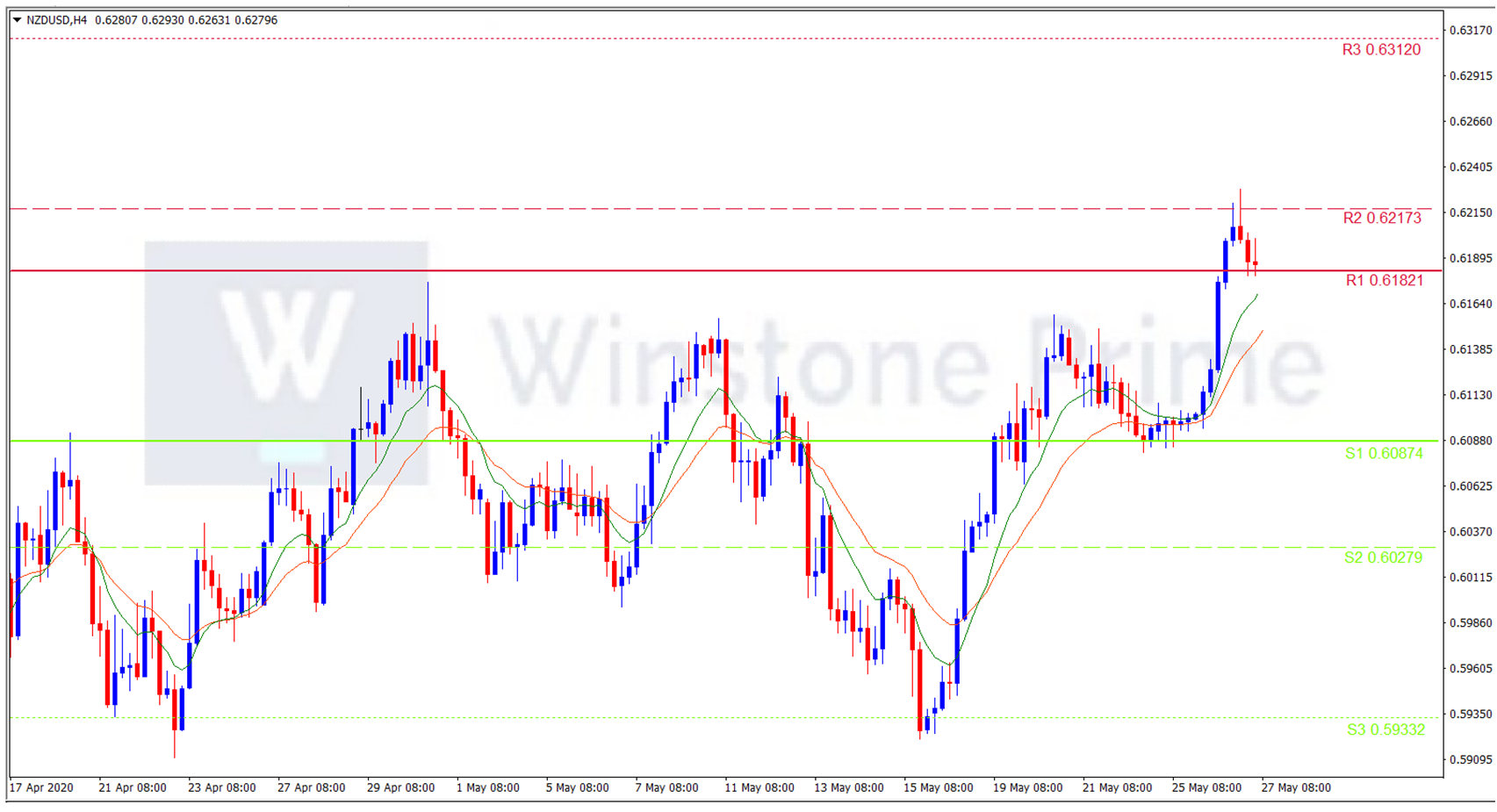
We expect an uptrend for the pair. If the bull trend continues we could see NZD/USD breaking 0.6182(R1) and aim for 0.6217(R2) and if the bear markets take over then we can expect it to break at 0.6087(S1) and aim for next 0.6028(S2).

NZD/USD 4 Hour Chart:


Support: 0.6087(S1), 0.6028(S2), 0.5933(S3).

Resistance: 0.6182(R1), 0.6217(R2), 0.6312(R3).

The catalyst has lead optimism in trading NZD/USD.

BOJ Meeting impacts on Yen

USD/JPY in a bearish trend as BOJ’s Kuroda speech is pessimistic on the economy. Bank of Japan Governor Haruhiko Kuroda said the central bank would consider additional rapid easing if the coronavirus outbreak significantly threatened Japan’s economy and price trends. He called the coronavirus outbreak the “biggest uncertainty” for the domestic economy and added for additional easing steps without hesitation if the economic risks from the virus heightened.

In the parliament, BOJ Governor Haruhiko said “Japan’s economy likely to remain in a severe state, prices to remain on a weak note due to pandemic impact, falling oil costs,” and also added that the risks to Japan’s economic outlook are skewed to the downside. Interest rates are set below zero in the last 4 years for the QE program.

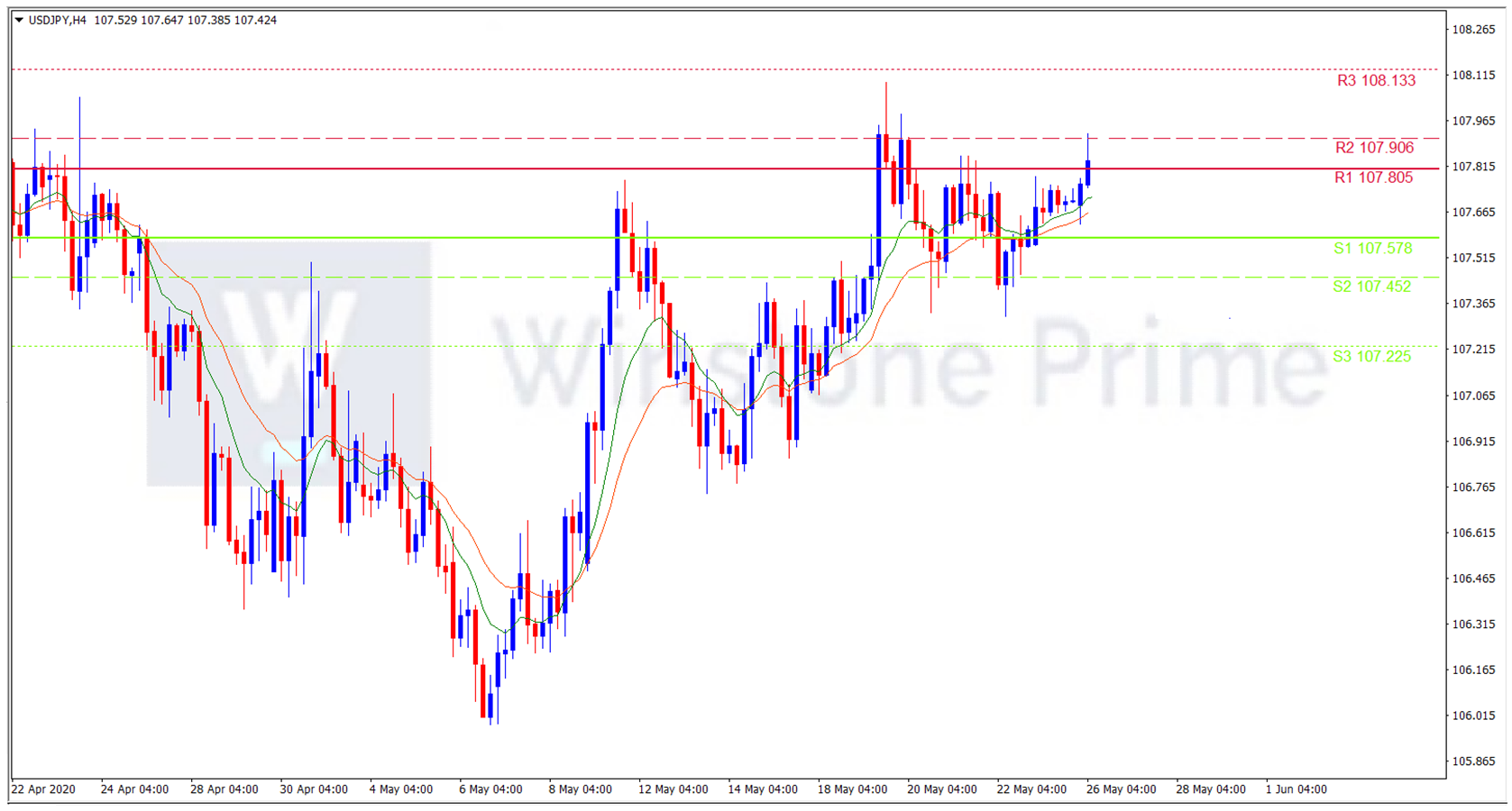
USD/JPY has been trading within a range of 108.10 to 107.30 since May 19. A breakout in the range was expected as the US stock market rally is not showing any signs of slowing down. As of Friday, the S&P 500 index was up nearly 35% from the low of 2,192 observed in March. The stocks continuously remain in bid despite the escalating US-China tensions and fears of the second wave of coronavirus.

We expect a bearish trend. If the bear trend continues we could see USD/JPY breaking 107.58 (S1) and aim for next 107.45 (S2) and if the bull markets take over then we can expect it to break at 107.80 (R1) and aim for 107.91 (R2).

USD/JPY 4 Hour Chart:

Support: 107.58(S1), 107.45(S2), 107.22(S3).

Resistance:  107.80(R1), 107.91(R2), 108.13(R3).

Considering all the catalysts, we expect a bearish trend for the pair.